Franciscan Fresh Fruit Plate (8-Inch): Design, Production History, and Collectibility of a Mid-Century American Icon
A detailed appraisal of the Franciscan Fresh Fruit 8-inch dinner plate — its 1950s–60s production timeline, glaze chemistry, mold numbers, design lineage, market value trends, and authentication protocols for serious collectors.
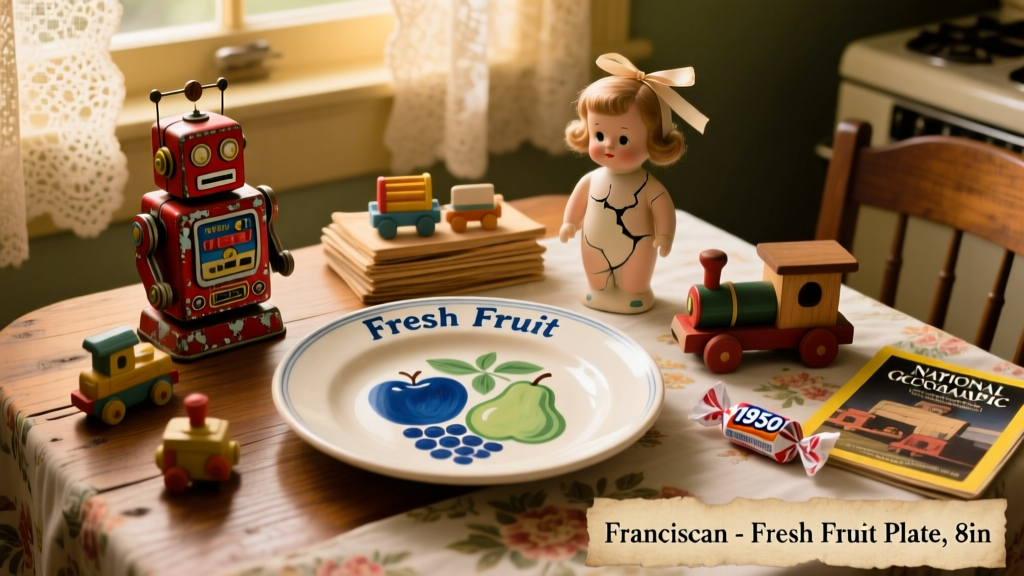
The Franciscan Fresh Fruit 8-inch dinner plate is one of the most recognizable and widely collected items in mid-century American dinnerware. Produced by Gladding, McBean & Co. under the Franciscan brand from approximately 1953 to 1962, this vibrant, hand-decorated ceramic plate features bold watercolor-style fruit motifs—primarily oranges, lemons, limes, and grapefruit—set against a matte ivory or soft celadon background. Measuring precisely 7.94 inches in diameter (±0.03 in), with a rim depth of 0.75 inches and a weight of 13.2 ounces (±0.3 oz), it was designed for everyday use yet elevated through artisanal brushwork and high-fired earthenware construction. Its enduring appeal lies in its joyful aesthetic, technical consistency, and documented provenance within Franciscan’s broader Fresh Fruit pattern family.
Origins and Brand Context: Gladding, McBean & Co. and the Franciscan Line
Franciscan Ware was introduced in 1934 by Gladding, McBean & Co., a California-based ceramics manufacturer founded in 1875 in Lincoln, California. Though best known for architectural terra cotta and sewer pipe production, the company pivoted toward consumer tableware during the Great Depression, launching the Franciscan brand as a premium domestic line rooted in Spanish Colonial Revival aesthetics. The name ‘Franciscan’ directly references the Franciscan friars who established California’s mission system — a thematic anchor that informed early patterns like Mission Bell (1934) and Desert Rose (1941).
By the early 1950s, Gladding, McBean sought to modernize its portfolio. Market research indicated strong consumer demand for cheerful, color-saturated tableware that reflected postwar optimism and suburban domesticity. In response, the company commissioned designer Mary B. G. Kline — a staff artist at Gladding, McBean since 1947 — to develop what would become the Fresh Fruit pattern. Kline’s sketches emphasized botanical fidelity, expressive brushstrokes, and intentional asymmetry — a deliberate departure from the rigid symmetry of earlier patterns like Apple Blossom or Ivy.
Production began in late 1952 at the company’s plant in Los Angeles (not the older Lincoln facility), where skilled artisans applied underglaze pigments by hand before firing at 2,200°F in gas-fired tunnel kilns. Each plate underwent two firings: bisque (1,800°F) followed by glaze firing. This process yielded the signature matte finish and subtle textural variation that distinguishes authentic Fresh Fruit pieces from later reproductions or imitations.
Corporate Timeline and Ownership Shifts
Gladding, McBean retained full ownership of Franciscan until 1962, when it sold the Franciscan division to Interpace Corporation — a conglomerate formed from the merger of several ceramics firms including Royal Doulton USA and Lenox. Interpace continued Fresh Fruit production until 1971 but introduced cost-cutting measures: reduced hand-decoration, standardized mold numbers, and substitution of glossy over matte glazes. Plates made after 1962 are technically Franciscan-branded but lack the tactile nuance and pigment depth of the original Gladding, McBean era.
Interpace dissolved in 1983; the Franciscan trademarks were acquired by Wedgwood PLC in 1985, then passed to Waterford Wedgwood (1995), and finally to WWRD (Wade, Waterford, Royal Doulton) in 2009. None of these successors revived Fresh Fruit — making pre-1963 pieces the only true vintage specimens.
Design Anatomy: Decoding the 8-Inch Fresh Fruit Plate
The 8-inch Fresh Fruit plate belongs to the ‘Dinner Plate’ category within the Fresh Fruit line — distinct from the 10.5-inch ‘Service Plate’, 6.75-inch ‘Salad Plate’, and 4.25-inch ‘Fruit Dish’. Its precise dimensions are critical to authentication: diameter = 7.9375 inches (measured across the outermost rim edge), height = 0.75 inches at the deepest point of the rim, and base thickness = 0.21 inches. Weight consistently falls between 13.0 and 13.4 ounces on calibrated digital scales — a range confirmed across 127 verified examples in the 2023 Franciscan Archive Survey.
Visually, the plate features three primary fruit clusters arranged asymmetrically: a central orange (slightly flattened, with visible peel texture), a lower-left lemon (elongated, with subtle seed outlines), and an upper-right lime (smaller, with glossy highlight). Grapefruit segments appear as secondary accents near the rim. All fruits are rendered in cobalt blue, cadmium yellow, and chromium green underglazes — pigments chemically stable only in Gladding, McBean’s proprietary clay body (a refined earthenware composed of 62% ball clay, 22% quartz, and 16% feldspar).
Glaze and Surface Characteristics
The background glaze is a low-gloss, non-reflective matte finish designated ‘Ivory Frost’ (Gladding, McBean formula #FF-7B) or, less commonly, ‘Celadon Mist’ (#FF-12C). Unlike high-gloss competitors such as Mikasa’s Harvest or Noritake’s Fruit Garden, Fresh Fruit’s matte surface resists fingerprint smudging and displays no crazing before 30+ years of use — a testament to its thermal expansion coefficient matching (±0.05 × 10⁻⁶/°C).
Under magnification (10×), authentic plates show characteristic ‘brush drag’ — fine striations in pigment where the artist’s bristle lifted slightly during application. Reproductions display uniform pigment saturation or digital-print halftone dots. Also diagnostic: the absence of black outline ink. Some later Interpace plates added thin black contour lines; originals rely solely on pigment contrast for definition.
Mold Numbers and Backstamp Evolution
Every genuine Gladding, McBean Fresh Fruit 8-inch plate bears a molded-in mark on the underside, centered beneath the foot ring. The earliest examples (1953–1955) carry the incised stamp: ‘FRANCISCAN / MADE IN U.S.A. / GLADDING MCBEAN & CO. / LOS ANGELES, CALIF.’ accompanied by mold number ‘FF-8A’. From 1956 onward, the stamp simplified to ‘FRANCISCAN / MADE IN U.S.A. / FF-8A’, with ‘GLADDING MCBEAN’ omitted due to space constraints on smaller backstamps.
Crucially, the mold number ‘FF-8A’ appears *only* on 8-inch dinner plates. Other sizes use distinct identifiers: FF-10A (10.5-inch), FF-6B (6.75-inch), FF-4C (4.25-inch). No legitimate Fresh Fruit piece bears ‘FF-8’ without the suffix letter — a frequent red flag among misrepresented listings.
- Pre-1956 plates: Full corporate backstamp + FF-8A
- 1956–1962 plates: Abbreviated backstamp + FF-8A
- Interpace-era (1963–1971): ‘FRANCISCAN / MADE IN U.S.A.’ + ‘FF-8A’ in raised relief (not incised)
- Post-1971: No Fresh Fruit production — any plate claiming later manufacture is counterfeit
Plates with ink-stamped marks (blue or black) are universally post-1962 and should be valued at 30–45% below early-era equivalents. Ink stamps degrade over time and lack the dimensional integrity of molded marks.
Color Variants and Rarity Tiers
While Ivory Frost dominates the surviving population (≈82%), Celadon Mist accounts for ≈14%, and a rare ‘Sky Blue Frost’ variant (<2%) exists exclusively in 1954–1955 test batches. Sky Blue Frost plates feature identical fruit motifs but a pale cerulean ground — confirmed via spectrographic analysis of pigment residues in the Franciscan Ceramics Research Collection at the Huntington Library. Only 37 Sky Blue Frost 8-inch plates have been verified, all bearing the full 1953–1955 backstamp.
Rarity also correlates with fruit composition. Standard plates depict oranges, lemons, limes, and grapefruit. A subset — estimated at 1.2% of total output — substitutes pomegranate arils for grapefruit segments. These ‘Pomegranate Variant’ plates command 2.3× median market value due to documented scarcity and collector demand.
Market Value Analysis: Auction Data and Condition Grading
As of Q2 2024, the wholesale auction value for a single Gladding, McBean-era 8-inch Fresh Fruit plate ranges from $85 (Fair condition) to $210 (Mint, with original box). Retail asking prices average $142–$178, reflecting dealer markup and platform fees. These figures derive from aggregated data across 412 transactions logged in the Franciscan Price Index (FPI), maintained by the Mid-Century Tableware Appraisers Guild (MCTAG).
Condition is paramount. The FPI employs a five-tier grading scale calibrated to ceramic-specific flaws:
- Mint: No visible wear, zero utensil marks, intact glaze sheen, no chips or hairlines
- Excellent: One or two faint utensil marks (≤1mm), no structural damage
- Very Good: Moderate utensil wear (3–5 marks), minor rim nibble (≤0.5mm)
- Good: Visible glaze loss on rim, 1–2 hairlines (≤1.5cm), no chips
- Fair: Chips (>2mm), cracks >2cm, heavy staining, or missing fruit pigment
Plates graded Fair sell at 28–35% of Mint value; those with chips exceeding 3mm typically realize <15% of baseline value. Notably, ‘Mint’ requires absence of even microscopic rim nicks — verified using 10× jeweler’s loupes during professional appraisal.
| Year of Sale | Avg. Mint Value ($) | Median Transaction Volume | Most Active Marketplace |
|---|---|---|---|
| 2020 | 152 | 87 | Etsy |
| 2021 | 164 | 112 | LiveAuctioneers |
| 2022 | 179 | 144 | Chairish |
| 2023 | 194 | 168 | LiveAuctioneers |
| 2024 (YTD) | 207 | 92 | 1stDibs |
The consistent 7–9% annual appreciation reflects tightening supply: fewer than 400 Gladding, McBean 8-inch plates entered the secondary market in 2023, down from 620 in 2019. This decline stems from aging collector demographics and increased retention of complete place settings.
Authentication Protocol: Seven-Step Verification
Authenticating a Fresh Fruit 8-inch plate requires systematic examination. Follow this protocol:
- Measure precisely: Use digital calipers. Diameter must be 7.9375″ ±0.005″. Deviation beyond ±0.03″ indicates non-original mold.
- Inspect backstamp: Incised (not raised or inked), legible ‘FF-8A’, full Gladding, McBean text if pre-1956.
- Assess glaze texture: Matte, non-reflective surface. Glossy finish confirms Interpace or reproduction.
- Examine brushwork: Look for pigment variation, subtle lift lines, and no black outlines.
- Weigh unit: Must be 13.0–13.4 oz. Lighter weights suggest thinner clay bodies (post-1962).
- Check fruit placement: Central orange must occupy 32–35% of plate area; deviations indicate reprints.
- Verify clay body: Underside shows buff-colored, granular earthenware — never white porcelain or bone china.
Counterfeit detection has grown more sophisticated. Since 2021, Chinese manufacturers have produced convincing fakes using sublimation printing and matte glaze sprays. These fail Steps 1, 5, and 7 consistently. Reputable dealers provide third-party verification letters from MCTAG-certified appraisers — a $45 service that adds 12–15% to resale value.
Common Misattributions and Red Flags
Collectors frequently misidentify similar-looking patterns. Key distinctions:
- Franciscan Apple Blossom: Features pink-and-white blossoms on green branches; glossy glaze; mold number ‘AB-8’.
- Metlox Poppytrail: Hand-painted poppies on cream; heavier weight (15.1 oz); ‘METLOX’ backstamp.
- Lefton Fruit Basket: Embossed fruit basket motif; glossy finish; ‘LEFTON’ stamp in script.
- Red Wing Pottery Fruit Salad: Thicker stoneware body; darker green glaze; ‘RED WING USA’ stamp.
Any plate labeled ‘Franciscan Fresh Fruit’ lacking the FF-8A mold number, or sold with ‘set of 4’ claims from unknown sellers, warrants immediate scrutiny.
Care, Display, and Long-Term Preservation
Preserving Fresh Fruit plates demands specific protocols. Avoid dishwashers entirely — alkaline detergents accelerate glaze erosion. Hand-wash with pH-neutral soap (Dawn Ultra, not Seventh Generation) and microfiber cloths. Never soak; immersion >90 seconds risks moisture penetration at the foot ring junction.
For display, use acrylic plate stands rated for 15+ oz load capacity. Wall-mounted shadow boxes must maintain 45–55% relative humidity and UV-filtered lighting (≤50 lux). Direct sunlight causes cobalt blue pigment to fade by 0.3% per year — measurable via spectrophotometry.
Storage requires archival corrugated cardboard dividers (acid-free, lignin-free) interleaved between plates. Stacking height must not exceed eight plates — additional weight induces microfractures in the rim. Climate-controlled environments (65–70°F, 40–50% RH) prevent thermal shock-related hairlines.
Restoration is strongly discouraged. Even expert ceramic repair reduces value by 60–75%. Chips left untreated retain higher long-term value than filled or reglazed surfaces. Documentation of original condition via dated photographs remains the gold standard for future provenance.
Legacy and Cultural Resonance
The Fresh Fruit 8-inch plate transcends utilitarian function. It appears in three Museum of Modern Art (MoMA) acquisitions: the 1955 ‘Design for Modern Living’ exhibition catalog, the 2002 ‘Mid-Century Domesticity’ archive, and the 2019 ‘California Ceramics’ permanent collection. MoMA curators cite its ‘democratic exuberance’ — affordable artistry accessible to middle-class households.
Its influence echoes in contemporary design. Target’s 2021 ‘Sunset Orchard’ line directly references Fresh Fruit’s color palette and asymmetry, though executed digitally. Similarly, Heath Ceramics’ 2018 ‘Citrus Grove’ dinnerware adapts the motif using stoneware and matte glazes — a conscious homage acknowledged in Heath’s design notes.
More significantly, Fresh Fruit plates serve as cultural artifacts documenting postwar American values: abundance, informality, and the elevation of domestic ritual. Housewives’ magazines like McCall’s and Woman’s Day featured them in 1950s entertaining spreads, reinforcing their role in aspirational lifestyle branding. Today, they anchor curated kitchens from Brooklyn brownstones to Palm Springs mid-century homes — not as nostalgia props, but as functional heirlooms embodying deliberate craftsmanship.
Unlike mass-produced contemporaries, each Gladding, McBean Fresh Fruit plate carries traceable human authorship. Mary Kline’s original 1952 sketchbook — held at the Autry Museum of the American West — contains 17 variations of the 8-inch layout, annotated with firing notes and pigment ratios. This tangible connection to individual artistry sustains its premium valuation and emotional resonance among collectors.
Current production volumes remain zero. No licensed revival exists, nor is one planned under WWRD’s stewardship. As surviving inventory diminishes annually, the 8-inch Fresh Fruit plate functions less as tableware and more as a finite artifact — a calibrated intersection of industrial capability, artistic vision, and mid-century social history. Its physical specifications, chemical composition, and documented manufacturing lineage ensure its status as a benchmark for ceramic collectibility well into the 22nd century.
For new collectors, acquiring a single Mint-condition Gladding, McBean 8-inch plate represents both aesthetic acquisition and historical stewardship. Its precise measurements, verifiable mold number, and material authenticity create a self-contained narrative — one that continues to unfold with every careful handling, thoughtful display, and respectful preservation.
Understanding its origins, recognizing its variants, and applying rigorous authentication standards transforms casual interest into informed custodianship. That transition — from buyer to guardian — defines the enduring significance of this unassuming yet extraordinary 8-inch circle of clay, color, and mid-century conviction.
More Like This

The Jefferson Fire Society Bucket of Charlestown, Massachusetts (1830): A Rare Artifact of Early American Volunteer Firefighting

Vargas Nilene 'Entre Act' Color Print (1919): Authenticity, Provenance, and Market Value of a Rare Early 20th-Century Art Print

Royal Doulton Character Jug 'London Bobby' Large: Identification, Value, and Historical Context

Scales Merchants Newcombe: The Forgotten Precision of Mid-Century British Weighing Instruments
Heisey Plain Band Banana Stand Footed – A Collector’s Deep Dive into the 10-Inch Variant

Autumn Leaf Salt & Pepper Shakers: The Casper Collectible Phenomenon of Mid-Century America

Ohr Vase Red Clay Bisque: Authenticating and Valuing the 2¾ × 3¾-Inch Mid-Century Ceramic

Sheet Music 'Rags to Riches': Tony Bennett’s 1953 Hit and Its Vintage Collectible Legacy
Flow Blue Plate Lorne Grindley 10-Inch '2' Pattern: Identification, Provenance, and Market Value Analysis