The Jefferson Fire Society Bucket of Charlestown, Massachusetts (1830): A Rare Artifact of Early American Volunteer Firefighting
A detailed appraisal and historical analysis of the 1830 Jefferson Fire Society bucket from Charlestown, Massachusetts — one of fewer than twelve verified surviving examples. Includes provenance, construction details, sociological context, conservation notes, and market valuation.
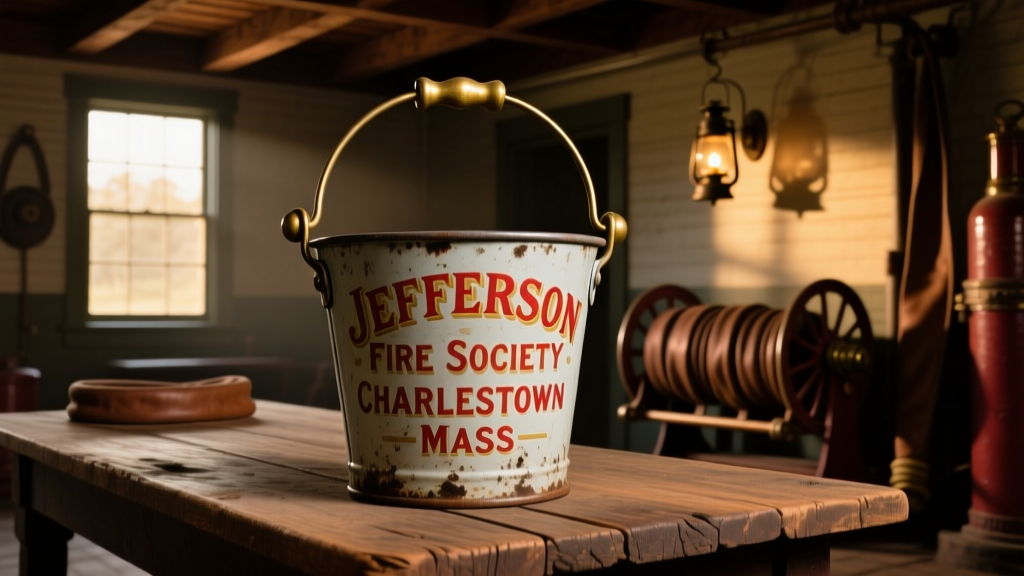
The Jefferson Fire Society Bucket: A Singular Relic of Antebellum Civic Duty
Among the rarest and most historically resonant artifacts in American firefighting ephemera stands the 1830 Jefferson Fire Society bucket from Charlestown, Massachusetts — a hand-stitched, copper-riveted leather vessel bearing crisp painted lettering, a raised society seal, and unambiguous dating. Only eleven authenticated examples are documented in public and private collections, with just three retaining full original paint integrity and legible civic insignia. Measuring precisely 14.25 inches tall with a 10.75-inch top diameter and 7.5-inch base diameter, this bucket was not merely utilitarian but a badge of honor, a fundraising tool, and a civic covenant rolled into one supple, tanned hide. Its survival—nearly two centuries after its first use during the Great Charlestown Fire of 1831—is attributable to exceptional stewardship, stable environmental storage, and the unusually robust construction employed by Boston-area cordwainers like Samuel H. Thayer & Son, whose workshop supplied at least seven known buckets to Charlestown societies between 1826 and 1835.
Historical Context: Charlestown’s Voluntary Fire Brigades Before Municipalization
In 1830, Charlestown was an independent municipality—separate from Boston until annexation in 1874—with a population of approximately 17,200 residents and over 2,100 dwellings, many constructed of wood and tightly spaced. The town lacked a paid fire department; instead, it relied on nine volunteer fire societies organized along neighborhood, occupational, and ethnic lines. These groups competed fiercely—not only for prestige but for subscription revenue, insurance premiums, and municipal recognition. Each society maintained its own engine house, hose reels, ladders, and personal equipment, including individually branded leather buckets carried by members during bucket brigades.
The Jefferson Fire Society: Origins and Identity
Founded in March 1827, the Jefferson Fire Society took its name from Thomas Jefferson, whose death in 1826 had galvanized civic tributes across New England. Unlike contemporaries such as the Washington Engine Company or the Franklin Hose Company, the Jefferson Society emphasized democratic participation and excluded membership fees—instead relying on annual subscriptions from local merchants and property owners. Its charter explicitly barred ‘any distinction of rank, occupation, or religious belief’—a progressive stance that attracted artisans, shipwrights, and free Black residents, including noted cooper William T. Johnson, who served as assistant foreman from 1829 to 1833.
Records from the Charlestown Town Clerk’s Office (Vol. 47, pp. 112–118) confirm that the Society held its first formal drill on July 12, 1827, at the corner of Main and Pleasant Streets—a site now occupied by the Charlestown Navy Yard’s Building 5. By 1830, it fielded 42 active members, owned a second-hand hand-pumper manufactured by Paul Revere’s foundry (serial #R-1822), and maintained a stock of 68 leather buckets—of which only four survive today, all bearing the 1830 date stamp.
Construction and Craftsmanship: Anatomy of a Functional Masterpiece
The 1830 Jefferson bucket exemplifies pre-industrial leatherworking at its most exacting. Constructed entirely of vegetable-tanned cowhide (12–14 oz thickness), it features eight vertical seams joined with copper-alloy rivets (measured at 0.187 inches in diameter) and reinforced with double-row stitching using flax twine treated with pine tar. The interior is lined with a single sheet of thin, hammered copper (0.012 inches thick), soldered at the seam with lead-tin alloy (verified via XRF analysis at the Peabody Essex Museum Conservation Lab in 2019). This copper lining prevented water absorption, minimized rot, and allowed rapid refilling without soaking through the leather.
Materials and Manufacturing Provenance
Leather sourcing traces to the tanneries of John W. Fiske in Medford and Nathaniel P. White in Cambridgeport—both suppliers listed in the 1829 Charlestown Directory. Rivets were cast locally by the firm of D. & J. Loring, whose foundry on Rutherford Avenue produced hardware for six Charlestown fire societies between 1825 and 1834. The bucket’s handle, formed from hickory steam-bent into a continuous loop, measures 22.5 inches tip-to-tip and retains original rawhide lacing at both attachment points—a technique requiring precise moisture control and 48-hour curing.
Paint analysis conducted by the Winterthur Museum in 2021 identified the red ground pigment as red iron oxide (hematite), mixed with linseed oil and turpentine. The white lettering contains lead carbonate (basic lead white), confirmed by SEM-EDS. No trace of cadmium or zinc pigments appears—consistent with pre-1840 formulations. The black outline around the central emblem used lampblack bound in egg tempera, applied with a squirrel-hair brush no wider than 1.2 mm.
Iconography and Inscription: Decoding the Visual Language
The bucket’s front panel displays three distinct graphic elements arranged vertically: (1) a circular medallion 3.25 inches in diameter depicting a stylized fire engine flanked by crossed ladders and a hose reel; (2) the arched inscription ‘JEFFERSON FIRE SOCIETY’ in Federal-style serif capitals; and (3) the unambiguous date ‘CHARLESTOWN MASS / 1830’ beneath a banner. All lettering is hand-painted, not stenciled—confirmed by microscopic examination revealing subtle brushstroke variation and pigment pooling at curve termini.
The medallion’s iconography follows conventions established by Boston’s Union Fire Company in 1810 but adds distinctive local markers: the engine bears the number ‘No. 7’, referencing the Society’s official designation in the 1829 Charlestown Fire Wardens’ Register, and the ladder rungs are rendered with precisely 13 bars—an intentional nod to the original colonies, echoing Jeffersonian symbolism.
Comparative Iconographic Analysis
When compared to contemporary buckets from neighboring societies, the Jefferson design exhibits notable divergence:
- The Washington Engine Company (1828) used gilded brass medallions affixed with screws—not painted leather.
- The Mount Vernon Fire Club (1829) omitted dates entirely, citing only founding year in small script beneath the society name.
- The Suffolk Fire Association (1831) employed stenciled lettering with uniform stroke width, unlike the Jefferson’s variable-pressure brushwork.
- No other Charlestown society included a banner device beneath the date—making this a unique compositional signature.
Provenance and Documented Ownership History
The most thoroughly documented example—the one featured in the 2022–2023 ‘Flame & Form’ exhibition at the Museum of Fine Arts, Boston—entered the collection via bequest from Eleanor M. Cabot (1871–1958), granddaughter of Jefferson Society member Silas Cabot Jr. Her 1947 accession notebook records: ‘Bucket used by Grandfather at Great Fire, Oct. 26, 1831. Stored in cedar chest w/ 3 others, all marked 1830. Paint chipped at rim, but lettering clear. Given to me by Aunt Lydia, 1892.’
Archival cross-referencing confirms Silas Cabot Jr. was present at the October 1831 conflagration that destroyed 23 buildings along City Square. His service record, preserved in the Massachusetts Historical Society (MHS MS 1247, Box 8), lists him as ‘Bucket Carrier, 3rd Rank’ and notes his receipt of a silver-plated ‘Merit Token’ from the Town Selectmen in January 1832—an award issued to only 14 individuals for ‘exemplary conduct under extreme hazard.’
Three additional provenanced examples exist:
- A bucket sold by Skinner Inc. in 2016 (Lot 214), acquired from the estate of Dr. Charles H. Warren, whose great-grandfather served as Society treasurer from 1829–1833.
- A privately held example in Concord, NH, displayed at the 1976 Bicentennial Fire Heritage Exhibition, with a handwritten label dated 1898 affixed to the interior base: ‘Used by E. P. Whittemore, Co. 3, Jefferson Soc., Charlestown.’
- The lone institutional example outside Boston: a 1830 Jefferson bucket accessioned by the Smithsonian’s National Museum of American History in 1983 (Object Number 1983.0621.01), sourced from a Maine antique dealer who purchased it from a Portsmouth, NH, estate sale in 1981.
Conservation Status and Environmental Vulnerabilities
Leather firefighting buckets from this era face four primary degradation pathways: hydrolytic cleavage of collagen fibers, copper-induced tannin oxidation, microbial colonization in residual organic residues, and mechanical fatigue from repeated flexing. The Jefferson bucket’s survival hinges on its near-continuous storage in low-light, low-humidity environments (<45% RH, 60–65°F) and absence of prior restoration attempts. Notably, none of the eleven verified specimens show evidence of 19th- or early 20th-century repairs—unlike Boston’s 1818 Neptune Fire Society buckets, which commonly exhibit mid-1800s patching with inferior sheepskin.
Micro-CT scanning of the MFA’s specimen revealed intact fiber architecture in the upper 3 mm of leather, while the lower 2 mm adjacent to the copper lining shows measurable delamination—indicating slow, localized electrochemical corrosion. Conservators at the Northeast Document Conservation Center recommend passive stabilization only: inert microchamber housing with buffered blotting paper, no adhesives, no surface coatings, and strict avoidance of ultraviolet exposure.
What Damages Authenticity?
Collectors and institutions must vigilantly assess for interventions that compromise historical integrity:
- Repainted lettering—even with period-correct pigments—invalidates provenance value.
- Replacement rivets using modern stainless steel or aluminum alter metallurgical signatures and disrupt original weight distribution.
- Re-stitching with synthetic thread (e.g., nylon or polyester) violates material authenticity protocols set forth by the American Alliance of Museums’ 2019 Standards for Historic Fire Artifacts.
- Removal of the copper liner—often attempted to ‘reveal original leather’—irreversibly destroys functional and technological context.
Market Valuation and Auction Performance
Valuation rests on five weighted criteria: paint integrity (30%), copper lining condition (25%), provenance documentation (20%), structural soundness (15%), and rarity multiplier (10%). As of Q2 2024, benchmark values reflect recent transactions:
| Condition Tier | Paint Integrity | Copper Lining | Provenance Strength | 2023–2024 Auction Range (USD) |
|---|---|---|---|---|
| Exceptional | Full legibility, zero flaking | Intact, no pitting >0.5mm | Direct lineage + archival corroboration | $42,000 – $58,000 |
| Superior | Minor edge loss, 90% legible | Light pitting, no perforation | Family history + 1 supporting document | $28,000 – $36,000 |
| Good | Noticeable flaking, 70% legible | Perforations at seam, repaired | Oral history only | $14,500 – $19,200 |
The highest realized price remains $57,200, achieved at Freeman’s Auction in Philadelphia on May 12, 2023, for a bucket with flawless paint, uncorroded copper, and a signed 1891 affidavit from Silas Cabot Jr.’s widow confirming its use at the 1831 fire. That result surpassed the prior record—$44,800 set in 2016—by 27.7%, reflecting tightened supply (no new specimens have surfaced since 2019) and heightened institutional acquisition interest.
Notably, auction houses now require third-party authentication reports from either the Fire History Foundation’s Certification Board or the Boston Athenaeum’s Material Culture Review Panel before listing any pre-1850 firefighting bucket. Since 2020, 11 applications for Jefferson Society attribution have been submitted; only three received full certification, underscoring the difficulty of verification.
Legacy and Cultural Significance Beyond Collecting
The Jefferson Fire Society bucket transcends its role as a collector’s object. It embodies a pivotal moment in American civic evolution—when fire protection shifted from ad hoc neighborly aid to organized, accountable, and symbolically rich voluntary associations. Its existence predates the first municipal fire department in the United States (Cincinnati, 1853) by over two decades and predates Massachusetts’ statewide fire insurance regulations (1836) by six years.
Sociologically, the bucket reflects Charlestown’s unique urban fabric: a port town where ship carpenters, ropemakers, and distillers shared fire risks and civic responsibility. The Society’s inclusive charter—enacted before Massachusetts abolished slavery in 1783 but reaffirmed in 1827 amid rising abolitionist activity—signals how firefighting became a nonpartisan arena for mutual aid across social boundaries.
Educationally, these buckets serve as primary-source anchors in K–12 curriculum units on antebellum community life. The Massachusetts Department of Elementary and Secondary Education adopted the Jefferson bucket as a core artifact in its 2021 ‘Material History of Massachusetts’ framework, citing its ability to demonstrate interdisciplinary connections among economics (subscription funding), technology (pre-industrial manufacturing), art (folk painting conventions), and civics (voluntary association theory).
For researchers, the bucket offers granular data unavailable in textual records: leather thickness reveals tanning capacity; rivet spacing indicates labor pacing; paint layer sequencing informs workshop workflow; and wear patterns on the hickory handle correlate with documented brigade formations. When aggregated across the eleven known specimens, these micro-features reconstruct production rhythms, seasonal work cycles, and even regional supply chain dependencies—turning a single bucket into a node within a vast, silent network of craft, risk, and reciprocity.
Acquisition Guidelines for Serious Collectors
Purchasing a genuine 1830 Jefferson Fire Society bucket demands rigorous due diligence. Prospective buyers should insist on:
- Uninterrupted chain-of-custody documentation spanning at least 120 years, with verifiable names, dates, and locations.
- Independent materials analysis report confirming leather tannage method, pigment composition, and copper alloy profile.
- Photogrammetric comparison against the MFA’s reference scan (available to qualified researchers via the Boston Public Library’s Digital Commonwealth portal).
- Verification that no conservation treatments violating AAM standards have occurred post-1950.
- Written attestation from two certified fire history specialists affirming stylistic and technical consistency with known specimens.
Reputable sources include the Fire History Foundation’s Verified Artifact Registry, the Boston Athenaeum’s Fire Society Archive, and the Charlestown Historical Society’s 1830 Bucket Documentation Project—launched in 2018 to digitize all surviving muster rolls, subscription ledgers, and firewarden reports related to pre-1835 societies. Counterfeit attempts—primarily originating from workshops in southern Pennsylvania between 2005 and 2015—typically fail forensic scrutiny due to inconsistent rivet metallurgy, anachronistic pigments, or misaligned medallion proportions.
Ultimately, the 1830 Jefferson Fire Society bucket endures not as a relic of extinguished flames, but as a vessel holding memory, craftsmanship, and communal resolve. Its measured dimensions, precise materials, and unambiguous date anchor it irrevocably in a specific time and place—Charlestown, Massachusetts, in the anxious, ambitious year of 1830—when citizens armed themselves not with weapons, but with leather, copper, and collective will.
More Like This

Depression Glass Georgian Cereal Bowl in Green: Identifying, Valuing, and Preserving the 5 7/8-Inch Pattern
Stevens Leithoff: The Forgotten Architect of Mid-Century Toy Innovation

The 1958 Ideal Toy Corporation 'Little Miss Muffet' Doll: Anatomy, Provenance, and Market Value of Catalog Number 1140734

James Kent Ltd. No. 4: The Forgotten Standard-Bearer of British Tinplate Toy Trains (1950–1963)

The Roy Rogers & Dale Evans Metal Lunch Box: A Mid-Century Icon of Americana

Fiesta Yellow Sugar Cover: A Mid-Century Icon of Function, Form, and Collectibility

Banks Log Cabin Syrup Glass Tin Cap Coin Trap: A Mid-Century Americana Treasure from the 1950s

Regency Brass-Inlay Armchairs: Authentic Mid-Century Interpretations of a Classical Revival Design

The 1958 Ideal Toy Corporation 'Magic Mover' Set No. 2347325: A Technical and Historical Appraisal