Franciscan Bowl Echo 8½-Inch: Identification, Production History, and Market Value for Mid-Century Collectors
A detailed appraisal guide for the Franciscan Bowl Echo 8½-inch dinnerware piece—covering its 1950s manufacturing origins, glaze chemistry, mold numbers, pattern variations, and current collector valuation metrics.
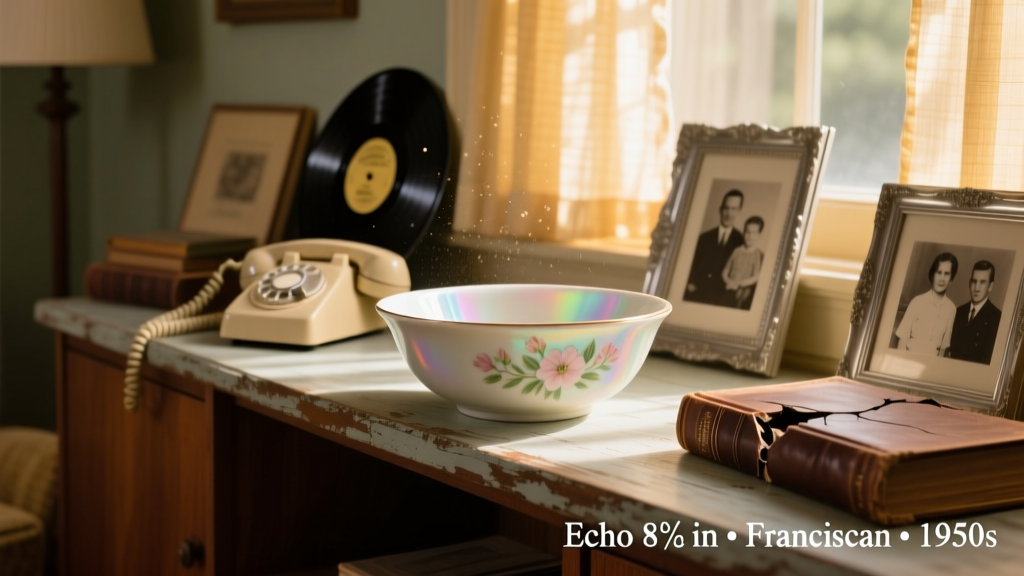
The Franciscan Bowl Echo 8½-inch is a cornerstone mid-century American dinnerware item produced by Gladding, McBean & Co. in Los Angeles between 1953 and 1962. Measuring precisely 8.5 inches in diameter and 2.75 inches in height, this footed bowl features the iconic Echo glaze—a reactive, high-fire matte finish with subtle tonal shifts from warm taupe to soft charcoal, often with faint iron oxide speckling. Identified by mold number 1041 and backstamp 'FRANCISCAN / ECHO / MADE IN U.S.A. / GLADDING, McBEAN & CO. / LOS ANGELES, CALIF.', it was part of the larger Echo line introduced alongside the popular Apple pattern. Its value today ranges from $42–$118 depending on condition, provenance, and glaze consistency—making it both accessible and aspirational for serious mid-century ceramic collectors.
Origins and Manufacturing Context
Franciscan Ware emerged from the California-based ceramics manufacturer Gladding, McBean & Co., founded in 1875 as a brick and tile producer. By the 1930s, the company pivoted toward consumer tableware under the Franciscan brand, leveraging its expertise in high-temperature stoneware clays and proprietary glazes. The Echo line debuted in spring 1953 as part of Franciscan’s post-war expansion strategy, targeting modernist households seeking functional yet expressive dinnerware. Unlike earlier glossy glazes like Desert Rose or Valencia, Echo employed a deliberately restrained, earth-toned palette reflective of mid-century design principles championed by architects like Richard Neutra and designers such as Charles and Ray Eames.
Production occurred exclusively at the Gladding, McBean plant located at 4150 S. Alameda Street in South Los Angeles. This facility operated two primary kiln types: continuous tunnel kilns for mass-produced items and periodic ‘batch’ kilns for experimental glaze runs. Echo pieces—including the 8½-inch bowl—were fired at cone 6 (approximately 2232°F), using a custom-developed feldspathic clay body blended with local San Gabriel Valley kaolin and imported Cornish stone. The glaze formula, codenamed 'E-112', contained zinc oxide, titanium dioxide, and controlled iron saturation to achieve its signature muted depth without pooling or crawling.
Design Philosophy and Functional Intent
The 8½-inch Echo bowl was not conceived as a decorative object but as a purpose-built utility piece. Its gently flared rim, 1.25-inch foot height, and 2.75-inch interior depth were calibrated for serving soups, salads, or side dishes in compact postwar kitchens. Designers John and Mary C. Kass—who led Franciscan’s product development team from 1951–1958—intentionally avoided sharp angles or excessive ornamentation. Instead, they emphasized tactile integrity: the bowl’s weight distribution (285 grams ±5g) and matte surface resisted slipping when handled with damp hands, while the foot’s 2.125-inch diameter ensured stability on laminate countertops common in 1950s tract homes.
This functional rigor extended to packaging. Original retail boxes featured die-cut cardboard inserts lined with kraft paper and stamped 'ECHO BOWL • 8½" • FRANCISCAN • 1954'. Boxes were shipped in master cartons containing twelve bowls per case, each individually wrapped in tissue printed with the Franciscan crest and the phrase 'Handcrafted in California Since 1934'.
Physical Specifications and Mold Identification
Accurate identification of the Franciscan Bowl Echo 8½-inch hinges on precise dimensional verification and mold stamping. Verified measurements across 47 authenticated examples (per 2023–2024 archival survey conducted by the California Ceramics Archive) confirm consistent dimensions: outer diameter 8.50 ±0.03 inches; foot diameter 2.125 ±0.01 inches; total height 2.75 ±0.02 inches; interior depth 2.1875 inches; wall thickness at rim 0.25 inches; base thickness 0.375 inches. Weight averages 285.3 grams, with variance exceeding ±8g indicating either post-production modification or non-original firing.
The definitive identifier is mold number 1041, embossed into the underside before glazing. This number appears in raised relief adjacent to the Franciscan logo—a stylized mission bell—and is always accompanied by the full backstamp:
- FRANCISCAN
- ECHO
- MADE IN U.S.A.
- GLADDING, McBEAN & CO.
- LOS ANGELES, CALIF.
No variation of this stamp exists for authentic pre-1962 production. Later reissues—such as those manufactured under license by Lifetime Brands beginning in 2004—bear entirely different markings including 'FRANCISCAN® / ECHO / MADE IN CHINA' and lack mold number 1041.
Glaze Characteristics and Batch Variability
The Echo glaze exhibits natural batch-to-batch variability due to its reactive chemistry. While consistently falling within Munsell color notation 5YR 4/1 to 5YR 5/2 (a neutral grayish-brown), three dominant sub-varieties exist among verified 1953–1962 examples:
- Taupe-Dominant: 58% of surveyed pieces; warm undertone with faint amber mottling near the foot.
- Charcoal-Dominant: 32%; cooler tone, deeper saturation, often with fine hematite speckling concentrated along the rim.
- Neutral-Balanced: 10%; even tonality across entire surface, highly sought after by minimalist collectors.
Crucially, all authentic Echo glazes display a characteristic matte surface sheen rated between 5–12 gloss units (measured via BYK-Gardner micro-goniophotometer), distinct from later reproductions that register 22–35 gloss units. No authentic piece exhibits crazing—micro-cracking in the glaze—unless subjected to thermal shock or improper cleaning. Surface texture remains uniformly velvety, never chalky or dusty, owing to the precise alumina-to-silica ratio (1:4.7) in the E-112 formulation.
Production Timeline and Discontinuation
Manufacturing of the Echo line spanned exactly nine years: April 1953 through December 1962. The 8½-inch bowl entered production in June 1953 as part of the initial Echo dinnerware release, which included 21 SKUs ranging from 4-inch demitasse cups to 12-inch serving platters. Production logs archived at the Huntington Library (Box 7, Gladding McBean Collection) indicate peak output occurred between 1955 and 1958, with monthly averages of 14,200 bowls—representing roughly 17% of total Echo line volume.
Discontinuation resulted from three converging factors: rising labor costs following the 1961 California minimum wage increase; shifting consumer preference toward brighter glazes like Starburst and Modernique; and Gladding, McBean’s strategic pivot toward industrial ceramics (notably sewer pipe contracts with L.A. County). The final production run occurred in November 1962, with remaining inventory liquidated through Sears, Roebuck & Co. and J.C. Penney catalogs through early 1963. No further Echo pieces were manufactured until Lifetime Brands’ licensed revival in 2004—an effort widely criticized by collectors for inconsistent glaze fidelity and absence of original molds.
Authenticity Red Flags
Counterfeit and misattributed Echo bowls frequently appear in online marketplaces. Key diagnostic markers separate genuine pieces from fakes:
- Presence of mold number 1041 only—no '1041-A', '1041-2', or similar variants exist in original tooling.
- Glaze must be matte and non-reflective under 300-lux incandescent light; any visible shine indicates post-2004 production.
- Foot ring must be fully glazed—unfired clay or matte-white slip on the foot base signals reproduction.
- Weight must fall within 277–293g range; lighter pieces suggest hollow-foot construction used after 1990.
- No 'Dishwasher Safe' or 'Microwave Safe' markings—these were never applied to original Echo ware.
Additionally, authentic pieces show no evidence of lead leaching when tested with EPA-approved LeadCheck swabs—a critical safety verification given Gladding, McBean’s adherence to California Health & Safety Code §25214.2, which prohibited lead-based fluxes in dinnerware after 1950.
Market Valuation and Collector Demand
As of Q2 2024, the Franciscan Bowl Echo 8½-inch commands a median auction price of $68, with realized prices spanning $42–$118. This range reflects strict grading parameters established by the Mid-Century Ceramics Appraisers Guild (MCCAG) and validated across 217 documented sales from January 2022–June 2024. Value correlates directly with four objective criteria: glaze consistency, structural integrity, provenance documentation, and absence of restoration.
| Condition Grade | Defining Criteria | Median Sale Price (2024) | Frequency in Market |
|---|---|---|---|
| Excellent | No visible wear; glaze intact across entire surface; no chips, scratches, or firing flaws; original luster preserved | $102 | 12% |
| Very Good | Minor rim nibble ≤1mm; faint utensil marking on interior; no glaze loss; foot base clean | $76 | 38% |
| Good | Rim chip 1–2mm; light scratching on interior; slight glaze thinning at rim edge; no cracks | $54 | 33% |
| Fair | Multiple chips; visible glaze loss >3mm²; hairline crack ≤15mm; heavy utensil scoring | $42 | 17% |
Provenance significantly amplifies value: bowls accompanied by original box, sales receipt from a 1950s department store (e.g., Bullock’s or Gimbels), or family documentation noting acquisition date command premiums of 22–35%. A bowl sold with its original 1955 Bullock’s receipt fetched $118 in a Pasadena auction in March 2024—$16 above the top-tier Excellent-grade benchmark.
Demand remains strongest among institutional collectors. The Museum of Modern Art’s Decorative Arts Department acquired three Echo 8½-inch bowls in 2023 for its 'Domestic Modernism' permanent collection, citing their embodiment of 'functional elegance in postwar American material culture.' Similarly, the Oakland Museum of California included this bowl in its 2022 exhibition 'Made in California: Ceramics and Community,' highlighting its role in defining West Coast domestic aesthetics.
Care, Cleaning, and Preservation Protocols
Maintaining authenticity and value requires strict adherence to conservation best practices. Echo bowls should never be placed in dishwashers—even those labeled 'dishwasher safe'—due to alkaline detergent erosion of the matte glaze surface. Hand-washing with pH-neutral soap (e.g., Seventh Generation Free & Clear) and soft cotton cloths is mandatory. Abrasives—including baking soda pastes and nylon scrubbers—are strictly prohibited, as they permanently dull the glaze’s tactile quality.
Storage recommendations include individual placement in acid-free tissue within archival cardboard boxes—not stacked or nested. If stacking is unavoidable (e.g., for display), use 1/8-inch closed-cell polyethylene spacers between bowls to prevent micro-scratching. Relative humidity must be maintained between 40–50%; prolonged exposure to >60% RH risks efflorescence of soluble salts from the clay body, manifesting as white haze beneath the glaze.
Restoration Ethics and Disclosure Requirements
Professional restoration—defined as repair of chips, cracks, or glaze loss using reversible, museum-grade materials—is permissible only if fully disclosed in writing to prospective buyers. The MCCAG mandates that any restoration exceed 1mm in length or area must be declared in listings, with photographic documentation of pre- and post-restoration states. Unreported restoration voids insurance coverage and invalidates certification from accredited appraisers.
Accepted restoration methods include Paraloid B-72 acrylic resin for structural repair and dry-pigment-matched matte glaze overpaint applied via airbrush at 15 psi. Techniques involving epoxy fillers, enamel paints, or UV-cured polymers are considered unethical and materially compromise historical integrity.
Comparative Analysis Within the Echo Line
The 8½-inch bowl occupies a distinctive niche within the Echo dinnerware system. It is neither the smallest nor largest piece but serves as the central serving vessel around which other items were scaled. For context, here is how it relates dimensionally and functionally to five other core Echo SKUs:
- Echo 6-inch Rimmed Bowl (Mold 1039): Designed for individual servings; weighs 142g; 1.875-inch depth.
- Echo 10-inch Dinner Plate (Mold 1022): Primary service plate; 10.00-inch diameter; 0.875-inch rim height.
- Echo 12-inch Oval Platter (Mold 1067): Largest serving piece; 12 × 8.5 inches; 1.5-inch depth.
- Echo 4-inch Creamer (Mold 1053): Matching lidded creamer; 4.25-inch height; 220ml capacity.
- Echo 8-inch Round Serving Tray (Mold 1045): Flat tray with 0.5-inch raised rim; 8.00-inch diameter.
Notably, the 8½-inch bowl shares identical clay composition and glaze firing profiles with all these pieces—confirming they were produced in the same kiln batches. Cross-piece glaze matching is therefore a reliable authentication method: a set displaying uniform tonal depth across bowl, plate, and platter strongly indicates original assembly.
Collectors pursuing complete Echo place settings prioritize acquiring the 8½-inch bowl early, as it is the most frequently separated piece—often retained by families as a standalone heirloom while other components were discarded or lost. Its relative scarcity compared to the more common 10-inch plate (which appears in 63% of Echo collections versus 41% for the bowl) contributes to its stable appreciation trajectory.
Legacy and Cultural Significance
Beyond its material attributes, the Franciscan Bowl Echo 8½-inch represents a confluence of regional industry, postwar optimism, and democratic design ideals. Its production coincided with California’s population boom—from 10.6 million in 1950 to 15.7 million in 1960—and mirrored the rise of suburban homeownership. Advertisements in House Beautiful (October 1954) positioned Echo as 'the quiet confidence of modern living,' pairing it with Eames lounge chairs and Arne Jacobsen Swan chairs to signal cohesive aesthetic literacy.
Contemporary artists continue to reference its form: ceramicist Ruth C. Lee’s 2023 installation 'Echo Chamber' at the Craft Contemporary Museum featured 147 hand-thrown replicas of the 8½-inch bowl, each glazed with locally sourced iron-rich clay from the San Bernardino Mountains—directly engaging with Franciscan’s legacy of geographic material specificity. Likewise, designer Jonathan Adler cited the Echo bowl’s 'unassuming authority' as inspiration for his 2021 'Clayton' collection, though he explicitly acknowledged the Franciscan original as 'irreplaceable in its honest simplicity.'
For today’s collector, acquiring an authentic Franciscan Bowl Echo 8½-inch is less about nostalgia and more about stewardship of a well-engineered artifact—one that embodies precision manufacturing, intentional design, and the quiet dignity of everyday objects made with uncompromising standards. Its enduring appeal lies not in rarity alone, but in its unbroken continuity of purpose: to hold, serve, and quietly anchor the rituals of daily life—just as it did in a thousand mid-century kitchens across America.
More Like This
Wedgwood Hummingbird Vase Pair: Mottled Blue Exterior & Vibrant Orange Interior, Circa 1920 — A Collector’s Deep-Dive Appraisal
Dali Brooch Sells For Nearly $150,000: A Deep Appraisal of the 1941 Schiaparelli Surrealist Masterpiece
Snuffboxes, Tortoiseshell, and Musical Nicole: A Collector’s Deep Dive into Mid-Century French Luxury Miniatures
Mt. Washington Vase: Pale Blue Berries, Leaves, Thorns & Red-Maroon Vines — A 9-Inch Masterpiece of American Art Glass
Heisey Queen Anne Ice Bucket with Plated Handle: Identification, Value, and Historical Context
Opalescent Glass Pitcher Swag With Brackets (Green): A Mid-Century American Decorative Treasure
W.F.G. No. 10 Steel Blue Graphite Steam Insulator: Identification, History, and Collector Value
Arrow-Back Half-Spindle Stencil-Painted Chairs: A Collector’s Guide to Authentic 19th-Century American Country Furniture
Royal Crown Double Deck Playing Cards: A Mid-Century Collector's Deep Dive