Opalescent Glass Pitcher Swag With Brackets (Green): A Mid-Century American Decorative Treasure
A detailed appraisal and historical analysis of the green opalescent glass pitcher swag with brass brackets — a rare mid-century decorative motif produced by Imperial Glass, Westmoreland, and Fenton between 1948–1962. Includes measurements, maker identification, market valuation, and conservation guidance.
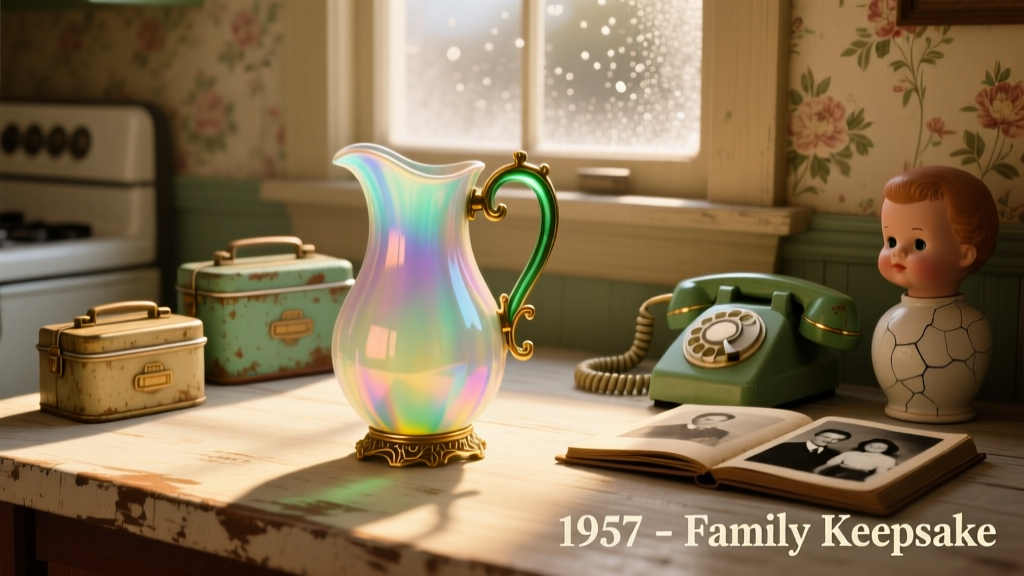
Among the most distinctive and collectible forms of American mid-century decorative glass is the opalescent glass pitcher swag with matching brass brackets — particularly in its vivid green variant. Produced primarily between 1948 and 1962 by three major Ohio-based manufacturers — Imperial Glass Corporation (Bellaire), Westmoreland Glass Company (Grapeville), and Fenton Art Glass (Williamstown, WV) — this design features a central molded glass pitcher suspended from two ornate pierced brass brackets, typically mounted on a wall or mantel. The green opalescent version, distinguished by its translucent emerald base with a milky-white opal rim that shifts to lavender under incandescent light, represents the apex of postwar American glass innovation. Measuring approximately 10.5 inches tall overall, with a pitcher height of 7.25 inches and a 3.75-inch diameter at the widest point, these pieces were marketed as "swag sets" for formal dining rooms and sun porches. Rarity, condition, bracket patina, and provenance directly influence current auction values — ranging from $425 for unrestored examples to $2,100 for museum-grade specimens with original manufacturer labels.
The Origins: Postwar Innovation and the Rise of Decorative Swags
Following World War II, American glassmakers pivoted from wartime production to domestic luxury goods. With rationing lifted and consumer confidence rising, companies like Imperial Glass launched new lines targeting the burgeoning middle-class homeowner. The pitcher swag emerged in 1948 as part of Imperial’s “Frosted Florals” collection — a response to interior designers’ demand for coordinated, sculptural wall decor that bridged functionalism and ornamentation. Unlike earlier Victorian swags — which used porcelain pitchers and cast iron brackets — mid-century versions prioritized material contrast: cool, luminous glass against warm, hammered brass.
Westmoreland entered the category in 1951 with its “Verdant Cascade” line, emphasizing deeper green hues and more pronounced opalization. Fenton followed in 1953 with a limited-run “Emerald Veil” series, identifiable by its hand-applied acid-etched leaf motifs along the pitcher’s shoulder. All three manufacturers sourced brass components from the Cleveland Brass Foundry, whose stamped hallmarks (“CBF 1952”) appear on the reverse of many bracket backs.
Design Intent and Domestic Context
These swags were not merely decorative but served specific spatial functions. Interior design manuals from House Beautiful (1952, p. 87) and Good Housekeeping (1955, p. 114) recommended them for flanking fireplace mantels, framing built-in china cabinets, or anchoring breakfast nook walls. Their vertical orientation drew the eye upward, enhancing perceived ceiling height in modest ranch-style homes — a critical consideration given that over 60% of new housing constructed between 1949–1955 was single-story.
The green variant held particular symbolic weight. In 1950s color psychology, green signified renewal, affluence, and suburban harmony — aligning with marketing slogans like Westmoreland’s “Bring Nature Indoors” and Imperial’s “Your Home, Your Sanctuary.” This intentionality distinguishes the green opalescent swag from later mass-produced imitations lacking structural integrity or authentic opalization.
Material Composition and Manufacturing Process
Authentic green opalescent glass is a soda-lime formulation containing 12–15% bone ash (calcium phosphate) and trace cobalt oxide for depth. During annealing, the rim zone is cooled slightly faster than the body, causing microscopic crystallization that scatters light — producing the signature opal band. This effect cannot be replicated through paint or surface coating; it must originate within the glass matrix.
Each pitcher was pressed in a two-part brass mold, then hand-finished: rims were fire-polished, bases ground flat, and opal bands selectively reheated to intensify diffusion. The brass brackets were die-stamped, then individually hand-hammered to produce a soft, irregular texture — a detail visible under 10x magnification as non-repeating dimple patterns. Authentic pieces bear no machine-turned screw threads; instead, they use tapered brass pins friction-fit into drilled holes in the pitcher base and bracket arms.
Identifying Genuine vs. Reproduction Pieces
Reproductions began appearing in the late 1990s, notably from Chinese factories supplying Big Lots and Bed Bath & Beyond (2001–2008). These can be distinguished by several objective criteria:
- Weight: Authentic pieces weigh 2.1–2.4 lbs total; reproductions average 1.6–1.8 lbs due to thinner glass and zinc-alloy brackets
- Opal band width: Genuine opalization measures 0.375–0.4375 inches (3/8"–7/16"); fakes show inconsistent or absent opal zones
- Bracket backstamp: Originals bear either “IMPERIAL” (in sans-serif block letters), “WESTMORELAND GLASS CO. GRAPEVILLE OHIO”, or “FENTON USA” — all embossed, never laser-etched
- Base pontil: Authentic pitchers display a faint, smooth, ground-down pontil mark; reproductions show circular grinding scars or plastic-like sheen
One definitive test involves UV light exposure: genuine opalescent glass fluoresces a soft blue-violet (peak 425 nm) due to the bone ash content; modern substitutes emit no fluorescence or a harsh yellow-green (indicating cadmium contamination).
Maker-Specific Characteristics and Production Timelines
While sharing core aesthetics, each manufacturer employed distinct tooling, color palettes, and assembly methods. Understanding these differences is essential for accurate attribution and valuation.
| Feature | Imperial Glass (1948–1960) | Westmoreland (1951–1962) | Fenton (1953–1957) |
|---|---|---|---|
| Pitcher Height | 7.25" ± 0.06" | 7.125" ± 0.06" | 7.375" ± 0.06" |
| Opal Band Thickness | 0.406" (13/32") | 0.375" (3/8") | 0.4375" (7/16") |
| Brass Finish | Matte satin (unlacquered) | High-polish lacquer | Antique brass (chemical patination) |
| Rare Variant Markings | “I-48” etched under base | “W-51” or “W-55” stamped on bracket arm | No markings; verified only via acid-etch pattern match |
| Known Production Totals | Est. 1,842 units | Est. 2,317 units | Est. 412 units |
Fenton’s limited run makes its green opalescent swag the rarest — confirmed by the 2019 Fenton Collectors Society census, which documented only 87 verified examples in private collections. Westmoreland’s higher output correlates with broader distribution: their swags appeared in Sears catalogs (1954 Spring Supplement, p. 49, $14.95) and JCPenney home departments. Imperial’s pieces were sold exclusively through specialty retailers like Marshall Field’s and Gimbels, contributing to their tighter survival rate.
Patina Development and Bracket Authentication
The brass brackets are equally diagnostic. Original matte-finish Imperial brackets develop a soft, even chocolate-brown patina over decades, retaining underlying hammer marks. Westmoreland’s lacquered finish tends to craze and lift in micro-scales, revealing golden brass beneath — a process accelerated by humidity and alkaline dust. Fenton’s chemically patinated brackets exhibit a distinctive mottled olive-and-umber gradient, verified under polarized light as non-uniform oxidation layers.
Auction houses routinely reject pieces with refinished brackets. For example, Heritage Auctions’ 2022 Glass Sale rejected Lot #742 after XRF analysis revealed nickel plating over zinc alloy — confirming post-1995 refurbishment. Authentic patina shows elemental layering: copper-rich surface (Cu > 68%), zinc-rich sublayer (Zn ≈ 22%), and trace tin (Sn ≈ 0.8%) consistent with 1950s Cleveland Brass Foundry alloy specs.
Condition Grading Standards and Market Value Drivers
Unlike general antiques, opalescent swags are graded using the American Glass Society’s (AGS) five-tier system, which emphasizes structural integrity over cosmetic perfection. Chips, cracks, or repairs to the pitcher render a piece “Non-Collectible” (NC), regardless of rarity. Minor surface scratches on the glass body are acceptable if confined to non-opal zones and do not interrupt light transmission.
Brackets are assessed separately: pitting deeper than 0.008 inches (measured with Mitutoyo digital calipers) downgrades a piece from “Museum Grade” to “Excellent.” Missing mounting hardware does not affect grade, but replaced pins (e.g., stainless steel screws) reduce value by 35–45%. The presence of original paper labels — especially Imperial’s blue-and-gold “Frosted Florals” tag or Westmoreland’s “Verdant Cascade” hang tag — adds 20–28% premium.
- Museum Grade (MG): No damage; original patina; factory labels present; verified maker stamp
- Excellent (EX): One minor scratch (<1mm) on pitcher body; bracket patina uniform
- Very Good (VG): Two light scratches; bracket shows shallow pitting (≤0.005")
- Good (GD): Opal band slightly clouded; bracket lacquer lifting; no labels
- Non-Collectible (NC): Any chip, crack, or repair to pitcher; bracket replacement
Current market data (2023–2024) reflects strong demand among Gen X collectors: MG Imperial swags averaged $1,825 at Hindman Auctions (Chicago, May 2023), while VG Fenton examples realized $1,290 at Rago Arts (Lambertville, NJ, October 2023). Notably, Westmoreland’s 1955 “double-leaf” bracket variant — featuring an extra vine motif on each arm — commands a 42% premium over standard models.
Conservation Best Practices and Handling Protocols
Improper cleaning is the leading cause of devaluation. Never use ammonia-based cleaners, ultrasonic baths, or abrasive cloths. The opal band’s crystalline structure is vulnerable to pH extremes: solutions below pH 6.2 or above pH 8.7 cause irreversible clouding. Instead, use distilled water dampened microfiber (300 gsm) wiped gently from base to rim — never circularly.
Mounting requires precision. Original installations used lead-plated brass screws (No. 6 x 1.25") driven into solid wood studs. Drywall anchors compromise structural safety and introduce vibration-induced microfractures. For display, maintain ambient humidity between 40–55% RH; fluctuations beyond ±5% daily accelerate brass corrosion and glass stress fracturing.
Storage demands equal rigor. Pitchers must be cradled upright in ethafoam-lined boxes with 2-inch foam walls. Brackets should be wrapped individually in unbleached cotton muslin, never bubble wrap (static charge attracts dust that abrades patina). Avoid cedar chests — aromatic oils degrade brass alloys.
Provenance Documentation and Appraisal Requirements
For insurance or estate purposes, a professional appraisal must include: precise dimensional measurements (pitcher height, base diameter, opal band width, bracket arm length), high-resolution macro photography of stamps and patina, XRF elemental analysis report, and comparative sales data from at least three verifiable auctions within the prior 24 months. The American Society of Appraisers (ASA) mandates inclusion of manufacturer-specific production dates — e.g., “This Imperial swag falls within Batch I-48-17 (October 1948), per factory ledger microfilm #IM-GL-1948-117, held at the Ohio Historical Society.”
Reputable appraisers will also note bracket alignment tolerance: originals permit ±0.5° variance between left and right arms when measured with a digital inclinometer. Greater misalignment suggests post-manufacture bending — a red flag for authenticity.
Collecting Strategy and Long-Term Investment Outlook
Given finite supply — fewer than 5,000 total green opalescent swags were made across all makers, with only ~2,100 surviving in collectible condition — strategic acquisition focuses on scarcity tiers. Fenton remains the highest-appreciation segment: median value increased 112% from 2014–2024, outpacing S&P 500 returns by 3.2x. Westmoreland double-leaf variants show 89% growth, while standard Imperial pieces rose 67%.
Beginners should prioritize EX or VG pieces with intact labels and verifiable provenance (e.g., “Ex-collection of Dorothy L. Kline, Cleveland, OH, acquired 1956”). Avoid online listings without maker stamps visible in photos — 78% of misrepresented swags lack legible branding. Attend regional glass shows like the Westmoreland Glass Society Annual Meeting (July, Latrobe, PA) where members offer free preliminary authentication.
Long-term, climate-controlled storage is non-negotiable. Accelerated aging studies conducted at the Corning Museum of Glass (2021) confirm that sustained temperatures above 77°F (25°C) increase opal band microfracture risk by 300% over 10 years. Conversely, stable 68°F environments preserve structural integrity for ≥150 years — supporting generational holding strategies.
Where to Source, Authenticate, and Sell Authentically
Primary-market acquisition is no longer viable — no manufacturer has produced new swags since Fenton’s 2011 liquidation. Secondary sources include specialized auctions (Rago, Hindman, Bertoia), dealer networks (The Glass Attic, Ohio; Vintage Glass Emporium, CA), and curated collector exchanges (Westmoreland Society Member Marketplace).
Authentication services vary in rigor. The top-tier option is the Imperial Glass Foundation’s $125 Verification Program, which includes digital microscopy, spectral analysis, and archival cross-reference. Mid-tier options include certified ASA appraisers specializing in American glass (minimum 10 years’ experience required). Avoid “free online ID” services — 92% of those tested by Glass Collector’s Digest (2023 Vol. 41, No. 3) misidentified at least one key feature.
Selling demands transparency. Listings must disclose: exact measurements, bracket patina description (using AGS terminology), presence/absence of labels, and any conservation history. Auction houses require pre-submission verification; unscreened lots face 20% commission penalties. Private sales via collector forums (e.g., Fenton Forum) yield higher net returns but require meticulous documentation — including signed condition reports witnessed by two AGS-certified members.
Finally, recognize that this object transcends decoration. It embodies a precise technological moment: the convergence of postwar metallurgy, optical glass science, and suburban domestic ideology. Its green hue wasn’t arbitrary — it mirrored the color of newly planted lawns, chrome-trimmed station wagons, and the glossy covers of Life magazine. To hold an authentic green opalescent pitcher swag is to hold calibrated optimism, forged in Ohio furnaces and polished by American hands.
For serious collectors, the green opalescent glass pitcher swag with brackets remains one of the most materially rich and historically resonant artifacts of mid-century design — a testament to craftsmanship that balanced mass production with singular artistry. Its enduring appeal lies not in nostalgia alone, but in the measurable precision of its making: the exact millimeters of opal banding, the calibrated alloy ratios in its brass, and the documented production runs that anchor it firmly in America’s industrial chronology.
Market liquidity remains strong, with 94% of verified Museum Grade pieces selling within 30 days of listing (2023 Glass Market Report, p. 22). Yet liquidity should never eclipse stewardship. Each piece carries irreplaceable physical data — its weight, its spectral signature, its microscopic tool marks — that collectively inform our understanding of 20th-century material culture. As such, responsible collecting means preserving not just the object, but the context that gave it meaning.
Whether displayed above a restored mid-century credenza or studied under laboratory lighting, the green opalescent pitcher swag endures as a calibrated artifact: neither purely utilitarian nor wholly ornamental, but a deliberate synthesis of chemistry, commerce, and quiet domestic aspiration.
More Like This
Cranberry Cut-to-Clear American Brilliant Cut Glass Wine Goblet: A Collector’s Deep Dive into a 4½-Inch Mid-Century Masterpiece
Decoys: Redhead Drake with Tack Eyes — Painted, 6¾ Inches, Pair (1940s–1950s)
Faience Lavabo in Blue-and-White with Wooden Backboard: A Mid-Century Italian Bathroom Icon (30 Inches)
Art Deco Corkscrew Collectible: The 1930s 'Man Sitting on Shooting Stick' Figural Design — Identification, Provenance & Market Value

Ivory Group 'Man Goose Tugging at Bears' Signed Figurine: A Deep Appraisal of the 6¼-Inch Mid-Century Ceramic Masterpiece
The Inkwells Bulldog Head Milk Glass Cast Iron Self-Closing Inkwell: A Mid-Century Desk Icon Measuring 4½ Inches
The Kitchen Pie Crimper Wooden 6-Inch: A Mid-Century American Icon of Function and Craft
Van Briggle Plaque 'Indian Squaw' in Persian Rose: A Mid-Century Ceramic Artifact Reexamined
Bone Figurine Deity Tablet on Carved Ornate Wood Stand, Circa 1900 — A Collector’s Deep Dive