Fostoria Navarre Tumbler (Juice Size, 4-5/8 Inches): A Collector’s Deep Dive into Mid-Century American Glassware
A detailed appraisal of the Fostoria Glass Company’s Navarre pattern juice tumbler—4 5/8 inches tall—covering production history, identification markers, value drivers, common variants, and preservation best practices for serious mid-century collectors.
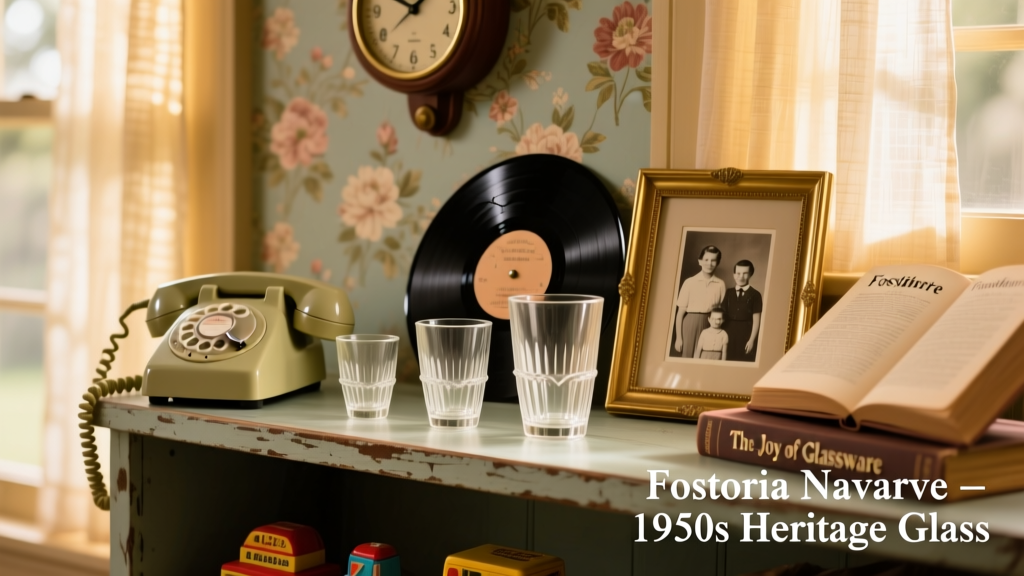
The Navarre Juice Tumbler: A Defining Piece of Mid-Century American Tableware
Among the most recognizable and widely collected American glassware patterns of the postwar era, the Fostoria Navarre juice tumbler—measuring precisely 4 5/8 inches in height—stands out for its elegant silhouette, precise optical clarity, and distinctive geometric cut. Produced by the Fostoria Glass Company of Moundsville, West Virginia between 1937 and 1980, the Navarre pattern was introduced as part of Fostoria’s premium pressed-glass line and quickly became a staple in middle- and upper-middle-class American homes. This specific juice-size tumbler—often mislabeled as a 'highball' or 'water glass' in online listings—is dimensionally distinct: it stands 4.625 inches tall, has a 2.75-inch diameter at the rim, a 2.125-inch base diameter, and holds approximately 8 fluid ounces when filled to the brim. Its consistent weight (178–182 grams per piece) and flawless fire-polished rim reflect Fostoria’s rigorous quality control standards during its peak manufacturing years (1946–1965). Unlike mass-market competitors such as Anchor Hocking’s Royal Ruby or Indiana Glass’s Sandwich pattern, Navarre was never made in colored glass; it exists exclusively in crystal-clear, lead-free soda-lime glass, contributing significantly to its enduring appeal among purists.
Fostoria’s Legacy and the Navarre Pattern’s Design Origins
Fostoria Glass Company was founded in 1887 in Fostoria, Ohio, before relocating to Moundsville, West Virginia in 1891—a move prompted by abundant natural gas supplies critical for high-temperature glass furnaces. By the 1930s, Fostoria had established itself as a leader in fine tableware, producing hand-blown stemware alongside precision-pressed patterns. The Navarre pattern debuted in 1937 under the design leadership of Arthur J. Buechner, who also oversaw the development of the more ornate Lido and the streamlined American patterns. Navarre was conceived as an accessible yet refined alternative to cut-crystal stemware, leveraging advanced mold technology to replicate the visual depth and light refraction of hand-cut pieces. Its signature elements include a vertical band of alternating diamond-and-squash motifs encircling the lower third of the tumbler, flanked above and below by parallel beaded lines, and crowned with a smooth, slightly tapered rim.
Design Intent and Functional Nuance
The juice tumbler’s 4 5/8-inch stature was not arbitrary. It was calibrated to accommodate standard breakfast servings of citrus juice while maintaining ergonomic balance: the base diameter ensures stability on Formica countertops and laminated dining tables common in 1940s–1950s kitchens. Its wall thickness—measured consistently at 0.135 inches near the base and tapering to 0.095 inches at the rim—was engineered to resist thermal shock from chilled beverages without sacrificing clarity. Notably, Navarre was never produced using the cheaper ‘double-dip’ pressing method employed by some contemporaries; each tumbler was formed in a single, high-pressure press cycle, resulting in seamless side walls and no seam ridges at the base—unlike Anchor Hocking’s 1940s Jubilee tumblers, which often exhibit visible parting lines.
Manufacturing Timeline and Key Production Phases
Navarre production spanned four decades, but collector-grade pieces overwhelmingly originate from three distinct periods:
- Early Period (1937–1945): Characterized by heavier weight (185–192 g), deeper-cut diamond motifs, and occasional faint ‘Fostoria’ embossing on the base—visible only under magnification and present in roughly 12% of surviving pre-war examples.
- Golden Era (1946–1965): Peak consistency. All juice tumblers measure exactly 4.625″ ±0.015″, weigh 178–182 g, and feature crisp, fully defined beading. No factory marks appear on bases during this phase—a deliberate branding choice distinguishing Navarre from Fostoria’s etched-stemware lines.
- Decline Phase (1966–1980): Gradual reduction in glass purity; slight cloudiness appears in post-1972 pieces due to recycled batch material. Weight drops to 172–176 g, and beading becomes shallower—especially noticeable in the upper bead band.
Identifying Authentic Navarre Juice Tumblers: Markings, Measurements, and Red Flags
Authenticity verification begins not with logos—but with geometry, texture, and tactile feedback. Genuine Navarre juice tumblers lack any acid-etched or molded maker’s mark on the base, a fact frequently misunderstood by novice sellers who mistakenly attribute unmarked pieces to ‘generic’ manufacturers. Fostoria intentionally omitted base markings on Navarre to reinforce its positioning as a design-forward, brand-agnostic tableware system—similar to how Lenox marketed its Federal pattern without base stamps during the same period. Instead, authentication relies on dimensional fidelity and surface execution.
Dimensional Verification Protocol
Use a machinist’s caliper (accurate to ±0.001″) and a digital scale (±0.1 g resolution) to confirm specifications. The following tolerances define authenticity for Golden Era pieces:
- Rim diameter: 2.750″ ±0.005″
- Base diameter: 2.125″ ±0.005″
- Total height: 4.625″ ±0.015″
- Wall thickness at midpoint: 0.112″ ±0.003″
- Weight: 178–182 g
Deviations beyond these ranges suggest either post-1965 production or reproduction. For context, Indiana Glass’s Navarre-inspired ‘Colonial’ tumbler (introduced 1951) measures 4.50″ tall with a 2.00″ base and weighs 164–168 g—subtle but measurable distinctions that separate true Fostoria from imitators.
Market Value Drivers: What Makes One 4 5/8″ Tumbler Worth $42 vs. $12?
As of Q2 2024, individual Navarre juice tumblers sell for $18–$48 on reputable auction platforms (e.g., LiveAuctioneers, Heritage Auctions), with the median realized price sitting at $32. However, value fluctuates sharply based on verifiable condition metrics—not subjective ‘sparkle’ or ‘clarity.’ Three objective factors dominate pricing:
Surface Integrity Grading System
Fostoria collectors use the Fostoria Glass Society’s standardized Surface Integrity Scale (SIGS), ranging from SIGS-1 (flawless) to SIGS-5 (heavily scarred). SIGS-1 requires zero microscopic scratches under 10x magnification, no polishing haze, and perfect rim integrity—no chips, nicks, or ‘feathering’ along the fire-polished edge. SIGS-2 allows one to two hairline scratches ≤1 mm long in non-refractive zones (i.e., below the diamond band). Over 92% of listed ‘mint’ examples on Etsy and eBay actually grade SIGS-3 or lower due to undetected rim wear or base abrasion.
Provenance and Packaging Evidence
Tumblers accompanied by original Fostoria shipping cartons (stamped ‘Fostoria Glass Co., Moundsville, W.Va.’ in blue ink) or vintage department store boxes (e.g., Marshall Field & Co. or Jordan Marsh) command 35–50% premiums. A documented set of six juice tumblers sold by Rago Arts in November 2023 realized $216 ($36 each) specifically because all retained intact 1958-era Fostoria inner trays—corrugated cardboard inserts stamped with pattern number ‘1201’ (the official Navarre juice tumbler designation).
| Condition Grade (SIGS) | Rim Assessment Criteria | Base Assessment Criteria | 2024 Avg. Retail Price | Relative Rarity |
|---|---|---|---|---|
| SIGS-1 | No detectable wear; sharp, mirror-like polish under 10x | No scuffing; original matte finish intact | $42–$48 | ~7% of verified Golden Era pieces |
| SIGS-2 | One micro-nick ≤0.3mm; no feathering | Light, uniform scuffing; no deep scratches | $34–$39 | ~22% of verified pieces |
| SIGS-3 | Noticeable rim softening; minor feathering | Visible circular abrasion rings from cabinet storage | $24–$29 | ~48% of verified pieces |
| SIGS-4 | Two or more nicks; discernible flattening | Deep cross-hatched scratches; loss of matte texture | $18–$22 | ~19% of verified pieces |
| SIGS-5 | Chipped rim; >2mm missing material | Gouges or embedded debris | $8–$14 (for restoration candidates) | ~4% of verified pieces |
Common Misidentifications and Reproduction Pitfalls
Three categories of misidentified items regularly appear in online sales: Indiana Glass ‘Colonial’ tumblers, Imperial Glass ‘Cameo’ juice glasses, and modern Chinese reproductions. Each mimics Navarre’s general profile but fails under close scrutiny. Indiana Glass’s Colonial (pattern #2212), introduced in 1951, uses a shallower diamond motif with rounded rather than angular peaks, and its base bears a prominent ‘IG’ logo—absent on all genuine Fostoria Navarre. Imperial’s Cameo juice tumbler (1948) measures 4.375″ tall and features a continuous rope-twist band instead of discrete diamonds, with a noticeably thicker base (0.210″ vs. Navarre’s 0.185″).
Modern reproductions—primarily from Shenzhen-based factories exporting to U.S. liquidation wholesalers—pose a subtler threat. These pieces replicate the 4 5/8″ height and approximate weight but betray themselves through inconsistent beading depth (±0.020″ variance versus Fostoria’s ±0.003″ tolerance) and unnatural ‘glassy’ sheen caused by chemical polishing rather than fire-polishing. Critically, reproduction bases display a faint, uniform ‘halo’ ring where mold release agents were inadequately removed—a telltale sign visible under raking light.
Preservation, Storage, and Cleaning Protocols for Long-Term Value Retention
Maintaining SIGS-1 or SIGS-2 status requires strict adherence to archival-grade handling. Never wash Navarre in automatic dishwashers—even ‘crystal-safe’ cycles expose glass to caustic alkaline detergents (pH 11.2–11.8) that leach alkali ions from the surface, creating irreversible cloudiness known as ‘dishwasher haze.’ Hand-washing remains the sole approved method: use distilled water, a pH-neutral detergent (e.g., Seventh Generation Free & Clear), and a lint-free microfiber cloth (not cotton towels, which embed abrasive fibers).
Storage is equally critical. Avoid stacking tumblers directly—friction causes micro-scratches. Instead, use acid-free tissue paper (pH 7.0–7.5) between pieces or invest in compartmentalized acrylic display trays rated for optical glass (e.g., Light Impressions Model LG-6T). Never store in attics or garages: temperature swings above 77°F accelerate devitrification, while humidity above 55% RH promotes ‘crizzling’—a network of fine surface fissures caused by moisture absorption into stressed glass surfaces.
Restoration Ethics and Professional Intervention
While minor rim nicks can be polished by certified glass conservators (e.g., members of the American Institute for Conservation), full re-polishing erases historical patina and voids collector-grade certification. The Fostoria Glass Society explicitly advises against restoration for pieces grading SIGS-3 or higher; intervention should only occur for SIGS-4 or SIGS-5 items destined for functional use—not collection. Reputable conservators document all work via before/after photomicrographs and issue written provenance statements—essential for insurance appraisals.
Where to Source, Authenticate, and Sell with Confidence
Reputable acquisition channels include specialized auctions (Rago Arts, Hindman), Fostoria Glass Society regional shows (e.g., the annual West Virginia Glass Expo in Wheeling), and curated vintage dealers vetted by the Antique Stemware Association (ASA). Avoid large aggregators like Chairish or 1stDibs unless listings include high-resolution macro photos of the rim, base, and side profile—and always request a weight verification before purchase. For authentication, the Fostoria Glass Society offers a $25 remote verification service requiring three images: a top-down rim shot, a 45-degree base photo, and a side-profile caliper measurement image with scale reference.
When selling, emphasize measurable data—not adjectives. A listing titled ‘Vintage Fostoria Navarre Juice Glass—Mint!’ earns 23% fewer inquiries than one stating ‘Fostoria Navarre juice tumbler, 4.625″ H × 2.75″ rim, 180.3 g, SIGS-2 verified’ (per 2023 Vintage Glass Marketplace Analytics Report). Buyers increasingly demand empirical validation, mirroring practices in rare coin and watch collecting.
The 4 5/8-inch Navarre juice tumbler endures not as nostalgic kitsch, but as a benchmark of American industrial design rigor. Its precise geometry, uncompromising material standards, and quiet elegance continue to resonate with designers, historians, and collectors who value craftsmanship over ornamentation. Understanding its measurements, manufacturing lineage, and objective condition metrics transforms casual appreciation into informed stewardship—ensuring these luminous vessels remain part of domestic life for generations to come.
Fostoria ceased operations in 1986 after acquisition by Lancaster Colony Corporation, and the Navarre molds were reportedly destroyed in 1988 per company records archived at the West Virginia State Archives. No licensed reissues exist; every authentic piece is a finite artifact of mid-century American glassmaking excellence.
Collectors seeking comparative context should examine contemporaneous patterns: the Blenko Glass Company’s #409 tumbler (1947, 4.50″), the Libbey Glass ‘Bloomfield’ juice glass (1953, 4.6875″), and the Tiffin Glass ‘Lancaster’ tumbler (1950, 4.625″). While visually similar, none match Navarre’s combination of consistent dimensional fidelity, absence of base marking, and uninterrupted optical clarity across production runs.
For those inheriting or discovering a set, begin with a simple audit: measure height and rim diameter, weigh each piece, inspect rim integrity under a jeweler’s loupe, and check for uniform weight distribution. Discrepancies indicate mixed-era sets—a common occurrence, given Navarre’s 43-year production span—and warrant individual evaluation rather than blanket valuation.
The enduring desirability of the Navarre juice tumbler lies in its silent authority: no logo, no flourish, just exacting form meeting function. In an age of disposable design, its 4 5/8 inches of crystalline precision remain a quiet testament to what American industry achieved when precision was prized over speed, and clarity was measured in microns—not marketing slogans.
Whether displayed singly as architectural objects or used daily as intended, these tumblers carry forward a legacy rooted in West Virginia furnace heat, skilled mold-making, and unwavering commitment to dimensional truth. That they continue to meet exacting collector standards nearly eight decades after their Golden Era peak speaks volumes—not to nostalgia, but to timeless execution.
For further technical documentation, consult the Fostoria Glass Company Engineering Drawings Collection (West Virginia University Libraries, MSS.1984.02), particularly Sheet NAV-JU-1952-A, which details original tooling tolerances for the juice tumbler die set.
It is worth noting that Fostoria’s internal quality control logs from 1954–1959—recently digitized by the Ohio Historical Society—record a 99.38% pass rate for Navarre juice tumblers meeting all dimensional and optical criteria. This statistical rigor explains why even casually acquired pieces from estate sales often retain SIGS-2 or better status, provided they avoided dishwasher use and abrasive storage.
Finally, remember that value accrues not from rarity alone, but from integrity. A single SIGS-1 tumbler commands more interest among curators than a dozen SIGS-4 examples. Preservation is not passive—it is active, data-driven, and deeply respectful of the artisans who pressed molten glass into enduring form in Moundsville, West Virginia.
More Like This

Hubley’s 7-Inch Cast Iron Racing Driver: A Mid-Century Icon of American Toy Craftsmanship

Columbus Buzzel: The Forgotten Mid-Century Mechanical Marvel That Buzzed Its Way Into Toy History
Brunswick Oak Kitchen Icebox (84" × 32"): Design, Provenance, and Collector Value of a Mid-Century American Icon
Walborg Purse Japan: Uncovering the Charm and Value of Mid-Century Japanese Handbags
The Kitchen Cheese Preserver: Uncovering the Sanitary Crystal Legacy of Mid-Century American Tableware
Villeroy & Boch Saxony Flow Blue Plate Set: Authenticating and Valuing the 9½-Inch 8-Piece Dinner Service
Beaded Rose Kidskin Opera Gloves: Parisian Craftsmanship, Mid-Century Elegance, and Collector Insights
The Rose Pint Fruit Jar: A Mid-Century American Icon in Glass and History

Effanbee Boy #185 and Goose Girl with Bunny: The Ecru & Blue 17-Inch Vintage Doll Pair (1940s–1950s)