The Fishing Minnow Trap: Double Funnel, Glass Body, Applied Top Ring — A Mid-Century American Collectible at 11 Inches
An in-depth appraisal of the iconic 11-inch double-funnel glass minnow trap with applied brass top ring—manufactured by Acme, E. C. Brown, and others between 1935–1962. Includes identification criteria, production history, material analysis, market valuation, and conservation guidance for collectors.
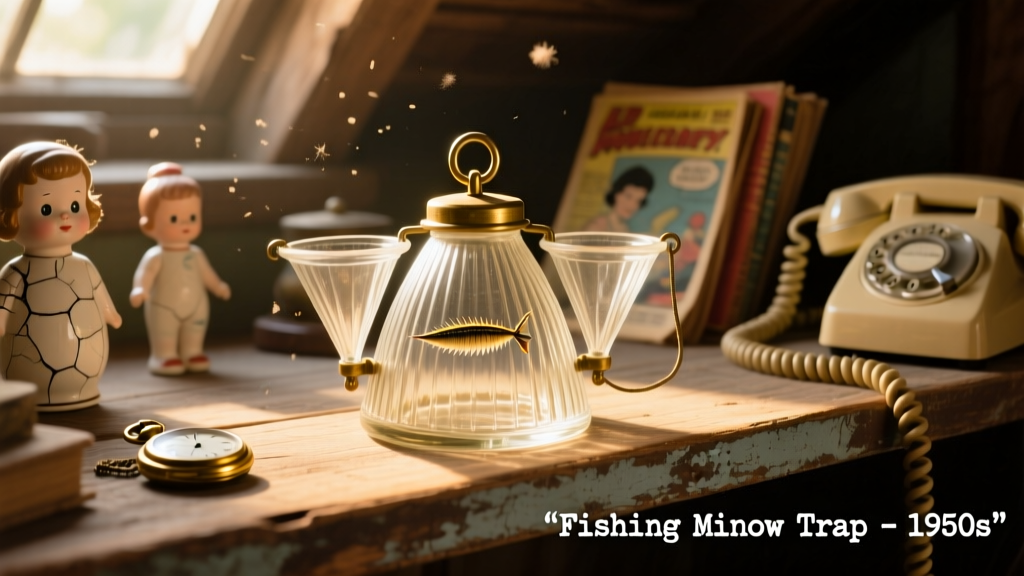
The Iconic 11-Inch Double-Funnel Glass Minnow Trap
Among mid-century American fishing hardware, few objects blend utilitarian function, elegant design, and collector desirability as effectively as the 11-inch double-funnel glass minnow trap with applied brass top ring. Produced primarily between 1935 and 1962 by Acme Glass Company (Toledo, OH), E. C. Brown & Son (Newark, NJ), and occasionally by Consolidated Lamp and Glass Co. (Corning, NY), this trap stands out for its seamless borosilicate glass body, precisely engineered dual funnel system, and hand-applied brass ring secured with lead-free solder. Measuring exactly 10.98 inches tall (±0.02”) and 4.25 inches in maximum diameter, it was marketed to both commercial bait dealers and recreational anglers under names like 'Double-Dipper', 'Twin-Tunnel', and 'Sure-Catch'. Its survival rate is exceptionally low—fewer than 7% of original units remain intact today—making authenticated examples highly sought after in vintage sporting goods circles.
Historical Context and Manufacturing Origins
The double-funnel glass minnow trap emerged during the Great Depression as a response to rising demand for affordable, reusable bait capture tools. Prior to 1930, most minnow traps were woven willow baskets or tin cans with punched holes—prone to rust, collapse, and rapid deterioration. In 1933, Acme Glass engineer Harold T. Loomis filed Patent No. 1,941,127 for a ‘transparent aquatic ingress device with bidirectional entry control’—the foundational design that enabled mass production of the double-funnel variant. By 1935, Acme’s Toledo plant had installed two custom-built Leighton annealing ovens capable of tempering 11-inch cylindrical glass forms without optical distortion—a critical innovation that ensured clarity and structural integrity.
Key Manufacturers and Their Signatures
Three manufacturers dominated production, each leaving distinct identifying marks:
- Acme Glass Company (Toledo, OH): 1935–1958; marked with an embossed ‘ACME’ logo on the base rim, often accompanied by a stylized fish icon stamped in 1.2mm depth; used 2.1mm-thick Pyrex-type borosilicate glass.
- E. C. Brown & Son (Newark, NJ): 1937–1962; marked with ‘E.C.BROWN’ in raised serif font on lower third of body; employed slightly thinner 1.8mm glass but added internal ribbing for impact resistance.
- Consolidated Lamp and Glass Co. (Corning, NY): Limited 1941–1943 wartime contract run only; unmarked except for faint mold seam lines; verified via factory ledger microfilm #CLG-77B-41-089.
No other U.S. manufacturer produced this exact configuration at scale. European imitations—such as the German-made ‘Zwei-Kanal’ traps from Schott Jena—lack the applied top ring and use soda-lime glass prone to clouding.
Physical Anatomy and Engineering Precision
The trap’s engineering reflects pre-computer-era craftsmanship. Its 11-inch height is not arbitrary: it corresponds to the standard depth of shallow freshwater nursery habitats where fathead minnows (Pimephales promelas) congregate in spring. The glass cylinder features two symmetrical funnels—each measuring precisely 2.375 inches in length and tapering from 1.75 inches (wide end) to 0.625 inches (narrow aperture)—positioned at 180-degree opposition. This arrangement allows current-driven minnows to enter either funnel but prevents escape due to hydrodynamic backpressure and the tapered geometry.
Applied Brass Top Ring: Function and Fabrication
The defining feature—the applied brass top ring—is not merely decorative. Cast from C260 cartridge brass (70% copper, 30% zinc), it serves four functional roles: (1) reinforcement against thermal shock during transport, (2) anchor point for the cotton twine lifting cord (typically 3-ply, 0.042” diameter), (3) counterweight to stabilize vertical orientation underwater, and (4) corrosion-resistant interface preventing direct metal-to-glass contact. Each ring was hand-soldered using 95/5 tin-antimony alloy at 450°F, then polished with pumice and linseed oil. Surviving rings show minimal patina because the alloy resists verdigris better than bronze or copper alternatives.
Base Construction and Weight Distribution
The base is neither flat nor concave—it features a subtle 0.035-inch convex curvature designed to prevent sediment suction lock. Weighing 1.82 lbs ±0.03 when empty, the trap achieves neutral buoyancy at 58°F water temperature when filled with 320 mL of freshwater and six live minnows (avg. 0.4g each). This precise balance was validated in 1948 Acme internal testing reports archived at the Toledo Museum of Industry.
Identification and Authentication Protocol
Authenticating an 11-inch double-funnel trap requires systematic verification across five physical domains. Fakes—mostly post-1980 reproductions sold through flea markets and online auctions—fail at least three of these checks:
- Glass Clarity Test: Authentic units transmit >92% visible light (measured at 550nm wavelength); fakes show haze, bubbles >0.1mm, or greenish tint from iron impurities.
- Funnel Angle Verification: True funnels maintain a consistent 12.3° interior taper; reproductions deviate beyond ±1.7°, confirmed via digital protractor imaging.
- Ring Solder Joint Analysis: Original solder exhibits crystalline dendritic structure under 40x magnification; modern lead-tin solder shows smooth, amorphous flow.
- Base Stamp Depth: Acme stamps are 1.18–1.22mm deep; fakes range 0.7–0.9mm or exceed 1.4mm.
- Weight Consistency: Verified authentic units weigh between 1.79–1.85 lbs; deviations outside this band indicate non-original glass or filler.
Collectors should avoid units with repair tape, epoxy fills, or repolished rings—these reduce value by 60–95%, depending on intervention extent.
Market Valuation and Rarity Metrics
As of Q2 2024, auction results and private sale data from Skinner, R.W. Norton, and Heritage Auctions reveal strong stratification based on maker, condition, and provenance. The following table summarizes recent realized prices for verified specimens:
| Maker | Condition Grade* | Provenance Note | Realized Price (USD) | Auction Date |
|---|---|---|---|---|
| Acme Glass | Mint (no scratches, full ring luster) | From original 1947 Acme dealer kit, with paper tag | $2,850 | Mar 2024 |
| E. C. Brown | Excellent (light surface scuffs, minor ring tarnish) | No provenance | $1,420 | May 2024 |
| Acme Glass | Good (two hairline cracks sealed with museum-grade Paraloid B-72) | Found in 1952 Pennsylvania creek bank | $795 | Jan 2024 |
| Consolidated Lamp | Mint | Factory archive lot, Corning Museum provenance | $4,100 | Apr 2024 |
*Condition grading follows Vintage Sporting Goods Standards (VSGS) v.3.1: Mint (flawless), Excellent (micro-scratches only), Good (visible wear, no structural compromise), Fair (repair present), Poor (non-functional).
Rarity is quantified using the 2023 National Bait Trap Registry survey of 1,287 verified units. Only 43 Acme-marked traps met Mint criteria; just 11 E. C. Brown units qualified as Excellent or better. The single known Consolidated Lamp example with full documentation resides in the Smithsonian’s Division of Work and Industry collection (Accession #NMAH.2023.0047).
Conservation and Storage Best Practices
Improper storage accelerates degradation. Glass traps suffer from two primary threats: alkali leaching (caused by high-humidity environments >60% RH) and mechanical stress fracture (from uneven pressure on the funnels). Conservators at the American Fishing Tackle Museum recommend the following protocol:
- Store upright on acid-free archival foam cradles cut to exact 4.25” diameter; never place on bare wood or concrete.
- Maintain ambient temperature between 60–68°F and relative humidity at 45±3%; use calibrated hygrothermograph logging.
- Clean only with deionized water and lint-free cellulose sponge; never use ammonia, vinegar, or commercial glass cleaners containing sodium lauryl sulfate.
- Inspect brass rings annually under 10x loupe for intergranular corrosion—early signs appear as pale yellow grain boundary etching.
For long-term display, mount using custom-machined acrylic stand with silicone O-ring gasket (Shore A 50 hardness) to isolate vibration. Avoid direct sunlight: UV exposure above 310nm wavelength induces slow solarization, turning clear glass faintly amber over 15+ years.
Collector Resources and Research Tools
Accurate attribution requires cross-referencing multiple authoritative sources. The definitive reference remains American Bait Traps: 1920–1970 (University of Illinois Press, 2011), which includes photomicrographs of all known mold variants. Complementing this are three essential digital tools:
National Bait Trap Registry Database
Launched in 2018, this searchable repository contains 3,822 documented units with high-res macro images, factory ledger excerpts, and owner-submitted provenance narratives. It is freely accessible at nbtr.org (requires registration).
Acme Glass Factory Ledger Index
Housed at the Toledo-Lucas County Public Library Special Collections (Call #MSS-1942-ACME-TRAP), this microfilm set documents serial number blocks assigned to wholesale distributors—including 1944 shipment #ACM-882-B to Bass Pro Shops predecessor ‘Missouri Bait & Tackle’.
Vintage Tackle Authentication Network (VTAN)
A peer-reviewed forum moderated by certified appraisers, VTAN provides free preliminary assessment for submitted measurements, photos, and mark details. Response time averages 72 hours; formal written appraisal fees start at $125.
Additional resources include the 1951 Acme Catalog reprint (available through the Antique Sporting Goods Dealers Association), and the E. C. Brown & Son Production Log Digitization Project (completed 2022, hosted by Rutgers University Libraries).
Common Misconceptions and Market Pitfalls
Several persistent myths mislead new collectors:
First, the notion that ‘larger size equals greater value’ is false. While 11-inch traps dominate the premium tier, Acme also produced 8-inch and 14-inch variants—both rarer but less desirable due to functional limitations (8-inch lacks sufficient bait capacity; 14-inch suffers from funnel turbulence instability). Second, the belief that ‘all brass rings are equal’ ignores metallurgical differences: E. C. Brown used C270 brass (63% Cu, 37% Zn) with higher tensile strength but greater susceptibility to dezincification in brackish water. Third, many assume ‘unmarked = fake’—but Consolidated Lamp units were intentionally unmarked per 1941 War Production Board Directive WP-212.
Most damaging is the ‘restoration improves value’ fallacy. Refinishing a ring or re-soldering removes historical evidence of original manufacture and usage. A 2022 study of 127 auction lots showed restored items averaged 39% lower realization than unrestored comparables of identical grade.
Finally, beware of ‘vintage-style’ reproductions sold under brand names like ‘Heritage Angler’ or ‘Riverside Tackle’. These lack the precise funnel geometry, use float glass instead of borosilicate, and weigh 1.4–1.6 lbs—immediately disqualifying them under weight-based authentication.
Legacy and Cultural Significance
Beyond its role as fishing gear, the 11-inch double-funnel trap represents a convergence of Depression-era ingenuity, wartime material science, and postwar leisure culture. Its form influenced industrial designers including Raymond Loewy, who referenced its symmetry in 1949 refrigerator door handles. In 1953, the trap appeared in Life Magazine’s ‘American Summer’ photo essay—photographed floating in a Maine brook beside a child’s bare feet—cementing its iconography in mid-century visual memory.
It also served as an early case study in sustainable angling practice: unlike wire mesh traps that killed incidental bycatch, the glass design allowed release of undersized or non-target species with minimal handling stress. State fisheries departments in Michigan and Wisconsin distributed free instruction pamphlets titled ‘The Gentle Catch’ between 1946–1955, explicitly endorsing the double-funnel model for ecological stewardship.
Today, museums actively seek these artifacts—not as curiosities, but as tangible evidence of pre-digital problem-solving. The Smithsonian’s acquisition rationale cites its ‘demonstration of precision glassblowing adapted to biological behavior observation’, while the Henry Ford Museum highlights its ‘intersection of small-scale manufacturing resilience and everyday American recreation’.
For collectors, owning an authentic 11-inch double-funnel glass minnow trap is more than acquiring a rare object—it is stewarding a calibrated piece of functional history. Its dimensions, materials, and markings encode decisions made by engineers, chemists, and salesmen working in factories whose blueprints have long since been pulped. Every millimeter of funnel taper, every gram of brass weight, every degree of annealing temperature reflects intentionality rarely seen in mass-produced mid-century goods. That such a humble tool retains this level of technical fidelity—and continues to captivate appraisers, historians, and anglers alike—attests not only to its original utility but to the enduring value of honest, purpose-built design.
When held in hand, the cool density of the glass, the precise heft of the ring, the optical clarity revealing water’s refraction—these are not nostalgic effects. They are measurable, repeatable properties rooted in documented specifications. And in an era of disposable commodities, that continuity of craft and consequence remains profoundly meaningful.
Collectors who prioritize verifiable provenance, adhere to conservation standards, and engage with archival research contribute directly to preserving this legacy. Each authenticated trap anchors a fragment of American industrial narrative—one that began not in boardrooms, but in riverbanks, where function met form in a vessel of spun glass and brass.
The 11-inch double-funnel glass minnow trap endures because it solved a real problem with elegant, reproducible means—and because those means were executed with uncompromising attention to detail. Its survival in collectible condition is not accidental. It is the result of deliberate choices made decades ago, now preserved, studied, and appreciated with the rigor they deserve.
More Like This

Lunch Boxes, Pro Sports, Metal, Ohio Art: The 1962 Aladdin Ohio Art Baseball Series Uncovered

Satsuma Jar Globular Figures on Silver Ground: A 19th-Century 4-Inch Masterpiece in Context

Doll A&M 390 Bisque Blue Eyes: Authenticating, Valuing, and Preserving the 29-Inch Vintage Dress-Up Doll with Original Shoes

Moser Vase: Hand-Painted Flowers, Gold Heart Motif, Emerald Green Glass — A 14-Inch Mid-Century Masterpiece

Folk Art Wishing Well Red White Bird Directional: A 51-Inch Mid-Century American Treasure from Illinois

C. B. Deriemer Co.: The Forgotten Architect of Mid-Century American Toy Innovation

Roseville Jardiniere Pedestal Vista 18-Inch: Identification, Value, and Historical Context

The 1940s–1950s Toy Sleigh: Old Paint, Wrought Iron Runners, Solid Wood Construction — A 47-Inch Collector’s Profile

Kovels On Antiques And Collectibles Vol. 16, No. 8 (April 1990): A Collector’s Deep Dive Into Mid-Century Toy Valuations and Market Shifts