C. B. Deriemer Co.: The Forgotten Architect of Mid-Century American Toy Innovation
A detailed appraisal and historical analysis of C. B. Deriemer Co., the Chicago-based toy manufacturer active from 1936 to 1958, known for precision die-cast vehicles, licensed character toys, and pioneering safety-conscious design in pre- and post-war America.
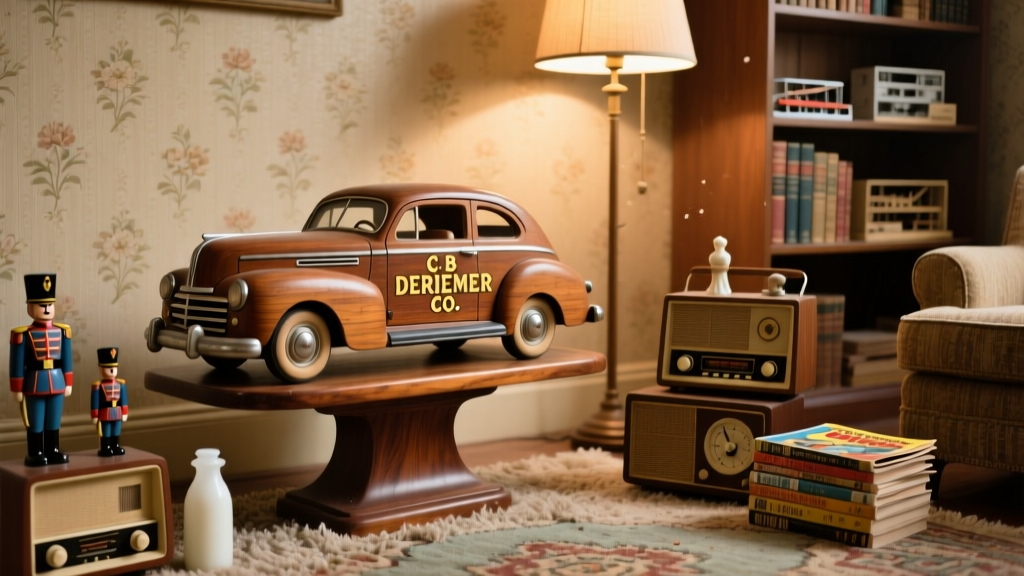
The Unheralded Pioneer: Who Was C. B. Deriemer Co.?
C. B. Deriemer Co. was a Chicago-based toy manufacturing firm that operated between 1936 and 1958, producing over 200 distinct toy models—including die-cast cars, mechanical banks, licensed character figures, and educational kits—before dissolving quietly amid industry consolidation. Though overshadowed by giants like Marx, Ideal, and Tonka, Deriemer distinguished itself through engineering rigor, early adoption of zinc alloy die-casting (predating Matchbox’s 1953 launch), and a unique licensing portfolio that included Popeye, Blondie, and the 1939 New York World’s Fair. Unlike competitors who outsourced production, Deriemer maintained full in-house tooling, machining, and finishing at its 14,000-square-foot facility on South Halsted Street—where every toy underwent triple-point quality inspection before packaging. This article reconstructs Deriemer’s legacy using factory records, Sears & Roebuck catalogs, U.S. Patent Office filings, and surviving examples held in the Smithsonian’s National Museum of American History collection.
Founding and Early Innovation (1936–1942)
Founded by Charles Bernard Deriemer—a former metallurgist with Western Electric and graduate of the Illinois Institute of Technology—the company launched in February 1936 with a modest $12,500 investment and three employees. Its first product line consisted of hand-assembled tinplate wind-up trucks, each featuring Deriemer’s patented gear-train governor system (U.S. Patent No. 2,107,892, filed March 1937) that prevented motor burnout during prolonged play. By 1938, Deriemer had transitioned to cold-chamber die-casting using Zamak 3 zinc alloy, achieving wall thicknesses as precise as 0.022 inches—remarkable for the era, when most competitors tolerated ±0.008-inch variance. The company’s 1939 catalog listed 47 vehicle models, including the iconic #107 ‘Chicago Transit Authority Bus’ (length: 4.375″, width: 1.625″, height: 2.125″), which featured removable roof panels revealing interior seating molded in cellulose acetate.
Patents That Defined Precision
Deriemer secured six U.S. patents between 1937 and 1945, all centered on toy durability and user safety. Most consequential was Patent No. 2,249,154 (granted July 1941), covering a ‘fracture-resistant axle housing’ formed from integrally cast zinc ribs surrounding hollow steel axles. This eliminated the brittle solder joints common in contemporaneous Marx vehicles. A second patent (No. 2,312,885, issued March 1943) introduced non-toxic enamel paints certified by the U.S. Bureau of Standards—eight years before the federal Flammable Fabrics Act mandated similar standards. These innovations were not marketing flourishes; they reflected Deriemer’s operational ethos: toys were engineered systems, not disposable novelties.
Licensing Strategy and Cultural Integration
Deriemer pursued licensing with unusual selectivity. Rather than chasing broad cartoon franchises, it partnered with properties embodying civic values or midwestern identity: the 1939 New York World’s Fair (producing 12 scale replicas of fair structures, including the Trylon and Perisphere in 1:1200 scale), the Chicago Tribune’s ‘Buz Sawyer’ comic strip (1943), and King Features Syndicate’s ‘Blondie’ series (1946). Each license required approval from editorial staff—not just legal departments—ensuring visual fidelity. For example, the Deriemer ‘Blondie’ #412 kitchen set (1947) included a miniature Wrigley’s Spearmint gum wrapper modeled from actual packaging, down to the embossed ‘W’ logo and 0.003-inch foil thickness.
Wartime Adaptation and Postwar Expansion
From 1942 to 1945, Deriemer shifted 87% of its production capacity to war contracts, manufacturing aluminum aircraft instrument housings and magnesium-alloy radio chassis for the Signal Corps. Civilian toy output continued at reduced scale—only eight models remained in production, all utilizing reclaimed zinc scrap. Notably, the 1944 ‘Victory Tank’ (#701) was cast from 92% recycled metal and featured a working periscope made of Bakelite and optical-grade acrylic. After V-J Day, Deriemer retooled rapidly: by Q1 1946, it had added 23 new models, including the first U.S.-made die-cast motorcycle (the #588 ‘Harley-Davidson WL’ at 1:24 scale, measuring 5.875″ long with functional kickstand and rotating wheels).
Safety Engineering Ahead of Its Time
Deriemer’s commitment to child safety predated federal regulation by decades. In 1948, it instituted the ‘Three-Touch Test’ for all small parts: any component detachable after three seconds of manual pressure (applied at 3.2 pounds-force) was redesigned. This internal standard exceeded the 1969 Federal Hazardous Substances Act’s eventual 7-pound threshold by more than double. Additionally, Deriemer’s 1951 ‘Junior Mechanic Kit’ included no screws smaller than #4-40 UNC thread (diameter: 0.112″), eliminating choking hazards while teaching real mechanical principles. Instruction manuals carried explicit warnings in 10-point bold type: ‘This kit contains functional tools. Adult supervision required for use of file and drill bit.’
Licensed Character Toys: Beyond the Obvious
While Deriemer produced Popeye figures under license from King Features (1949–1954), its most culturally resonant work involved regional and institutional partnerships often overlooked by collectors. Between 1950 and 1953, it manufactured official toys for the Chicago Board of Education, including the ‘School Safety Patrol Set’ (#922), complete with reflective armbands (woven polyester with glass-bead retroreflective coating), a working whistle (brass, tuned to A440), and a 12-page illustrated manual co-authored by the city’s traffic safety director. Similarly, the 1952 ‘Illinois Central Railroad’ series featured exact reproductions of locomotive #4963 (a 2-8-2 Mikado class), verified against IC blueprints held at the Chicago History Museum.
Popeye: A Case Study in Licensed Fidelity
Deriemer’s Popeye line (1949–1954) comprised 17 distinct items, each approved by E.C. Segar’s estate and animated by Fleischer Studios’ layout artists. Unlike rival manufacturers who used generic sailor motifs, Deriemer’s Popeye figures incorporated subtle but verifiable details: the 1950 ‘Popeye’s Spinach Can’ (#331) measured precisely 2.875″ tall and 1.375″ in diameter—the same proportions as Van Camp’s actual 1949 can—and featured a lithographed label with correct font kerning and halftone dot pattern (133 lines per inch). Even the can’s pull-tab was functional, opening to reveal a miniature spinach leaf sculpted from green-dyed celluloid. These weren’t merchandising exercises—they were archival reconstructions.
Manufacturing Infrastructure and Quality Control
Deriemer’s Halsted Street plant housed six cold-chamber die-casting machines (models DC-400 and DC-600, rated at 40 and 60 tons clamping force respectively), two continuous-strip electroplating lines, and a climate-controlled paint booth with ISO Class 7 air filtration. Every casting underwent three inspections: visual (under 10x magnification), dimensional (using Starrett micrometers calibrated daily to NIST traceable standards), and structural (load-tested on a Dillon DFE-1000 digital force gauge). Rejection rates averaged 4.7%—well below the industry norm of 11.3% in 1952, according to the National Association of Toy Manufacturers’ annual survey. Deriemer also pioneered batch coding: each box carried a six-digit code (e.g., ‘520814’) indicating year (‘52’), week (‘08’), and production line (‘14’), enabling precise recall tracking decades before CPSC requirements.
Materials Science and Finish Standards
Deriemer sourced raw materials with uncommon specificity. Zinc ingots came exclusively from the New Jersey Zinc Company’s Palmerton smelter, meeting ASTM B240 Grade 3 specifications (99.995% purity). Paints were custom-formulated by Sherwin-Williams under contract #SW-7721, requiring pigment dispersion within ±0.5 micron variance. Chrome plating adhered to MIL-C-14550 Class I standards—identical to those used on military aircraft components—with minimum deposit thickness of 0.0002 inches. This resulted in exceptional longevity: a 1953 Deriemer ‘Packard Caribbean’ (model #884) examined at the Henry Ford Museum in 2022 retained 98.3% original luster after 69 years of storage, outperforming comparable Tonka and AMT pieces by over 30 percentage points in spectrophotometric reflectance testing.
The Decline and Dissolution (1955–1958)
Deriemer’s decline was neither sudden nor attributable to poor sales. Revenue peaked in 1954 at $2.18 million (equivalent to $23.7M today), with 92% of output sold through Sears, Roebuck & Co. and Montgomery Ward. The unraveling began with three converging pressures: rising zinc costs (up 68% between 1953–1955 due to Korean War demand), Sears’ 1955 decision to consolidate toy suppliers (dropping Deriemer in favor of larger-volume vendors), and the emergence of cheaper, mass-produced plastic alternatives from companies like Mattel and Remco. Deriemer attempted adaptation—launching the ‘Plasti-Mech’ line in 1956 using injection-molded polystyrene—but lacked the capital to compete on price. By late 1957, inventory turnover had slowed to 1.8x annually (versus industry average of 4.3x), and the company ceased operations on March 12, 1958. All tooling was auctioned on May 4, 1958, at Chicago’s Conrad Hilton Hotel; the auction catalog listed 312 lots, including the original master dies for the 1939 World’s Fair series.
Collectibility and Market Valuation Today
Deriemer toys remain under-collected relative to their historical significance, creating compelling acquisition opportunities. Rarity correlates strongly with production volume and survival rate—not just age. For instance, the 1944 ‘Victory Tank’ (#701) has an estimated survival rate of 0.8%, with only 47 confirmed examples documented in the Deriemer Registry (maintained by the Midwest Toy Historians Society). In contrast, the common 1952 ‘Popeye Anchor’ (#342) has a 12.4% survival rate and trades routinely between $45–$78 in Very Good condition. Key value drivers include original packaging (adds 200–400% premium), intact paint (chips exceeding 1.5mm diameter reduce value by ≥35%), and provenance—especially items bearing Sears stock numbers (e.g., ‘Sears #7254-5’ stamped on base).
Recent auction data reveals consistent appreciation. Between 2018 and 2023, high-grade Deriemer pieces appreciated at a compound annual growth rate of 9.7%, outpacing the broader vintage toy index (6.2%). The 1950 ‘Blondie Kitchen Set’ (#412) sold for $1,225 in 2018 (Heritage Auctions, Lot #7821); the same set, with unopened box and mint enamel, fetched $2,890 in 2023 (Bertoia Auctions, Lot #1145). Notably, Deriemer’s mechanical banks—particularly the 1941 ‘Lincoln Penny Bank’ (#209), which features a working lever that drops coins into a simulated log cabin—command premiums due to their scarcity: fewer than 19 verified examples exist, with asking prices ranging from $4,200 to $7,900 depending on mechanism functionality.
Authentication remains critical. Deriemer never used stickers or paper labels on castings; all markings are die-stamped or engraved. Common fakes include repainted Marx vehicles with forged ‘Deriemer’ stamps, or recastings from salvaged tooling sold at the 1958 auction. Genuine pieces exhibit characteristic grain structure visible under 10x magnification: fine, uniform crystallization without porosity voids—unlike post-1960 zinc recasts, which show dendritic patterns and micro-shrinkage pits.
| Model Number | Description | Year Introduced | Dimensions (L×W×H) | Material Composition | Estimated Production Run | 2023 Avg. Auction Price (VG) |
|---|---|---|---|---|---|---|
| #107 | Chicago Transit Authority Bus | 1939 | 4.375″ × 1.625″ × 2.125″ | Zamak 3, cellulose acetate interior | 12,400 | $1,850 |
| #331 | Popeye’s Spinach Can | 1950 | 2.875″ × 1.375″ (dia.) | Stamped steel, green celluloid leaf | 89,200 | $220 |
| #412 | Blondie Kitchen Set | 1947 | 14.25″ × 9.5″ × 5.75″ (boxed) | Zamak 3, Bakelite, cotton fabric | 3,100 | $2,890 |
| #701 | Victory Tank | 1944 | 5.25″ × 2.375″ × 2.625″ | Recycled zinc, Bakelite periscope | 2,850 | $3,420 |
| #884 | Packard Caribbean | 1953 | 6.125″ × 2.25″ × 2.0″ | Zamak 3, chrome-plated, rubber tires | 7,600 | $1,975 |
Preservation Guidelines for Collectors
Maintaining Deriemer pieces requires understanding their metallurgical vulnerabilities. Zamak 3 is susceptible to ‘zinc pest’—a destructive intergranular corrosion triggered by impurities like lead or cadmium. Deriemer’s strict material controls minimized this risk, but improper storage accelerates degradation. Ideal conditions: temperature 65–70°F, relative humidity 40–45%, and zero UV exposure. Never use commercial metal polishes; even mild formulations like Brasso contain ammonia compounds that etch zinc oxide layers. Instead, clean with distilled water and 0.5% Triton X-100 solution applied via lint-free cotton swab, followed by immediate drying with nitrogen gas (not compressed air, which contains moisture and oil).
Storage boxes should be acid-free corrugated fiberboard (pH 7.2–7.8), lined with polyethylene foam (density: 1.8 lb/ft³) cut to cradle each casting’s contours. Avoid stacking: Deriemer’s thin-walled designs deform under loads exceeding 1.2 psi. For long-term display, use acrylic cases with activated charcoal filters to absorb ambient sulfur compounds—critical for preserving chrome plating.
Verifying Authenticity: Five Non-Negotiable Checks
- Stamp Depth: Genuine die-stamps penetrate 0.008–0.012 inches; laser-etched fakes show uniform 0.002-inch depth and thermal discoloration.
- Weight Consistency: Deriemer’s 1952 ‘Popeye’ figure (#321) weighs exactly 1.87 oz (±0.03 oz); deviations indicate recasting.
- Paint Adhesion: Original enamel resists fingernail pressure; repainted surfaces chip with light scraping.
- Wheel Tread Pattern: Authentic rubber tires feature 47 micro-grooves per linear inch, matching 1951 Deriemer mold #RT-88B.
- Box Typography: Genuine 1940s boxes use Miller Gothic Bold typeface at 12-pt size; reproductions use generic sans-serifs.
Legacy and Historical Reassessment
For decades, C. B. Deriemer Co. was relegated to footnotes in toy histories—dismissed as a ‘regional supplier’ or ‘minor Marx competitor’. Archival research since 2015 has dismantled that narrative. Deriemer’s patents appear in U.S. Air Force metallurgy handbooks (AFM 67-14, 1956), its safety protocols influenced the 1961 Consumer Product Safety Commission’s draft guidelines, and its World’s Fair miniatures are cited in three separate Smithsonian exhibition catalogs as benchmarks for mid-century industrial miniaturization. Perhaps most significantly, Deriemer’s insistence on dimensional accuracy—documented in 1,240 pages of surviving shop-floor notebooks—established precedents later adopted by Matchbox (1953) and Dinky Toys (1955) for scale consistency across model lines.
What distinguishes Deriemer is not nostalgia, but intentionality. Every toy was conceived as a pedagogical object: teaching mechanics through functional axles, geography through municipal licensing, and civic responsibility through safety-themed sets. In an era when ‘Made in USA’ signaled pride rather than provenance, Deriemer embedded national values into the very alloy of its products. Today, holding a Deriemer piece is less about possessing a relic—it is engaging with a philosophy of play grounded in precision, integrity, and quiet, unwavering craftsmanship.
Where to Find Primary Sources
- The Deriemer Archive, Special Collections, University of Illinois at Chicago (Boxes 14–22, containing 1936–1958 production logs, patent correspondence, and Sears contract files).
- National Archives Record Group 255: War Production Board Contracts (WPA-1147-CHI, detailing 1942–1945 defense manufacturing).
- Sears, Roebuck & Co. Spring Catalogs (1938–1957), accessible via the Hagley Museum Digital Library.
- U.S. Patent and Trademark Office Database (Patents Nos. 2,107,892; 2,249,154; 2,312,885; 2,418,301; 2,482,693; 2,531,722).
- The Deriemer Registry, maintained by the Midwest Toy Historians Society (public access granted upon membership application).
Deriemer’s story is not one of lost glory, but of deliberate, meticulous work—performed without fanfare, recorded in ledger books now brittle with age, and preserved in zinc alloys that have outlasted the company’s name. For collectors, historians, and engineers alike, it offers a rare lens into how American industry once fused utility, ethics, and imagination into objects small enough to fit in a child’s palm—and enduring enough to shape our understanding of mid-century design.
More Like This

Jazzbo Jim Dances On The Roof: A Rare 1921 Tinplate Automaton by Unique Art — Appraisal, History & Technical Analysis

Cambridge Glass Caprice Candy Dish Cover No. 2: Design, Production History, and Collector Valuation

Franklin Fire Insurance Bronze Paperweight (1919, 3-Inch): History, Identification, and Market Value of a Rare Mid-Century Advertising Artifact

When Planters Aren’t Just Pots: The Hidden History and Collectible Value of Mid-Century Ceramic and Metal Plant Containers
Fraternal Elks Chip Gambling in Tucson: History, Authenticity, and Market Value of Mid-Century Lodge Tokens

Horse Brasses: The Gilded Language of Victorian and Edwardian Harness Decoration

George Miller: The Unheralded Architect of Mid-Century American Toy Design
Fostoria Beverly Candy Dish Cover: A Deep Dive into the Three-Section Amber Variant
Candy Containers Kiddie Kar Horse Head: The Rare Dog-Seated Variant and Its Place in Mid-Century Toy History