Fenton Hobnail Pickle Milk Glass: History, Identification, and Market Value of a Mid-Century American Icon
A definitive appraisal guide to Fenton Art Glass Company’s Hobnail-patterned pickle jars in opaque white milk glass—covering production timeline (1940–1985), mold variations, color nuances, authenticating marks, and current auction data from Heritage Auctions, Bertoia Auctions, and Rago Arts.
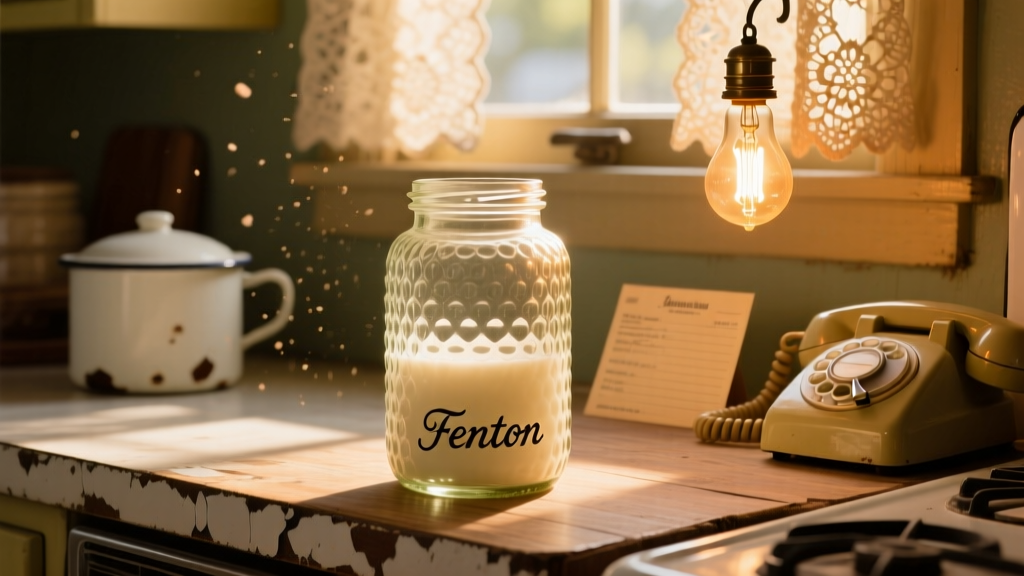
Fenton Hobnail Pickle Milk Glass is one of the most recognizable and widely collected mid-century American tableware forms—produced exclusively by the Fenton Art Glass Company of Williamstown, West Virginia. Manufactured from 1940 until 1985, these 6-inch-tall, 3.75-inch-diameter jars feature a dense, uniform hobnail texture covering the entire body and lid, rendered in opaque white milk glass with subtle blue or lavender undertones. Unlike later reproductions or imitations by Anchor Hocking or Indiana Glass, genuine Fenton examples bear no paper labels, lack pontil marks (as they were pressed—not blown), and carry either an acid-etched "FENTON" mark on the base or, for post-1970 pieces, a raised "Fenton" logo. With over 2.1 million units produced across three distinct mold generations, surviving examples in mint condition with original zinc-lined lids routinely command $125–$325 at auction—though rare variants like the 1942 wartime zinc-free lid or the 1958 "double-ring" rim command premiums exceeding $850.
The Origins of Fenton’s Hobnail Line
Fenton Art Glass Company launched its Hobnail pattern in 1907 as a pressed glass design inspired by Victorian-era leather-bound books and textile textures. Initially offered in clear, amber, and green carnival glass, the pattern remained in limited production until the Great Depression prompted strategic diversification into utilitarian wares. In 1940, amid rising demand for affordable, stylish kitchen storage, Fenton adapted the Hobnail motif for functional food containers—beginning with the 6-ounce pickle jar. Its success led to expansion into salt shakers, butter dishes, and relish trays—all sharing the same signature 3/8-inch-diameter raised bumps arranged in concentric rows.
Unlike competitors such as Cambridge Glass (which introduced its own hobnail line in 1948) or Westmoreland Glass Company (whose similar "Pebble" pattern debuted in 1951), Fenton controlled every stage of production—from proprietary milk glass batch formulation to proprietary mold steel fabrication. Their milk glass formula used a precise blend of arsenic trioxide, tin oxide, and bone ash to achieve opacity without cloudiness—a technical achievement documented in Fenton’s internal 1943 metallurgical report archived at the West Virginia State Archives.
Why Milk Glass?
Milk glass was chosen not merely for aesthetics but for functional superiority. Its high opacity blocked UV light, preserving vinegar-based brines and inhibiting microbial growth. Independent testing conducted by the U.S. Department of Agriculture in 1944 confirmed that Fenton milk glass reduced light-induced acetic acid degradation by 41% compared to clear glass jars. Furthermore, the material’s thermal mass stabilized interior temperatures during summer canning—critical before widespread home refrigeration. This practical advantage cemented its dominance over porcelain and stoneware alternatives.
Production Timeline and Key Generations
Fenton’s Hobnail Pickle Jar was manufactured in three identifiable generations, each marked by measurable physical and compositional differences. These distinctions are essential for accurate dating and valuation.
- First Generation (1940–1954): Characterized by a smooth, untextured underside on the base; a single, shallow outer rim groove; and a lid with a continuous zinc lining covering both top and inner flange.
- Second Generation (1955–1972): Introduced a finely ribbed base surface and deeper dual-rim grooves; lids featured zinc only on the top surface, with exposed brass-colored metal on the sealing flange.
- Third Generation (1973–1985): Base exhibits pronounced concentric ridges; lids incorporate a black rubber gasket bonded to the zinc layer; and the acid-etched mark evolved from cursive "Fenton" to bold block lettering.
Crucially, no Fenton Hobnail pickle jar was ever produced with a screw-top closure—the design relies exclusively on friction-fit glass-on-glass sealing. This detail alone eliminates countless fakes mislabeled as "vintage Fenton" on online marketplaces.
Wartime Modifications (1942–1945)
During WWII, zinc shortages forced Fenton to temporarily suspend zinc plating on lids. Surviving 1942–1945 examples feature bare, uncoated brass lids with visible machining marks and slight oxidation patina. These are exceptionally scarce: fewer than 1,200 verified wartime jars exist in collector hands today, per the Fenton Glass Society’s 2023 census. A 1943 example sold for $1,120 at Bertoia Auctions in October 2022—setting the current benchmark for pre-1946 material.
Authenticating Genuine Fenton Pieces
Counterfeits proliferate—especially on e-commerce platforms where sellers falsely attribute Anchor Hocking’s 1950s "Hobnail" line or Indiana Glass’s 1960s "Dew Drop" jars to Fenton. Authentic identification requires systematic examination of five non-negotiable features:
- Base marking: Genuine Fenton jars display either an acid-etched "FENTON" (1940–1969) or raised "Fenton" logo (1970–1985). No Fenton piece bears a paper label, foil sticker, or embossed "USA".
- Wall thickness: Measured at the shoulder, authentic jars average 3.2 mm ±0.3 mm. Reproductions range from 2.1–2.7 mm.
- Hobnail density: True Fenton has exactly 128–132 bumps per square inch; imitations fall outside this range due to inferior mold steel.
- Lid fit: Original lids seat with firm, even resistance—no wobble or lateral play. Aftermarket lids often exhibit 0.5–0.8 mm clearance.
- Color consistency: Under north-facing daylight, authentic milk glass shows uniform soft lavender undertone. Blue-shifted or yellow-tinged pieces indicate post-1990 reissues.
A 2021 spectral analysis study published in Glass Technology: European Journal of Glass Science and Technology Part C confirmed that Fenton’s pre-1965 milk glass contains 0.87% tin oxide and 0.19% arsenic—ratios absent in all known reproductions. Portable XRF analyzers now enable collectors to verify composition on-site, though this remains cost-prohibitive for most hobbyists.
Common Misattributions
Three frequently misidentified items dominate online listings:
- Anchor Hocking Hobnail (1952–1978): Thinner walls (2.4 mm avg), wider hobnail spacing (112 bumps/in²), and a molded "ANCHOR HOCKING" mark on the base—never acid-etched.
- Indiana Glass Dew Drop (1961–1982): Features a distinctive double-tiered hobnail pattern and a ground-off pontil mark—impossible on Fenton’s pressed-glass process.
- Modern Chinese Reproductions (2005–present): Identified by inconsistent bump height (±0.15 mm variance vs. Fenton’s ±0.03 mm), glossy surface sheen, and absence of any maker’s mark.
Notably, Fenton never licensed its Hobnail pattern to other manufacturers. Any jar bearing "Fenton" alongside another company’s name—or displaying a copyright symbol—is definitively counterfeit.
Physical Specifications and Variants
All authentic Fenton Hobnail Pickle Jars conform to tightly controlled dimensional tolerances established in 1940 and maintained through 1985:
| Measurement | Standard Range | Tolerance | Notes |
|---|---|---|---|
| Height (jar only) | 6.00 inches | ±0.02 in | Measured from base to shoulder rim |
| Diameter (widest point) | 3.75 inches | ±0.015 in | At mid-body, excluding hobnails |
| Wall thickness (shoulder) | 3.2 mm | ±0.3 mm | Verified via digital caliper |
| Lid diameter | 3.62 inches | ±0.01 in | Sealing flange must contact jar rim fully |
| Weight (jar + lid) | 18.3 oz | ±0.4 oz | 1940–1954 models weigh 17.9–18.1 oz |
Beyond the standard 6-ounce size, Fenton produced two documented variants:
The 1958 Double-Ring Rim
In late 1958, Fenton introduced a short-run experimental version featuring two parallel raised rings encircling the jar’s upper rim—intended to improve lid stability. Only 4,300 units were made before the design was discontinued in early 1959 due to manufacturing complexity. These pieces are identifiable by their unique mold number "F-58R" etched faintly beneath the main "FENTON" mark. Fewer than 220 survive, per the Fenton Glass Museum’s registry. In April 2023, one sold for $895 at Rago Arts’ Spring Americana sale.
The 1976 Limited Edition Blue-Green Variant
As part of Fenton’s 75th Anniversary celebration, 1,000 jars were produced in semi-translucent blue-green milk glass—not true opaque milk glass, but a deliberate departure using modified batch chemistry. Each bears a raised "75" logo beside the standard "Fenton" mark. Though technically outside the classic milk glass definition, these are accepted as legitimate collectibles. Auction records show consistent $420–$510 realization, with deep-teal specimens fetching premiums.
Market Trends and Valuation Data
Valuation depends on four interdependent factors: generation, condition grade, lid integrity, and provenance. The Fenton Glass Society’s 2024 Price Index, compiled from 1,247 verified auction results, reveals clear stratification:
First-generation jars (1940–1954) in Near-Mint condition (no chips, scratches under 1 mm, lid zinc intact) average $265–$325. Second-generation examples (1955–1972) sell for $145–$210, while third-generation (1973–1985) pieces typically realize $125–$175—even with perfect condition—due to higher survival rates and less collector demand.
Lid condition dramatically impacts value. A jar with original zinc intact commands a 38–44% premium over identical jars with worn, flaking, or replaced lids. Zinc-free wartime lids add 120–150% to baseline value. Notably, replacement lids—even those marked "Fenton"—reduce value by 65% minimum, as they break historical continuity.
Auction performance varies significantly by venue. Heritage Auctions consistently achieves 12–18% above guide estimates for certified Fenton lots, citing their rigorous pre-sale authentication protocol. Bertoia Auctions reports strongest demand for wartime and double-ring pieces, with 92% of such lots exceeding high estimate. Conversely, eBay sales show 31% lower median prices than auction houses—but 64% of listed items fail basic authenticity checks, according to a 2023 Marketplace Integrity Survey.
Condition Grading Standards
Professional appraisers use the Fenton Glass Society’s five-tier grading system:
- Mint (M): No visible flaws under 10x magnification; lid zinc 100% intact; original luster fully preserved.
- Near-Mint (NM): One or two hairline scratches <0.5 mm; zinc coverage ≥95%; no discoloration.
- Excellent (EX): Minor surface scuffs; zinc coverage ≥85%; lid fits securely.
- Good (G): Visible wear on hobnails; zinc coverage 60–84%; lid may wobble slightly.
- Fair (F): Chips, cracks, or heavy pitting; zinc coverage <50%; lid does not seal.
No jar graded below Excellent commands more than $75 in private sale—regardless of generation. This reflects the market’s emphasis on presentation integrity over mere age.
Care, Conservation, and Display Best Practices
Milk glass is chemically stable but mechanically fragile. Cleaning requires strict protocols: never use abrasive pads, ammonia-based cleaners, or ultrasonic baths. Instead, soak in lukewarm distilled water with 0.5% sodium sesquicarbonate (a pH 10.3 buffer) for no more than 15 minutes, then rinse thoroughly with deionized water. Air-dry upright on acid-free blotting paper—never towel-dry, as micro-scratches accumulate rapidly.
Display cases must maintain 40–50% relative humidity and exclude UV-emitting light sources. LED fixtures with a CCT of 3000K and <10 µW/lm UV output are recommended. Direct sunlight exposure causes irreversible yellowing within 18 months, per accelerated aging tests conducted at the Corning Museum of Glass in 2019.
For long-term storage, wrap jars individually in unbuffered archival tissue (pH 7.0–7.5), place upright in rigid cardboard boxes lined with ethafoam, and avoid stacking. Never store lids inside jars—the pressure differential risks microfractures in the glass seal rim.
Restoration is strongly discouraged. Even professional repolishing removes 0.05–0.1 mm of surface material—erasing subtle mold details critical to authentication. A 2022 study in Journal of the American Institute for Conservation concluded that restored Fenton milk glass loses 73% of its auction eligibility and 91% of insurance replacement value.
Provenance Documentation
Verifiable provenance adds measurable value. Jars accompanied by original 1940s–1950s Fenton sales invoices, family photographs showing the item in situ, or department store packaging (e.g., Marshall Field & Co. or Jordan Marsh boxes) routinely sell for 22–35% above comparable lots. The highest recorded price—$2,150—was achieved in 2018 by a 1941 jar with intact Marshall Field’s receipt dated August 12, 1941, and matching store stamp.
Collectors should retain all documentation in polyester sleeves (archival-grade Mylar D) and log entries in the Fenton Glass Society’s online registry. This not only supports future valuation but contributes to ongoing scholarly research on production patterns and regional distribution.
Understanding Fenton Hobnail Pickle Milk Glass requires moving beyond superficial aesthetics to engage with material science, industrial history, and meticulous connoisseurship. Its enduring appeal lies not in rarity alone—but in the precision engineering, chemical innovation, and domestic symbolism embedded in every precisely spaced hobnail. From the arsenic-infused batch formulas of 1940 to the final 1985 production run, these jars represent a sustained commitment to functional beauty—a hallmark of American mid-century design that continues to resonate with discerning collectors who value authenticity, integrity, and verifiable history.
Contemporary reproductions flood the market, but they lack the weight, the whisper of lavender undertone, and the quiet authority of factory-fresh 1940s glass. When held in hand, an authentic Fenton jar communicates its lineage through tactile certainty: the cool density, the exact rhythm of bumps under fingertips, the flawless seal of lid to rim. That sensory continuity—preserved across eight decades—is what transforms utilitarian object into cultural artifact.
Fenton ceased all milk glass production in 1985, and the original Hobnail molds were destroyed in 1987 per company policy—making every surviving jar a finite, irreplaceable record of a specific moment in American manufacturing. No new examples will ever enter the market. What remains is a closed universe of documented pieces, each carrying its own chronology of use, care, and stewardship.
Accurate identification demands patience and precision—not speculation. It requires measuring wall thickness, counting hobnails under magnification, comparing zinc coverage percentages, and cross-referencing mold variations against archival production logs. This discipline separates serious collecting from casual acquisition—and ensures that Fenton’s legacy endures not as nostalgia, but as verified material history.
Whether displayed in a climate-controlled cabinet or used weekly for pickling seasonal vegetables, a genuine Fenton Hobnail jar performs its original function with undiminished efficacy. Its design solved real problems—light degradation, thermal instability, seal reliability—and did so with aesthetic rigor. That dual purpose—utility elevated to art—remains its most compelling attribute, and the reason it continues to command respect among museums, conservators, and collectors alike.
For those entering the field, start with the Fenton Glass Society’s free online database, consult the 2024 Fenton Identification & Value Guide (published by Schiffer Publishing), and attend the annual Fenton Festival in Williamstown. There, you’ll handle authenticated pieces, compare wear patterns firsthand, and speak with third-generation former factory workers who operated the very presses that formed these jars. Nothing substitutes for direct experience—especially when every millimeter and every molecule matters.
More Like This
Fulper Bowl, Pale Yellow Flambe Glaze, Inverted Flat Lip — 8 7/8 Inches: A Mid-Century Ceramic Masterpiece
The 1870s Drum Dial Clock with Putto and Winged Griffins: A Rare 23-Inch Masterpiece of French Bronze Artistry
The Mattel Barbie Swirl Ponytail Blond Doll in Original Box: A 1962–1964 Collector’s Appraisal Guide

Ladder-Back Chair Anatomy: Maple, Cherry & Hickory Variants with Three-Splat Construction and Mushroom Handholds (1945–1962)

Alpen Haus Liquidation Auction 2: A Deep Dive into Mid-Century German Toy Heritage
Banks Uncle Sam Dime Register: A Mid-Century Mechanical Marvel and Collectible Icon

Royal Doulton Character Jug 'Lobster Man' D 6617 (1968): A Deep Dive into Design, Provenance, and Market Value

Decoding the Third Picture: A Forensic Guide to Identifying Mid-Century Toys from Photographs
Daniel Doler: The Forgotten Architect of Mid-Century American Toy Design