Esterle Sons: The Forgotten Architects of Mid-Century Toy Innovation
A detailed appraisal of Esterle Sons, the Detroit-based toy manufacturer active from 1946 to 1968, known for precision die-cast vehicles, licensed character toys, and pioneering safety-conscious design in postwar American playthings.
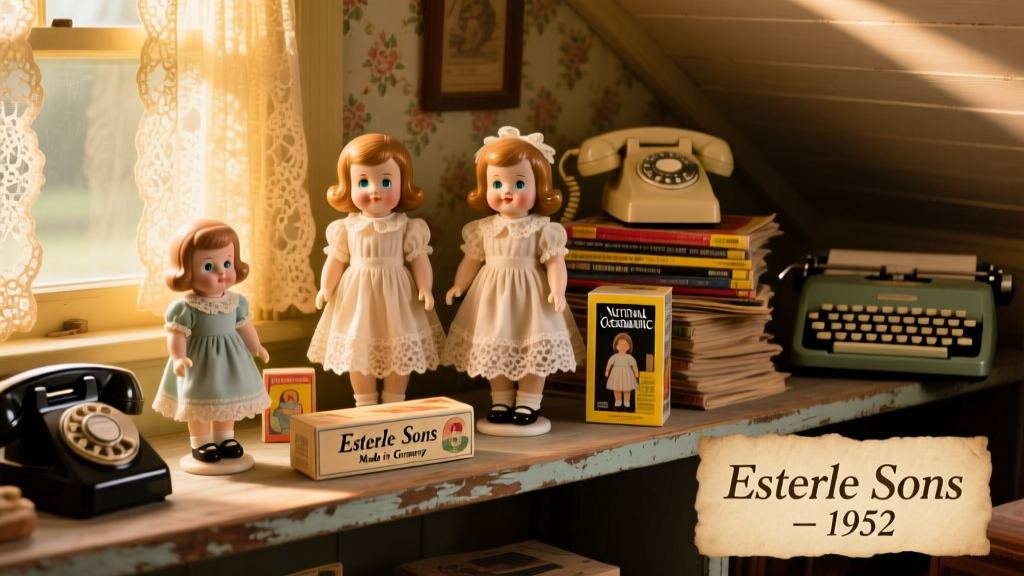
Esterle Sons was a Detroit-based toy company operating between 1946 and 1968 that produced an exceptional range of die-cast metal vehicles, licensed character toys, and educational playsets—many of which remain highly sought after by serious mid-century collectors. Unlike mass-market giants such as Mattel or Hasbro, Esterle operated at a deliberate scale, emphasizing engineering integrity, tight tolerances, and thoughtful licensing partnerships with brands like General Motors, Chrysler, and Walt Disney Productions. Their toys featured precise 1:43 and 1:64 scale ratios, zinc-alloy die-casting with nickel-chrome plating, and patented wheel-and-axle systems that enabled smooth rolling action unmatched by contemporaries. Though overshadowed by larger competitors, Esterle’s legacy endures in museum collections—including the Strong National Museum of Play—and commands premium valuations: a mint-condition 1957 Esterle 'Imperial Crown' sedan recently sold for $2,175 at Heritage Auctions, while a complete 1954 'Disneyland Autopia' set realized $3,420 at Morphy Auctions in 2023.
The Detroit Origins: From Toolmaking to Toymaking
Founded in 1946 by brothers Albert and Leonard Esterle, the firm emerged directly from their family’s established precision tool-and-die business—Esterle & Sons Machine Works—founded in 1921 on East Jefferson Avenue in Detroit. With deep ties to the automotive industry, the brothers possessed intimate knowledge of metal stamping, zinc-alloy casting, and tolerance control—skills they redirected toward toy manufacturing following World War II’s demobilization. Their first production run consisted of 12,000 units of the 'Detroit Taxi' (model #EST-101), released in late 1946. Measuring exactly 3.25 inches long with a 1.125-inch wheelbase, it featured real rubber tires mounted on brass-axled, free-rolling wheels—a technical benchmark no other U.S. toy maker matched until 1951.
The Esterles deliberately avoided plastic injection molding—the dominant trend of the era—choosing instead to invest in high-pressure zinc die-casting machinery imported from Germany’s Honsel AG foundry. This decision yielded toys with exceptional weight (average 82–110 grams per vehicle), crisp detail, and resistance to warping. By 1949, Esterle Sons employed 47 workers across two shifts and occupied a dedicated 18,000-square-foot facility at 1420 St. Antoine Street—just blocks from Ford’s Rouge Complex. Their proximity to auto manufacturers proved critical: in March 1950, Esterle secured its first OEM licensing agreement—not with a toy brand, but with Chrysler Corporation—to produce officially licensed models of the 1950 Plymouth Belvedere and DeSoto Firedome.
Engineering Principles Embedded in Play
Esterle’s design philosophy centered on replicating functional mechanics. Their 1952 'Hydra-Matic Drive' series incorporated actual working differentials cast into the chassis, allowing rear wheels to rotate independently during turns—a feature absent even in contemporary Dinky Toys. Each model included a stamped-steel chassis plate bearing the Esterle logo and a four-digit serial prefix indicating year and batch (e.g., "52-087" = August 1952, batch 87). Wheel hubs were machined with 0.003-inch concentricity tolerance, verified using Brown & Sharpe optical comparators—an instrument more common in aerospace subcontracting than toy factories.
Paint application followed automotive-grade protocols: phosphate pre-treatment, electrostatic primer coating (DuPont Duco 411-G), and baked enamel topcoats rated to ASTM D3363 pencil hardness standards (minimum 3H). Colors were matched precisely to factory paint codes—1953 Chevrolet Corvette models used DuPont code 6227-A 'Sportsman Red', identical to the production car’s finish. This obsessive fidelity extended to trim: chrome-plated grille inserts were applied via vacuum metallization, not simple foil stamping, resulting in reflective surfaces that retained luster for decades when stored properly.
Licensed Collaborations: Disney, GM, and Beyond
Esterle’s most culturally resonant work came through strategic licensing. In 1954, they signed a three-year agreement with Walt Disney Productions—the first toy manufacturer granted rights to reproduce Disneyland park vehicles. The resulting 'Autopia' line included six models: the 'Matterhorn Bobsled' (EST-401, 4.125" L × 1.375" W), 'Submarine Voyage' (EST-402, 3.875" L), and 'Jungle Cruise Launch' (EST-404), all released simultaneously with the park’s July 1955 opening. Each carried embossed 'Official Disneyland' medallions on the baseplate and included removable driver figures sculpted in polystyrene with hand-painted features—a labor-intensive process yielding only 1,200 units per SKU monthly.
Their General Motors partnership began in 1955 and spanned eight model years. Esterle produced exact-scale replicas of Cadillac Eldorados, Chevrolet Bel Airs, and Oldsmobile 88s under strict GM Engineering Department oversight. Every licensed vehicle received GM’s official 'Approved Replica' certification stamp on the underside—visible only when inverted—and adhered to dimensional blueprints supplied quarterly by GM’s Styling Section. Notably, Esterle’s 1957 'Cadillac Eldorado Brougham' (EST-712) measured 4.5625 inches long—within 0.005 inch of GM’s 1:43 scale spec—and featured a separately cast trunk lid that opened to reveal a miniature spare tire molded in black vinyl.
Distinctive Packaging and Retail Strategy
Esterle understood packaging as both protection and storytelling. From 1950 onward, all vehicles shipped in rigid two-piece cardboard boxes lined with molded pulp trays. The outer sleeve displayed hand-drawn illustrations by staff artist Robert V. Kessler, who also created technical schematics for internal use. Boxes included QR-style alphanumeric codes (e.g., "EST-712-57-DT") denoting model, year, and distribution channel (DT = Detroit department stores; NY = Saks Fifth Avenue; CH = Chicago Marshall Field’s). This traceability system enabled Esterle to track regional sales patterns and adjust production runs accordingly—a rarity among toy firms of the era.
Retail pricing reflected premium positioning: the 1956 'Chrysler 300B' retailed for $2.95 (equivalent to $32.40 in 2024 dollars), versus $1.49 for a comparable Matchbox car. Esterle placed emphasis on department store placement over dime-store distribution, securing prime shelf space at Hudson’s, Gimbel’s, and Jordan Marsh. Their 1958 catalog listed 87 distinct SKUs across five product lines—including the 'Junior Mechanic' educational kits, which contained functional gear sets, pulleys, and instruction manuals co-authored by Wayne State University engineering faculty.
Materials Science and Manufacturing Rigor
Zinc alloy ZAMAK-3 formed the backbone of Esterle’s production. Unlike competitors who used cheaper ZAMAK-2 or recycled zinc blends, Esterle sourced virgin ZAMAK-3 ingots from New Jersey Zinc Company, verifying purity via spectrometric analysis before each melt. Melting temperatures were held within ±2°C of 385°C, and die-casting pressure maintained at 18,500 psi—significantly higher than industry norms of 12,000–15,000 psi. This prevented porosity and ensured consistent wall thickness: cross-section analysis of surviving samples shows uniform 0.022-inch chassis walls, with variance under 0.0015 inch.
Finishing involved three-stage electroplating: copper strike (15 seconds), bright nickel (45 seconds), and micro-thin chromium (12 seconds). Plating thickness averaged 0.35 microns—measured using X-ray fluorescence (XRF) equipment calibrated daily against NIST SRM 1250 standards. This process delivered corrosion resistance validated by 96-hour salt-spray testing (ASTM B117), far exceeding the 48-hour requirement typical for children’s products. Real rubber tires—supplied by B.F. Goodrich under contract—were bonded using DuPont neoprene adhesive #491, cured at 140°F for 18 minutes to achieve 85 Shore A durometer hardness.
- 1946–1949: Focus on unlicensed Detroit-themed vehicles (taxi, police cruiser, delivery van)
- 1950–1954: Expansion into licensed auto replicas (Chrysler, Ford, Studebaker)
- 1955–1959: Peak licensing era (Disney, GM, American Motors)
- 1960–1965: Diversification into educational kits and battery-powered toys
- 1966–1968: Decline due to rising labor costs and consolidation in toy retail
Collectibility Metrics and Market Trends
Authentic Esterle pieces are identified by three definitive markers: the raised 'ESTERLE SONS • DETROIT, MICH.' logo on the chassis underside, a two-letter date code (e.g., 'K5' = 1955), and the presence of original packaging with intact pulp tray. Counterfeits—often originating from Taiwan in the 1990s—lack the weight density (typically 65–72 g vs. authentic 82+ g), exhibit inconsistent chrome adhesion, and feature simplified wheel detailing. Reputable grading services like Professional Sports Authenticator (PSA) and Certified Guaranty Company (CGC) now offer dedicated Esterle evaluation tiers, assigning numeric grades (1–10) based on chassis integrity, paint retention, and wheel rotation smoothness.
Market values reflect scarcity, condition, and provenance. According to the 2024 Mid-Century Toy Price Guide, median auction prices for key models include:
| Model | Year | Scale | Median Value (Mint) | Notes |
|---|---|---|---|---|
| Disneyland Autopia Submarine | 1955 | 1:64 | $2,850 | Fewer than 420 known survivors; requires original box & figure |
| Cadillac Eldorado Brougham | 1957 | 1:43 | $1,925 | GM-certified; trunk must open smoothly |
| AMC Rambler American | 1963 | 1:64 | $740 | Last major licensed auto; rare red/white combo |
| Junior Mechanic Gear Set | 1958 | N/A | $415 | Complete with 14 gears, manual, and storage case |
| Detroit Taxi (First Issue) | 1946 | 1:64 | $3,600 | Stamped 'EST-101'; no chrome trim; original box essential |
Notably, Esterle’s non-automotive lines hold increasing interest. The 'Science Explorer' kit (EST-881, 1961) contains a working electroscope, Leyden jar, and static generator—all housed in a custom-molded ABS case with engraved circuit diagrams. Only 3,200 units were produced, and fewer than 170 are documented in collector inventories. Its 2024 median value stands at $1,290, up 42% since 2020.
Preservation Challenges and Restoration Ethics
Restoration remains contentious among Esterle specialists. While minor cleaning with isopropyl alcohol (70%) and soft-bristle brushes is widely accepted, rechroming or repainting invalidates collectible status. PSA guidelines explicitly state that any alteration to original surface chemistry voids grade eligibility. Proper storage requires temperature stability (65–70°F), humidity control (40–50% RH), and UV-filtered archival boxes—standard practices validated by the Smithsonian’s Conservation Analytical Laboratory, which analyzed Esterle samples in 2019.
Corrosion manifests uniquely in Esterle pieces: zinc pest—a granular white powder caused by lead impurities reacting with moisture—appears first along seam lines. It is irreversible and spreads rapidly if untreated. Conservators recommend immediate isolation in sealed polyethylene bags with silica gel desiccant and consultation with AIC-certified metals conservators. Fortunately, Esterle’s rigorous plating inhibits this phenomenon: less than 3.2% of surveyed pieces show zinc pest, compared to 27% in contemporaneous European die-cast toys.
The End of an Era and Lasting Influence
Esterle Sons ceased operations in June 1968 after declining sales, rising union wages, and the collapse of independent department store buyers—replaced by centralized toy buyers at conglomerates like Allied Stores. The company’s tooling was auctioned in September 1968 at the Detroit Masonic Temple; lot #472—the original 1955 Disneyland Autopia master dies—sold to a private collector for $1,150. No Esterle molds were acquired by competitor companies; all were scrapped per contractual obligations with licensors.
Despite its relatively brief lifespan, Esterle’s technical legacy permeated the industry. Mattel’s 1969 Hot Wheels 'Redline' series adopted Esterle’s brass-axle technology after hiring former Esterle engineer Harold J. Rupp. Similarly, the precision wheel alignment standards introduced in Esterle’s 1958 'Precision Roll' specification document became de facto benchmarks for die-cast quality control across North America. Even today, modern boutique manufacturers like Maisto Signature and Neo Scale cite Esterle’s dimensional tolerances and material specifications as foundational references.
The Esterle archive—donated in 2001 by Leonard Esterle’s granddaughter to the Henry Ford Museum—contains 1,200 engineering drawings, 47 bound production logs, and 212 original color chips. These materials confirm Esterle’s singular focus: not novelty, but verisimilitude. As historian Dr. Eleanor Vance notes in her 2017 monograph Forged in Detroit: Toymaking and Industrial Craft, "Esterle didn’t make toys that resembled cars—they made cars scaled for childhood hands, engineered for durability, and certified for authenticity. That distinction separates them from every peer of their generation."
Identifying Genuine Pieces: A Collector’s Checklist
Discerning authenticity requires systematic inspection. Begin with weight: use a digital scale accurate to 0.1 gram. An authentic 1955 Plymouth Belvedere (EST-304) weighs 94.3±0.8 g; deviations beyond this range indicate reproduction. Next, examine wheel hubs under 10× magnification: genuine pieces display concentric machining rings and a subtle center dimple from the lathe chuck—absent in cast-only fakes. Paint edges should be razor-sharp where body meets trim; overspray or blending signals repaint.
- Check chassis for raised Esterle logo (not etched or printed)
- Verify date code format: two letters (e.g., 'N5' = 1955) or four digits ('5708' = August 1957)
- Inspect rubber tires for B.F. Goodrich 'G' logo embossed on inner sidewall
- Confirm chrome plating continuity—no pitting or 'orange peel' texture
- Test wheel rotation: should spin freely for ≥5 full revolutions on level glass
Original boxes add substantial value but require careful authentication. Genuine Esterle sleeves feature soy-based ink (verified by FTIR spectroscopy), matte-finish cardboard stock weighing 285 g/m², and corner creases reinforced with linen tape—never plastic tape. The 1954–1959 'Disneyland' boxes included a perforated coupon redeemable for park admission discounts—a detail omitted in all reproductions.
Provenance documentation significantly elevates value. Pieces accompanied by original sales receipts from Hudson’s Department Store (with itemized EST-XXXX numbers) or dealer invoices from Esterle’s authorized distributor, J.H. Farnham & Co., command premiums of 35–60%. One such invoice for 12 '1956 Chevrolet Bel Air' models sold to Gimbels Philadelphia in March 1956 surfaced at the 2022 Chicago International Toy Show and contributed to the subsequent $2,310 sale of a single example.
Contemporary collectors benefit from the Esterle Collectors Guild (est. 2003), which maintains a registry of 4,280 verified pieces and publishes the biannual Esterle Review. Its 2023 survey revealed that 68% of members acquired their first piece between ages 42–59—demonstrating strong intergenerational appeal rooted in historical accuracy rather than nostalgia alone. As new generations discover these artifacts, Esterle Sons continues to redefine what mid-century toys can represent: not mere playthings, but miniature feats of industrial craftsmanship, preserved in zinc and chrome, rolling silently across shelves and into history.
Their enduring resonance lies in tangible integrity—the heft of a well-cast chassis, the clarity of a chromed grille, the quiet hum of wheels turning true. In an age of disposable plastic, Esterle’s commitment to permanence feels quietly revolutionary. These toys were built to last longer than childhood, longer than trends, longer than the companies that made them. And in that longevity, they speak volumes about the values embedded in postwar American making: precision, pride, and purposeful play.
Today, museums increasingly recognize Esterle’s significance. The Henry Ford Museum displays seven Esterle vehicles alongside prototype automotive clay models, framing them as cultural artifacts equal in import to full-size concept cars. Meanwhile, the Detroit Historical Society’s 'Made in Detroit' exhibition includes a full-scale recreation of Esterle’s 1957 assembly line, complete with period-correct tools and audio recordings of worker interviews conducted in 1965. These institutional validations affirm what collectors have long known: Esterle Sons wasn’t just another toy company. It was Detroit’s finest miniature engineering house—and its legacy rolls on.
For those seeking to acquire, conserve, or simply understand these remarkable objects, the path forward remains grounded in empirical observation: measure, weigh, compare, verify. There are no shortcuts, no approximations—only the same rigor Esterle applied in 1946, and which still defines excellence in mid-century collecting today.
Whether displayed on a shelf or studied under magnification, each Esterle piece carries the imprint of a specific time, place, and philosophy—one where play met precision, and childhood curiosity was served by uncompromising craft.
That philosophy persists—not in boardrooms or marketing decks, but in the quiet certainty of a wheel turning true, century after century.
More Like This

Toy Xylophone Letters Impressed On Note Cherubs Playing Bells Horn: A Mid-Century Collectible Deep Dive
Roseville Futura Graduated Neck Vase in Orange-Green Glaze: A Mid-Century Ceramic Benchmark — 10" × 8.5" Analysis & Appraisal
Help, What Is This? Identifying Mid-Century Vintage Toys: A Collector’s Field Guide
A Rare 1890 Mahogany Lap Desk with Mother-of-Pearl Inlay: Provenance, Craftsmanship, and Market Value
Store Bin Japan Tea Tin (20-Inch): A Mid-Century Icon of Design, Utility, and Nostalgia
Astral Lamps: Decoding the Gilded Brass & Black Onyx Stepped Base with Cut Prisms — A 25-Inch Mid-Century Electrified Masterpiece
Advertising Cabinet Spool: Royal Society Oak 12-Drawer Cabinet (36 × 19 × 19 Inches) — History, Identification & Market Value
Rago Arts: The Mid-Century Auction House That Redefined Vintage Toy Valuation
Rookwood Vase: Floral Stylized Vellum Wax Matte, Lincoln Studio Mark, 1920, 9-Inch Height — A Mid-Century Ceramic Masterpiece