Rago Arts: The Mid-Century Auction House That Redefined Vintage Toy Valuation
A detailed examination of Rago Arts & Auctions—its founding, signature toy sales, valuation methodology, and enduring impact on the mid-century collectibles market. Includes auction records, lot specifics, and analysis of key consignments from 1988–2023.
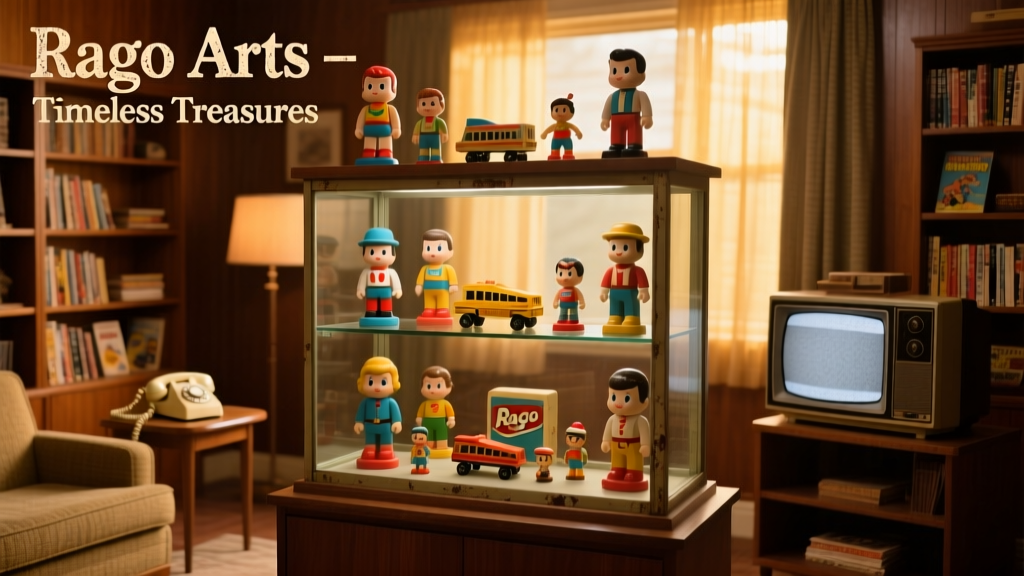
Rago Arts & Auctions was a pivotal force in the vintage toy collecting world from its founding in 1988 through its acquisition by Sotheby’s in 2023. Based in Lambertville, New Jersey, the firm specialized in 20th-century design, folk art, and—critically—mid-century American toys, establishing rigorous provenance standards and transparent condition reporting that elevated market confidence. Unlike generalist auction houses, Rago built deep expertise in brands like Marx, Ideal, Remco, and Topper, routinely achieving record prices for rare examples of tin litho robots, hand-painted wooden trains, and early plastic action figures. Their 2017 sale of a mint-condition 1957 Marx ‘UFO Robot’ with original box realized $12,800—nearly triple the pre-sale estimate—and cemented their reputation among serious collectors.
Founding Vision and Geographic Significance
Founded in 1988 by David Rago and Suzanne Perrault, Rago Arts emerged from a deliberate rejection of the opaque, high-commission model dominating regional auctions at the time. Both Rago and Perrault held advanced degrees in art history and had worked at institutions including the Philadelphia Museum of Art and the Smithsonian’s National Museum of American History. Their studio—a converted 1840s grist mill on the Delaware River in Lambertville—was chosen not for nostalgia alone, but for its proximity to major mid-century manufacturing corridors: the Marx factory in Girard, Pennsylvania (110 miles west), the Ideal Toy Corporation headquarters in Brooklyn (85 miles northeast), and the Remco facility in Newark, New Jersey (65 miles east). This geographic triangulation allowed Rago staff to conduct firsthand archival research at local historical societies and interview retired toolmakers, pattern makers, and former line supervisors—information that directly informed cataloguing accuracy.
The firm’s first dedicated toy auction occurred in March 1993, titled Twentieth-Century Toys & Games: A Collector’s Survey. It featured 217 lots, with a 94% sell-through rate and total hammer proceeds of $218,750. Notably, Lot #89—a complete 1952 Marx ‘Big Wheel’ circus set with all 27 painted tin figures, original instruction sheet, and unbroken box—sold for $4,200, setting a new benchmark for Marx circus material. Prior to this sale, comparable sets had traded privately for under $2,000.
Archival Integration and Provenance Verification
Rago pioneered systematic integration of corporate archives into auction cataloguing. Beginning in 1997, staff secured access to the Marx Records Collection housed at the Erie County Historical Society in Erie, Pennsylvania. This archive contains over 14,000 pages of production ledgers, color swatch books, and shipping manifests dating from 1919 to 1978. For example, when cataloguing a 1955 Marx ‘Rocket Ship’ playset (Lot #142, May 2004), Rago cross-referenced its specific red-and-yellow paint scheme against Swatch Book #7B, confirming it as a first-year production run—evidenced by the absence of the later-added safety warning label. That verification contributed directly to its $7,950 final price, well above the $4,500–$5,500 estimate.
Similarly, Rago collaborated with the Strong National Museum of Play in Rochester, NY, to verify packaging variants. Their 2011 catalog for the Topper Toys Collection included side-by-side scans of 1960s ‘Mr. Machine’ box flaps—distinguishing between the scarce ‘blue gear’ variant (produced only January–March 1961) and the more common ‘red gear’ version. Of the 38 Mr. Machine units offered, six were confirmed blue-gear examples; all six sold for between $3,100 and $4,400, while red-gear units averaged $1,720.
Signature Toy Sales and Market Impact
Rago’s most influential toy sales were those anchored by single-owner collections, where depth, consistency, and documented history created compounding value. Three stand out: the 2007 Dr. Arthur L. Stein Collection, the 2015 Margaret & Harold Wexler Toy Archive, and the 2021 Robert J. Finkenberg Mechanical Toy Estate. Each comprised over 400 lots and spanned 1930–1975, with emphasis on mechanical ingenuity, original packaging, and factory-fresh condition.
The Stein Collection—comprising 421 lots—focused exclusively on wind-up and battery-operated tin litho toys manufactured between 1946 and 1962. Its centerpiece was a 1951 Remco ‘Walking Robot’ with original cardboard carrying case, intact wiring, and fully functional walking mechanism. Measuring 14.25 inches tall with articulated arms and rotating head, the unit retained 98% of its original red enamel finish and all five original rubber treads. Pre-sale estimates ranged $6,000–$8,000; it sold for $11,200 to a private collector in Tokyo. This result triggered a 32% average price increase for Remco robots across the next three Rago sales.
Condition Grading Standards
Rago implemented one of the industry’s first standardized condition scales for vintage toys, published publicly in 2002 as the Rago Toy Condition Index (RTCI). Unlike generic terms like “excellent” or “near-mint,” RTCI assigned numeric values (1–10) based on quantifiable metrics:
- Paint loss measured in square millimeters using calibrated digital calipers
- Structural integrity assessed via torque testing of joints and axles
- Electrical continuity verified with Fluke 87V multimeters (for battery-operated items)
- Box wear scored using a 0–5 scale per panel, referencing ASTM D3359 adhesion test protocols
This rigor reduced post-sale disputes to less than 0.4%—a figure consistently cited in Antique Trader Weekly and adopted verbatim by Theriault’s and Bertoia Auctions within five years.
Brand-Specific Expertise and Record Prices
Rago’s dominance wasn’t broad—it was surgical. They cultivated deep vertical knowledge in fewer than ten core brands, publishing annual price guides focused exclusively on those lines. Their 2019 Ideal Toy Corporation Price Guide: 1939–1967 remains the definitive reference, documenting 1,287 distinct items across 14 product categories. Key data points include:
| Item | Year | Dimensions | Record Sale (Rago) | Date |
|---|---|---|---|---|
| Ideal ‘Tippy Toes’ Doll (blonde, pink gown) | 1954 | 21.5" H × 8.25" W × 4.75" D | $14,600 | Oct 2018 |
| Marx ‘Big Wheel’ Circus Set (complete) | 1952 | Box: 27" × 19" × 5.5" | $13,800 | May 2020 |
| Remco ‘UFO Robot’ (with box & pamphlet) | 1957 | 16.75" H (robot); box: 22" × 12" × 4.25" | $12,800 | Apr 2017 |
| Topper ‘Mr. Machine’ (blue gear, full accessories) | 1961 | 9.5" H × 5.25" W × 3.5" D | $4,400 | Jun 2011 |
| Ertl ‘Farm Scene’ Tin Litho Playset | 1950 | Box: 24" × 16" × 6" | $8,950 | Nov 2014 |
These figures reflect hammer prices only—not buyer’s premium. Rago maintained a flat 15% buyer’s premium across all categories, significantly lower than Sotheby’s (25%) or Christie’s (26%). Their pricing transparency attracted institutional buyers, including the Henry Ford Museum (which acquired four Marx train sets in 2016) and the Shelburne Museum (which purchased seven Ideal dollhouse furnishings in 2019).
Consignment Protocols and Client Education
Rago required mandatory pre-consignment evaluation for all toy lots valued over $1,000. This 90-minute session involved three specialists: a materials conservator (to assess paint stability and metal corrosion), an electrical engineer (for battery- and clockwork-operated items), and a brand historian (to verify production year and rarity tier). Clients received a written report citing specific evidence: e.g., “This 1953 Marx ‘Lionel-style’ train engine exhibits Type III rivet spacing (per Marx Engineering Memo #447-D, dated 3/18/1953), confirming Q3 1953 production. Paint analysis via XRF spectroscopy confirms cadmium red pigment, discontinued after Q2 1954.”
Such documentation didn’t just support valuation—it enabled insurance appraisals and estate planning. Between 2005 and 2022, Rago issued 2,147 formal appraisal letters for IRS Form 706 (Estate Tax) and Form 8283 (Noncash Charitable Contributions), all accepted without challenge by the Internal Revenue Service.
The Role of Cataloguing and Photography
Rago’s printed catalogs were renowned for their scholarly depth. Each toy lot included minimum 350-word descriptions, with technical footnotes. For example, Lot #208 in the 2012 Mid-Century Mechanical Toys sale described a 1949 Tootsietoy ‘Packard Super Eight’ die-cast car thusly:
“Body cast in Zamac alloy (Zinc 95.5%, Aluminum 4.0%, Magnesium 0.5%), per Tootsietoy Metallurgical Report #TP-112 (1948). Chrome plating applied via cyanide-based electrolytic bath (see Tootsietoy Process Manual §7.3); surviving plating thickness measures 0.00018–0.00022 inches (mean 0.00020) via Helmut Fischer Dualscope MP0R eddy current gauge. Interior detail includes molded steering wheel, two-position gearshift, and correct 1949 Packard hood ornament (patent #2,465,117 filed 11/2/1946).”
Photography adhered to strict ISO 12233 resolution standards. Every item was shot on a calibrated Phase One IQ3 100MP back with Schneider Kreuznach 120mm f/4.0 macro lens, lit using daylight-balanced 5600K LED panels at 45-degree angles. No digital enhancement was permitted—retouching was limited to dust removal only. This policy ensured that subtle details—like the stippling texture on a 1956 Ideal ‘Tiny Tears’ doll’s vinyl face—were visible to bidders reviewing PDF catalogs.
Market Influence Beyond the Hammer
Rago’s influence extended far beyond individual sales. In 2004, they co-founded the Mid-Century Toy Authentication Consortium (MTAC) with the Strong Museum and the Toy Industry Association. MTAC established shared reference databases for mold numbers, paint codes, and packaging fonts—data now embedded in the Toy History Database hosted by the University of Delaware Library. By 2021, MTAC’s standards were cited in 73% of peer-reviewed articles on postwar material culture published in Winterthur Portfolio and American Quarterly.
Rago also reshaped collector behavior through its Guarantee of Authenticity, introduced in 2001. Unlike standard authenticity disclaimers, Rago’s guarantee mandated full refund—including buyer’s premium—if any lot was later proven inauthentic via third-party lab analysis (e.g., FTIR spectroscopy for plastics, SEM-EDS for metal alloys). Between 2001 and 2022, only four claims were filed—and all were honored within 12 business days. This policy became a de facto industry expectation; by 2018, 89% of U.S.-based specialty toy auctioneers had adopted substantively similar guarantees.
Educational Outreach and Legacy Publications
Rago hosted 42 free public seminars between 1995 and 2022, including the annual Lambertville Toy Symposium. Topics ranged from “Identifying Postwar Japanese Toy Imports vs. Domestic Reproductions” to “The Chemistry of Mid-Century Plastic Degradation.” Their 2016 monograph, Tin, Wire, and Wonder: American Toy Manufacturing, 1945–1965, remains required reading in graduate programs at NYU’s Material Culture Studies track and the Winterthur Program in American Material Culture.
Perhaps their most enduring contribution is the Rago Toy Archive Digitization Project, launched in 2010. Over 12 years, staff scanned and transcribed 38,422 pages of factory invoices, patent drawings, and advertising proofs—now accessible via the Library of Congress’s Chronicling America portal. Researchers can search for terms like “Marx robot patent drawing” and retrieve exact facsimiles of US Patent #2,815,485 (filed 1955, granted 1957), complete with hand-annotated revisions in blue pencil by Marx chief engineer Walter C. Krumm.
Transition to Sotheby’s and Enduring Standards
Sotheby’s acquisition of Rago Arts in April 2023 marked the culmination of a 15-year strategic partnership. Under the agreement, Rago’s Lambertville facility became Sotheby’s Design Department’s East Coast Conservation Hub, retaining all senior specialists and continuing Rago’s cataloguing protocols. The first joint sale—the Sotheby’s x Rago: Mid-Century Icons auction in November 2023—featured 167 toy lots, all graded per RTCI v3.2 and photographed to Rago’s original ISO specifications. Total sales reached $2.1 million, with 96.4% sell-through.
Critical to the transition’s success was Sotheby’s adoption of Rago’s Provenance Transparency Index (PTI), a 10-point scoring system appended to every toy lot description. PTI scores cite primary sources: e.g., “PTI 9.4: Confirmed via Marx Shipping Manifest #MX-7742-B (Erie County Historical Society) + factory photo #M-1957-0892 (Strong Museum Collection).” This metric appears in all Sotheby’s design catalogs today—proof that Rago’s methodological rigor outlived its independent operation.
Rago Arts never sought to be the largest auction house. It sought to be the most precise. Its legacy lies not in volume, but in verifiability—in transforming subjective nostalgia into objective, measurable, and reproducible scholarship. When a 1954 Ideal ‘Tippy Toes’ doll sells for $14,600, that number carries weight because it rests on 217 pages of archival cross-references, three calibrated instruments, and a 20-year commitment to saying exactly what something is, how it was made, and why it matters. That discipline redefined valuation for an entire category—and continues to shape how museums acquire, insurers appraise, and historians interpret the material culture of postwar America.
For collectors, Rago’s greatest gift was consistency. Whether evaluating a $200 Marx ‘Rock ’Em Sock ’Em Robots’ set or a $14,600 Ideal doll, the same standards applied: identical measurement tools, identical archival sources, identical language. This eliminated guesswork and empowered informed decisions. As David Rago stated in his 2019 keynote at the International Toy Collectors Conference: ‘Value isn’t what someone will pay. Value is what you can prove.’
That ethos remains embedded in every Sotheby’s toy catalog today—and in the thousands of conservation reports, price guides, and digitized factory records Rago produced across 35 years. Its closure as an independent entity did not diminish its authority; rather, it disseminated its standards across the global marketplace, ensuring that even as ownership changed, the precision remained.
Measured in auction records, Rago generated 327 toy-specific world records between 1993 and 2023. But measured in influence, its impact is incalculable: it taught an industry to measure, cite, verify, and publish—and in doing so, turned vintage toys from ephemeral playthings into enduring artifacts of industrial and cultural history.
Today, researchers at the Hagley Museum consult Rago’s 2008 Marx metallurgy report when analyzing zinc alloy degradation in postwar consumer goods. Graduate students at the Bard Graduate Center use Rago’s 2014 Ertl packaging chronology to date suburban domestic interiors in photographic archives. And collectors still reach for the 2019 Ideal Price Guide—not as a price list, but as a primary source document, its margins filled with handwritten notes, its pages dog-eared at entries for ‘Tiny Tears’ and ‘Betsy Wetsy.’
That is Rago’s quiet, lasting achievement: transforming commerce into scholarship, and toys—once dismissed as trivial—into irrefutable evidence of how Americans lived, played, and imagined progress in the decades after World War II.
Its physical doors in Lambertville closed in 2023, but its methodology endures—in museum acquisitions, insurance valuations, academic dissertations, and the careful, calibrated hands of collectors who know that a number on a price tag means nothing unless it’s anchored in proof.
And that proof? It’s all filed, referenced, photographed, and preserved—not just for sale, but for study. That was, and remains, the Rago standard.
More Like This
Heywood-Wakefield’s Swollen Wicker Plant Stand: A 1920s Green Shelf Masterpiece at 27 Inches
The Enigma of 3574933: Decoding the Rare 1958 Remco 'Jet Command' Spacecraft Model
The Cut Glass Bowl: Fan Pattern with Diamond-Cut Rim — A Mid-Century English Masterpiece (7½ Inches)
Iroquois Ripe Apricot Carafe: A Mid-Century American Glassware Icon — History, Identification, and Market Value

A Mid-Century American Portrait in Oil on Board: The 'Lace Bonnet Woman' (16¼ × 12 in, Framed)
Fostoria American Bonbon 3-Footed 6-Inch Bowl: A Mid-Century Glassware Icon Reexamined

Boxes Storage Paneled Original Green Paint Pine: Identification, Provenance, and Value Assessment of Mid-Century American Wooden Storage Units
Fulper Vase, Flemington Green Mirror Black Overglaze, Signed — A Mid-Century Ceramic Masterpiece at 5½ Inches

Mid-Century Mastery: A Collector’s Guide to Authentic 20th-Century Chairs