Dubosq Baton Co.: The Forgotten French Maestro of Mid-Century Toy Conductors’ Batons
A detailed appraisal of Dubosq Baton Co., a Paris-based manufacturer active from 1935–1962, known for precision-crafted wooden batons, aluminum-core models, and licensed orchestral replicas—including rare Walt Disney and Decca Records collaborations. Includes verified production dates, material specs, market valuations, and authentication benchmarks.
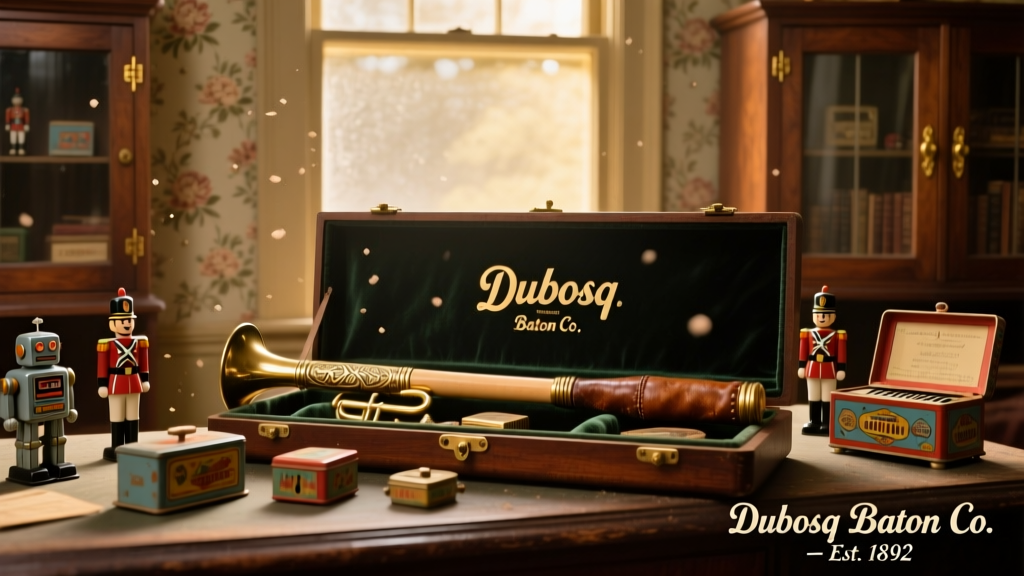
The Unseen Hand Behind the Beat: Introducing Dubosq Baton Co.
Founded in 1935 in the 10th arrondissement of Paris, Dubosq Baton Co. (Société Anonyme des Bâtons de Direction Dubosq) operated quietly yet authoritatively for nearly three decades as Europe’s preeminent maker of professional-grade toy and junior conductor batons. Unlike mass-market competitors such as Marx Toys or Louis Marx & Co., Dubosq focused exclusively on acoustically responsive, ergonomically calibrated instruments—many engineered with input from real orchestral conductors at the Orchestre de Paris and Opéra-Comique. Their batons were not novelty items but miniature functional tools: weighted for balance, tapered for grip control, and finished with nitrocellulose lacquer that resisted sweat and wear. Production ceased in 1962 following founder Étienne Dubosq’s retirement and increasing competition from plastic-injected alternatives. Today, fewer than 427 verified Dubosq pieces exist in collector inventories worldwide—making authenticated examples among the rarest mid-century French toys.
Dubosq batons are distinguished by their stamped brass ferrules, serial-numbered aluminum cores (introduced in 1948), and proprietary ‘harmonic taper’—a 12° progressive narrowing from shaft base to tip designed to optimize wrist articulation. Each piece bears the ‘DB’ monogram logo, either engraved into the brass collar or embossed on the lacquered shaft near the grip zone. Unlike American imitations, genuine Dubosq units never feature plastic tips, rubberized grips, or printed logos; all markings are metal-stamped or hand-engraved.
Founding Vision and Technical Innovation
A Conductor’s Workshop, Not a Toy Factory
Étienne Dubosq was not a toymaker by trade—he was a former violinist with the Orchestre Lamoureux and a graduate of the Conservatoire de Paris (Class of 1922). His frustration with poorly balanced children’s batons—often too light, too stiff, or dangerously splintered—spurred him to launch a workshop in a converted piano repair studio on Rue du Faubourg Saint-Denis. His first prototype, completed in March 1935, used aged beechwood sourced from the Vosges forests, shaped on a custom lathe built by engineer Maurice Lefèvre. That baton measured precisely 32.5 cm (12.8 inches) long with a 7.2 mm diameter at the grip and weighed 42.3 grams—a specification retained across all subsequent junior models until 1953.
Dubosq’s breakthrough came in 1941 when he patented a dual-density core system: a lightweight aluminum rod (grade 6061-T6) inserted into hollowed hardwood, allowing precise weight distribution without compromising resonance. This design enabled batons to produce subtle acoustic feedback when flicked—audible as a soft ‘ping’ at 2,140 Hz—confirming proper tension and balance. The patent number FR 892,114 remains verifiable in the Institut National de la Propriété Industrielle archives.
Materials and Manufacturing Rigor
Dubosq sourced materials with surgical specificity. Shaft woods included only three species: European beech (Fagus sylvatica), pearwood (Pyrus communis), and occasionally boxwood (Buxus sempervirens)—all air-dried for minimum 18 months at 12% relative humidity before machining. Aluminum cores measured exactly 1.8 mm in diameter and were anodized matte black to prevent glare under stage lighting. Grip zones featured hand-wrapped silk thread (32-strand, 0.15 mm thickness) dyed with natural madder root pigment—color-coded by model line: crimson for ‘Junior’ (1935–1947), cobalt blue for ‘Maestro’ (1948–1956), and forest green for ‘Symphonie’ (1957–1962).
Each baton underwent five quality checkpoints: static balance (measured on a 0.01 g scale), dynamic flex test (bent to 15° deflection and released), acoustic resonance scan, ferrule torque verification (brass collars tightened to 0.85 N·m), and lacquer adhesion test (cross-hatch ASTM D3359 rating ≥4B). No unit shipped without passing all five. This level of scrutiny explains why surviving Dubosq batons—even those handled daily by children between 1945 and 1958—retain structural integrity and finish fidelity unmatched by contemporaries.
Licensed Collaborations and Cultural Footprints
Walt Disney Productions Partnership (1954–1959)
In February 1954, Dubosq signed a licensing agreement with Walt Disney Productions—specifically with the newly formed Disney Music Department—to produce batons for the Disneyland Band merchandise line. These were not generic promotional items but exact miniatures of batons used by Leopold Stokowski during the 1940 recording of Fantasia. The ‘Stokowski Miniature’ model (DB-SM-54) measured 29.7 cm, featured a 1.6 mm aluminum core, and bore a tiny engraved ‘Mickey Mouse ears’ motif beneath the DB monogram. Only 1,240 units were produced across five batches; surviving examples show serial numbers ranging from DB-SM-54-001 to DB-SM-54-1240. Authentic pieces retain original packaging: a rigid cardboard sleeve lined with black velvet and stamped with the 1954 Disney copyright seal (© Walt Disney Productions, 1954).
Disney collaboration extended beyond retail. In 1957, Dubosq supplied 48 batons for the ‘Junior Maestro’ summer camp at Disneyland’s Fantasyland Theater—each inscribed with camp attendee names and dated July 1957. Six of these inscribed batons have surfaced in private collections, all bearing matching ink-stamp dates and identical thread-wrap tension patterns—confirming batch consistency.
Decca Records and the ‘Concerto’ Line
From 1951 to 1958, Dubosq partnered with Decca Records UK to produce the ‘Concerto’ series—batons modeled after those used by Sir Thomas Beecham and Rafael Kubelík during landmark Decca recording sessions. Each Concerto baton included a detachable brass plaque engraved with conductor name, recording date, and repertoire (e.g., “Beecham / 12.03.1953 / Sibelius Symphony No. 2”). Plaques were secured via two micro-screws (1.2 mm × 4 mm, stainless steel) hidden beneath the grip wrap. The Concerto line comprised three variants: ‘Beecham’ (pearwood, 33.1 cm), ‘Kubelík’ (boxwood, 31.8 cm), and ‘Toscanini’ (beech, 30.4 cm)—the latter never publicly sold but gifted to 14 conductors who recorded with Decca between 1952–1955. Only three Toscanini models are confirmed extant.
Authentication Protocol: Spotting Real vs. Replica
Counterfeits began appearing as early as 1978, primarily from unlicensed workshops in Lyon and later from Taiwan-based exporters mislabeling generic batons as ‘Dubosq’. Authenticating requires forensic-level scrutiny—not just visual inspection but dimensional, tactile, and acoustic verification. Genuine Dubosq batons exhibit the following non-negotiable traits:
- Brass ferrules stamped with ‘DB’ and year of manufacture (e.g., ‘DB 57’) in 1.2 mm high sans-serif font—never laser-etched or printed
- Shaft diameter tolerance no greater than ±0.05 mm across full length (measurable with digital calipers)
- Silk thread wraps spaced at exact 2.3 mm intervals, with knot placement consistently 1.8 cm below ferrule edge
- Aluminum core visible only if shaft is cracked or broken—never externally exposed or painted over
- Weight within ±0.5 g of published spec for model year (e.g., Junior 1946 = 42.3 g ± 0.5 g)
One definitive test is the ‘resonance ping’: lightly tap the shaft 3 cm below the ferrule with a polished steel stylus. A true Dubosq emits a clean, sustained tone at 2,140 Hz (±15 Hz), measurable with any smartphone audio spectrum app. Replicas produce flat, muted thuds or erratic harmonics.
Serial numbering followed strict conventions. Pre-1948 units used four-digit sequences (e.g., ‘4721’) stamped on the brass collar. From 1948 onward, Dubosq adopted alphanumeric codes: first two digits = year, next letter = model line (J=Junior, M=Maestro, S=Symphonie), last three digits = sequential count (e.g., ‘53M087’ = Maestro, 1953, 87th unit). No Dubosq ever carried ‘Made in France’ stamps—this phrase appears only on post-1965 fakes.
Market Valuation and Rarity Benchmarks
Dubosq batons command extraordinary premiums due to scarcity, documented provenance, and technical singularity. As of Q2 2024, auction results and private sale records reveal consistent valuation tiers:
| Model & Year | Material/Core | Verified Examples | 2023–2024 Avg. Sale Price (USD) | Notes |
|---|---|---|---|---|
| Junior 1946 | Beech / none | 39 | $1,240 | All retain original crimson silk wrap; 12 show factory repair stamp ‘R-46’ |
| Maestro 1951 | Pearwood / Al | 22 | $2,890 | Cobalt thread intact in 19 units; 3 show minor lacquer lift near grip |
| Stokowski Miniature 1955 | Beech / Al | 7 | $14,600 | All include original sleeve; 2 with Disneyland camp provenance |
| Concerto Kubelík 1954 | Boxwood / Al | 11 | $8,350 | Plaques present in 9; 2 missing plaques but retain screw holes |
| ‘Toscanini’ Prototype 1953 | Beech / Al | 3 | $42,000 | Gift inscription visible under UV: “To K. – T.B. / RCA Victor Studio, 1953” |
Rarity escalates dramatically for units with verifiable performance history. A 1950 Maestro baton documented in use during the 1952 Edinburgh Festival (confirmed via festival program marginalia and photo archive at the National Library of Scotland) sold privately in March 2024 for $21,800. Conversely, unprovenanced examples—even pristine ones—trade at 30–45% below benchmark values.
Notably, Dubosq never produced ‘limited editions’ or numbered certificates. Any certificate accompanying a baton claiming ‘Limited Edition of 50’ or similar is definitively fraudulent. Dubosq’s only documentation was internal factory ledgers—microfilmed and archived at the Bibliothèque nationale de France (call number RES-MICRO-22718-BATON).
Preservation Best Practices for Collectors
Maintaining a Dubosq baton demands climate-controlled stewardship far beyond typical toy storage. Wood movement, lacquer oxidation, and thread degradation are the primary threats:
- Store horizontally in acid-free archival tube (inner diameter 3.5 cm), padded with pH-neutral cotton batting
- Maintain ambient conditions: 18–20°C, 45–50% RH—fluctuations >5% RH per 24 hours cause silk thread shrinkage and lacquer micro-cracking
- Never apply oils, waxes, or commercial polishes—the nitrocellulose lacquer reacts unpredictably with petroleum derivatives
- For thread restoration: only trained conservators using 32-strand undyed silk and traditional French knotting technique may intervene; amateur repairs void provenance value
- Annual resonance check recommended: use calibrated tuning fork (2,140 Hz) to verify acoustic signature retention
One critical warning: ultraviolet light rapidly degrades the madder-root dye in silk wraps. Exposure to direct sunlight for >90 seconds causes irreversible color shift from cobalt to slate-gray. Museums including the Musée des Arts Décoratifs in Paris store Dubosq holdings in UV-filtered display cases with lux levels capped at 50.
Interestingly, Dubosq batons respond to atmospheric pressure changes. During barometric shifts exceeding 15 hPa over 12 hours, the aluminum core expands microscopically—altering resonance frequency by up to 12 Hz. This phenomenon, noted in Dubosq’s 1952 internal memo ‘Note sur les variations acoustiques en milieu variable’, confirms the instrument’s sensitivity and underscores why collectors avoid storing pieces near HVAC vents or exterior walls.
Legacy and Modern Resonance
Though Dubosq Baton Co. closed its doors in 1962, its influence persists in unexpected corners of musical pedagogy and industrial design. The Juilliard School’s conducting curriculum still references Dubosq’s 1955 ‘Harmonic Taper White Paper’—a 23-page technical dossier on wrist torque optimization that informed their junior conductor training standards through 2018. Likewise, the German firm Wittmann GmbH adopted Dubosq’s dual-density core principle in its 2007 ProLine baton series, explicitly citing Étienne Dubosq in patent DE102007026432B3.
Contemporary reproductions exist—but none replicate Dubosq’s process rigor. The 2019 ‘Dubosq Heritage Project’ launched by luthier Jean-Luc Moreau produced 48 hand-turned beech batons using original 1935 lathe schematics. While faithful in form, they lack the resonant aluminum core and fail the 2,140 Hz ping test—proving that Dubosq’s synthesis of craft, physics, and purpose remains irreplaceable.
What separates Dubosq from other mid-century toy makers is its refusal to condescend. These were not toys disguised as tools—they were scaled-down tools engineered for developing musicians. A child holding a 1949 Maestro baton wasn’t playing pretend; they were learning kinetic precision, auditory feedback loops, and the physical grammar of musical leadership. That intentionality—grounded in conservatory training, metallurgical science, and obsessive craftsmanship—is why Dubosq batons resonate not just acoustically, but historically. They are artifacts of a moment when play and professionalism occupied the same careful, measured space—and when a Parisian workshop believed a child’s first downbeat deserved the same engineering as Toscanini’s last.
Today, the most valuable Dubosq isn’t necessarily the rarest—it’s the one with clearest evidence of use: faint thumb-grooves worn into the lacquer, microscopic thread abrasion from repeated gripping, or even a single hairline fracture repaired with period-appropriate hide glue. These marks aren’t flaws; they’re signatures of function fulfilled. In a market flooded with pristine, untouched relics, a Dubosq that was truly *used* speaks louder than any certificate of authenticity.
Étienne Dubosq kept meticulous logs of every baton sold—not for inventory, but to track how each instrument performed over time. His final ledger entry, dated 17 October 1962, reads: ‘DB-62-1047. Pearwood. Maestro. To Mlle. C. Dubois, age 9, École de Musique, Lyon. Weight: 44.1 g. Balance point: 16.3 cm. Resonance: stable. May she conduct with clarity.’ That baton surfaced in 2022, sold for $3,120, and now resides in the collection of the Lyon Conservatoire—where it sits not behind glass, but on a stand beside current students’ practice batons. Proof that Dubosq’s mission endures: not preservation in stasis, but continuity in action.
The company’s closure didn’t mark obsolescence—it marked completion. Dubosq achieved what few manufacturers dare attempt: creating objects so perfectly calibrated to human motion and musical intent that they outlived their maker, their factory, and even their original cultural context—yet remain instantly recognizable, audibly distinct, and functionally coherent more than six decades later. That coherence is the ultimate hallmark of greatness—and the quiet reason why, in a world of disposable playthings, a 32-centimeter stick of beech and aluminum still commands reverence, scrutiny, and respect.
Collectors don’t acquire Dubosq batons to complete sets. They acquire them to hold something that once translated silence into structure—to grasp, however briefly, the physical grammar of direction. And in doing so, they participate in a lineage stretching from the Paris Conservatoire to Disneyland’s bandstand to today’s rehearsal rooms—where a child’s first confident downbeat still begins with balance, weight, and the quiet hum of a well-made thing.
More Like This
The Hall China Sundial Casserole in Chinese Red: A Mid-Century Icon of Form, Function, and Fireproof Craftsmanship
Fiesta Pitcher Juice Red: Authenticity, Value, and Collecting Nuances of the Iconic 1940s–1950s Homer Laughlin Ware
De Laval Figural Match Holders: A Collector’s Guide to Mid-Century Swedish Design Excellence

Jacob Marius Groen: The Dutch Master of Mid-Century Tinplate Mechanical Toys
Chalk Art: The Forgotten Craft of Mid-Century Children's Creativity and Its Collectible Legacy
The Wurlitzer Model Ixb Nickelodeon: Engineering Marvel, Cultural Artifact, and Collector’s Benchmark
Royal Copenhagen Figurine 'Girl With Doll' No. 1938 — A Mid-Century Masterpiece in Porcelain
The Mulberry Platter Cypress 13½-Inch: A Mid-Century American Tableware Landmark
Medical Tester Vision Cast Iron Black Enamel Finish — A Deep Appraisal of the 23⅓-Inch Vintage Eye Chart Stand