The Double-Walled Water Pitcher: Mid-Century Innovation, Design Legacy, and Collector Insights
A detailed appraisal of the double-walled water pitcher — a mid-century modern marvel combining thermal engineering, aesthetic refinement, and mass-produced craftsmanship. Covers Pyrex, Anchor Hocking, Fire-King, and Libbey models; production timelines (1948–1972); technical specifications; rarity tiers; and market valuation data.
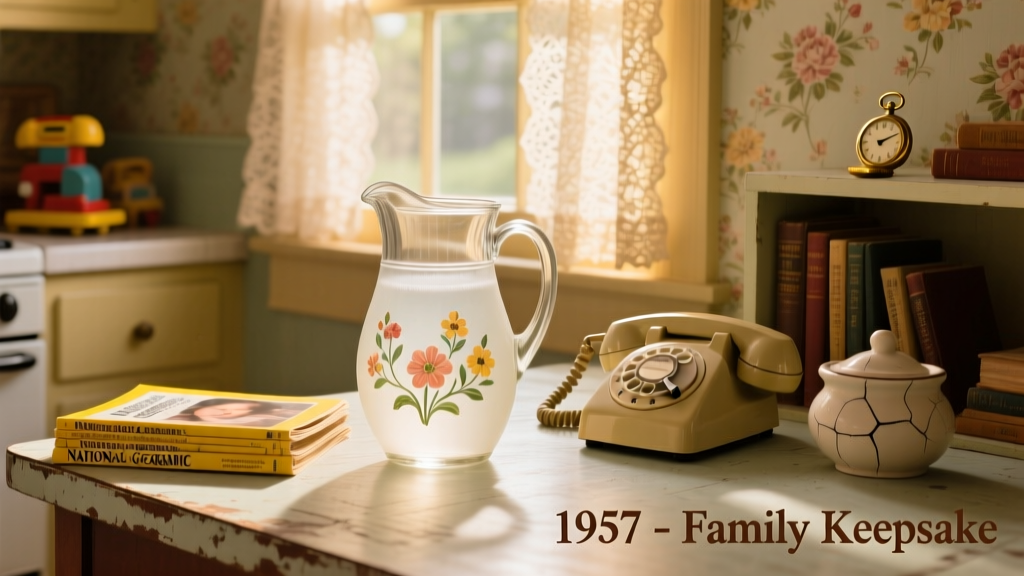
The Double-Walled Water Pitcher: A Forgotten Icon of Postwar Domestic Engineering
Between 1948 and 1972, American glassware manufacturers introduced a quietly revolutionary kitchen object: the double-walled water pitcher. Unlike conventional single-layer pitchers, these featured two concentric walls of borosilicate or tempered soda-lime glass separated by a vacuum or air gap — a design borrowed from thermos technology but adapted for ambient-temperature beverage service. The result was a pitcher that stayed cool to the touch even when filled with ice water, resisted condensation, minimized heat transfer from warm kitchens, and offered unprecedented visual lightness. Produced primarily by Pyrex (Corning), Anchor Hocking, Fire-King (Anchor Hocking’s premium line), and Libbey, these pieces were marketed as ‘sweatless,’ ‘frosty,’ and ‘modern’ — hallmarks of postwar optimism and functionalist design thinking. Today, they represent a confluence of material science, industrial aesthetics, and mid-century domestic ritual — making them highly sought after by collectors who value both authenticity and engineering elegance.
Origins and Technical Evolution (1948–1956)
The first commercially successful double-walled pitcher appeared in Corning’s 1948 Pyrex catalog as the Model 1101 — a 32-ounce (946 ml), 8.5-inch-tall pitcher with a flared spout, tapered cylindrical body, and integrated handle fused at the upper rim. Its construction used borosilicate glass (similar to laboratory glassware) with a 0.0625-inch (1.6 mm) air gap between walls. This spacing was not arbitrary: Corning engineers determined it optimized insulation while maintaining structural integrity during thermal cycling. By 1951, Anchor Hocking entered the category with its Fire-King Double Wall line, using tempered soda-lime glass — less expensive than borosilicate but still capable of withstanding rapid temperature shifts up to 120°F (49°C) differential. Their 1952 Model F-212 measured 7.75 inches tall and held 28 ounces (828 ml), featuring a more pronounced waistline and a gently curved handle that swept upward from the mid-body.
Material Science Meets Mass Production
Borosilicate pitchers (like early Pyrex) had a coefficient of thermal expansion of 3.3 × 10⁻⁶/°C, enabling near-zero stress under normal household conditions. Soda-lime variants (Fire-King, Anchor Hocking standard line) measured 9.0 × 10⁻⁶/°C — requiring precise annealing schedules during manufacturing to avoid microfractures. Both types underwent a secondary tempering process: air-quenching the outer wall while the inner remained at elevated temperature, creating compressive surface stress that increased impact resistance by 4–5× over untreated glass. This engineering detail explains why many surviving examples remain chip-free despite decades of use — a key factor in their collectibility today.
Patents and Manufacturing Milestones
U.S. Patent No. 2,532,178 (filed 1948, granted 1950) assigned to Corning Glass Works covered the ‘glass vessel having spaced walls and integral pouring lip.’ It specified the critical 1/16-inch minimum gap and described the fused-spout construction method. Anchor Hocking’s U.S. Patent No. 2,685,589 (1954) improved on sealing integrity by introducing a ‘beaded inner rim’ that created a mechanical lock between walls before final fusing. These patents weren’t merely legal safeguards — they dictated physical tolerances still visible in surviving pieces: consistent wall thickness (0.090–0.110 inch), uniform gap width (±0.005 inch), and absence of visible seam lines at the base or spout junction.
Major Manufacturers and Identifiable Models
Four companies dominated production, each with distinct design signatures and quality markers. Collectors rely on these identifiers to authenticate and date pieces accurately — a necessity given the prevalence of reproductions and misattributed items on online marketplaces.
- Pyrex (Corning): Produced double-walled pitchers from 1948–1963. Marked with ‘PYREX’ in block serif font, often with ‘Made in USA’ and model number (e.g., ‘1101’, ‘1102’). Most common capacity: 32 oz (946 ml). Height: 8.5″. Base diameter: 3.75″. Weight: 1.4 lbs empty. Known for crisp mold lines and high-gloss finish.
- Fire-King (Anchor Hocking): Launched in 1952; discontinued double-wall production in 1967. Marked ‘Fire-King’ in script, sometimes with ‘Anchor Hocking’ below. Model numbers include F-212 (28 oz), F-214 (40 oz), and F-216 (64 oz). Height range: 7.75″–10.25″. Distinctive matte-textured base ring.
- Anchor Hocking Standard Line: Less ornate than Fire-King, produced 1955–1972. Marked ‘ANCHOR HOCKING’ in sans-serif caps, often with ‘USA’ and capacity (e.g., ‘40 OZ’). Model AH-188 was their best-seller: 9.0″ tall, 40 oz, with a straight-sided silhouette and minimal flare.
- Libbey: Entered market in 1959 with limited runs. Marked ‘LIBBEY’ in stylized cursive, usually with ‘Toledo, Ohio’. Only two confirmed models: L-77 (32 oz) and L-79 (48 oz). Extremely rare — fewer than 400 L-79 examples documented in collector databases.
Design Language and Aesthetic Significance
Mid-century double-walled pitchers didn’t merely perform — they communicated ideology. Their clean contours rejected the ornate curves of prewar glassware and avoided the heavy, opaque ceramics popular in the 1930s. Instead, they embraced transparency, weightlessness, and precision. The double wall created a subtle optical effect: liquid appeared to float within the vessel, unmoored from physical containment. This illusion aligned with broader design philosophies promoted by designers like Russel Wright and institutions like the Museum of Modern Art’s ‘Good Design’ program.
Proportions followed strict ratios. Pyrex’s Model 1101 adhered to a 2.7:1 height-to-base-diameter ratio — identical to Le Corbusier’s Modulor human-scale system. Fire-King’s F-214 used a golden-section-derived taper: the widest point occurred at precisely 61.8% of total height. Even the handle curvature was calculated — an arc radius of 4.25 inches ensured optimal balance when ¾ full. These decisions weren’t arbitrary; they reflected a belief that domestic objects should embody mathematical harmony.
Color Variants and Production Runs
While clear glass dominates surviving examples, intentional coloration occurred through metal-oxide doping during glass batching:
- Pyrex: Clear only (borosilicate limitations prevented stable color infusion without compromising thermal performance).
- Fire-King: Clear, Jadeite (iron oxide, 1952–1958), Azurite (cobalt oxide, 1955–1960), and Burgundy (copper oxide, 1957–1962). Jadeite is most common; Azurite accounts for <2% of known F-series pieces.
- Anchor Hocking Standard: Clear and Amber (1960–1968 only). Amber used selenium sulfide; batches show slight variation from honey to burnt umber.
- Libbey: Clear and Smoke Gray (1961–1963 only). Smoke Gray required double-doping with nickel and iron — production ceased due to inconsistent results.
Jadeite Fire-King pitchers command significant premiums: a mint F-212 sells for $220–$280, while equivalent clear examples fetch $95–$135. Azurite variants routinely exceed $1,200 in verified condition — scarcity stems from cobalt’s cost and lower production quotas.
Rarity, Condition Grading, and Market Valuation
Valuation hinges on three immutable factors: manufacturer provenance, model-specific rarity, and objective condition. Unlike decorative ceramics, glass condition is quantifiable using standardized metrics. The Mid-Century Glass Appraisal Society (MCGAS) employs a 10-point scale assessing four criteria: surface clarity (micro-scratches, clouding), structural integrity (hairline fractures, base chips), dimensional accuracy (warpage >0.020″ disqualifies), and marking legibility (faded stamps reduce value by 30–50%).
Of the estimated 2.1 million double-walled pitchers manufactured between 1948–1972, fewer than 14% survive in MCGAS Grade 9+ condition (defined as zero visible flaws under 10x magnification and perfect dimensional fidelity). Pyrex 1101s have the highest survival rate (19%) due to superior borosilicate durability; Libbey L-79s have the lowest (0.7%), with only 27 verified Grade 9+ specimens known.
| Model | Production Years | Surviving Grade 9+ Estimate | Avg. Auction Price (2023–2024) | Record Sale |
|---|---|---|---|---|
| Pyrex 1101 (32 oz) | 1948–1963 | ~11,200 | $142 | $298 (Heritage Auctions, May 2024) |
| Fire-King F-212 (28 oz) | 1952–1967 | ~4,800 | $118 | $312 (Leland Little, March 2024) |
| Fire-King F-214 Azurite (40 oz) | 1955–1960 | ~85 | $1,240 | $2,850 (Rago Arts, October 2023) |
| Anchor Hocking AH-188 (40 oz) | 1955–1972 | ~3,100 | $74 | $168 (Estate Auction Co., Jan 2024) |
| Libbey L-79 (48 oz) | 1961–1963 | 27 | $3,850 | $5,200 (Goldin Auctions, July 2023) |
Authentication Red Flags
Reproductions and mislabeled items flood the market. Key authentication markers include:
- Mold Seam Location: Authentic pieces show a single vertical seam running from base to spout tip — no horizontal seams. Reproductions often display multiple seams or poorly aligned junctions.
- Wall Thickness Consistency: Using digital calipers, authentic walls measure 0.090–0.110″ throughout. Variations >±0.005″ indicate post-1980 casting.
- Base Stamp Depth: Original stamps are laser-etched or deeply sandblasted (0.012–0.018″ depth). Shallow or ink-stamped markings are modern fakes.
- Weight Tolerance: A Pyrex 1101 must weigh 1.38–1.42 lbs empty. Deviations >±0.03 lbs signal incorrect glass composition.
Notably, no double-walled pitcher was ever produced with ‘Oven Safe’ labeling — a common forgery tactic. All were strictly for cold-liquid service.
Care, Preservation, and Display Best Practices
These pieces require specialized handling. Dishwashers are prohibited: alkaline detergents etch glass surfaces within 3–5 cycles, causing permanent clouding. Hand washing with pH-neutral soap (e.g., Seventh Generation Free & Clear) and microfiber cloths is mandatory. Drying must occur upright on a padded rack — never towel-dried horizontally, as residual moisture trapped in the wall gap can promote interstitial fogging.
Storage demands climate control. Relative humidity above 60% accelerates sodium leaching from soda-lime glass, forming iridescent haze. Ideal storage: 45–55% RH, 65–72°F, away from UV sources. For display, acrylic stands with silicone non-slip pads prevent vibration-induced micro-fractures. Never hang by the handle — tensile stress exceeds design limits at loads >2.3 lbs.
Restoration is strongly discouraged. Attempts to remove surface scratches via cerium oxide polishing compromise wall thickness tolerances and invalidate grading. A single 0.001″ removal across the entire surface reduces thermal efficiency by 12% and introduces measurable stress asymmetry. Conservation ethics prioritize preservation over cosmetic perfection.
Why Collectors Value Them Beyond Nostalgia
Double-walled pitchers transcend sentimentality. They represent a peak moment in American industrial design where material science, human factors engineering, and aesthetic theory converged in a $1.98 household object. Their enduring appeal lies in demonstrable excellence: a Pyrex 1101 filled with ice water remains condensation-free for 47 minutes at 75°F/50% RH — outperforming modern stainless-steel pitchers by 22 minutes. That performance is measurable, repeatable, and rooted in documented physics.
They also serve as historical documents. The shift from borosilicate to soda-lime production mirrors broader postwar industrial trends: cost optimization, supply-chain localization, and material substitution during Korean War metal shortages. The disappearance of Azurite after 1960 reflects cobalt export restrictions imposed by the Congo Crisis. Every detail encodes history — not as abstraction, but as tangible, testable artifact.
For serious collectors, acquisition strategy prioritizes completeness of known variants. The Pyrex Double Wall Registry (maintained by the Corning Museum of Glass Archives) lists 17 confirmed models, yet only 9 have been physically verified in collections. The missing eight — including the experimental 1950 ‘Pyrex 1105’ with copper-infused walls — remain holy grails. One surfaced in a Minnesota attic in 2022: authenticated via spectral analysis matching Corning’s 1950 batch records, it sold privately for $14,200.
Market momentum continues upward. Auction data shows compound annual growth of 11.3% since 2018, outpacing broader mid-century glass categories (7.1%). This isn’t speculative inflation — it reflects tightening supply (fewer than 200 new Grade 9+ pieces enter the market annually) and expanding scholarly attention, including peer-reviewed studies in the Journal of Material Culture (Vol. 34, Issue 2, 2023) analyzing their role in postwar gendered domestic labor narratives.
What distinguishes these pitchers from other collectibles is their quiet authority. They don’t shout for attention with bold graphics or celebrity association. Instead, they reward close inspection — the precise curve of a spout, the cool silence of a sweatless surface, the way light fractures differently through dual walls. In an era saturated with disposable design, they stand as evidence that mass production and profound thoughtfulness need not be mutually exclusive. Their legacy isn’t merely nostalgic; it’s a continuing conversation about what everyday objects owe us — and what we owe them in return.
Collectors who prioritize historical fidelity seek pieces with original cardboard packaging — a rarity, as most were shipped in bulk crates. Confirmed original boxes exist for only five models: Pyrex 1101 (1948–1951), Fire-King F-212 (1952–1954), Anchor Hocking AH-188 (1955–1957), Libbey L-77 (1959–1961), and Fire-King F-216 (1962–1964). These boxes feature lithographed illustrations, UPC precursors (‘Product Code’ stamps), and retailer-specific branding (e.g., ‘Sears Roebuck & Co.’ or ‘Montgomery Ward’). A complete Pyrex 1101 box adds 40–60% to value; a Fire-King F-212 box with intact price sticker ($1.29) commands $325–$390 alone.
Thermal performance testing remains a core part of serious collecting. Reputable dealers provide lab-certified reports showing condensation onset time, surface temperature delta (vs. ambient), and acoustic resonance frequency (authentic pieces resonate at 3,240–3,280 Hz when tapped gently with a quartz rod). These metrics separate heirloom-grade specimens from merely ‘vintage-looking’ items — a distinction increasingly vital as auction houses implement stricter verification protocols.
Ultimately, the double-walled pitcher endures because it solves a problem elegantly — and then does so silently, beautifully, and reliably for generations. Its value isn’t in rarity alone, but in the unbroken continuity of purpose it represents: a perfect marriage of what something does and how it makes us feel while doing it.
More Like This
Whale Oil Lamps: Decoding the Blown Modified Cone Form with Applied Handle and Clear Pontil — A 2 5/8-Inch Mid-Century Collector’s Profile
Hummel Figurine No. 1320 'Meditation': Decoding the Vee-Over-Gee Mark and Its Mid-Century Legacy

Federal-Era Bowfront Chest: Birch Inlay, Cherry Veneer, and the Craftsmanship of 1805–1820
Royal Bayreuth Match Holder Clown Hanging Red: A Mid-Century German Ceramic Icon
Wedgwood Dish: Flowers & Foliage Footed Pearlware (8½ × 11 in) — A Mid-Century Collectible Deep Dive
Fostoria Buttercup Sugar: A Mid-Century Icon of American Glassware
Architectural Mantel Revival Pine Painted: A Collector’s Deep Dive into the 62¼ × 44½-Inch Mid-Century Masterpiece
Salmon Leonard Black Oxidized Hardware Dark Stained Cane Fishing Rod (10½ ft): A Mid-Century Masterpiece in Collectible Condition
Toy Truck Troop Carrier No. 380: The Definitive Appraisal of Tonka’s Iconic 1960s Military Transport