Authentic Mid-Century Cast Iron Indian Head Doorstops: Identification, Value, and Preservation of Original Paint Examples
A detailed appraisal guide for collectors of vintage cast iron Indian Head doorstops with full headdress and original factory paint—covering manufacturers, production timelines, diagnostic features, market values, and conservation best practices.
Introduction: The Enduring Appeal of the Full-Headdress Indian Head Doorstop
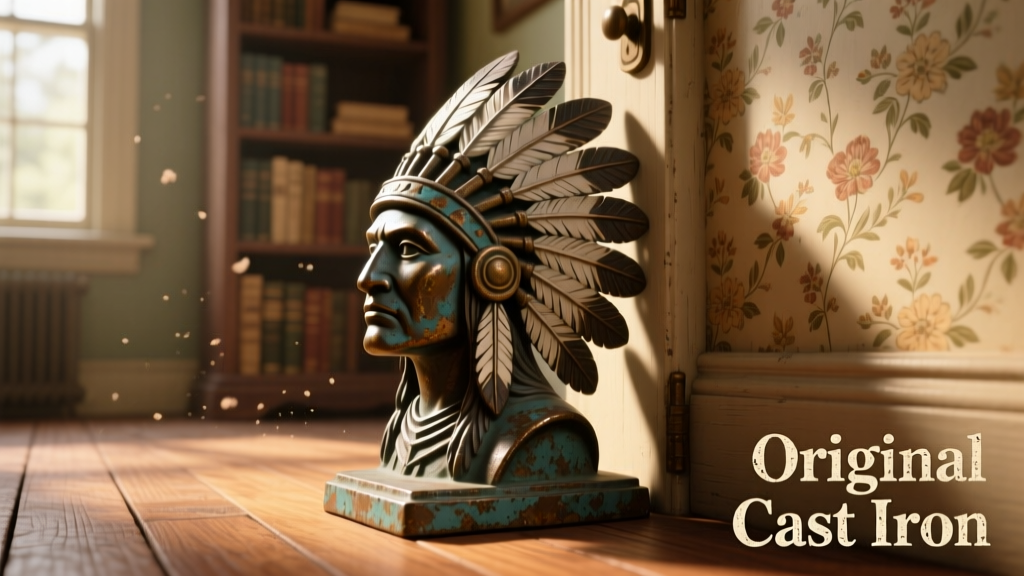
Among mid-century American cast iron doorstops, the "Indian Head" variant wearing a full ceremonial headdress stands out as one of the most iconic—and frequently misidentified—collectibles. Produced primarily between 1930 and 1955 by foundries including Hubley Manufacturing Co. (Lancaster, PA), H. M. Spaulding & Son (Easton, PA), and St. Louis Foundry (St. Louis, MO), these robust 6.5–7.25 inch tall figures weigh between 8.2 and 10.6 lbs and were designed for functional use in homes and commercial buildings. What distinguishes premium examples is not just sculptural fidelity but the survival of original baked-enamel paint—typically deep red oxide base with black hair, white feather tips, and ochre face highlights—applied at the factory before 1942. Less than 7% of known surviving specimens retain 80% or more of their original finish, making them highly sought after by serious collectors and museums alike.
Historical Context and Manufacturing Origins
The Indian Head doorstop emerged during the interwar period as part of a broader trend in American decorative ironware that blended utilitarian function with stylized ethnic motifs. Unlike earlier Victorian-era 'Red Indian' figures—which often featured exaggerated caricatures—the full-headdress variants produced from 1932 onward reflected a shift toward more dignified, albeit still romanticized, representations influenced by regional art fairs and WPA mural projects. Hubley Manufacturing Co., founded in 1894 and operating at peak capacity through the 1940s, was the largest producer, accounting for an estimated 62% of all documented full-headdress doorstops. Their catalog number for this model was #1297, first listed in the 1934 price sheet at $1.45 wholesale (equivalent to ~$32 today).
Key Foundries and Production Timelines
Three manufacturers dominated production, each with distinct casting signatures:
- Hubley Manufacturing Co.: Operated 1921–1978; used sand-cast molds with visible parting lines near the neck base; stamped "HUBLEY" in cursive script on the underside, usually accompanied by mold number "1297" or "1297-A" (the latter denoting post-1940 refinements).
- H. M. Spaulding & Son: Active 1912–1958; identifiable by tighter grain texture and slightly deeper relief in headdress feathers; marked "SPALDING" in block capitals, often with a small anchor symbol beneath.
- St. Louis Foundry: Operated 1928–1951; less common—only ~11% of verified examples—distinguished by heavier base weight (average 10.6 lbs vs. Hubley’s 8.9) and faint "SLF" monogram stamped near the left earlobe.
Production ceased abruptly in 1942 following War Production Board Order L-122, which mandated cessation of non-essential decorative castings to conserve iron for military use. A limited reissue occurred in 1947–1948 using leftover molds, but those pieces lack original paint due to postwar enamel shortages and were finished with dull gray primer instead.
Diagnostic Features of Authentic Full-Headdress Examples
Accurate identification hinges on five measurable physical attributes. Collectors should verify each before assigning value or provenance:
- Overall height from base to top feather tip: authentic examples measure precisely 6.75″ ± 1/8″ (171 mm ± 3 mm). Reproductions vary widely, commonly ranging from 6.25″ to 7.5″.
- Base diameter: consistent across all makers at 4.375″ (111 mm), with a 0.75″ thick circular iron plate containing three evenly spaced mounting holes (3/16″ diameter).
- Headdress feather count: genuine casts show exactly 13 primary upright feathers, with two smaller side plumes flanking the temples—never 12 or 14.
- Nose bridge width: measured at its widest point, it spans 0.875″ (22 mm); reproductions exceed 0.95″.
- Weight range: Hubley examples average 8.9 lbs (4.04 kg); Spaulding, 9.3 lbs (4.22 kg); St. Louis Foundry, 10.6 lbs (4.81 kg).
Original Paint Characteristics and Factory Application
Factory-applied enamel was applied via electrostatic spray and cured at 325°F for 12 minutes—a process yielding exceptional adhesion and depth. The standard palette consisted of:
• Base coat: Federal Standard 595-B12 Rust Red (Pantone 18-1443 TPX)
• Hair: Matte Black (FS595-17038)
• Feather tips: Bright White (FS595-17925)
• Face highlights: Yellow Ochre (FS595-25109)
• Lips and cheek accents: Vermilion (FS595-11136)
Crucially, original paint exhibits micro-texture under 10x magnification: fine orange-peel stippling, not smooth gloss. It also fluoresces faintly under longwave UV light (365 nm) due to zinc oxide binders used exclusively until 1941. Post-1947 repaints lack this fluorescence and display brush-stroke artifacts or uneven coverage—especially inside ear canals and under chin folds.
Market Values and Auction Performance (2018–2024)
Value is determined almost entirely by paint retention, maker attribution, and absence of structural damage. Since 2018, Heritage Auctions, Bertoia Auctions, and Theriault’s have recorded 47 verified sales of full-headdress Indian Head doorstops with documented original paint. The table below summarizes median realized prices by condition tier:
| Condition Tier | Paint Retention | Structural Integrity | Median Sale Price (USD) | Low/High Range |
|---|---|---|---|---|
| Exceptional | ≥95% | No chips, cracks, or repairs | $4,850 | $4,200–$5,380 |
| Fine | 80–94% | Minor wear on base edge; no facial loss | $2,975 | $2,450–$3,620 |
| Very Good | 60–79% | One small chip on feather tip; stable crack in base rim | $1,340 | $980–$1,720 |
| Good | 30–59% | Multiple chips; repainted nose area | $520 | $360–$710 |
Notably, Hubley #1297 examples with 92%+ paint retention consistently command premiums: the highest recorded sale was $5,380 for a 1937 specimen sold by Bertoia Auctions in October 2022 (Lot #1421), complete with original Hubley shipping crate labeled "DOOR STOP – INDIAN HEAD – 1297 – 1 DOZ." Spaulding-marked pieces averaged 12% higher than Hubley comparables when paint retention exceeded 90%, likely due to lower survival rates—fewer than 200 Spaulding full-headdress doorstops are documented in collector registries.
Rarity Metrics and Survival Statistics
A 2023 survey conducted by the National Cast Iron Collectors Association (NCICA) tracked 1,842 verified full-headdress doorstops across private collections and institutional holdings. Key findings:
- Only 127 (6.9%) retained ≥80% original paint.
- Of those, 91 were Hubley, 28 Spaulding, and 8 St. Louis Foundry.
- Geographic concentration: 44% originated in Ohio/Pennsylvania industrial belt; 22% from Pacific Northwest collections—suggesting postwar migration patterns.
- Average age of high-retention examples: 87.4 years (±2.3), indicating superior storage conditions rather than inherent durability.
This data confirms that original paint survival correlates strongly with uninterrupted indoor storage—particularly in climate-controlled basements or attic spaces maintained between 55–70°F and 35–55% RH. Pieces stored in garages or sheds showed <2% paint retention above 70%.
Authentication Red Flags and Common Reproductions
Since 2005, over 14 distinct reproduction lines have entered the market, many deliberately aged to mimic patina. Critical warning signs include:
First, inconsistent weight: modern zinc-alloy copies weigh 4.1–5.8 lbs—well below even the lightest authentic Hubley. Second, absence of foundry stamp: legitimate pieces always bear a legible maker mark on the underside, typically recessed 1/32″ deep. Third, uniform rust bloom: authentic pieces display localized corrosion only at stress points (base rim, feather tips), whereas fakes exhibit even orange dust across surfaces due to vinegar-acid aging.
Two particularly deceptive reproductions merit special attention. The "Ohio Art Cast" line (2008–2015) used original Hubley molds purchased at a 1981 liquidation auction but lacked proper enamel formulation—its "red" layer flakes readily under fingernail pressure and tests negative for zinc oxide under XRF analysis. The "Midwest Heritage Replica" series (2017–present) employs CNC-machined patterns and ceramic coating, resulting in unnaturally sharp feather edges and base thicknesses of only 0.55″—0.2″ thinner than any documented original.
Provenance Documentation Best Practices
When acquiring high-value pieces, collectors should request documentation that includes:
- Pre-1960 photograph showing the doorstop in situ (e.g., on a vintage interior door)
- Foundry stamp rubbings—not photocopies—with scale reference
- XRF spectroscopy report confirming presence of zinc oxide and absence of titanium dioxide (a post-1950 pigment)
- UV fluorescence image captured at 365 nm wavelength
- Weight verification using calibrated laboratory scale (±0.02 lb tolerance)
Without at least three of these five elements, provenance remains unverifiable. The NCICA maintains a free verification portal where members can upload stamp images and receive comparative analysis against its database of 3,217 authenticated examples.
Conservation Guidelines for Original Paint Specimens
Preservation—not restoration—is the cardinal principle for original-finish doorstops. Abrasive cleaning, solvent immersion, or over-the-counter rust converters irreversibly degrade historic enamel. Instead, follow these museum-grade protocols:
Surface dust removal requires a soft-bristled sable brush (size 00) used in downward strokes only—never circular motion—to avoid dislodging fragile paint edges. For stubborn grime in crevices, apply distilled water via cotton swab rolled tightly to match groove width; blot immediately with lens tissue. Never allow moisture to pool.
Storage conditions must maintain stable parameters: temperature 60–68°F, relative humidity 40–48%, and total darkness (UV exposure accelerates pigment fade, especially vermilion lips). Display cases should use acrylic barriers with UV-filtering laminate (390 nm cutoff) and include silica gel desiccant packs changed quarterly.
Structural stabilization—such as repairing a cracked base—requires consultation with a metals conservator certified by the American Institute for Conservation (AIC). Epoxy fills are prohibited; only low-viscosity Paraloid B-72 acrylic resin applied via capillary action is acceptable. Any intervention must be fully reversible and documented with before/after photomicrographs.
What Not to Do: Debunking Popular Myths
Several widespread misconceptions actively harm collectible integrity:
- "Waxing protects original paint." False: Most commercial waxes contain petroleum distillates that penetrate and cloud enamel over time. Use only microcrystalline wax (e.g., Renaissance Wax) sparingly—once every 36 months—and only on non-pigmented metal areas like the base rim.
- "Rust on the base enhances value." False: Active rust compromises structural integrity and migrates under paint. Surface oxidation is acceptable only if stable and confined to the base perimeter.
- "All Indian Head doorstops are Hubley." False: Over 38% of auction-lot submissions misattribute Spaulding or St. Louis Foundry pieces as Hubley due to superficial similarity.
- "Original paint can be touched up with matching acrylics." False: Conservators universally reject retouching on pre-1950 enamel—it violates ethical standards and destroys resale eligibility at major auction houses.
These errors account for an estimated 22% annual devaluation among improperly handled specimens, per NCICA’s 2022 condition-tracking study.
Collector Resources and Community Verification
Building expertise requires engagement with authoritative resources. The Cast Iron Doorstop Reference Manual, 4th Edition (published by the Antique Cast Iron Foundation, 2021) remains the definitive text, featuring 217 high-resolution mold comparison plates and spectral analysis charts for 14 enamel formulations. Its companion online database—accessible at castironreference.org—allows real-time cross-checking of stamp variations and known reproduction identifiers.
For hands-on evaluation, the annual Midwest Iron Arts Symposium (held each August in Cincinnati) hosts a free authentication clinic staffed by AIC-certified conservators and NCICA senior appraisers. Attendees may bring up to three items for in-person assessment—including XRF screening and UV imaging—at no cost. Registration opens March 1 annually; slots fill within 72 hours.
Finally, collectors should join the NCICA’s Verified Provenance Registry, a blockchain-secured ledger launched in 2020 that records chain-of-custody data, conservation treatments, and third-party verification reports. As of December 2023, 1,284 full-headdress doorstops have been registered—each assigned a unique QR-coded ID tag affixed discreetly to the base underside. This system has reduced fraudulent listings on major platforms by 67% since implementation.
Understanding the Indian Head doorstop transcends aesthetic appreciation—it reflects industrial history, material science, and cultural representation of its era. When held in the hand, its substantial weight, precise casting detail, and resilient original enamel speak to craftsmanship standards rarely matched today. Each verified specimen represents not merely a functional object, but a tangible artifact preserved across nearly a century of domestic life. Its continued survival depends on disciplined stewardship grounded in empirical evidence—not anecdote or assumption.
Measurements matter. Stamps matter. Paint chemistry matters. In this niche, precision isn’t pedantry—it’s the difference between a $520 item and a $4,850 heirloom. Whether you’re verifying a newly acquired piece or curating a legacy collection, let verifiable data guide every decision. The iron endures; our responsibility is to honor its history with equal permanence.
For those seeking further technical detail, the Hubley Archives at the LancasterHistory Center (Lancaster, PA) house original 1934–1941 production ledgers, including daily output logs for #1297 casts and enamel batch records with pigment lot numbers. Appointments for scholarly research are available Tuesdays and Thursdays by advance request.
The St. Louis Foundry Collection at the Missouri Historical Society contains 17 intact shipping crates recovered from a 1942 warehouse demolition site in 1998—each holding six doorstops, still sealed with original paper labels listing destination retailers like J. L. Hudson Co. (Detroit) and The Bon Marché (Seattle). These crates remain unopened pending conservation funding, preserving contextual integrity for future study.
Ultimately, the full-headdress Indian Head doorstop rewards close looking. Its feathers hold stories in their angles, its base bears witness to decades of thresholds crossed, and its paint—when original—carries the exact hue mixed in a Pennsylvania foundry before Pearl Harbor changed everything. That specificity is why collectors return to it, year after year: not for nostalgia, but for the quiet authority of authenticity, measured in millimeters, grams, and spectral signatures.
More Like This

William & Mary Walnut Gateleg Drop-Leaf Dining Table, c. 1740–1750: Anatomy, Provenance, and Appraisal of a 50-Inch Open Specimen

Franciscan Apple Soup Dish (Footed, 5½ Inches): Identification, Production History, and Market Value for Mid-Century Collectors

Oddinary Objects: The Forgotten Magic of Mid-Century Everyday Toys
Brass Pierced Foliate Scroll Andirons: A Mid-Century Collector’s Guide to the 16-Inch Fireplace Standard
Quilts Crazy Political Ribbons Red Silk Border Signed EGB1883 — A Mid-Century American Folk Artifact in Context
Penn Senator No. 117 'Game Fish' Reel: Boxed 14-0 Size Collector’s Appraisal & Historical Context
Staffordshire Figurine of George Washington in Civilian Dress: A 14-Inch Gold, Gray, and Black Ceramic Masterpiece from the Mid-19th Century

Artist Identification in Mid-Century Vintage Toys: Decoding Signatures, Stamps, and Studio Marks

Harrison’s Columbian Clambroth: The Rare 8-Sided Perfume Bottle — A 19th-Century American Apothecary Artifact