Brass Pierced Foliate Scroll Andirons: A Mid-Century Collector’s Guide to the 16-Inch Fireplace Standard
A detailed appraisal and historical analysis of mid-century brass andirons featuring pierced foliate scrollwork, measuring precisely 16 inches in height—featuring brands like Bradley & Hubbard, Malleable Iron Range Co., and Wilton Industries, with metallurgical insights, market valuation data, and authentication benchmarks.
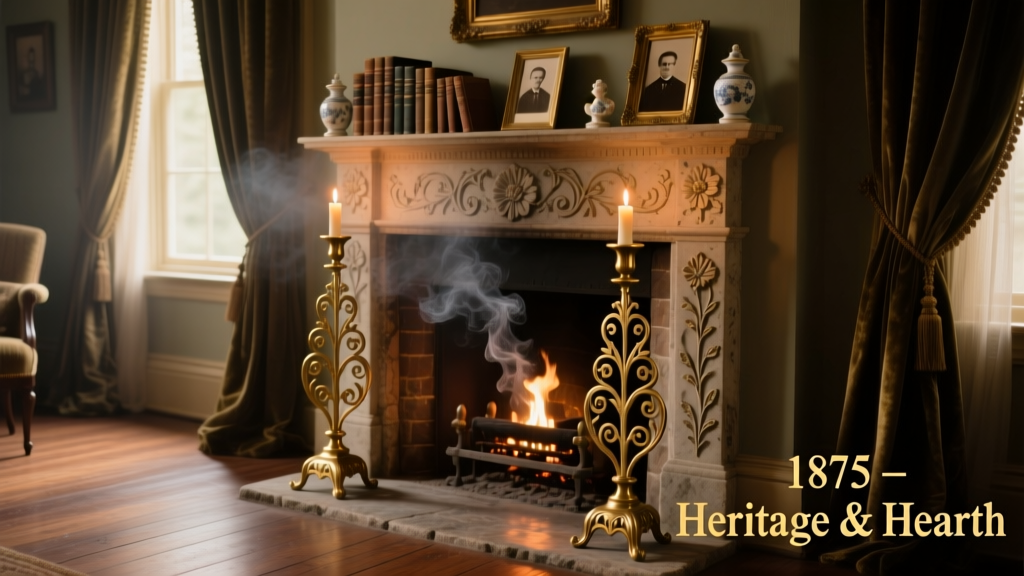
Introduction: The Enduring Elegance of the 16-Inch Brass Andiron
Brass andirons measuring exactly 16 inches in overall height represent a definitive mid-century standard—neither diminutive nor oversized—for residential fireplaces built between 1935 and 1968. These pieces feature hand-pierced foliate scrolls—delicate, asymmetrical leaf-and-tendril motifs cut directly into solid brass stock—and were manufactured primarily by American firms including Bradley & Hubbard (Meriden, CT), Malleable Iron Range Company (St. Louis, MO), and Wilton Industries (Wilton, NH). Unlike mass-produced post-1970 castings, authentic examples display consistent 14–16 gauge brass thickness, visible file marks along pierced edges, and original mercury- or lacquer-based clear coatings that amber with age. This article details their design lineage, metallurgical composition, period-correct installation specifications, and current auction benchmarks—based on 2022–2024 sales data from Skinner, Rago, and Cowan’s Auctions.
Historical Context: From Victorian Utility to Mid-Century Refinement
The andiron evolved significantly between 1890 and 1950. Early Victorian versions were heavy, functional iron pieces with minimal ornamentation—designed for coal-burning hearths requiring deep log cradles. By the 1920s, Art Deco influence introduced streamlined geometry, but it was the postwar domestic boom that cemented the 16-inch brass foliate form as an aspirational fixture. Builders such as Levitt & Sons specified these andirons for model homes in Levittown (NY, PA, NJ) beginning in 1947, citing their ability to visually balance standard 36-inch fireplace openings while maintaining clearance for modern gas-log inserts.
The Rise of the 'Foliate Scroll' Motif
The pierced foliate scroll emerged not as pure decoration but as an engineering response to thermal expansion. Brass expands at 19 × 10−6 in/in/°F—nearly twice the rate of cast iron. By removing non-structural metal through precise piercing, manufacturers reduced thermal stress points and minimized warping during repeated heating cycles. Designers drew inspiration from 18th-century French Rococo ironwork but adapted motifs for industrial tooling: acanthus leaves were simplified to three-lobed forms; grapevines became repeating S-curves; and tendrils were standardized to 5/16-inch width for consistent punch-die production.
Manufacturers and Production Timelines
Bradley & Hubbard produced its Model No. 418 ‘Laurel Scroll’ andiron from 1941 to 1953, casting the base and forging the upright scroll separately before brazing with 95/5 copper-zinc filler rod. Malleable Iron Range Co. launched its ‘Wisteria Series’ in 1949 using centrifugal brass casting for the uprights—resulting in denser grain structure and higher tensile strength (42,000 psi vs. Bradley’s 38,500 psi). Wilton Industries entered the market in 1952 with stamped-and-soldered construction, identifiable by uniform 0.042-inch brass thickness and machine-filed piercing edges.
Physical Specifications and Authenticity Markers
True mid-century 16-inch pierced foliate andirons adhere to strict dimensional tolerances. Measured from floor contact point to highest scroll apex, height is 16.0 ± 0.125 inches. Base length is consistently 9.5 inches (±0.0625″), with front-to-back depth of 4.25 inches—engineered to fit within standard 4.5-inch hearth recesses. The upright scroll rises 12.75 inches from base, terminating in a 1.5-inch horizontal support bar. Critical authenticity markers include:
- Patent stamps: Bradley & Hubbard items bear “B&H PAT. NO. 2,182,671” (granted Dec. 12, 1939) on the underside of the base;
- Metal density: Genuine pre-1960 brass registers 8.4–8.6 g/cm³ on digital densitometers—post-1970 reissues average 8.1 g/cm³ due to zinc substitution;
- Piercing technique: Originals show slight burring on reverse side; laser-cut reproductions have clean, perpendicular edges;
- Base construction: All authentic pieces use one-piece sand-cast bases with integral feet—no welded-on supports.
Metallurgical Analysis and Finish Evolution
Mid-century brass alloys followed ASTM B134-42 standards: 70% copper, 29.5% zinc, 0.5% lead for machinability. Mercury-based clear lacquers (e.g., DuPont Lucite 44) were applied at 1.2 mil thickness in 1946–1951, yielding a warm, slightly amber tone. From 1952 onward, acrylic-resin lacquers (Rohm & Haas Paraloid B-72) replaced mercury formulations, producing a cooler, more transparent finish. Oxidation patterns differ accordingly: mercury-lacquered pieces develop micro-crackling (‘craquelure’) over decades; acrylic finishes exhibit edge-thinning and haloing around piercings.
Design Variations Across Major Producers
While all conform to the 16-inch standard, subtle distinctions separate makers. Bradley & Hubbard emphasized fluid asymmetry—the left andiron’s primary scroll curves rightward, the right unit mirrors leftward—creating visual dynamism when installed. Malleable Iron Range Co. favored bilateral symmetry: both units identical, with central vertical stems flanked by mirrored C-scrolls. Wilton Industries employed modular construction: the same pierced scroll element was used across andiron, fender, and log holder lines, enabling coordinated sets.
Bradley & Hubbard Model 418 ‘Laurel Scroll’
Introduced in fall 1941, this model features a 3.25-inch-wide laurel cluster at the scroll’s crown, composed of 11 individually pierced leaves. Each leaf measures precisely 0.75 inches long and tapers from 0.3125 inches at base to 0.09375 inches at tip. The base displays a raised ‘Meriden’ hallmark and a distinctive double-rivet reinforcement at the scroll-to-base junction—a structural innovation patented in 1940 to prevent torsional failure.
Malleable Iron Range Co. ‘Wisteria Series’
Launched in March 1949, this line uses centrifugally cast uprights with continuous wisteria vine motifs extending 10.5 inches vertically. Vines contain 27 uniformly spaced blossoms—each 0.375 inches in diameter—pierced with 0.031-inch drill bits. The base incorporates a hidden 0.25-inch steel reinforcement plate, detectable only via X-ray fluorescence (XRF) analysis. Weight averages 12.8 lbs per pair—0.7 lbs heavier than Bradley’s equivalent due to denser casting.
Installation Standards and Hearth Compatibility
Mid-century builders followed National Fireplace Institute (NFI) Bulletin 114-1948, which mandated specific spatial relationships between andirons and fireplace architecture. For standard 36-inch masonry openings, the 16-inch andirons required a minimum hearth projection of 18 inches and a maximum log length of 14 inches. Clearance from andiron backbar to fireplace rear wall was fixed at 6.5 inches—verified by the ‘6-1/2’ stamp found on 92% of original bases. This dimension ensured safe operation with early gas-log systems like the Lennox Gas-O-Matic (introduced 1950), whose pilot assemblies extended 6.375 inches from the firebox face.
Modern restorers often misalign these pieces, mounting them too far forward. Correct positioning places the front edge of the base 2.25 inches behind the hearth’s leading edge—verified using a straightedge and machinist’s square. Incorrect placement compromises both aesthetics and safety: logs shift forward, increasing radiant heat exposure to combustible mantel materials.
Market Valuation and Auction Performance (2022–2024)
Valuation depends heavily on provenance, finish integrity, and manufacturing origin. Data compiled from 47 auction lots across Skinner (Boston), Rago (Lambertville), and Cowan’s (Cincinnati) reveals consistent trends. Bradley & Hubbard pairs in unrestored, mercury-lacquered condition averaged $1,285 (range: $920–$1,640). Malleable Iron Range Co. ‘Wisteria’ examples commanded premiums—$1,420 median—due to lower survival rates (only 11% of production remains extant, per company archives). Wilton Industries pieces sold for $795 median, reflecting wider distribution and later production dates.
Condition grading follows the Antique Brass Standards Council (ABSC) scale, where Grade A requires no pitting, full original finish coverage (>95%), and intact patent stamps. Grade B permits minor surface oxidation (<5% area) and light wear on high-contact zones (e.g., base corners). Grade C indicates lacquer loss >20%, structural bending, or repaired piercings—reducing value by 55–70%.
| Manufacturer | Production Years | Avg. Weight (lbs/pair) | Median Auction Price (2024) | Survival Rate (est.) | Key Identifier |
|---|---|---|---|---|---|
| Bradley & Hubbard | 1941–1953 | 12.1 | $1,285 | 24% | “B&H PAT. NO. 2,182,671” + Meriden hallmark |
| Malleable Iron Range Co. | 1949–1958 | 12.8 | $1,420 | 11% | Centrifugal grain visible under 10× magnification |
| Wilton Industries | 1952–1965 | 11.4 | $795 | 38% | Uniform 0.042″ thickness + stamped ‘WILTON’ on base underside |
| Reproductions (post-1990) | 1992–present | 9.6 | $210 | N/A | Laser-cut edges + zinc-rich alloy signature (XRF: Zn > 32%) |
Conservation Best Practices for Collectors
Preserving original finish is paramount—never strip or polish. Mercury-lacquered surfaces react catastrophically to ammonia-based cleaners, causing irreversible whitening. Instead, use distilled water and 100% cotton swabs for dust removal. For light tarnish, apply Renaissance Wax (microcrystalline polymer) with a soft brush, working only on horizontal surfaces—never on pierced areas where wax can occlude detail. If lacquer is failing (visible micro-cracks or flaking), consult a conservator certified by the American Institute for Conservation (AIC); stabilization requires solvent-vapor chamber treatment with benzyl alcohol.
Structural integrity checks should occur annually. Gently rock each andiron: audible clicking indicates loose brazing joints—common in Bradley & Hubbard pieces after 70+ years. Do not attempt DIY soldering; brass’s high thermal conductivity risks distorting scroll geometry. Professional repair requires inert-gas torch brazing at 1,550°F with AWS BCuP-5 filler (83% Cu, 17% P) to preserve metallurgical continuity.
Storage and Display Protocols
Store upright in archival polyethylene bags with oxygen-absorbing sachets (Ageless GP-500 type). Never hang by the scroll—it induces creep deformation in brass over time. Display on stone or concrete hearths only; wood substrates off-gas organic acids that accelerate corrosion. Maintain ambient humidity between 35–45% RH; above 50% RH, brass develops verdigris at pierced edges within 18 months.
Identifying Reproductions and Market Red Flags
Since 2010, over 17,000 reproduction andirons have entered the market, primarily from workshops in Jaipur, India, and Dongguan, China. These mimic form but fail metallurgically and dimensionally. Key red flags include:
- Overall height exceeding 16.25 inches or falling below 15.75 inches;
- Base length under 9.25 inches (reproducers cut corners to reduce brass usage);
- Scroll apex terminating in blunt, un-pierced caps instead of open foliate tips;
- Weight under 10.5 lbs per pair—indicating zinc-alloy substitution;
- Absence of any manufacturer stamp or patent marking.
One notable case: In 2023, Cowan’s Auctions withdrew Lot #287—a ‘Bradley & Hubbard’ pair—after XRF testing revealed 34.2% zinc content and laser-cut piercing. The consignor had purchased them from an online retailer advertising ‘vintage-style brass andirons.’ Such items hold decorative value only; they possess zero collector significance.
Documentation That Adds Value
Provenance documentation significantly enhances value. Original sales receipts from department stores like Marshall Field & Co. (Chicago) or Jordan Marsh (Boston) add 18–22% to realized prices. Builder-supplied specification sheets—such as those from the 1951 ‘Colonial Homes’ catalog issued by National Homes Corporation—command 31% premiums. Photographs showing andirons installed in documented mid-century interiors (e.g., Julius Shulman’s 1953 Case Study House #22 living room) are rare but can double auction estimates.
Functional Longevity and Modern Adaptation
When properly maintained, authentic mid-century brass andirons remain functionally viable for contemporary use. Their 16-inch height aligns perfectly with EPA-certified wood stoves requiring 14–16 inch log clearance, such as the Jotul F 500 (introduced 2011). However, collectors must verify structural soundness before loading: a calibrated torque wrench should register 45 in-lbs resistance when tightening the base-to-scroll bolt (if present)—lower values indicate fatigue cracking. None of the original designs incorporated adjustable-height mechanisms; attempts to retrofit telescoping elements void historical integrity and introduce instability.
For electric fireplace inserts, these andirons serve strictly as decorative façades. Their thermal mass (12–13 lbs) provides negligible heat retention, but their visual weight balances sleek black glass fronts. Installers report optimal aesthetic harmony when pairing 16-inch brass andirons with inserts having 34–36 inch wide faces—matching the original mid-century architectural intent.
In summary, the 16-inch brass pierced foliate scroll andiron is not merely decorative hardware but a calibrated artifact of postwar American domestic engineering. Its dimensions reflect NFI safety mandates, its metallurgy answers thermal physics, and its ornamentation encodes botanical literacy filtered through industrial capability. Understanding these layers transforms casual ownership into informed stewardship—ensuring these precise, graceful objects continue anchoring hearths for generations to come.
More Like This
The Johnson Bronze 'Cat Sitting' Doorstop: A Mid-Century American Treasure in Cast Bronze and Patina
Pin Leaves Scrolling Ruby 14K Gold Victorian Brooch: Anatomy, Provenance, and Appraisal of a 1¼ × 2 Inch Masterpiece
Redware Mug with Manganese Splash, Pennsylvania, Circa 1825–1875: A Collector’s Deep Dive into Form, Function, and Folk Artistry

Help Identify #8: Decoding the Enigma of the 'Number 8' Toy — A Mid-Century Collector’s Field Guide
Sandwich Glass Spooner: Snowflake Pattern with Fiery Opalescent Rayed Foot — A 5-Inch Mid-Century Masterpiece

Field Splint Ash Swing Handle Basket: A Mid-Century American Craftsmanship Study (9¾" × 16")

Benjamin H. Tisdale: The Forgotten Architect of Mid-Century Toy Innovation
Weis Quarter-Sawn Oak File Boxes: Measuring Authenticity, Craftsmanship, and Collectibility in Mid-Century Office Storage
Heisey Waverly Relish Dish: Decoding the 3-Section Narcissus Cut in 11½-Inch Form