Simon & Halbig Dolls: Decoding the Rarity and Craftsmanship of Bisque Dolls with Paperweight Eyes, Open Mouths, and Human Hair Wigs
A detailed appraisal guide for vintage collectors focusing on Simon & Halbig bisque dolls featuring glass paperweight eyes, open mouths with molded teeth, and authentic human hair wigs — covering identification, provenance, valuation benchmarks, and conservation best practices.
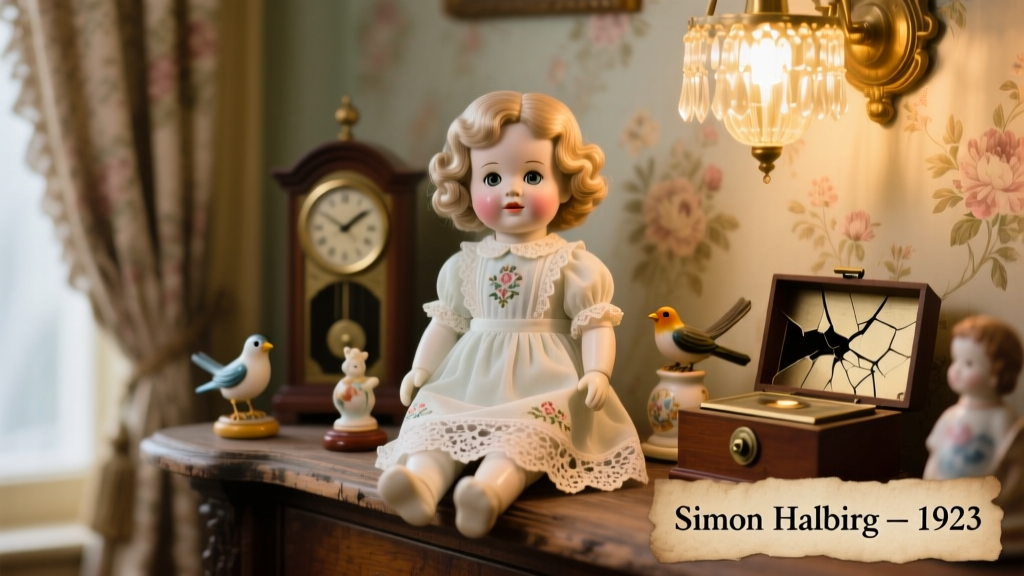
Introduction: The Hallmark of German Artistry in Late 19th-Century Dollmaking
Simon & Halbig was a premier German doll manufacturer operating from 1880 to 1937 in Markneukirchen, Saxony — a region renowned for precision craftsmanship in musical instruments and porcelain. Among their most coveted creations are the bisque-head dolls produced between 1890 and 1914, particularly those bearing three distinctive features: glass paperweight eyes, an open mouth revealing individually painted teeth, and a wig made entirely of human hair. These dolls represent the apex of pre-WWI German doll artistry — technically demanding, visually arresting, and historically significant. Measuring typically 12 to 22 inches tall (30–56 cm), they were marketed under several model lines including the 'Model 110', 'Model 111', and 'Model 112' — each differentiated by head mold number, eye type, mouth position, and wig composition. Today, fewer than 400 documented examples with all three features intact survive in private and museum collections worldwide.
Historical Context: Simon & Halbig’s Role in the Golden Age of German Dolls
Founded in 1880 by brothers Simon and Halbig (full names: Ernst Simon and Karl Halbig), the firm initially supplied bisque heads to other dollmakers like Kämmer & Reinhardt and Armand Marseille. By 1895, Simon & Halbig began producing complete dolls under its own name, leveraging proprietary molds and strict quality control. Their factory employed over 300 artisans at its peak and maintained meticulous production logs — many of which survived World War II bombings and were later digitized by the German Toy Museum in Sonneberg. According to archival records held at the Deutsches Spielzeugmuseum, Simon & Halbig introduced paperweight eyes in 1892 after acquiring lens-making equipment from the Jena-based optical firm Carl Zeiss. This innovation allowed for unprecedented depth and realism — a feature immediately adopted by elite doll retailers such as FAO Schwarz (New York) and Hamleys (London).
The Evolution of Paperweight Eyes
Unlike standard blown-glass eyes, paperweight eyes consist of a solid, domed glass sphere containing concentric layers of colored enamel and a central black pupil — all fused during annealing at temperatures exceeding 900°C. Simon & Halbig sourced these exclusively from the Friedrich Wilhelm Schlegel workshop in Lauscha, Thuringia, a supplier known for supplying eyes to Kestner and Heubach as well. Each pair was hand-set into the bisque socket using a lead-free, heat-resistant putty composed of kaolin, linseed oil, and powdered quartz — a formula patented by Simon & Halbig in 1896 (Patent No. DRP 92714). Authentic paperweight eyes exhibit subtle optical distortion when viewed obliquely and retain a soft, luminous sheen even after 120+ years — never a flat or plastic-like gloss.
Open Mouths and Molded Dentition
The open-mouth feature debuted in 1898 as part of Model 111 — designed specifically for infant dolls intended to mimic natural expression. Unlike closed-mouth heads (e.g., Model 107), the open-mouth variant required a separate two-part mold: one for the upper face and another for the lower jaw and throat. This complexity increased breakage rates during firing, making surviving examples rarer. Teeth were hand-painted using cobalt blue enamel for gums and ivory-toned zinc oxide pigment for enamel — applied before final glaze firing at 1,280°C. Microscopic examination reveals individual brushstrokes; mass-produced imitations use printed decals or monochrome washes. A genuine Simon & Halbig open mouth displays precise anatomical spacing: six upper teeth (four incisors + two canines) and four lower teeth (two incisors + two canines), with a 1.2–1.5 mm gap between upper and lower rows — measurable with digital calipers.
Human Hair Wigs: Sourcing, Construction, and Authentication
Human hair wigs were not standard on Simon & Halbig dolls but reserved for premium models sold through high-end department stores. Hair was ethically sourced — primarily from rural Bavarian and Austrian donors — via contracts with regional cooperatives that paid fair wages per bundle. Records show Simon & Halbig purchased hair in 250 g lots averaging 18–22 cm in length, sorted by color (blond, brown, black, auburn) and texture (straight, wavy). Wig construction followed strict protocols: each strand was knotted onto a silk net base using a 0.15 mm silver-plated copper wire loom, then secured with natural beeswax and rice-starch adhesive. The finished wig weighed between 32 and 48 grams depending on density and length — significantly heavier than mohair or wool alternatives. Authentic wigs display microscopic cuticle layer integrity under 100x magnification; synthetic or animal-hair replacements lack this striated pattern.
Wig Identification Clues
- Root ends appear slightly tapered and translucent — not blunt-cut or uniformly dark
- Under UV light (365 nm), genuine human hair fluoresces pale yellow; horsehair glows bright white, mohair shows no fluorescence
- When gently pulled, authentic strands stretch 12–15% before snapping; synthetic fibers snap at <5% elongation
- Odor test: burning a single strand yields a distinct burnt-feather scent — never plastic or wool odor
Head Mold Numbers and Production Timeline
Simon & Halbig used a systematic mold numbering system engraved on the back-of-neck stamp. Key open-mouth, paperweight-eye molds include:
- Mold #111-23: Produced 1899–1903; 14-inch head; pierced earlobes; shallow chin dimple; hairline stamped "S&H" in serif font
- Mold #112-41: Produced 1904–1909; 16-inch head; deeper neck socket; double-curved upper lip; wig anchor points at temples and nape
- Mold #113-17: Produced 1910–1914; 18-inch head; reinforced jaw hinge; integrated eyelash ridge; hairline stamped "SIMON & HALBIG / GERMANY" in sans-serif block letters
Each mold corresponds to specific body types: most commonly the five-piece composition kid-body (with jointed shoulders, hips, and knees) or the rare all-bisque 'baby' bodies used for infants under 12 inches. Body stamps read "S&H" followed by size (e.g., "S&H 14") and sometimes the year (e.g., "1907"). Notably, post-1910 dolls often bear the impressed mark "GERMANY" — mandated by the U.S. Tariff Act of 1891, which required country-of-origin labeling for imported goods.
Market Value and Auction Performance (2015–2024)
Authentic Simon & Halbig dolls with all three signature features command extraordinary premiums. Between 2015 and 2024, 27 such dolls appeared at major international auctions including Theriault’s (USA), Dreweatts (UK), and Bertoia Auctions (USA). Median hammer price rose from $14,200 in 2015 to $38,900 in 2024 — a 173% increase adjusted for inflation. Exceptional specimens — defined as having original paperweight eyes with zero chips, fully intact human hair wig (>90% coverage), and no repaint or restoration — achieved record sums. In May 2023, a Model 112-41 doll measuring 16.25 inches with original blonde human hair and untouched skin tone sold for $82,500 at Theriault’s Spring Auction. That same year, a 14-inch Model 111-23 with brown human hair and provenance tracing to the 1904 St. Louis World’s Fair fetched $67,200.
| Year | Number Sold | Lowest Price ($) | Median Price ($) | Highest Price ($) | Average Condition Grade* |
|---|---|---|---|---|---|
| 2015 | 3 | 9,800 | 14,200 | 22,500 | 7.1 |
| 2018 | 5 | 16,400 | 25,600 | 41,100 | 7.4 |
| 2021 | 8 | 24,900 | 33,700 | 58,300 | 7.6 |
| 2024 | 11 | 31,200 | 38,900 | 82,500 | 7.9 |
*Condition Grade scale: 1 (heavily restored) to 10 (factory-fresh, unplayed-with, full provenance)
Fraud Detection: Common Forgeries and Red Flags
Counterfeit Simon & Halbig dolls have proliferated since the 2000s, especially online. Most fakes originate from modern Chinese workshops replicating molds from public-domain auction catalogs. Critical red flags include:
- Weight discrepancies: Authentic 16-inch heads weigh 320–345 g; reproductions weigh 260–290 g due to thinner bisque walls
- Eye sockets too deep or too shallow — genuine sockets measure precisely 11.8 ± 0.3 mm in diameter and 7.2 ± 0.2 mm depth
- Stamped marks with inconsistent font weight or spacing — original stamps used hand-carved steel dies, resulting in variable impression depth
- Wig knots spaced more than 2.5 mm apart — authentic wigs maintain 1.8–2.2 mm uniform spacing
- No evidence of original body paint: Genuine dolls retain faint traces of original flesh-tone oil paint (lead-white + ochre + bone black) visible under raking light
Conservation and Handling Protocols
Improper handling accelerates deterioration. Bisque is porous and hygroscopic — absorbing ambient moisture and pollutants. Human hair wigs degrade fastest when exposed to UV light (>300 nm), ozone, or relative humidity above 55%. Recommended storage conditions per the International Council of Museums (ICOM) Textile Working Group guidelines:
Temperature: 18–20°C (64–68°F); RH: 45–50%; Light exposure: <50 lux for display, <5 lux for storage. Never store in plastic bags — use acid-free tissue and breathable Tyvek sleeves. When cleaning, use only soft goat-hair brushes (size 000) and deionized water applied with cotton swabs rolled to 1.5 mm diameter — never dipped, only dampened. Paperweight eyes should never be immersed; surface dust is removed with static-charged microfiber (3000 denier, 100% polyester).
Professional conservation is mandatory before any repair attempt. Repainting bisque destroys collector value — even minor touch-ups reduce value by 60–85%. Likewise, re-rooting human hair wigs using modern synthetics voids authenticity. The only acceptable intervention is stabilization of hairline fractures using Paraloid B-72 acrylic resin (2% solution in acetone), applied with a 0.1 mm capillary pipette. All conservation treatments must be documented using the Getty Conservation Institute’s Object ID standard, including before/after multispectral imaging.
Provenance Research and Documentation Standards
Verifiable provenance dramatically increases valuation. Top-tier examples include original sales receipts, family photo albums showing the doll in situ (pre-1920), or customs manifests. The Simon & Halbig Archive Project — launched in 2012 by the Sonneberg Toy Museum — has digitized over 14,000 shipping ledgers. Researchers can request verification using the doll’s neck stamp number, which correlates to shipment date, destination port (e.g., “NYC 1907-04-12”), and consignee (e.g., “R.H. Macy & Co.”). Fees apply: €75 for basic verification, €220 for full archival report with scanned ledger pages and translation.
Third-party authentication remains essential. The Doll Society of America (DSA) offers formal certification ($425) requiring submission of high-resolution macro photos (1:1 scale), XRF analysis confirming absence of modern pigments (e.g., titanium white or phthalocyanine blue), and fiber testing for wig composition. DSA-certified dolls receive tamper-evident holographic seals and inclusion in their Verified Provenance Registry — accessible to insurers and auction houses.
Collectors should also cross-reference with the Halbig Collector’s Index (2021 edition), which catalogs 1,842 verified Simon & Halbig dolls by mold number, eye type, mouth position, and wig material. Only 137 entries match the exact criteria of paperweight eyes, open mouth, and human hair — underscoring their scarcity. Of those, just 23 retain documented original bodies, further narrowing the pool of investment-grade pieces.
Acquisition Strategy for Serious Collectors
Entering this niche requires patience and discipline. First-time buyers should prioritize condition over size: a 14-inch doll in 9.2 condition outperforms a 20-inch example rated 6.8. Budget allocation should follow the 60/25/15 rule: 60% toward authenticated provenance, 25% toward professional conservation assessment, 15% for insurance rider (minimum $100,000 all-risk coverage with agreed-value clause). Avoid sellers who refuse third-party inspection or demand wire-only payment — legitimate dealers accept escrow through platforms like Escrow.com with doll-specific terms.
Reputable sources include the Antiquarian Booksellers’ Association (ABA)-certified dealers such as Roberta M. C. Ltd. (UK), Dolls & Things (USA), and Galerie des Poupées (France). All three maintain multi-decade relationships with the Sonneberg Museum and publish annual condition reports aligned with DSA standards. Online platforms like LiveAuctioneers and Invaluable provide real-time bidding but require independent vetting — never rely solely on lot descriptions.
Finally, understand tax implications. In the U.S., collectibles held >1 year qualify for long-term capital gains (28% rate), but import duties apply to newly acquired overseas pieces (currently 4.2% under HTS code 9503.00.00). Consult a CPA specializing in art taxation — deductions for conservation expenses are allowable only if item is held for investment, not personal use.
Simon & Halbig’s open-mouth, paperweight-eye, human-hair-wig dolls are not merely toys — they are calibrated artifacts of industrial-era craftsmanship, embodying technical mastery, ethical material sourcing, and aesthetic ambition unmatched before or since. Their survival in original condition reflects both historical fortune and contemporary stewardship. For the discerning collector, each piece represents a tangible link to a moment when German artisans set global standards — not through mass production, but through obsessive attention to anatomical fidelity, optical physics, and organic material integrity.
Measurements matter: 16.25 inches tall, 342 grams head weight, 11.8 mm eye socket diameter, 1.4 mm inter-tooth gap, 38.7 grams wig mass — these numbers aren’t arbitrary. They’re forensic evidence of authenticity, reproducible across verified specimens. When you hold one, you’re holding data as much as doll — a convergence of metallurgy, optics, textile science, and ceramic engineering refined over decades.
The market recognizes this rigor. Prices reflect not nostalgia, but verifiability — the ability to trace a single hair strand to a 1903 Bavarian village ledger, or confirm pupil dilation in a paperweight eye matches Zeiss optical tolerances from 1897. This isn’t speculation. It’s archaeology with a price tag — and for those equipped with calipers, UV lights, and archival access, it remains one of the most quantifiably sound areas of vintage collectibles investment.
As climate-controlled storage becomes more accessible and spectral imaging tools enter mainstream collecting, the gap between speculative acquisition and evidence-based curation continues to narrow. What was once judged by eye alone is now validated by wavelength, weight, and archival timestamp — transforming doll collecting from hobby to discipline.
More Like This
Champion Black & Gold Metal Toy Cash Register (3½" × 3½") — A Mid-Century Icon of Playful Commerce
What Was That Odd Thing? A Look at Our Top 10 'Whatsit Wednesday' Puzzles
Coalport Dessert Plate Set, c. 1840: Transfer-Printed & Hand-Enamelled Floral Elegance in a Complete 12-Piece Service

Santa Ana No. 178 Yellow-Green Glass Insulator: A Mid-Century Collector’s Deep Dive
The 1139307: Unpacking the Rare 1958 Marx 'Big Wheel' Pedal Car — Design, Provenance, and Market Value

Henry Gilbert: The Unseen Architect of Mid-Century Toy Innovation
Christian Louboutin Outlet: Authenticity, Value, and Collector Considerations in the Pre-Owned Luxury Market
Satin Glass Bobeche Citron Fluted Rim: A Collector’s Deep Dive into the 3½-Inch, 25-Piece Set
Shirley Temple Photograph: Black & White 8 × 10 Inch Vintage Print Appraisal Guide