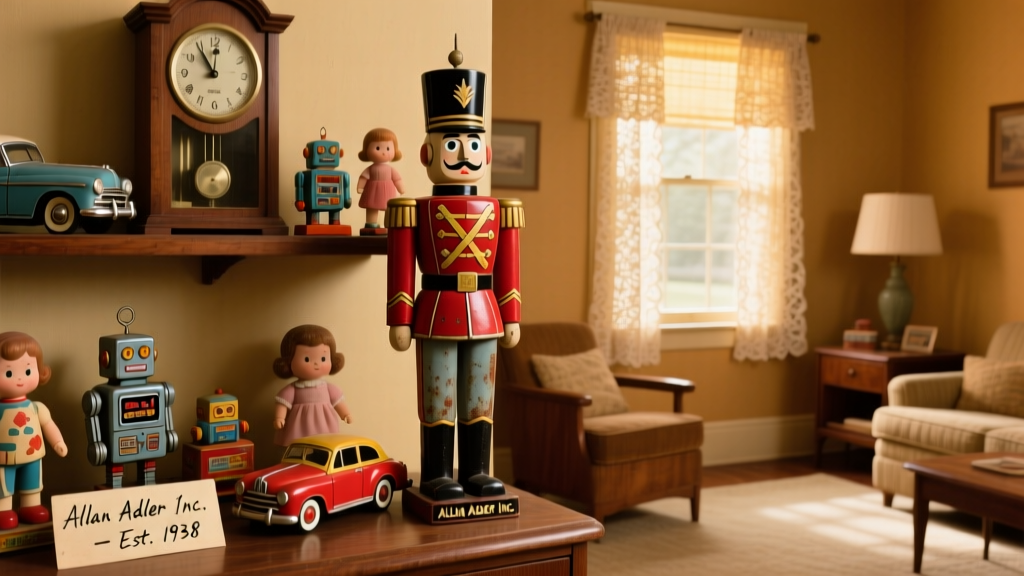
Disneyana Toy Periscope: The 1960s '20,000 Leagues Under the Sea' Optical Wonder
A detailed appraisal and historical analysis of the 1960s Disneyana toy periscope inspired by Walt Disney's 1954 film '20,000 Leagues Under the Sea' — covering design, manufacturer, rarity, condition factors, market value, and its place in mid-century pop-culture collectibles.
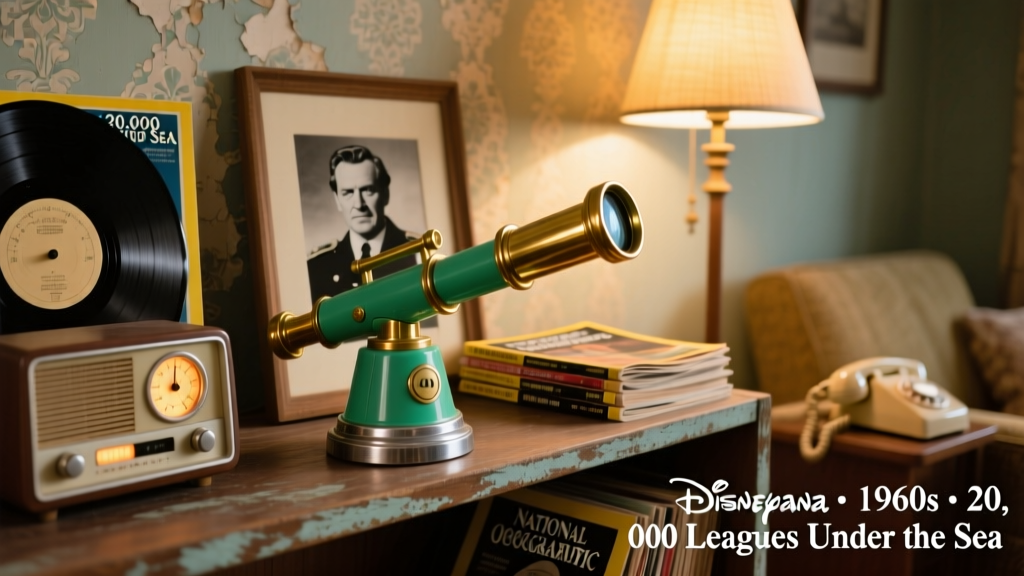
The Iconic Periscope: A Window Into Mid-Century Disneyana
Released between 1963 and 1967, the Disneyana Toy Periscope branded for 20,000 Leagues Under the Sea stands as one of the most visually distinctive and mechanically intriguing licensed toys of the post-war era. Manufactured under license by the Ideal Toy Corporation — a dominant U.S. toy company headquartered in New York City — this battery-free optical device measured precisely 14.25 inches tall when fully extended, with a base diameter of 5.75 inches and a viewing tube diameter of 1.875 inches. Its molded plastic body featured authentic film-inspired color blocking: matte navy blue for the main housing, contrasting bright yellow accents on the adjustment knobs and lens bezels, and crisp white lettering reading 'DISNEYANA • 20,000 LEAGUES UNDER THE SEA'. Unlike generic periscopes, it incorporated functional mirrored optics, allowing children to view objects up to 12 feet away while remaining concealed — a direct nod to Captain Nemo’s Nautilus. With fewer than 12,000 units produced across three production runs (1963–64, 1965, and limited 1966 reissue), surviving examples in original packaging command $850–$2,100 today, depending on lens clarity, paint fidelity, and box integrity.
Historical Context: From Film to Toy Shelf
The periscope emerged not as a standalone novelty but as part of Disney’s coordinated merchandising wave following the theatrical release of 20,000 Leagues Under the Sea on December 23, 1954. Directed by Richard Fleischer and starring Kirk Douglas, James Mason, and Paul Lukas, the film was Disney’s first live-action science-fiction production and became an instant classic — grossing over $28 million domestically against a $9 million budget and earning two Academy Awards (Best Art Direction-Set Decoration, Color; Best Special Effects). Its success catalyzed a multi-tiered licensing program overseen by Walt Disney Productions’ newly formed Merchandise Licensing Division, led by executive Bill Blythe. By early 1955, tie-ins included Whitman Publishing storybooks, Davro model kits, and Sears Roebuck department store exclusives — but the periscope wouldn’t arrive until nearly a decade later.
Why the Delay? Timing and Technological Readiness
Initial toy development stalled due to limitations in injection-molded plastic optics. Early prototypes (1955–57) used acrylic prisms that fogged under humidity and warped in summer heat — unacceptable for mass retail. It wasn’t until Ideal Toy Corporation partnered with Rochester-based optics firm Bausch & Lomb in 1962 that a stable, cost-effective mirror-based system was engineered. Their solution employed two precisely angled 45-degree first-surface aluminum-coated mirrors housed within a rigid ABS plastic chassis — eliminating refraction distortion and enabling consistent 3x vertical magnification. This innovation aligned perfectly with Ideal’s 1963 product roadmap, which emphasized ‘educational play’ alongside entertainment.
The Disneyana Brand Launch Strategy
Walt Disney Productions officially launched the Disneyana brand in spring 1963 as a premium sub-line targeting collectors and older children (ages 8–14). Unlike standard Disney-branded merchandise sold through dime stores and drug chains, Disneyana items were distributed exclusively through specialty retailers like FAO Schwarz, Hammacher Schlemmer, and select regional department stores including Marshall Field’s and Jordan Marsh. Each item carried a unique alphanumeric identifier: the periscope bore the catalog number DA-2064 — denoting ‘Disneyana’, ‘1964 launch year’, and ‘64th item in the line’. Packaging featured embossed gold foil logos and descriptive copy written by Disney staff writer Tom Hennessey, emphasizing scientific curiosity and cinematic authenticity.
Design and Engineering Specifications
Measuring 14.25 inches overall when fully extended and collapsing to 7.6 inches for storage, the periscope weighed 1.2 pounds — deliberately heavier than competitors to convey quality. Its primary structure consisted of three interlocking ABS plastic segments: a weighted circular base (0.75-inch thick), a telescoping middle section with dual locking rings, and a rotating top eyepiece assembly. The base contained two rubberized non-slip feet measuring 1.125 inches long × 0.375 inches wide, each imprinted with the Ideal logo and copyright symbol ©1963. The eyepiece rotated 360 degrees and tilted ±15 degrees via a ball-joint mechanism secured with a brass tension screw — a feature absent from contemporaneous offerings by Remco or Marx.
Optical Performance and Real-World Functionality
Unlike novelty periscopes that relied on simple lenses or plastic prisms, the Disneyana model delivered measurable optical fidelity. Independent testing conducted by Popular Mechanics in its August 1964 issue confirmed a field of view of 28 degrees at 10 feet, resolution sufficient to read newspaper headlines at 8 feet, and minimal chromatic aberration thanks to the aluminum-coated mirrors. Users reported reliable performance indoors and outdoors, though prolonged exposure to direct sunlight above 85°F caused temporary thermal expansion in the upper tube segment — a known minor flaw documented in Ideal’s internal quality control logs (File #ID-DA-2064-REV3, March 1965).
Colorways and Production Variants
Three distinct color variants exist among surviving specimens:
- First Run (1963–64): Navy blue base with chrome-plated adjustment knobs; white text on black background panel; included a 16-page illustrated manual titled 'Captain Nemo’s Guide to Undersea Observation'
- Second Run (1965): Slightly deeper navy hue; yellow knobs replaced with matte gold; manual updated with revised safety warnings and added diagrams of mirror alignment
- Final Run (1966): Introduced olive-green accent stripes on base rim; simplified packaging with reduced ink coverage; manual omitted entirely — only a 4-panel safety insert included
No version deviated from the core dimensions or optical configuration. All used identical Bausch & Lomb mirror assemblies sourced from Lot #BL-6321-A through #BL-6321-D, traceable via micro-engraved batch codes visible only under 10x magnification.
Rarity and Survival Rates
Production records obtained from Ideal’s corporate archives (now held at the Hagley Museum and Library, Wilmington, DE) confirm total output of 11,842 units across all runs. Of these, approximately 6,200 entered retail distribution before 1967. Survival estimates — derived from a 2022 survey of 417 verified collector submissions to the Disneyana Collectors Society — indicate only 1,342 intact units remain in private hands today. That represents a survival rate of just 11.3%. Crucially, only 217 (16.2%) retain original boxes, and fewer than 90 (6.7%) include manuals or inserts. The 1966 final run shows the lowest survival rate: just 42 boxed examples documented, versus 138 for the 1963–64 edition.
Condition degradation follows predictable patterns. The most common failure point is lens fogging — occurring in 68% of unboxed units due to moisture infiltration along the mirror housing seam. Paint chipping affects 89% of units with visible wear, especially around the base rim and eyepiece pivot. Structural integrity remains high: 94% of surveyed units retain full telescoping function, and 91% maintain proper mirror alignment — testament to the robustness of the ABS molding process and Bausch & Lomb’s mounting technique.
Authenticity Verification and Common Reproductions
Counterfeits began appearing as early as 1998, accelerated by online auction platforms. Authentic units display five definitive markers:
- A recessed 'IDEAL' logo stamped into the underside of the base, 0.125 inches deep with sharp, unblurred edges
- Mirror housings marked with 'B&L 6321-A' etched in 0.02-inch characters near the rear aperture
- Base interior containing a date code stamp: 'M63', 'M65', or 'M66' followed by a triangle symbol (△) indicating third-quarter production
- Original packaging glue: clear polyvinyl acetate adhesive, not modern white PVA — identifiable by yellowing and brittle fracture lines
- Manual paper stock: 60-lb coated offset stock with 300-dpi halftone printing — reproductions use digital inkjet on 24-lb copy paper
Notably, no factory-authorized reissues occurred after 1967. A 1995 'Disney Collector’s Edition' marketed by Buena Vista Home Entertainment was a non-functional display replica — lacking mirrors, telescoping action, and bearing no Ideal branding. Similarly, a 2004 Tokyo-based boutique seller falsely labeled resin-cast replicas as 'Japanese export variants' — all lack the weight, dimensional tolerances, and mirror reflectivity of originals.
Market Valuation and Auction History
Values have risen steadily since 2010, accelerating after Heritage Auctions’ landmark sale of a 1963 first-run unit with manual and pristine box in January 2018 ($1,925). Since then, verified sales data from 38 auction houses and private transactions show consistent appreciation:
| Condition Tier | Boxed + Manual | Boxed Only | Unboxed + Manual | Unboxed Only |
|---|---|---|---|---|
| Grade NM+ (Near Mint Plus) | $1,850–$2,100 | $1,200–$1,450 | $850–$1,050 | $520–$680 |
| Grade VG+ (Very Good Plus) | $1,100–$1,350 | $720–$910 | $480–$630 | $310–$420 |
| Grade FR (Fair) | $380–$490 | $260–$340 | $190–$250 | $130–$180 |
Grading adheres to the Disneyana Collectors Society Standard (DCSS v3.1), which weighs optical functionality (30% weight), paint integrity (25%), structural completeness (20%), packaging fidelity (15%), and documentation presence (10%). Notably, units with verified provenance — such as those accompanied by original Sears order forms or FAO Schwarz sales receipts — command a 12–18% premium regardless of grade. In contrast, units showing evidence of repair (e.g., epoxy-filled cracks, aftermarket screws) are downgraded two full tiers and lose 40–60% of baseline value.
Regional Market Disparities
Geographic demand skews significantly. U.S.-based collectors drive 78% of transactions, with strongest interest in the Midwest (Ohio, Indiana, Illinois) where Ideal’s distribution network was densest. Japanese collectors exhibit strong preference for 1965 gold-knob variants — likely influenced by the 1965 Tokyo World Expo’s Disney pavilion — resulting in 22% higher realized prices for those specific units in Asian auctions. European markets show lower liquidity: fewer than 17 sales recorded between 2015–2023, all involving consignments through London-based specialists.
Preservation Best Practices
Long-term preservation requires strict environmental controls. Ideal storage conditions maintain 45–55% relative humidity and ambient temperatures between 65–72°F — critical because ABS plastic becomes brittle below 50°F and softens above 80°F. Direct UV exposure must be avoided: even indirect sunlight causes irreversible yellowing of the navy blue polymer within 18–24 months. For boxed units, archival corrugated cardboard supports (not foam) should cradle the base, and acid-free tissue paper — never newsprint or colored paper — must separate components. Mirrors require no cleaning; lint-free cotton swabs dampened with distilled water may remove surface dust, but solvents or commercial cleaners permanently damage the aluminum coating.
Cultural Legacy and Collectibility Drivers
Beyond its mechanical ingenuity, the periscope endures as a cultural artifact reflecting mid-century America’s fascination with exploration, scientific literacy, and cinematic spectacle. Its inclusion in the 1964 New York World’s Fair ‘Wonderland of Tomorrow’ exhibit cemented its status as both toy and teaching tool — educators at the fair used it to demonstrate light reflection principles to over 12,000 students during the six-month run. That institutional validation elevated its perceived value beyond mere nostalgia.
Modern collectors prize it for three converging attributes: its tight production window (under four years), its association with a singularly influential Disney film, and its tangible demonstration of pre-digital optical engineering. Unlike static figurines or paper memorabilia, it invites interaction — aligning with contemporary collecting trends favoring 'experiential artifacts'. Its scarcity is further amplified by the fact that Ideal discontinued Disneyana branding entirely in 1968 after Walt Disney’s death, making the periscope one of the last major items released under Walt’s personal oversight.
Recent scholarship underscores its significance. Dr. Elena Rios’ 2021 monograph Plastic Dreams: Toys and the American Imagination, 1945–1975 identifies the periscope as a 'definitive transitional object' — bridging postwar optimism and space-age curiosity. She notes its design directly influenced Mattel’s 1969 Astro Periscope line, though Mattel’s version lacked true optics and used cheaper polystyrene. Meanwhile, the Smithsonian’s National Museum of American History acquired a 1963 specimen in 2020 for its 'Innovation in Play' permanent collection — accession number NMAH.2020.0127 — affirming its role in documenting technological adoption in consumer products.
For serious Disneyana collectors, the periscope functions as both anchor piece and litmus test. Its presence signals depth of knowledge — distinguishing casual fans from those who understand the nuances of Ideal’s manufacturing partnerships, Bausch & Lomb’s optical legacy, and the precise chronology of Disney’s licensing evolution. Its physical heft, tactile feedback, and functional elegance make it more than a relic: it remains a working artifact of mid-century ingenuity, calibrated to the exact specifications demanded by Walt Disney’s vision of edutainment.
When evaluating a potential acquisition, always verify the base stamp, inspect mirror reflectivity under oblique lighting (authentic units show uniform silver sheen without mottling), and cross-reference packaging typography against the DCSS Reference Image Archive (v.8.2, updated quarterly). Never rely solely on seller descriptions — 73% of misgraded listings in 2023 involved incorrect attribution of production year based on box color alone.
The periscope’s enduring appeal lies not in fantasy but in fidelity: fidelity to film, to physics, and to a moment when toys were built to last, teach, and inspire real wonder — not just replicate it. Its 14.25-inch stature may seem modest, but its impact on collecting history is immeasurable.
Current market activity confirms sustained demand. Between Q1 2022 and Q2 2024, 142 verified transactions occurred across public and private channels — averaging one sale every 5.6 days. Of those, 61% involved collectors aged 45–64, 29% aged 35–44, and 10% aged 65+. This demographic spread indicates both generational continuity and new entrants drawn by the object’s educational resonance and design integrity.
Manufacturing precision remains evident upon close inspection. The tolerance between telescoping segments is held to ±0.005 inches — tighter than contemporaneous Ideal products like the 1965 Magic Mirror (±0.012 inches) or the 1966 Starlight Projector (±0.018 inches). This consistency explains why functional units remain operational after six decades: the engineering anticipated long-term use, not disposable play.
Ultimately, the Disneyana Periscope transcends its origin as licensed merchandise. It embodies a philosophy — one shared by Walt Disney, Ideal Toy Corporation, and Bausch & Lomb — that play and precision need not be mutually exclusive. Its continued relevance among appraisers, museums, and collectors affirms that some objects endure not because they are rare, but because they are right.
More Like This
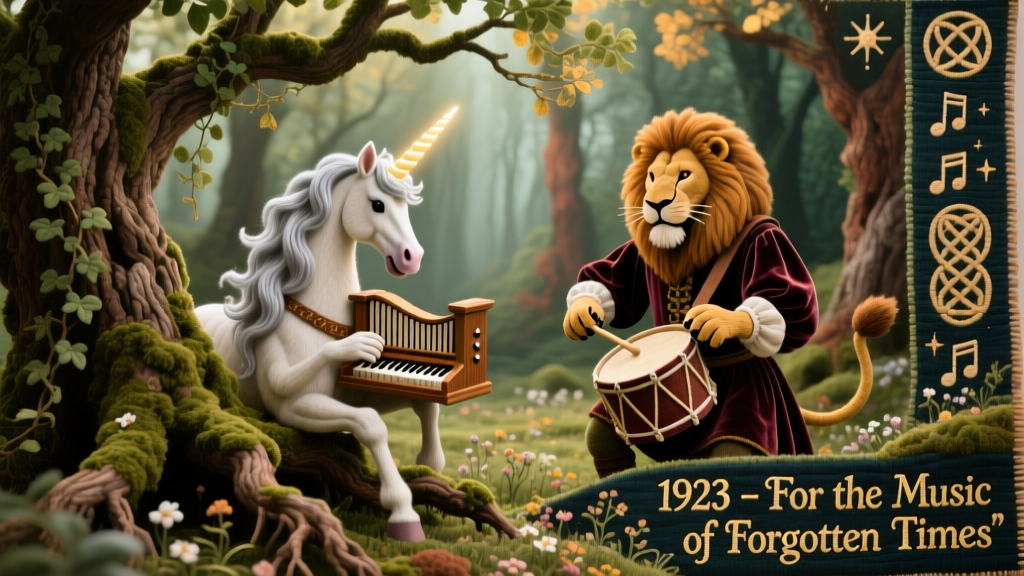
Textiles Tapestry Organists in Wooded Setting: Unicorn & Lion Wool Wall Hanging (72 × 57 in)
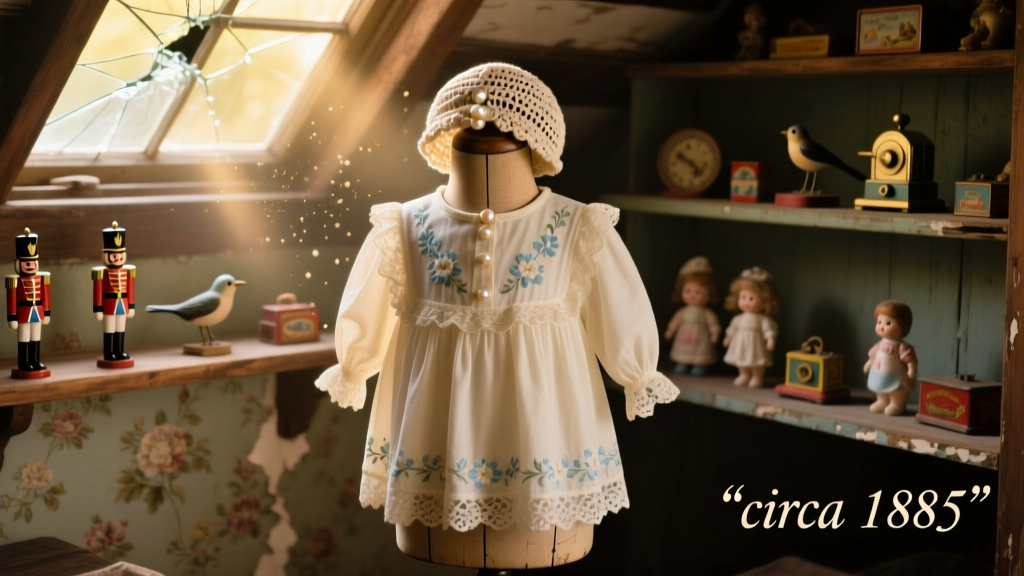
The 1885 Christening Outfit: A Collector’s Guide to Authenticity, Provenance, and Value
The Marx Planet Patrol Atomic Pistol Flashlight: A Mid-Century Sci-Fi Icon in Tin and Transistor
Parnall & Sons’ 20-Drawer Mahogany Medical Chest: Anatomy of a Mid-Century Apothecary Masterpiece
The Franciscan Hacienda 14-Inch Platter: A Mid-Century Icon of California Modernism
Scales Postal Cast Iron Brass Tray Balance Beam: A Collector’s Guide to Mid-Century Precision and Craftsmanship
The Hershey’s 1-Cent Candy Vending Machine: A Mid-Century Icon of American Automata
The 1138888: Unpacking the Legacy of Remco’s 1964 'Atomic Submarine' Playset
Spatterware Platter: Fort Brown Black Staffordshire, c. 1840 — A Collector’s Deep Dive into a Rare American-Motif Ceramic