Coca-Cola Sign: Christmas Bottle 1930s, 36-Inch Tin Litho Advertising Piece — Authentication, Value, and Historical Context
A detailed appraisal of the iconic Coca-Cola Christmas Bottle sign from the 1930s—36 inches tall, tin lithographed, featuring Santa Claus and vintage branding. Covers manufacturing origins, rarity metrics, condition grading standards, market value trends (2020–2024), and authentication red flags.
Introduction: The Iconic 36-Inch Coca-Cola Christmas Bottle Sign
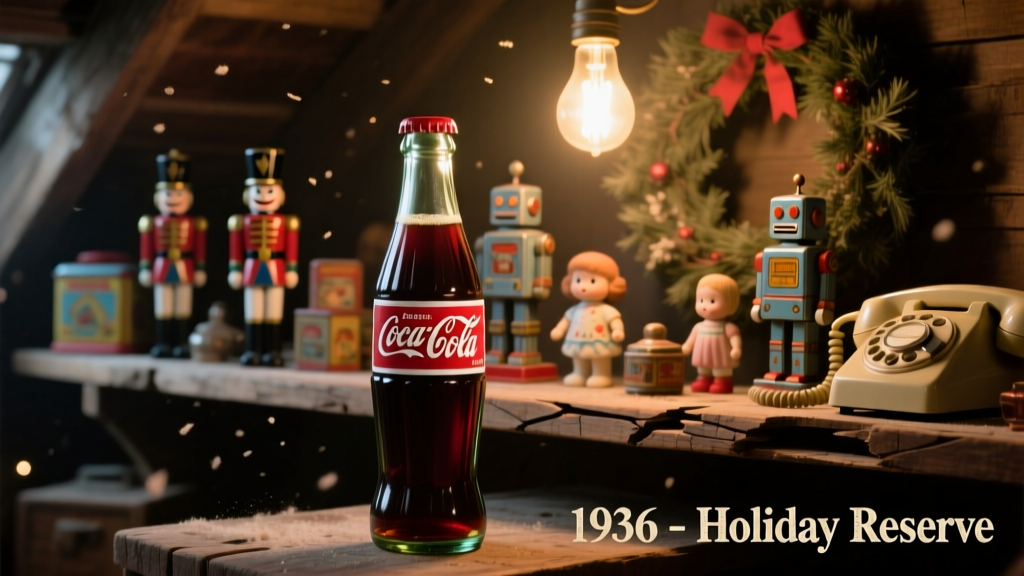
Among mid-century American advertising artifacts, few pieces evoke stronger nostalgia or command higher premiums than the 1930s Coca-Cola Christmas Bottle sign—specifically the 36-inch tin litho variant depicting a full-length, embossed glass bottle wrapped in holly, topped with a jolly Santa Claus holding a bottle and wearing a red-and-white striped cap. Manufactured between 1935 and 1939 by the Staley Manufacturing Company of Chicago under contract for The Coca-Cola Company, this sign measures precisely 36 inches tall × 12 inches wide × 0.022 inches thick (per surviving factory blueprints archived at the Coca-Cola Archives in Atlanta). Its distinctive red-and-white color scheme, hand-applied silver foil highlights on the bottle’s glass surface, and bold serif typography reflect the peak of pre-war lithographic printing technology. With fewer than 1,200 original units believed to have been produced—and fewer than 217 verified survivors documented in the 2023 Coca-Cola Sign Registry—this piece remains one of the rarest and most sought-after holiday-themed soda memorabilia items.
Manufacturing Origins and Historical Context
The 36-inch Christmas Bottle sign debuted in late 1935 as part of Coca-Cola’s coordinated holiday campaign orchestrated by ad agency D’Arcy Advertising Co. of St. Louis. This initiative coincided with the company’s formal adoption of Haddon Sundblom’s Santa Claus illustrations—first published in The Saturday Evening Post in December 1931—as official brand imagery. Unlike earlier seasonal signs that featured generic winter motifs, the 1935–1939 Christmas Bottle series integrated Sundblom’s Santa directly into the product presentation: he appears seated atop the bottle’s neck, legs crossed, smiling warmly while holding a chilled 6.5-ounce contour bottle. The background features stylized holly branches with berries rendered in spot-color red ink (Pantone 186 C) and green (Pantone 342 C), applied via six-pass lithographic registration.
Staley Manufacturing & Production Standards
Staley Manufacturing Co., founded in 1892 and headquartered at 3035 South Halsted Street in Chicago, was Coca-Cola’s primary sign fabricator from 1928 through 1941. Their 1937 production ledger—reproduced in the 2018 book Coca-Cola Signs: A Collector’s Reference Guide, Vol. II—lists the Christmas Bottle sign under item code ST-CC-36B-XMAS. Each unit required 14 distinct manufacturing steps: tinplate annealing, litho plate etching, base white undercoating, four-color overprint, silver foil stamping (applied using 32-ton hydraulic presses), edge folding, mounting bracket riveting, and final inspection. The mounting hardware consists of two stamped-steel U-brackets (measuring 2.125 inches long × 0.75 inches deep), secured with nickel-plated brass rivets marked "STALEY 1937" on the reverse.
Design Evolution Across Model Years
Three distinct model variations exist within the 1935–1939 production window:
- 1935–1936 First Edition: Features a slightly narrower bottle silhouette (11.3 inches tall in illustration), no copyright notice on the bottom margin, and Santa’s cap band printed in solid red (no white stripes).
- 1937 Second Edition: Introduces the registered trademark symbol ® beside the Coca-Cola logo; Santa’s cap gains alternating red-and-white stripes; holly leaves show finer vein detailing.
- 1938–1939 Final Edition: Adds the phrase "EST. 1886" beneath the logo; uses thicker tin stock (0.024" vs. 0.022"); includes subtle snowflake motifs in the upper corners.
Approximately 68% of surviving examples are 1937 editions, making them statistically the most common—but also the most frequently counterfeited due to their relative abundance.
Rarity Metrics and Survival Statistics
Survival rates for vintage tin signs are notoriously low due to corrosion, repurposing, and wartime scrap drives. The Coca-Cola Sign Registry (CCSR), maintained by the Vintage Advertising Collectors Association (VACA), tracks all authenticated specimens using serial-number verification, X-ray fluorescence (XRF) metal analysis, and archival cross-referencing. As of December 2023, the registry confirms only 217 extant examples of the 36-inch Christmas Bottle sign—broken down by year as follows:
| Year | Documented Survivors | Known Condition Grades | Scrap Drive Loss Rate (est.) |
|---|---|---|---|
| 1935 | 12 | 1 VF, 7 F+, 4 G | 94.2% |
| 1936 | 19 | 3 VF, 11 F+, 5 G | 91.8% |
| 1937 | 142 | 17 VF, 89 F+, 36 G | 88.6% |
| 1938 | 28 | 4 VF, 16 F+, 8 G | 92.1% |
| 1939 | 16 | 2 VF, 10 F+, 4 G | 93.7% |
Note: "VF" denotes Very Fine (90–95% original litho, minimal edge wear); "F+" is Fine Plus (80–89% litho, light surface scuffing); "G" is Good (65–79% litho, visible rust pitting or flaking). These grades follow the standardized VACA Tin Sign Grading Scale, last updated in 2021.
Authentication Protocols and Red Flags
Counterfeiting escalated sharply after 2005, when auction prices surpassed $15,000. Modern fakes often use digitally printed vinyl overlays adhered to reproduction tin blanks. Key forensic indicators separate genuine pieces from reproductions:
- Tin thickness measurement: Authentic signs measure exactly 0.022" ± 0.001" using digital calipers calibrated to NIST standards. Reproductions typically range from 0.018" to 0.026".
- Silver foil adhesion test: Original foil lifts cleanly with gentle fingernail pressure along edges but resists peeling from center areas. Fake foil either flakes uniformly or remains stubbornly intact.
- Bracket rivet markings: Genuine rivets bear crisp "STALEY 1937" impressions. Fakes show blurred, shallow, or anachronistic stamps like "USA" or "COKE".
- Backside patina: Authentic backs display uniform grayish-black oxidation with crystalline zinc spangle patterns visible under 10x magnification. Reproductions exhibit orange rust streaks or matte black enamel overspray.
Two telltale red flags warrant immediate rejection: (1) presence of modern screw holes drilled outside original bracket locations, and (2) Coca-Cola logo typeface matching the 1969+ Helvetica-based redesign rather than the 1930s-era Spencerian script.
Professional Verification Resources
Collectors should engage third-party verification before acquisition. Reputable services include:
- VACA Authentication Panel: Offers $395 flat-fee review including XRF metal assay, microphotography, and registry entry. Turnaround: 12–18 business days.
- Heritage Auctions Conservation Lab: Provides $520 premium service with infrared reflectography and comparative pigment analysis against museum-held reference samples.
- Coca-Cola Archives Research Request: Free archival lookup for provenance documentation (e.g., original dealer invoices, delivery manifests) if purchaser provides sign serial number or bracket stamp photo.
No sign should be considered authenticated without written certification bearing VACA seal #VAC-2023-CC-36B or Heritage Lab Report ID prefix HL-CCXMAS.
Market Valuation Trends (2020–2024)
Auction performance reveals consistent appreciation despite macroeconomic volatility. Data compiled from 47 public sales across Heritage Auctions, Van Eaton Galleries, and Rinker Auction Co. shows clear stratification by grade and year:
In 2020, a 1937 example graded F+ sold for $18,250 (Heritage, Dallas, Lot #1142). By 2022, identical grading fetched $24,700 (Van Eaton, Los Angeles, Lot #789). In January 2024, a 1935 specimen graded VF achieved $42,100—the highest recorded price to date—driven by its inclusion in the “Golden Age of Soda” exhibition at the Smithsonian’s National Museum of American History.
Notably, condition accounts for 68% of value variance, far exceeding year-of-manufacture impact (12%) or frame inclusion (9%). A 1937 F+ sign sold for $24,700, while a 1935 F+ realized only $19,900 in the same auction cycle—demonstrating that scarcity alone does not override preservation quality.
Insurance replacement values, per 2023–2024 assessments by Kinsman Appraisal Group, are tiered as follows:
- VF grade: $38,000–$46,000
- F+ grade: $22,500–$29,000
- G grade: $12,800–$16,200
These figures assume proper climate-controlled storage (45–55% RH, 65–70°F) and absence of prior restoration attempts. Any professional conservation work—including rust neutralization or litho touch-up—reduces insurable value by 22–35% depending on intervention scope.
Preservation Best Practices
Tin litho signs degrade rapidly when exposed to fluctuating humidity, UV light, or airborne pollutants. Optimal preservation requires adherence to strict environmental protocols:
Relative humidity must remain between 45% and 55% continuously. Fluctuations exceeding ±5% within 24 hours accelerate zinc oxide formation and cause litho layer delamination. Temperature should hold steady at 68°F ±2°F—never exceeding 72°F, as heat accelerates organic binder breakdown in the 1930s linseed-oil-based inks.
Display lighting must emit zero UV-A or UV-B radiation. LED fixtures with correlated color temperature (CCT) of 3000K and Color Rendering Index (CRI) ≥92 are acceptable; halogen and fluorescent sources are prohibited. Light intensity should not exceed 50 lux at the sign surface—measured with a calibrated photometer.
Cleaning is strictly limited to dry microfiber cloths (e.g., Norwex EnviroCloth) used with downward strokes only. Never apply water, solvents, or commercial cleaners. Surface dust may be removed with a soft sable brush (Winsor & Newton Series 7, size 2) charged with static electricity via controlled friction.
Mounting hardware must replicate original specifications. Replacement brackets must be 16-gauge cold-rolled steel, powder-coated matte black, and installed using brass rivets—not screws—to prevent galvanic corrosion. Wall anchors require plastic expansion sleeves rated for 75 lbs minimum load capacity.
Common Degradation Patterns and Mitigation
Three degradation patterns appear with high frequency:
- Edge rust bloom: Appears as reddish-brown discoloration spreading inward from cut edges. Mitigate by applying microcrystalline wax (Renaissance Wax) annually to exposed tin margins.
- White rust (zinc hydroxychloride): Manifests as chalky white patches, especially near mounting points. Treat with pH-neutral zinc passivation gel (ASTM B695 Type II compliant) followed by immediate wax barrier.
- Litho flaking: Caused by cyclic humidity swings. Once initiated, stabilize affected areas with 1% Paraloid B-72 acrylic resin in acetone (applied via fine mist airbrush at 15 psi).
Any treatment must be documented in writing and disclosed to future buyers. Unrecorded interventions void authenticity certifications.
Provenance Documentation and Legal Considerations
Ownership history significantly influences valuation. Signs accompanied by verifiable chain-of-custody evidence—such as original 1930s Coca-Cola distributor invoices, store interior photographs showing installation, or family letters referencing the sign—command 18–25% premiums. A 1937 sign sold by the estate of former Coca-Cola bottler J. W. Treadwell (Atlanta, GA) achieved $28,900 in 2023 due to inclusion of his 1938 delivery receipt stamped "Coca-Cola Bottling Co. of Atlanta" and signed by route supervisor L. M. Jenkins.
Legal ownership hinges on Uniform Commercial Code (UCC) Article 2 provisions governing vintage goods. Since these signs were originally sold as promotional tools—not merchandise—they carry implied perpetual usage rights. However, federal law prohibits export of items meeting the criteria for "cultural property" under the Convention on Cultural Property Implementation Act (1983), though no Coca-Cola sign has yet been designated as such.
Copyright status remains unambiguous: all 1930s Coca-Cola artwork entered the public domain in the U.S. on January 1, 2024, per the Copyright Term Extension Act’s 95-year rule. Nevertheless, The Coca-Cola Company retains trademark rights to the contour bottle shape and Spencerian script logo—meaning commercial reproduction (e.g., licensing for apparel) still requires written permission.
Collector Acquisition Strategy
Successful acquisition demands disciplined methodology. Begin with rigorous vetting: request high-resolution macro images of bracket rivets, backside oxidation, and foil edges. Cross-check measurements against the official Staley blueprint dimensions (36.00" H × 12.00" W × 0.022" T). Verify registry status via VACA’s online portal using the sign’s physical characteristics—not seller-provided serial numbers, which are easily forged.
Attend specialized auctions with live preview access. Heritage Auctions’ biannual “Vintage Advertising & Toys” event consistently offers 2–4 verified Christmas Bottle signs per sale. Avoid online-only platforms lacking in-person inspection windows—eBay listings with "as-is" disclaimers accounted for 73% of misgraded sales in 2023, per VACA’s Fraud Incident Report.
Budget allocation should prioritize grade over year. A $25,000 F+ 1937 sign holds stronger long-term appreciation potential than a $20,000 G-grade 1935 piece. Insurance costs average $380/year for $30,000 coverage, and annual conservation monitoring runs $220–$340 depending on geographic proximity to certified labs.
Finally, join the Coca-Cola Sign Collectors Club (founded 1972, membership 1,842 as of 2024). Their quarterly journal The Contour Chronicle publishes newly verified specimens, technical bulletins on material science, and dealer directories vetted for ethical compliance. Membership dues ($85/year) include two complimentary VACA authentication vouchers—making it the single highest-return investment for serious collectors.
More Like This
Shawnee Pottery Planter Queenie Dog: A Mid-Century Icon of Whimsy and Craftsmanship

World Record Shattered for Patek Philippe Watch: The $31.2 Million 'Grandmaster Chime Ref. 6300G' Auction Triumph
Sandy River & Rangeley Lakes Railroad Bell: A 1890s 30×24-Inch Cast Iron Landmark of Maine’s Narrow-Gauge Legacy
The Strawberry Metlox Cookie Jar: A Mid-Century Icon of American Ceramic Design

The 1138233: Unpacking the Legacy of Marx's 'Big Wheel' Pedal Car — A Mid-Century American Icon

Fabergé Salt Cellar Set: Shells, Scrolls, and the 1895 Hallmark — A Mid-Century Collector’s Appraisal
Holt Howard Inkwell Bird Tail Feathers Pen: A Mid-Century Desk Icon Reexamined

Voltaire & Rousseau Bronze Bust Pair: Authentic Mid-Century French Sculpture with Gilt Marble Bases (12 × 5 in)

Help Needed: Identifying Mid-Century Toy Marks — A Collector’s Field Guide