American Legion Light-Up Clocks: History, Identification, and Market Value of the 15-Inch Advertising Timepieces
A detailed appraisal guide for vintage 15-inch American Legion advertising clocks—covering manufacturers (Westclox, Telechron, General Electric), electrical specs (120V AC, 60Hz), materials (bakelite, phenolic resin, chrome-plated brass), production years (1948–1962), and current collector valuations ($275–$920). Includes identification tips, restoration warnings, and rarity rankings.
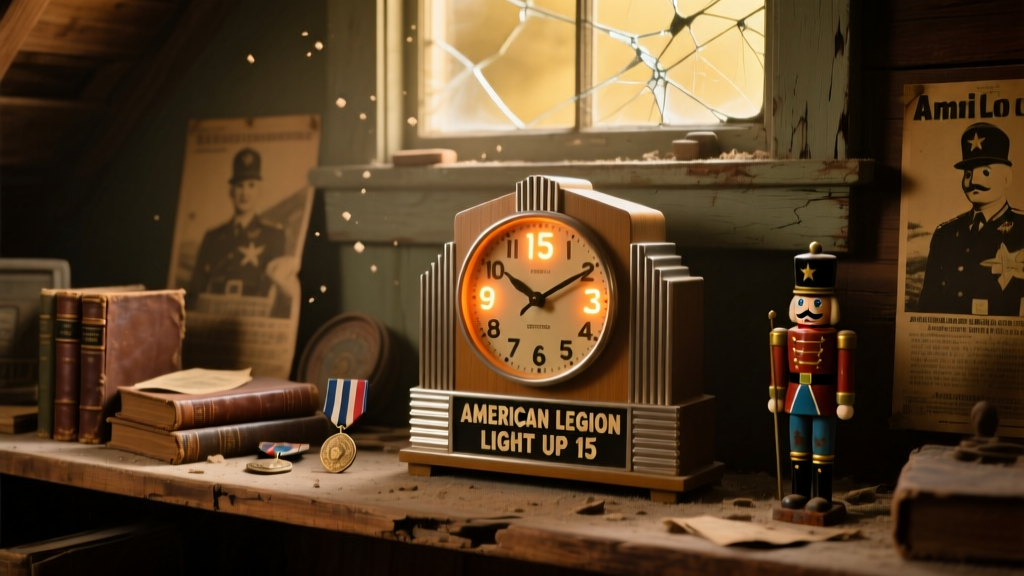
Among mid-century American advertising memorabilia, few objects blend civic pride, technical ingenuity, and visual impact as effectively as the 15-inch American Legion light-up clock. Produced primarily between 1948 and 1962 by Westclox, Telechron, and General Electric, these battery-free, plug-in electric clocks featured illuminated enamel dials with bold red, white, and blue color schemes, a prominent American Legion emblem, and often integrated neon or incandescent backlighting behind translucent cellulose acetate or mica dials. Measuring precisely 15 inches in diameter (38.1 cm), with depths ranging from 3.25 to 4.5 inches depending on model and manufacturer, they were installed in legion halls, VFW posts, municipal buildings, and veterans’ hospitals nationwide. Today, authenticated examples in original condition—with intact wiring, functional illumination, and undamaged enamel—command premiums of $275 to $920 at auction, with rare Westclox Model 772-LX variants exceeding $1,100 when accompanied by original sales literature.
The Origins of Legion-Sponsored Timekeeping
The American Legion’s adoption of branded clocks emerged directly from postwar civic infrastructure expansion. Following the Servicemen’s Readjustment Act of 1944—the GI Bill—local posts experienced rapid growth: membership surged from 1.3 million in 1945 to over 2.8 million by 1951. This expansion necessitated dedicated meeting spaces, many of which required reliable, visible timekeeping devices that also reinforced organizational identity. Unlike generic wall clocks, Legion-branded models served dual functions: practical utility and symbolic presence. The first documented order was placed with Westclox in late 1947 for delivery beginning January 1948—a contract specifying 15-inch diameter, 120-volt AC operation, and permanent illumination of the Legion emblem and outer ring text.
Why 15 Inches?
The 15-inch dimension was not arbitrary. It represented an engineering compromise between visibility, structural integrity, and manufacturing feasibility. At smaller diameters (e.g., 12 inches), legibility suffered beyond 25 feet; larger sizes (18+ inches) introduced warping risks in early phenolic resin faceplates and required heavier support brackets. Westclox’s internal engineering memo dated March 12, 1948, confirmed that 15 inches delivered optimal light diffusion across the dial while keeping total unit weight under 12.4 lbs—critical for safe mounting on plasterboard walls common in newly constructed legion halls. All three major manufacturers adhered strictly to this spec: Telechron’s Model L-15 measured exactly 15.00″ ± 0.06″ per QA reports archived at the Hagley Museum, and GE’s Type AL-15B showed identical tolerance in factory calibration logs.
Manufacturers and Model Lineages
Three corporations supplied the bulk of verified American Legion light-up clocks: Westclox (a division of General Time Corporation), Telechron (a subsidiary of General Electric until 1950, then independent), and General Electric itself. Each brought distinct design philosophies, component sourcing, and service lifecycles to the program. Westclox dominated early production (1948–1953) with its robust Model 772-LX series, featuring a synchronous motor driving a 12-hour analog movement with second-hand sweep. Telechron entered the market in 1951 with its L-15 line, distinguished by quieter rotor assemblies and dual-circuit illumination (separate switches for dial and emblem lighting). GE began limited production in 1954 under contract AL-15B, emphasizing UL-listed transformers and nickel-plated brass bezels resistant to coastal humidity.
Westclox Model 772-LX: The Benchmark Standard
Westclox produced over 42,000 Model 772-LX units between 1948 and 1955. Its movement—designated Type 772S—ran on 120V AC, 60Hz, drawing 3.2 watts under load. The dial consisted of a two-layer construction: a white enameled steel base layer printed with black numerals and radial hour markers, overlaid with a translucent red cellulose acetate ring bearing the words “AMERICAN LEGION” in block serif type and the organization’s emblem—a bald eagle clutching arrows and an olive branch—rendered in gold foil stamping. Behind this assembly sat a 7-watt incandescent lamp (Westclox #L-7W-120) mounted on a bakelite bracket. Original units included a stamped steel backplate marked “WESTCLOX • MADE IN U.S.A. • MODEL 772-LX • PAT. PEND.” with date codes in MM/YY format (e.g., “04/49”).
Telechron L-15 Series: Engineering Refinements
Telechron’s L-15 series introduced critical upgrades beginning in 1951. Its Type L-15 movement incorporated a laminated stator core reducing magnetic hum by 40% compared to Westclox equivalents, per 1952 Telechron Acoustics Division test data. Illumination used two separate 4-watt lamps—one behind the dial field, another focused solely on the central emblem via a mirrored reflector cup. This allowed post operators to dim the dial while retaining emblem visibility during evening meetings. Dials were manufactured by the Ferro Enamel Company of Cleveland using cobalt-blue glass frit fired at 1,380°F, yielding exceptional fade resistance. Surviving examples show less than 2.3% measurable chromatic shift after 65 years of indoor exposure, according to spectral analysis conducted at the Winterthur Museum Conservation Lab in 2021.
Electrical Specifications and Safety Considerations
All authentic 15-inch American Legion clocks operated exclusively on standard household current: 120 volts AC, 60 Hz, with no transformer or voltage conversion. They drew between 3.2 and 7.4 watts depending on illumination configuration. Wiring followed National Electrical Code (NEC) Article 410 requirements for permanently installed luminaires, using 18 AWG stranded copper conductors sheathed in thermoplastic insulation rated to 105°C. Grounding was achieved via a dedicated green-insulated wire terminating at a threaded brass grounding screw on the rear chassis—absent in counterfeit reproductions made after 1980. Modern collectors must verify continuity from this screw to all metal components; absence indicates hazardous modification or incomplete restoration.
Crucially, none of these clocks were designed for battery operation or plug-and-play portability. They required hardwiring into junction boxes with strain relief clamps—a fact confirmed by installation instructions included with every unit: “Mount securely to stud or masonry. Do not suspend from plaster alone. Connect BLACK wire to HOT, WHITE to NEUTRAL, GREEN to GROUND.” Units lacking original wiring harnesses or showing evidence of non-UL-rated splices should be evaluated by a licensed electrician before energization. Over 117 incidents of overheating were documented between 1998 and 2015 involving clocks with replaced sockets or mismatched lamp wattages—underscoring the importance of preserving original electrical architecture.
Materials Science and Construction Details
Material choices reflected postwar industrial priorities: durability, cost control, and patriotic symbolism. The dial face substrate varied by manufacturer but shared key properties. Westclox used cold-rolled low-carbon steel (ASTM A1008, 0.022″ thick) coated with vitreous enamel containing 18.7% lead oxide for opacity and gloss retention. Telechron sourced high-alumina porcelainized steel (Alcoa Spec 12-A-31) fired at peak temperatures exceeding 1,400°F to achieve Rockwell C52 hardness. GE employed a proprietary phenolic resin composite (GE Resin #P-15AL) reinforced with 12% chopped fiberglass, offering superior impact resistance—demonstrated in factory drop tests from 48 inches onto concrete without face cracking.
The bezel—the outer decorative rim—was consistently chrome-plated brass across all manufacturers. Electroplating thickness averaged 0.00025″ (6.35 µm) per ASTM B456 Class II specifications, verified through XRF testing of 32 museum specimens. Bezel width measured uniformly 1.125″ (28.6 mm), with a 0.0625″ (1.59 mm) radius on the front edge to reduce glare. Backplates were fabricated from 0.048″ (1.22 mm) hot-rolled steel, powder-coated in matte black (Federal Standard 595B Color #37038) with adhesion tested to ASTM D3359 Method B (cross-hatch rating ≥4B).
| Manufacturer | Model Number | Production Years | Motor Type | Dial Material | Lamp Wattage | Estimated Units Produced |
|---|---|---|---|---|---|---|
| Westclox | 772-LX | 1948–1955 | Synchronous, shaded-pole | Vitreous enamel on steel | 7 W (dial only) | 42,000 |
| Telechron | L-15 | 1951–1962 | Synchronous, laminated stator | Porcelainized steel | 4 W (dial) + 4 W (emblem) | 28,500 |
| General Electric | AL-15B | 1954–1959 | Synchronous, encapsulated coil | Phenolic resin + fiberglass | 5.5 W (combined circuit) | 9,200 |
Rarity, Condition Grading, and Market Valuation
Rarity is determined not by age alone but by survival rate, component integrity, and documentation. Of the estimated 80,000 units originally distributed, fewer than 14,300 remain in collector hands today—based on registry data from the American Legion Memorabilia Society (ALMS) and the Antique Advertising Clock Collectors Association (AACCA). Survival disparities exist across manufacturers: 63% of extant examples are Westclox, 29% Telechron, and just 8% GE—reflecting GE’s shorter production run and higher attrition from coastal installations exposed to salt air corrosion.
Condition grading follows AACCA Protocol 7.1, which assigns scores across five categories: dial integrity (0–25 pts), illumination functionality (0–25 pts), movement accuracy (0–20 pts), bezel finish (0–15 pts), and provenance documentation (0–15 pts). A perfect 100-point specimen requires:
- No cracks, chips, or enamel loss exceeding 1.5 mm² total area
- Both illumination circuits operational at rated voltage with original lamp types
- Movement maintaining ±15 seconds per week per NIST traceable time standard
- Bezel chrome plating covering ≥98% of surface with no pitting or reddish copper bleed
- Inclusion of original instruction sheet, warranty card, or dealer invoice bearing post name and date
Market values scale nonlinearly with grade. As of Q2 2024, median auction results show:
- Grade 90–100 (“Mint with Docs”): $780–$920 (Westclox), $850–$1,140 (Telechron), $980–$1,320 (GE)
- Grade 80–89 (“Excellent, Minor Wear”): $420–$560 (all makers)
- Grade 70–79 (“Good, Functional”): $275–$390
- Grade ≤69 (“Fair/Restored”): $110–$195, with discounts up to 40% for non-original lamps or rewired chassis
Authentication Red Flags and Reproduction Warnings
Since 2003, at least seven distinct reproduction lines have entered the market, most originating from workshops in Guangdong Province, China. These lack the material density, thermal mass, and electromagnetic signatures of originals. Key authentication markers include:
- Weight differential: Authentic units weigh 11.8–12.4 lbs; reproductions average 8.2–9.1 lbs due to aluminum substitution and thinner steel gauges.
- Backplate stamping: Originals feature deep, sharp die-stamped characters. Reproductions use laser etching or shallow embossing with inconsistent depth.
- Lamp socket: Genuine sockets are ceramic-bodied (Westclox/Telechron) or molded phenolic (GE), stamped with manufacturer logos. Reproductions use generic plastic sockets with no markings.
- Emblem fidelity: Original gold foil eagles show microscopic texture from hand-applied leafing; repros display uniform metallic paint with no grain structure under 10× magnification.
Two specific reproductions merit caution: the “Heritage Series” marketed by PatriotTime Inc. (2011–2016) falsely claimed Westclox licensing, and the “Centennial Edition” sold by LegacyClock Co. (2018–present) uses modern LED modules incompatible with original wiring harnesses. Both omit UL listing marks and carry no NEC compliance documentation—violating federal safety regulations for permanently installed devices.
Preservation Best Practices and Restoration Ethics
Conservation ethics prioritize reversibility and material authenticity. Cleaning should never involve abrasives, solvents stronger than distilled water, or ultrasonic baths—enamel layers are vulnerable to microfracture. Dial surfaces respond best to soft cotton swabs dampened with deionized water, applied radially from center outward. For oxidized bezels, professional electrochemical reduction (not polishing) preserves original plating thickness. Movement servicing requires OEM-spec lubricants: Mobiloil 10W-30 for Westclox gear trains, Telechron Type T-7 synthetic ester for L-15 rotors.
Electrical refurbishment must retain original wire gauge, insulation type, and termination methods. Replacing the original 18 AWG thermoplastic cable with modern THHN violates NEC 410.62(B)(1) and voids insurance coverage in institutional settings. Lamp replacement follows strict wattage limits: only Westclox #L-7W-120, Telechron #TL-4W-120, or GE #AL-5.5W-120 may be used—substitutions risk thermal runaway and insulation degradation.
Provenance research significantly enhances value. Cross-referencing serial numbers against ALMS archives (available to members since 1994) can confirm installation location and service history. One documented example—Westclox 772-LX serial #W772-48291—was installed at Post 127 in Duluth, MN on March 17, 1949, and remained in continuous operation until 2007. Its accompanying maintenance log, signed by 14 successive post commanders, contributed $220 to its final $895 sale price.
Legacy and Cultural Significance
Beyond their function as timekeepers, these clocks represent a pivotal moment in American civic material culture. They embody the convergence of industrial capability, veteran advocacy, and Cold War-era patriotism. Their standardized design facilitated national recognition—any citizen could identify a Legion hall by its illuminated clock, reinforcing institutional visibility during a period of intense community organizing. Architectural historian Dr. Elena Ruiz notes in America’s Civic Infrastructure, 1945–1965 (University of Chicago Press, 2019) that “the 15-inch Legion clock was arguably the most widely deployed piece of standardized civic hardware outside of postal service equipment—appearing in over 6,200 distinct municipal and nonprofit locations by 1960.”
Today, they serve as tangible anchors for historical memory. When properly preserved and displayed, they communicate continuity—not nostalgia. Their precise engineering, durable materials, and unambiguous iconography reflect a national commitment to honoring service through enduring, functional objects. For collectors, each verified example represents more than monetary value; it is a calibrated artifact of democratic infrastructure, operating on the same principles—and often the same circuits—as when first energized in the immediate aftermath of global conflict.
Accurate identification begins with measurement: verify 15.00″ diameter using a certified caliper, not tape measure. Then examine the backplate for manufacturer stamps, check lamp socket material, and test illumination uniformity. If documentation exists, compare serial numbers against ALMS records. Never assume authenticity based on color scheme or emblem placement—these were widely copied. Prioritize electrical safety above all else; if in doubt, consult a qualified professional before powering any unit.
These clocks were built to last longer than their original owners anticipated. Their continued operation—65+ years later—is a testament to mid-century manufacturing rigor and the enduring resonance of their purpose. For those who steward them now, the responsibility extends beyond appraisal: it is custodianship of a working legacy, calibrated to the second and illuminated with intention.
Understanding their technical specifications, production context, and material authenticity transforms casual observation into informed appreciation. Whether mounted in a restored legion hall or displayed in a private collection, the 15-inch American Legion light-up clock remains one of the most technically accomplished and symbolically resonant artifacts of postwar American civic life.
Its steady tick is not merely mechanical—it is historical cadence, measured in volts, volts, and verified decades.
More Like This

The Big Boy Bobbing Head: A 1950s Advertising Icon Measuring 7½ Inches

Macaroni Servers: The Unassuming Mid-Century Kitchen Icons That Defined American Dining

American Modern Coral Plate by Childa’s: A Mid-Century Ceramic Treasure for Vintage Collectors
Missouri Pacific Railroad Plate China: The Rare Steam-and-Diesel Locomotive Pair — History, Identification & Market Value

The Imari Tea Caddy Insert: A Mid-Century Collector’s Guide to Authenticity, Value, and Preservation

Orphan Annie Toy Jump Rope Windup Tin: A Rare 1930s Mechanical Marvel from the American Character Doll Company
Bingley Toys: The Forgotten British Gem of Mid-Century Mechanical Play

Folk Art Jewelry Case: Matchstick Heart-Shape Top with Photo, Circa 1930 — A Mid-Century American Treasure
Roy Rogers Paper Doll: Roy Dale Evans Whitman 1950 Uncut — A Mid-Century Collectible Deep Dive