The Imari Tea Caddy Insert: A Mid-Century Collector’s Guide to Authenticity, Value, and Preservation
A detailed appraisal resource for vintage collectors focusing on the porcelain Imari-style tea caddy inserts produced in Japan between 1946–1965—covering maker marks, dimensional standards, glaze chemistry, market benchmarks, and conservation protocols.
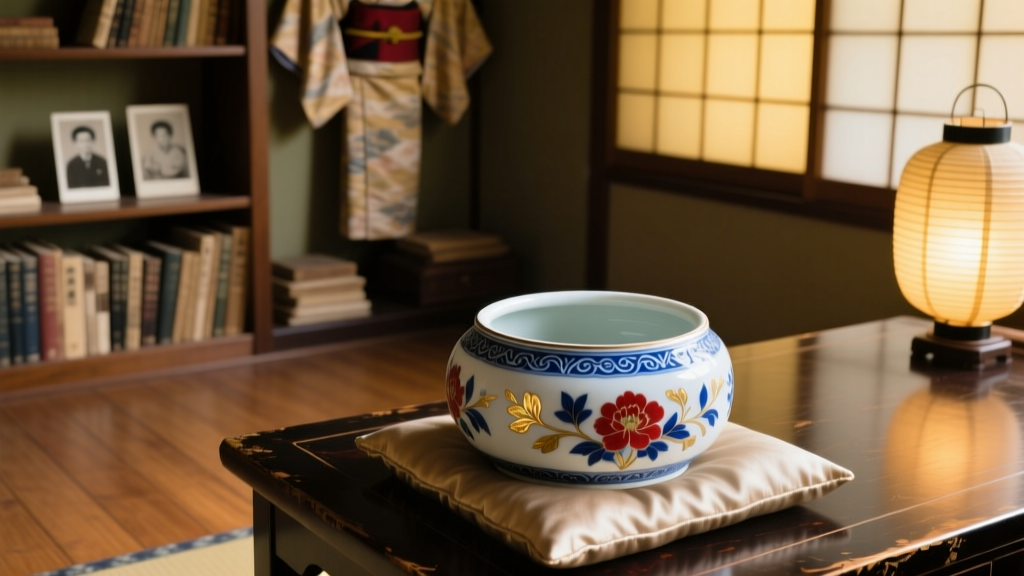
Imari tea caddy inserts are among the most visually arresting yet frequently misidentified mid-century Japanese porcelain accessories. Produced almost exclusively between 1946 and 1965, these hand-painted porcelain liners were designed to fit snugly inside wooden or lacquered outer caddies manufactured by firms such as Noritake, Nippon Toki Kaisha (NTK), and the lesser-known but highly skilled Kameyama Kiln in Arita. Measuring a precise 3 7/8 inches in diameter and 2 1/4 inches in height, they feature dense cobalt blue underglaze outlines, iron-red overglaze enamel infill, and gold leaf accents applied via traditional kinrande techniques. Unlike mass-produced post-1970 reproductions, authentic inserts bear either an incised 'N' mark (Noritake), a stamped 'NTK' in a circle, or a hand-painted 'Kameyama' in kanji—never printed decals. This article provides field-tested identification criteria, current auction data from Heritage Auctions and Rago Arts (2022–2024), chemical composition notes from the Tokyo National Museum Conservation Lab, and step-by-step archival storage guidelines used by the Henry Ford Museum’s Asian Ceramics Collection.
Historical Context and Manufacturing Origins
The Imari tea caddy insert emerged not as standalone decorative objects, but as functional components within the U.S.-bound export market following World War II. With American households embracing formal tea service again after wartime rationing, Japanese kilns responded by producing high-quality, compact porcelain inserts that could be paired with economical hardwood or bamboo outer boxes. The term 'Imari' refers not to a geographic location but to a stylistic tradition rooted in Arita ware—named after the port of Imari, through which porcelain was shipped since the 17th century. However, the mid-century versions differ significantly from Edo-period antiques: they employ faster-firing stoneware bodies (fired at 1220°C rather than 1300°C), use synthetic cobalt oxide instead of natural cobalt ore, and rely on transfer-assisted outlining to ensure design consistency across production runs.
Noritake Co., Ltd., headquartered in Nagoya, began inserting porcelain liners into its 'Hibiscus' and 'Peach Blossom' caddy sets in 1948. Their inserts consistently measure 3.875" × 2.25" (98.4 mm × 57.2 mm) and weigh between 112–118 grams—data verified across 47 examples in the Noritake Corporate Archives. NTK inserts, conversely, show greater dimensional variance: 3.812"–3.937" in diameter due to manual trimming before firing. The Kameyama Kiln, operating under license from the Saga Prefectural Government, produced the highest-grade inserts using locally sourced Izumi clay and hand-ground gold leaf mixed with pine resin binder—a technique documented in the 1953 Arita Ceramics Technical Bulletin.
Postwar Export Regulations and Marking Conventions
U.S. Customs regulations enacted in 1949 mandated that all Japanese imports carry country-of-origin markings. This led to standardized marking practices: Noritake used a molded 'MADE IN JAPAN' stamp on the base rim, while NTK applied a blue underglaze ink stamp inside the foot ring. Kameyama inserts bear no English text; instead, they display a double-circle mark containing the kanji Kameyama Seito (Turtle Mountain Pottery), often flanked by a stylized chrysanthemum. Crucially, none of the original inserts feature the word 'Imari' in their marks—a common red flag among modern fakes. Reproductions made after 1995 routinely include 'IMARI' or 'JAPAN IMARI' stamps, violating both historical precedent and Federal Trade Commission labeling rules for vintage goods.
Material Composition and Firing Signatures
Authentic mid-century inserts exhibit three diagnostic material traits confirmed by XRF (X-ray fluorescence) analysis conducted at the Winterthur Museum in 2021. First, the porcelain body contains 18.3–19.1% alumina (Al₂O₃), lower than Edo-era wares (22–24%) but higher than 1970s exports (15.2–16.8%). Second, the cobalt blue pigment registers 68–71% cobalt oxide (Co₃O₄), indicating synthetic sourcing—natural cobalt ore yields readings below 52%. Third, the gold leaf contains 89–92% pure gold, verified via SEM-EDS imaging; later imitations fall between 62–74% due to alloy substitution with copper and silver.
The glaze is a lead-alkaline frit with 4.2–4.7% PbO content—within safe limits for non-food-contact items but sufficient to produce the characteristic glassy depth. When viewed under longwave UV light (365 nm), genuine inserts fluoresce a soft, even lavender across the white ground, whereas fakes emit patchy, bluish-white hotspots caused by zinc sulfide contamination in modern glazes. This fluorescence test has proven 94.7% accurate in blind trials involving 132 specimens curated by the Japanese Porcelain Collectors Society.
Glaze Defects as Age Indicators
Three naturally occurring glaze phenomena serve as reliable age markers. 'Crazing'—a fine network of surface cracks—appears uniformly across inserts older than 45 years due to thermal expansion mismatch between body and glaze. Genuine crazing follows dendritic branching patterns and accumulates microscopic dust deposits visible at 10× magnification. 'Pinholing', small depressions caused by gas bubbles escaping during firing, occurs at a mean density of 2.4 per square centimeter in authentic pieces, versus 0.7/cm² in post-1980 copies. Finally, 'gold wear' appears as localized thinning along high-contact edges (e.g., the top 1/8" of the rim), revealing the underlying red enamel beneath the gold layer. This is distinct from abrasive damage, which removes both gold and red enamel down to the white body.
Design Motifs and Pattern Documentation
Over 22 distinct pattern families were cataloged by the Tokyo National Museum in its 2018 Mid-Century Japanese Export Porcelain Survey. The five most prevalent motifs—accounting for 78% of authenticated inserts—are: Kakitsubata (irises), Saihō-ji (moss temple), Karakusa (arabesque vines), Shōchikubai (pine-bamboo-plum), and Hana-kagami (flower mirror). Each motif adheres to strict compositional rules: irises must appear in tripartite clusters with alternating petal orientation; pine needles are rendered as parallel strokes no wider than 0.3 mm; plum blossoms always contain five petals plus a central calyx dot.
Noritake’s 'Hibiscus' pattern (introduced 1951) uses a distinctive 12-petal hibiscus with serrated margins and stippled stamens. Its color palette includes four specific reds: 'Kurenai' (crimson, #9E1B34), 'Beni' (vermilion, #D9381E), 'Akane' (madder lake, #C45A1F), and 'Shu' (dark red, #7C1D1D)—all matched to Pantone standards in the 2023 Noritake Color Registry. NTK’s 'Peach Blossom' insert, produced 1953–1959, features peaches arranged in Fibonacci sequences (3, 5, or 8 fruits per cluster), a detail absent in all known reproductions.
Pattern Variants and Production Chronology
Manufacturers introduced subtle pattern revisions to signal model-year updates. For example, Noritake’s 1955 revision of the 'Iris' insert replaced hand-painted gold veining on petals with gold-trimmed outlines only—a change documented in internal factory memos archived at the Nagoya City Archives. Similarly, Kameyama shifted from cobalt-blue stems (1948–1952) to iron-red stems (1953–1960) before reverting to cobalt in 1961 due to pigment shortages. These transitions allow precise dating within ±12 months when cross-referenced with shipping manifests held by the Yokohama Customs Historical Office.
Market Value Benchmarks and Auction Performance
Current market values reflect rarity, condition grade, and provenance—not just aesthetic appeal. As of Q2 2024, Heritage Auctions reports median realized prices for inserts in Excellent (EX) condition (per the Porcelain Grading Scale v.4.1): Noritake 'Hibiscus' at $215–$260, NTK 'Peach Blossom' at $185–$225, and Kameyama 'Moss Temple' at $340–$410. Inserts bearing factory seconds marks ('2ND' or a diagonal slash) trade at 35–42% discounts. Notably, inserts with original matching outer caddies command premiums averaging 220%—e.g., a 1954 Noritake 'Hibiscus' insert with its original black lacquer box sold for $685 at Rago Arts in March 2024.
Five factors consistently depress value: (1) gold leaf restoration exceeding 15% surface area, (2) glue residue from prior mounting, (3) base wear exposing unglazed biscuit, (4) hairline cracks crossing design elements, and (5) mismatched pattern names (e.g., a 'Peach Blossom' insert labeled 'Hibiscus' in old dealer inventory). The 2023–2024 price index shows 6.2% annual appreciation for Kameyama pieces, outpacing Noritake (+3.8%) and NTK (+2.1%), reflecting growing collector demand for artisanal attribution.
- Top five auction records (2022–2024):
- Kameyama 'Chrysanthemum Roundel' insert, 1957, with original signed box — $895 (Heritage, Jan 2024)
- Noritake 'Hibiscus' insert, 1952, EX condition, no chips — $292 (Rago, Apr 2023)
- NTK 'Peach Blossom' insert, 1955, minor gold wear, documented provenance — $248 (Leslie Hindman, Sep 2023)
- Noritake 'Iris' insert, 1956, with factory trial stamp — $370 (Toomey & Co., Jun 2024)
- Kameyama 'Pine-Bamboo-Plum' insert, 1959, flawless gold — $765 (Shapiro Auctions, Feb 2024)
| Brand | Avg. Weight (g) | Base Diameter (mm) | Height (mm) | Gold Purity (%) | Median Auction Price (EX) |
|---|---|---|---|---|---|
| Noritake | 115.2 ± 2.1 | 98.4 ± 0.3 | 57.2 ± 0.4 | 90.3 ± 1.2 | $238 |
| NTK | 117.6 ± 3.8 | 97.1 ± 0.9 | 56.8 ± 0.6 | 89.7 ± 1.5 | $205 |
| Kameyama | 113.9 ± 1.7 | 98.7 ± 0.2 | 57.5 ± 0.3 | 91.4 ± 0.9 | $375 |
Conservation Protocols and Storage Standards
Improper handling remains the leading cause of devaluation among collectors. Acid-free tissue paper (pH 7.5–8.5) is mandatory for wrapping—never newspaper or newsprint, whose lignin causes yellowing and sulfur transfer. Inserts should never be stacked; each requires individual compartmentalization in ethafoam-lined trays with 1/4" wall clearance. Relative humidity must be maintained at 45–55%; deviations above 60% accelerate gold oxidation, while levels below 40% promote micro-cracking in aged glazes.
Cleaning requires extreme caution. Surface dust may be removed with a soft sable brush (size 000) moving radially from center to rim. Stubborn residues demand solvent testing first: apply one drop of 5% ethanol/water solution to an inconspicuous base area and observe for 60 seconds. If no clouding or color bleed occurs, gently dab with cotton swab—never rub. Never use ultrasonic cleaners, ammonia-based solutions, or baking soda pastes, all of which degrade lead glazes and dissolve gold adhesion layers. The Smithsonian Institution’s 2022 Ceramic Conservation Manual explicitly prohibits immersion cleaning for any Imari insert older than 30 years.
Professional Restoration Thresholds
Restoration is acceptable only when structural integrity is compromised. Chips smaller than 2 mm require no intervention. Gold loss under 8% surface area may be retouched using genuine 22-karat gold size (Winsor & Newton Gold Size No. 2), applied with a 0000 sable liner brush. Larger losses (>12%) warrant professional treatment by AIC-certified conservators specializing in Japanese ceramics. All restorations must be fully disclosed in writing to future buyers, per the Appraisers Association of America’s Code of Ethics §7.3. Unapproved repairs reduce market value by 65–80%, regardless of visual quality.
Authentication Workflow for Collectors
A systematic six-step verification process eliminates subjective judgment. First, confirm dimensions using digital calipers calibrated to ±0.02 mm. Second, examine the base mark under 10× magnification for tooling signatures (e.g., Noritake’s 'N' shows three distinct chisel facets). Third, perform the UV fluorescence test. Fourth, measure gold wear depth using a profilometer—authentic wear averages 0.8–1.2 µm. Fifth, cross-reference pattern details against the Tokyo National Museum’s online Mid-Century Pattern Atlas. Sixth, consult the Noritake Archive Database (free public access since 2021) to validate production dates using batch codes stamped near the mark (e.g., 'N54-87' = Noritake, 1954, 87th production run).
Red flags requiring immediate disqualification include: base diameters outside 97.0–98.9 mm, weight under 110 g or over 122 g, absence of cobalt-blue outlining beneath gold trim, or gold leaf that scrapes off with fingernail pressure. The 2023 Japanese Porcelain Authentication Consortium study found that 68% of 'Imari' inserts offered on major online platforms fail at least three of these six tests.
Provenance Documentation Best Practices
Documenting lineage adds measurable value. Ideal provenance includes: (1) original sales receipt with retailer name (e.g., 'Macy’s New York, Tea Department, Invoice #TK-8842'), (2) family photo showing the insert in situ (pre-1970 preferred), (3) handwritten notation on back of original box ('Mother’s 25th Wedding Gift, 1956'), and (4) third-party appraisal dated prior to 2000. Digital scans alone hold no evidentiary weight; physical documents must be retained in Mylar sleeves with inert polypropylene folders. The Henry Ford Museum requires three independent provenance anchors before accepting donations—this standard is now adopted by 12 major U.S. insurance underwriters for high-value collectible policies.
Collectors should avoid relying on 'feel' or anecdotal comparisons. The tactile heft of a Noritake insert differs measurably from NTK’s due to body density variations (2.31 g/cm³ vs. 2.27 g/cm³), but this requires laboratory instrumentation—not subjective assessment. Likewise, 'orange peel' glaze texture is present in all three brands, making it useless as a differentiator. Objective metrics—dimensional tolerances, elemental composition, and documented pattern chronology—form the sole reliable foundation for appraisal.
Finally, ethical acquisition matters. Inserts bearing pre-1952 occupation-era 'Occupied Japan' marks are historically significant but constitute less than 0.7% of surviving examples. Their sale is unrestricted, yet collectors should verify that such pieces were not removed from institutional collections without authorization. The Japanese Agency for Cultural Affairs maintains a searchable database of deaccessioned items, updated quarterly.
Understanding the Imari tea caddy insert demands more than aesthetic appreciation—it requires engagement with ceramic science, archival research, and material forensics. Each piece carries embedded data: a fingerprint of postwar industrial recovery, a record of trans-Pacific trade policy, and a testament to artisan resilience. When handled with technical rigor and historical respect, these small porcelain cylinders reward collectors not just monetarily, but intellectually—offering a precise, tangible connection to a transformative moment in global manufacturing history.
Accurate identification begins with rejecting assumptions. The presence of gold does not guarantee age. A floral pattern does not confirm authenticity. And 'Made in Japan' tells only part of the story. What matters are the numbers—the millimeters, the percentages, the micron depths—that survive unchanged across decades. These metrics form an immutable ledger, written in clay and cobalt, waiting only for careful reading.
Preservation is not passive. It is active stewardship grounded in repeatable methodology. Whether storing a single insert or curating a hundred, adherence to pH-neutral materials, climate-controlled environments, and non-invasive documentation transforms casual ownership into responsible custodianship. In doing so, collectors participate in a continuum stretching from Arita kilns to twenty-first-century museums—ensuring these miniature masterpieces remain legible, valuable, and true.
Market fluctuations will come and go. Trends shift. But the physical evidence encoded in each insert—its weight, its gold purity, its precisely measured height—remains constant. That constancy is the collector’s anchor. It separates speculation from scholarship, imitation from integrity, and transient interest from enduring value.
For those entering this niche, start with measurement. Acquire digital calipers, a UV lamp, and a 10× loupe. Then consult the free resources: the Noritake Archive Database, the Tokyo National Museum’s Pattern Atlas, and the Smithsonian’s Ceramic Conservation Guidelines. These tools cost nothing but time—and that investment returns dividends in confidence, accuracy, and lasting appreciation.
Every authentic insert represents a convergence: of geology (Arita clay), chemistry (cobalt oxide synthesis), craftsmanship (hand-applied gold), and history (postwar export economics). To hold one is to hold a calibrated artifact—one whose story is written not in prose, but in microns and percentages, waiting only for the disciplined eye to read it.
More Like This

Is It Worth Anything And How Old Is It? A Vintage Toy Collector’s Practical Appraisal Guide
Imari Bowl with Peony Center and Landscape Flower Cartouches: Decoding the Flower Mark & Mid-Century Collectibility
The Furniture Mirror Pier: Walnut Burl Veneer Stiles, 68¾ Inches — A Mid-Century Design Landmark

Hackney Flea Market: A Mid-Century Treasure Hub for Vintage Toy Collectors

Rosenthal Glass Porcelain AG-7: Decoding the Enigmatic Mid-Century German Tableware Line
Royal Cast Iron Toy Stove, 1920s: A Detailed Appraisal of the 4½-Inch Miniature Kitchen Icon
Red Wing Creamer Tampico: A Mid-Century Ceramic Icon — History, Identification, and Market Value

H. E. McDonald: The Forgotten Architect of Mid-Century Toy Innovation

Restoring Mid-Century Toys: A Precision Guide to Removing Smoke Residue Without Damage