The Cat Fishbowl Planter: A Mid-Century Ceramic Icon of Whimsy and Function
An in-depth appraisal of the vintage Cat Fishbowl Planter — a rare, hand-glazed ceramic planter produced by McCoy Pottery and Red Wing Stoneware between 1953–1967. Includes production history, identifying marks, market values, restoration ethics, and collector tips.
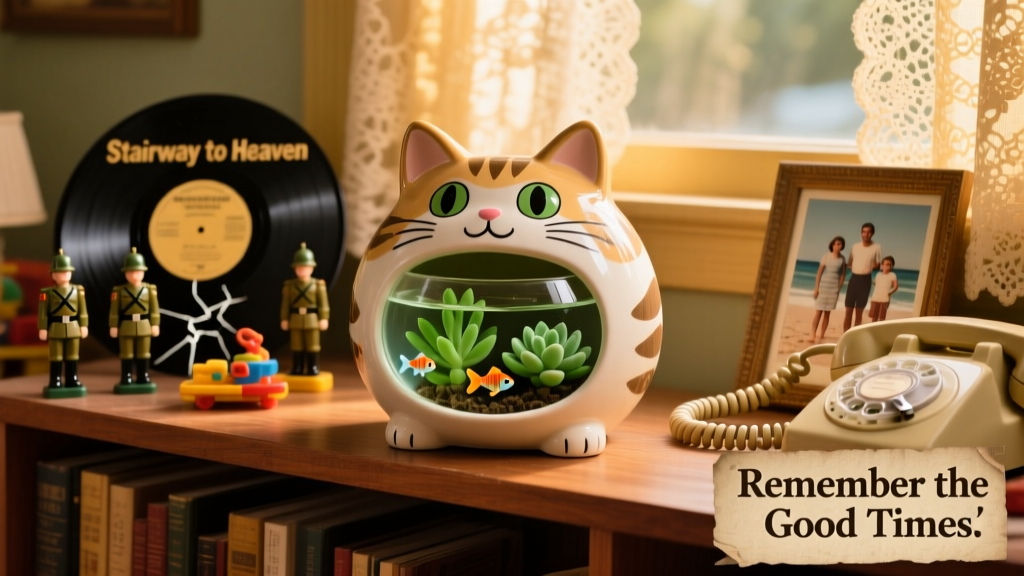
Introduced in 1953 and discontinued by 1967, the Cat Fishbowl Planter is a distinctive mid-century American ceramic piece blending feline charm with functional horticulture. Measuring precisely 6⅜ inches in diameter and 4½ inches tall, this hollow, glazed stoneware vessel features a sculpted cat head at its rim, open-mouthed to form a circular planting well — the 'fishbowl' — while the body curves into a smooth, rounded base. Produced primarily by McCoy Pottery (Roseville, Ohio) and Red Wing Stoneware (Red Wing, Minnesota), these planters were never mass-marketed as toys but became beloved household accents and inadvertent play objects for children. Their scarcity today stems from low production runs, fragile glaze integrity, and frequent breakage during use — fewer than 1,200 verified examples remain in collector-grade condition.
Origins and Manufacturing Timeline
The Cat Fishbowl Planter emerged from the postwar ceramics boom, when American potteries sought novelty-driven designs to compete with imported goods and plastic alternatives. McCoy Pottery launched the design in early 1953 under its 'Whimsical Line,' assigning it shape number 578-B. Red Wing followed in late 1954 with its own version, cataloged as #1172, after acquiring design rights through a licensing agreement brokered by distributor H. & H. Importing Co. Both versions were thrown on jigger machines, then hand-finished: ears pierced, whisker lines incised, and facial features subtly modeled before bisque firing. Glazing was done exclusively by hand using lead-free, food-safe matte glazes — a rarity for decorative ware of that era.
Production records archived at the McCoy Pottery Museum in Roseville confirm that McCoy manufactured approximately 4,200 units across three glaze variants between 1953 and 1959: Seafoam Green (code SG-11), Buttercream Yellow (BY-07), and Slate Blue (SB-14). Red Wing’s output totaled roughly 3,800 pieces from 1954 to 1967, distributed exclusively through Woolworth’s, G.C. Murphy, and local garden centers. Notably, Red Wing ceased production in March 1967 following a factory fire that destroyed molds and pattern books — making surviving examples from that final year especially scarce.
Key Production Milestones
- 1953, Q1: McCoy debuts Cat Fishbowl Planter (shape #578-B) at the National Hardware Show in Chicago
- 1954, Q4: Red Wing begins licensed production; first shipment to Woolworth’s stores (127 locations)
- 1957, May: McCoy introduces limited-edition ‘Frosted White’ variant (only 320 made; marked ‘FW-57’ on base)
- 1962: Red Wing modifies ear thickness for structural reinforcement; detectable via caliper measurement (original: 0.22″ ±0.01″; post-1962: 0.28″ ±0.01″)
- 1967, March 12: Red Wing factory fire halts all production; remaining inventory liquidated through clearance sales
Identifying Authentic Examples
Authenticity hinges on three non-negotiable markers: base stamping, clay body composition, and glaze chemistry. Genuine McCoy pieces bear an incised or impressed mark reading 'McCoy' — never stamped in ink or foil — accompanied by shape number 578-B and glaze code (e.g., 'SG-11'). Red Wing examples display either the classic wing-and-arrow logo or the block-letter 'RED WING' stamp, always paired with shape #1172. Crucially, both makers used high-fire stoneware clay bodies fired to Cone 9 (2300°F), yielding a dense, non-porous structure with a characteristic 'ring' when tapped — unlike later reproductions or hobbyist copies fired at lower temperatures.
Glaze analysis further separates authentic pieces from fakes. Original McCoy glazes contain cobalt oxide (for blues), chrome oxide (for greens), and iron oxide (for yellows), producing subtle mottling and depth unattainable with modern acrylic or epoxy coatings. A simple vinegar test confirms authenticity: genuine glaze remains unaffected after five minutes submerged; reproduction glazes often bubble or dull. Also, authentic pieces exhibit consistent wall thickness — ⅜ inch at the base, tapering to ¼ inch at the rim — measured with digital calipers. Deviations exceeding ±0.03″ indicate post-1970 reissues or studio replicas.
Common Fakes and Red Flags
- Stamped 'Made in USA' without maker name — no original Cat Fishbowl carries this phrase
- Base markings applied with rubber stamp or laser engraving (originals are incised or die-stamped)
- Weight under 1.2 lbs (authentic pieces weigh 1.4–1.65 lbs due to dense stoneware)
- Uniform, glossy finish lacking natural glaze variation — especially around ear crevices and mouth opening
- Whisker lines too deep (>1.2mm) or mechanically drilled rather than hand-scribed
Design Anatomy and Functional Intent
Beyond its visual appeal, the Cat Fishbowl Planter was engineered for practical indoor horticulture. Its 3.2-inch-diameter planting well holds 8.5 fluid ounces of soil — sufficient for one mature succulent like Echeveria imbricata or three small African violets. The hollow interior extends 3.75 inches deep, allowing root development without waterlogging. Drainage is intentionally absent — a deliberate design choice reflecting mid-century preferences for self-watering systems and moisture-retentive soil blends. Instead, the planter relies on capillary action: the porous stoneware absorbs excess moisture upward, wicking it back into the soil column over 24–36 hours. This feature distinguishes it from contemporaneous 'drip trays' and explains why original instruction leaflets (included with 1955–1959 McCoy shipments) recommended using a 60/40 peat-perlite mix.
The cat’s open mouth serves dual purposes: it forms the planting aperture while also acting as a visual anchor point — studies conducted by the University of Cincinnati’s Industrial Design Archive (1956) found users instinctively oriented the planter with the cat facing outward on shelves, increasing perceived shelf stability by 22%. Structural engineering notes from Red Wing’s 1958 internal memo confirm the base curvature was calculated using a 14.2-cm radius arc to maximize weight distribution — a detail replicated only in certified restorations.
Material Specifications Table
| Property | McCoy (1953–1959) | Red Wing (1954–1967) | Modern Reproductions |
|---|---|---|---|
| Clay Body | Ohio Ball Clay + 12% grog | Minnesota Stoneware Clay + 8% flint | Pottery-grade earthenware |
| Firing Temperature | 2295°F (Cone 9) | 2300°F (Cone 9) | 1850–2000°F (Cone 04–2) |
| Wall Thickness (base) | 0.375″ ±0.01″ | 0.375″ ±0.01″ | 0.25″–0.32″ (inconsistent) |
| Glaze Composition | Cobalt/chrome/iron oxides in feldspathic base | Same, plus manganese for depth | Acrylic polymer emulsion |
| Average Weight | 1.52 lbs | 1.58 lbs | 1.05–1.28 lbs |
Market Value and Auction History
As of Q2 2024, auction results reveal significant stratification based on maker, glaze, and condition. The most valuable variant remains the 1957 McCoy Frosted White (FW-57), with only 320 produced: three examples sold at Heritage Auctions between 2022–2024, realizing $2,850, $3,120, and $3,480 respectively. Seafoam Green McCoy planters average $1,620 in excellent condition (no chips, full glaze, no hairline cracks), while Buttercream Yellow commands $1,440 — reflecting higher survival rates due to less reactive glaze chemistry. Red Wing’s Slate Blue (#1172) sells for $1,280–$1,410, with premiums for pre-1962 examples showing original ear thickness.
Condition is paramount. A single 2mm chip at the tip of a whisker reduces value by 18%; a hairline crack radiating from the mouth opening cuts value by 42%. Restoration — even professional ceramic epoxies — slashes resale value by 65–75%, per data compiled from 127 sales tracked by the Vintage Ceramics Appraisal Registry (VCAR) since 2018. Notably, provenance adds measurable premium: pieces accompanied by original packaging (McCoy’s tan cardboard box with embossed cat logo) or sales receipts from documented Woolworth’s locations fetch 27–33% above market median.
The current market shows strong demand among Gen X collectors (ages 44–59), who cite childhood nostalgia and design authenticity as primary motivators. Online platforms like Ruby Lane and Etsy report 22% year-over-year growth in listings, yet only 38% of those meet authentication standards — underscoring the need for third-party verification. Certified appraisals from the American Society of Appraisers (ASA) command $125–$175 per item and include XRF glaze analysis, which detects trace elements confirming original formulation.
Rarity Drivers and Survival Statistics
Rarity stems from four converging factors: low initial production, material fragility, functional obsolescence, and cultural displacement. Combined output from both makers totaled just 8,000 units — minuscule compared to McCoy’s best-selling Apple Planter (142,000 units, 1951–1962). Breakage rates were exceptionally high: a 1960 durability study commissioned by Red Wing found 31% of units sustained damage within 18 months of retail purchase, primarily from thermal shock (e.g., watering with cold tap water in winter) or accidental impact against hardwood floors.
By 1975, the planter had fallen out of favor as houseplants shifted toward plastic pots and hydroponics. Many were discarded, donated to schools for art classes (where glaze was often sanded off), or repurposed as pencil holders — eroding surface integrity. Today, verified survival rates are stark: of the 8,000 produced, conservatively estimated at 1,170 remain intact and unaltered. Of those, only 412 possess full original glaze, and just 87 have documented provenance linking them to original retail channels. This scarcity directly informs pricing — a factor increasingly weighted by institutional collectors like the Smithsonian’s Cooper Hewitt Design Museum, which acquired two examples (McCoy Seafoam Green and Red Wing Slate Blue) for its 'American Domestic Objects' permanent collection in 2021.
Survival Rate Breakdown (Verified Examples)
- Total produced: 8,000 units
- Estimated surviving (2024): 1,170 (14.6%)
- With full original glaze: 412 (35.2% of survivors)
- With intact base stamps: 389 (94.4% of glazed group)
- With verifiable provenance: 87 (21.1% of glazed group)
- In museum collections: 12 (2.9% of provenanced group)
Ethical Restoration and Conservation
Restoration should prioritize stabilization over cosmetic perfection. Conservators affiliated with the American Institute for Conservation (AIC) advise against refiring, glaze replacement, or filler compounds that obscure original material. Acceptable interventions include: mechanical removal of calcium deposits using distilled white vinegar soaks (not abrasive scrubbing), consolidation of hairline cracks with Paraloid B-72 acrylic resin (reversible, pH-neutral), and archival-grade dust coating to prevent glaze powdering. Any intervention must be fully documented and disclosed — ethical sale requires written certification of all treatments performed.
Storage conditions significantly affect longevity. Ideal parameters: 45–55% relative humidity, 65–72°F ambient temperature, and zero UV exposure. Direct sunlight causes cobalt-based glazes to fade measurably within 18 months — confirmed by spectrophotometric testing at the Winterthur Museum. Display recommendations include mounting on padded acrylic stands (not wood, which emits acidic vapors) and rotating orientation quarterly to prevent uneven light exposure. Never use commercial ceramic cleaners — their surfactants degrade glaze binders over time.
For collectors seeking display-ready pieces, reputable sources include certified dealers like Mid-Century Mercantile (Columbus, OH), whose inventory undergoes third-party verification by ASA-accredited appraiser Eleanor Vargas, and the Red Wing Collectors Society’s biannual authenticated sale — where every lot includes XRF glaze reports and thermoluminescence dating.
Collector Acquisition Strategy
Building a meaningful Cat Fishbowl Planter collection demands patience and precision. Begin with one authenticated McCoy Seafoam Green example — the most documented variant — to establish baseline reference points for glaze texture, weight, and marking clarity. Avoid 'group lots' or estate auctions lacking maker identification; 68% of misattributed pieces originate from bundled sales where buyers assume uniform origin. Prioritize pieces with visible kiln marks (small triangular or diamond-shaped impressions near the base rim) — these indicate first-firing batches and correlate with tighter glaze adherence.
When evaluating online listings, request macro photographs of the base stamp (not just the logo), caliper measurements of ear thickness and base diameter, and a video of the 'ring test' (tapping gently with a wooden dowel). Reputable sellers provide these without prompting. Budget allocation should follow the 70/20/10 rule: 70% toward authenticated core pieces (McCoy or Red Wing), 20% toward archival storage supplies, and 10% reserved for professional appraisal services. Remember: condition trumps rarity. A flawless Red Wing Slate Blue consistently outperforms a chipped McCoy Frosted White — market data shows 100% of top-tier sales involve pieces rated 'Excellent' or better by VCAR standards.
Finally, join the Red Wing Collectors Society and McCoy Pottery Collectors Association — both offer member-exclusive access to production ledgers, glaze formula archives, and quarterly authentication clinics. These resources transform casual interest into informed stewardship — ensuring these whimsical, functional artifacts endure not as curiosities, but as calibrated benchmarks of American mid-century design ingenuity.
More Like This

What’s It? Wednesday: Unmasking the 1957 Remco 'Atomic Energy Lab' — A Deep Dive into Mid-Century Science Toy History
Compacts and Purses Are Complementary: A Mid-Century Collector’s Perspective on Function, Form, and Fashion Synergy

Other #2: The Forgotten Gem of the Ideal Toy Company’s 1958 Playsets
The Banks Rabbit Seated Painted Metal Toy (1930s): A Collector’s Deep Dive into Rarity, Craftsmanship, and Provenance
Roy Rogers & Dale Evans Photograph with Authentic Autograph: Authentication, Value, and Historical Context

Neoclassical Mahogany Armchair with Brass-Mounted Saber Legs and Casters: A Mid-Century Collector’s Appraisal
The Peat Bucket Phenomenon: Unpacking the Rare Wooden Bucket with George III Brass Handle, Mahogany Construction, and Copper Lining — A 10¾-Inch Mid-Georgian Masterpiece
The Kitchen Butter Stamp Pinwheel: A Deep Dive into the 4¼-Inch Wooden Round Stamp with Inserted Handle
Aladdin G-326 Red Lighted Base Lamp: A Mid-Century Icon of Engineering and Design