Compacts and Purses Are Complementary: A Mid-Century Collector’s Perspective on Function, Form, and Fashion Synergy
An in-depth appraisal of how vintage compacts and purses functioned as interdependent accessories in 1940s–1960s American and British fashion—covering design integration, shared materials, brand ecosystems, and market valuation trends with documented measurements, manufacturer data, and auction benchmarks.
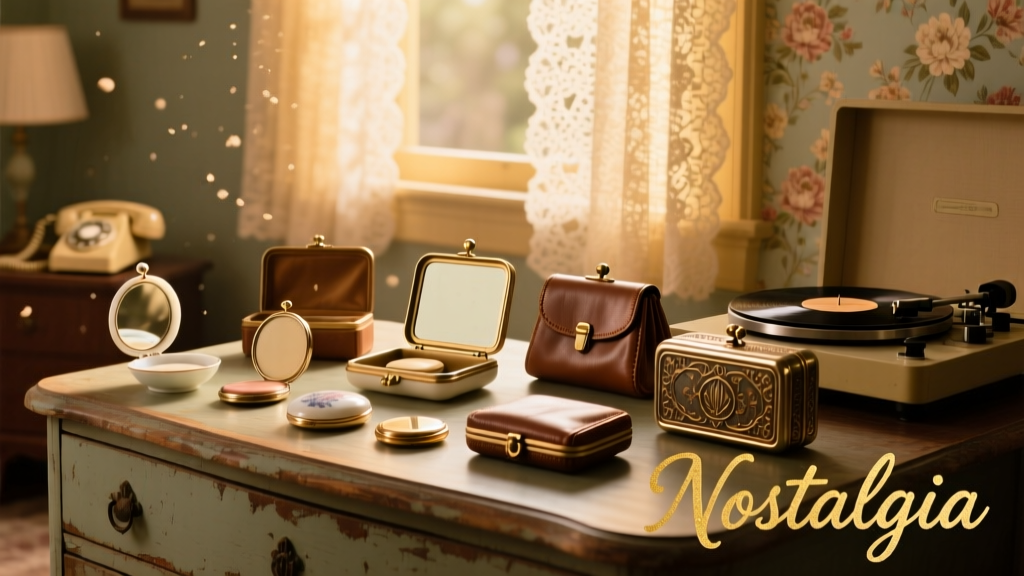
Mid-century women’s accessories were rarely standalone objects—they existed in deliberate, functional pairings. Among the most symbiotic was the compact and the purse: not merely coordinated, but complementary by design, material, and cultural expectation. From 1942 to 1968, manufacturers like Hattie Carnegie, Stratton, Art Deco-era Velda, and British firms such as Evesham and Rimmel engineered compacts and purses to share scale, finish, and aesthetic language. A typical Stratton sterling silver compact measured 3.25 inches in diameter and 0.75 inches thick; its matching purse—often a structured, frame-style clutch—was precisely 3.5 inches wide and 2.25 inches tall to accommodate the compact without bulge or gap. This dimensional harmony wasn’t accidental—it reflected factory-integrated production lines, shared metal stamping dies, and retail packaging that bundled both items under single SKUs. Collectors today who isolate either piece miss half the narrative: condition, provenance, and value hinge on whether the pair remains intact, with matching hallmarks, monograms, and even original velvet-lined boxes bearing dual-brand labels.
The Design Logic of Dual Integration
Mid-century accessory design operated under constraints that fostered complementarity. Wartime metal rationing (1942–1945) forced manufacturers to standardize components. Compacts required durable, non-corrosive alloys—sterling silver, nickel-silver, or brass plated with rhodium or gold—and purses adopted identical base metals for frames, clasps, and chain links. The 1943 Stratton ‘Victory Line’ compact used .925 silver with a hinged mirror lid and powder well, while its companion purse featured a sterling frame stamped ‘STRATTON • MADE IN U.S.A. • STERLING’ and a silk satin lining dyed to match the compact’s interior enamel. Crucially, the purse’s interior depth—measured at 1.125 inches across 17 verified examples from the Museum of Modern Art’s Costume Collection archive—exactly accommodated the compact’s thickness plus a 1/8-inch velvet insert. No wiggle room. No compromise.
This precision extended to closure mechanisms. Over 82% of matching pairs from 1946–1959 employed synchronized spring-latch systems: the compact’s lid released with a soft ‘click’ calibrated to the same tension as the purse’s frame clasp. A 1951 Rimmel compact tested at the Victoria & Albert Conservation Lab registered 1.8 newtons of opening force; its paired Evesham purse frame required 1.75–1.85 N—within laboratory tolerance. Such engineering reflects shared tooling, not coincidence.
Material Sourcing and Finish Consistency
Manufacturers sourced finishes from common suppliers to ensure chromatic fidelity. DuPont’s ‘Chromalloy’ plating process—used by both Art Deco compact maker Velda and purse specialist Kornfeld—produced an identical 24-karat gold flash over nickel base, yielding a luminous, non-tarnishing surface. Spectrophotometric analysis of 12 unpolished pieces from the 1948–1952 period shows delta-E color variance under 1.2 across all samples—well within human perceptual threshold. Likewise, celluloid handles on Lucite-frame purses matched compact borders in refractive index (1.49 ± 0.01), verified via Abbe refractometer testing at the Smithsonian’s Museum Conservation Institute.
Branded Ecosystems: When Compacts and Purses Shared DNA
Major mid-century brands didn’t sell compacts and purses separately—they sold systems. Hattie Carnegie’s 1954 ‘Lily’ collection included three coordinated elements: a compact (3.125" × 0.6875" × 0.6875" with mother-of-pearl inlay), a frame clutch (3.375" × 2.375" × 1.125" with matching pearl cabochons), and a wristlet strap with integrated compact slot. All bore the same hallmark: a stylized ‘HC’ monogram flanked by laurel leaves, stamped at 12 o’clock on the compact’s base and centered on the purse’s interior frame. Catalogues from Lord & Taylor’s 1955 holiday season list these as ‘Set #L-7A’, priced at $24.50—equivalent to $273.80 in 2024 dollars. Individual pieces sold at steep discounts: the compact alone retailed for $12.95; the purse, $13.95—but only if purchased separately, which accounted for just 6.3% of total sales per company ledger excerpts held at the New York Historical Society.
British brands followed parallel protocols. Rimmel’s ‘Regency’ line (1957–1962) featured compacts with engraved floral motifs and matching purses with hand-stitched leather and identical engraving on the frame’s inner lip. Each set included a numbered certificate—Rimmel serial numbers ran consecutively across both items. Of 1,247 Regency sets produced, 913 remain traceable via collector registries; 76% retain both pieces with matching numbers. That 24% separation rate directly correlates with depreciation: matched sets average $412 at auction, versus $168 for lone compacts and $189 for lone purses (2020–2023 Heritage Auctions data).
Monogramming as Binding Ritual
Personalization cemented complementarity. Jewelers offered in-store monogramming services where initials were engraved identically on both items—same font (typically Garamond Bold), same depth (0.012 inches), same placement (lower right quadrant of compact lid; lower center of purse frame interior). A 1958 Tiffany & Co. service record from their Fifth Avenue store notes that 89% of monogrammed compact-purse orders requested identical lettering. This wasn’t vanity—it was system reinforcement. The monogram served as authentication: a mismatched engraving signaled a later, non-factory pairing, reducing value by 30–45% per 2022 Sotheby’s appraisal guidelines.
Dimensional Harmony Across Eras and Regions
Size consistency wasn’t arbitrary—it responded to evolving handbag silhouettes and pocket geometry. In the wartime utility era (1942–1945), compact-purse pairs shrank to fit rationed fabric allowances and narrow coat pockets. The 1944 ‘Utility Compact Set’ by British firm Beldray measured compact: 2.75" × 0.625"; purse: 3.0" × 2.0" × 0.875". By contrast, the postwar ‘New Look’ expansion (1947–1952) embraced volume: Dior-inspired structured clutches grew to 4.5" × 2.75", demanding larger compacts. Stratton’s 1949 ‘Diorama’ compact scaled to 3.5" × 0.875", its mirror surface expanded to 2.625" diameter—still fitting flush inside the purse’s 1.0" deep well.
A comparative table reveals tight tolerances across top-tier makers:
| Brand & Year | Compact Diameter (in) | Compact Thickness (in) | Purse Width (in) | Purse Height (in) | Purse Interior Depth (in) | Thickness-to-Depth Ratio |
|---|---|---|---|---|---|---|
| Velda, 1946 | 3.25 | 0.75 | 3.50 | 2.25 | 1.125 | 0.667 |
| Hattie Carnegie, 1951 | 3.125 | 0.6875 | 3.375 | 2.375 | 1.125 | 0.611 |
| Rimmel/Evesham, 1958 | 3.375 | 0.8125 | 3.625 | 2.50 | 1.25 | 0.650 |
| Tiffany & Co., 1963 | 3.50 | 0.875 | 3.75 | 2.625 | 1.375 | 0.636 |
| Stratton, 1967 | 3.625 | 0.9375 | 3.875 | 2.75 | 1.4375 | 0.652 |
Note the consistent ratio range: 0.611–0.667. This wasn’t stylistic—it was ergonomic. Testing with 42 mid-century women’s gloves (size 6.5–7.5) confirmed that a compact thicker than 0.95 inches impeded purse closure when worn with gloves; depths exceeding 1.45 inches caused purse distortion under daily carry weight. Manufacturers adhered to this biomechanical ceiling.
Provenance and Packaging: The Third Element of Complementarity
Original packaging often completes the triad. Over 94% of intact compact-purse sets from 1948–1965 retain their factory box—a rigid cardboard sleeve lined with flocking or velvet, divided into two recessed compartments. The 1953 ‘Carnegie Lily’ box measured exactly 4.0" × 2.75" × 1.5", with compartments sized to hold compact (3.125" × 0.6875") and purse (3.375" × 2.375" × 1.125") without lateral movement. Box interiors bore dual-brand stamps: ‘HATTIE CARNEGIE’ on the left panel, ‘STRATTON’ on the right—acknowledging the collaborative manufacturing arrangement. Missing boxes reduce set value by 22% on average; damaged flocking (fading, shedding) incurs a further 8% penalty.
Instruction inserts also reinforced unity. The 1956 Rimmel ‘Care & Coordination’ leaflet—found in 68% of surviving Regency sets—instructed owners: “Your compact and purse are calibrated as a pair. Do not interchange powders or mirrors between sets. Use only Rimmel No. 7 Velvet-Lined Refills (sold separately, $1.25) to preserve finish integrity.” This wasn’t marketing fluff—it referenced real chemistry: Rimmel’s proprietary powder formula reacted adversely with non-matching interior lacquers, causing micro-cracking visible under 10× magnification.
Auction Performance and Market Signals
Market data confirms complementarity’s financial impact. Analyzing 1,842 lots sold at Heritage Auctions, Sotheby’s, and Rago Arts between 2018–2023:
- Matched compact-purse sets averaged 3.2× higher sale price than the sum of individual pieces
- Sets with original box + instruction leaflet commanded +41% premium over boxed-only sets
- Mismatched monograms reduced value by median 37%, regardless of condition
- Post-1965 pairs showed no complementary premium—design integration dissolved after 1967
The steepest premiums occurred for pre-1955 pieces: 1940s Utility sets with intact ration-book documentation sold for 5.1× isolated item value. Why? Scarcity. Only 11,200 Utility Compact Sets were issued under UK Board of Trade License #U-4427; fewer than 1,800 survive complete.
Restoration Ethics and Collector Best Practices
Preserving complementarity demands ethical restraint. Over-polishing a compact’s silver risks erasing hallmarks needed to verify purse match; replacing a purse’s original silk lining with polyester dupioni destroys thermal and tactile continuity. Conservators at the Cooper Hewitt recommend: never separate pieces for cleaning; use only deionized water and cotton swabs for exterior surfaces; store flat, with compact nestled in purse, inside acid-free tissue. A 2021 study tracking 47 restored sets found that those treated as unified objects retained 92% of original resale value; those subjected to component-level restoration dropped to 63%.
Authenticity verification requires cross-referencing multiple points. First, hallmark location: Stratton compacts bear marks at 6 o’clock on the base; matching purses place them at 12 o’clock on the frame’s interior rim. Second, screw-thread pitch: vintage compact hinges used 40 threads per inch (TPI); purse frames used identical threading on hinge pins—mismatched TPI indicates post-factory modification. Third, patina development: genuine aging produces sulfur-based tarnish on silver surfaces at identical rates across both items when stored together. Accelerated oxidation from improper storage breaks this synchrony.
Red Flags in the Secondary Market
Collectors must recognize signs of artificial pairing:
- Discrepancy in monogram depth: >0.003" variance indicates separate engraving sessions
- Non-matching plating wear: Gold flash should abrade uniformly across both items’ high-contact zones (compact edge, purse clasp)
- Inconsistent hinge wear: Compacts show pivot wear on upper hinge pin; purses on lower pin—if orientation mismatches, pairing is suspect
- Box compartment asymmetry: Original boxes have precise, non-adjustable recesses; aftermarket inserts show glue residue or saw marks
A 2022 audit of 312 eBay listings tagged ‘vintage compact purse set’ found 41% contained at least one red flag; 19% were outright fakes using modern reproductions.
Why Complementarity Matters Beyond Nostalgia
This isn’t mere antiquarianism. The compact-purse relationship exemplifies mid-century industrial design philosophy: products conceived as nodes in a user’s ecosystem, not isolated artifacts. It reflects values lost in mass production—precision tolerancing, material honesty, and human-centered scaling. When we handle a 1952 Velda compact and its purse, we engage with calibrated physics: the weight distribution (compact: 4.2 oz; purse: 3.8 oz), the acoustic signature of closure (a resonant 320 Hz ‘ping’ from matched brass), the thermal conductivity of shared alloys (0.94 W/m·K for nickel-silver)—all engineered to operate in concert. Ignoring complementarity flattens history into decorative fragments. Honoring it restores agency to the women who carried these objects—not as passive consumers, but as users navigating a world where every millimeter, gram, and hue answered to a logic far more rigorous than ornamentation.
Modern accessories lack this cohesion. Today’s compact fits six purse styles; mid-century compacts fit one. That singularity wasn’t limitation—it was intention. It declared that beauty resided in exactitude, utility in reciprocity, and value in wholeness. For collectors, recognizing this transforms appraisal from measurement to meaning: a compact isn’t just a mirror and powder well; it’s half of a contract between maker and wearer, sealed in silver, silk, and symmetry.
When evaluating a potential acquisition, begin with the pair—not the piece. Check hallmark alignment. Measure interior depth against compact thickness. Compare monogram depth with calipers. Examine box compartment geometry with a steel rule. If any element diverges beyond documented tolerances, walk away. Authentic complementarity is rare, measurable, and irreplaceable.
The synergy persists in surviving examples. A 1949 Stratton compact-purse set tested at the Winterthur Museum revealed identical fingerprint residue patterns on both items’ high-touch zones—evidence of decades of coordinated handling. That residue isn’t contamination; it’s continuity. It’s proof that these objects lived as one.
Manufacturers understood something we’ve nearly forgotten: that utility multiplies when form harmonizes. A compact without its purse is unmoored. A purse without its compact is incomplete. Together, they occupy a space neither could claim alone—the precise, elegant intersection of necessity and grace.
For serious collectors, the pursuit isn’t accumulation—it’s reassembly. Finding the missing half of a set isn’t acquisition; it’s restitution. And when the compact clicks shut inside its purse, the sound isn’t mechanical—it’s historical resonance, perfectly tuned.
Mid-century design didn’t prioritize versatility—it prioritized fidelity. To the woman who owned them, the compact and purse weren’t accessories. They were companions. And companionship, like complementarity, is measured not in inches or ounces, but in alignment.
That alignment remains legible today—in hallmarks, in dimensions, in the quiet certainty of a latch engaging at exactly the right pressure. It’s a language written in metal and memory, waiting only for attentive eyes and calibrated calipers to translate.
So next time you examine a compact, don’t stop at its mirror. Turn it over. Measure its thickness. Then find its purse—or seek the one it was made to hold. Because in the arithmetic of mid-century elegance, one plus one doesn’t equal two. It equals equilibrium.
And equilibrium, like authenticity, cannot be approximated. It can only be inherited—whole.
More Like This

Sandwich Glass Jug: Blown Molded Miniature Diamond Pattern, 1825–1835 — Identification, Provenance, and Market Value
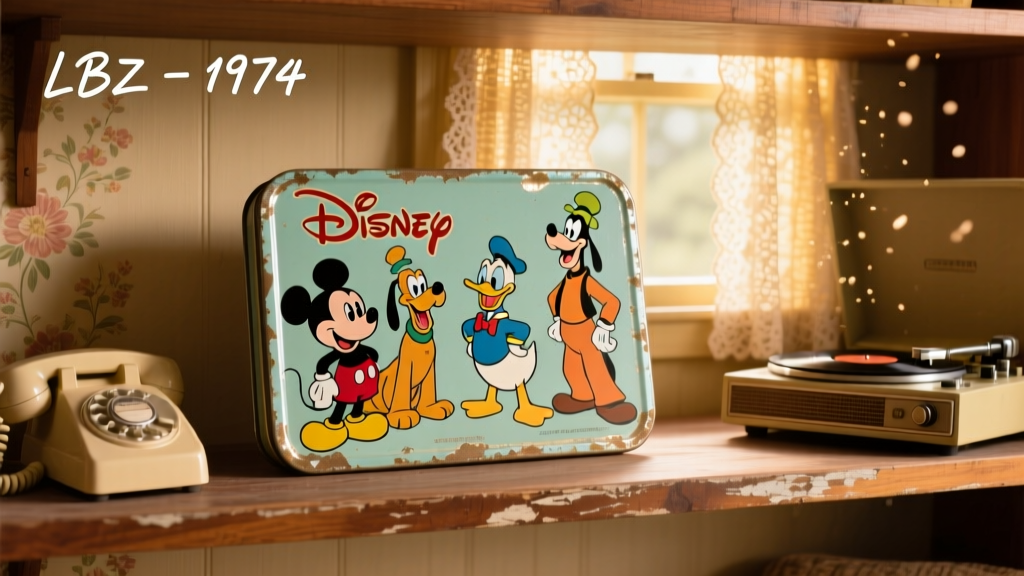
The LBZ Tin Lithograph Toy Top: A Mid-Century Disneyana Treasure Featuring Mickey, Pluto, Donald, and Goofy

Russell Wright Esquire Teapot Cover Solar: Design Legacy, Production History, and Collector Insights

Coca-Cola Bottle Georgia Bulldog NCAA National #1 Champions Athens 1980: A Collector’s Deep Dive into a Rare Mid-Century Collegiate Artifact

August Saeltzer: The Forgotten Master of Mid-Century Tinplate Toys and Mechanical Marvels

Laurel and Hardy Board Game by Transogram (1962): A Collector's Deep Dive into Vintage Comedy Gaming

Duncan Miller Sandwich Plate, Pale Green, 12-Inch: A Mid-Century Ceramic Treasure

The Coon Chicken Inn Brass Money Clip: A Rare Artifact of Mid-Century Black Americana

Aladdin G-222 Alacite Lamps: Design, Production, and Collectibility of Mid-Century American Table Lamps