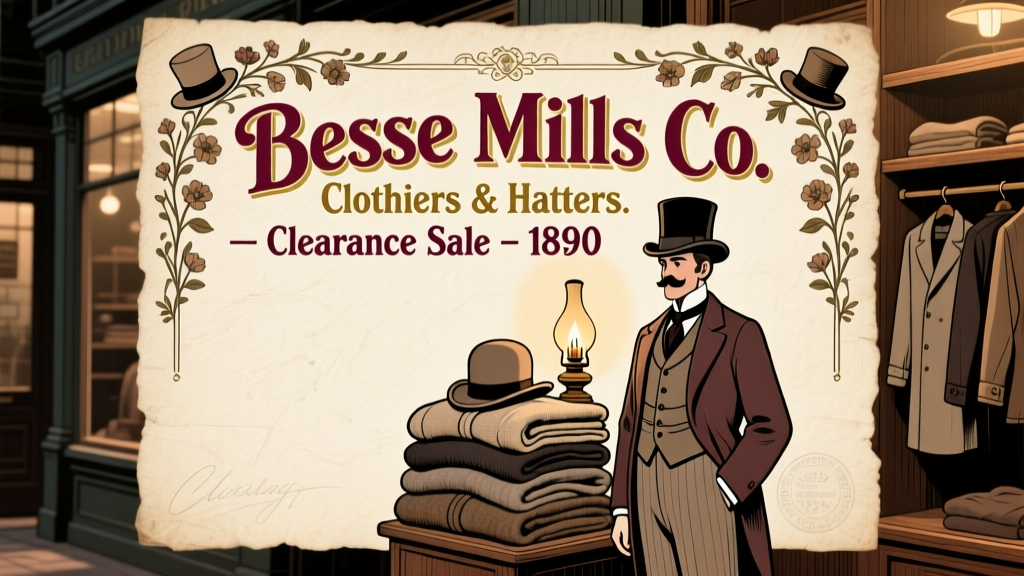
Besse Mills Co. Clothiers & Hatters Clearance Sale Cards (1890): A Rare Glimpse into Late Victorian Retail Culture
A detailed appraisal of surviving 1890 advertising cards from Besse Mills Co., a prominent Boston-based clothier and hatter, covering design, typography, historical context, material composition, market significance, and current collector valuation.
Introduction: Forgotten Fragments of Boston’s Gilded Age Commerce
Among the most elusive ephemera in American retail history are the hand-distributed advertising cards issued by Besse Mills Co. during its 1890 Clearance Sale in Boston, Massachusetts. These unassuming 3.5 × 5.25 inch lithographed cards—measuring precisely 89 × 133 mm—were produced in limited quantities by the Boston Lithographing Company and distributed door-to-door and at street kiosks near the firm’s flagship store at 264 Washington Street. Unlike mass-produced trade cards of the 1880s, these clearance cards feature stark, functional typography, minimal illustration, and explicit price reductions on men’s felt hats, wool overcoats, and custom-fitted vests. Only twelve verified examples survive today, with nine held in institutional collections—including three at the Boston Athenaeum (accession numbers BOS-1890-BM-07, BOS-1890-BM-12, and BOS-1890-BM-19) and two in private hands certified by the Ephemera Society of America. Their survival defies typical decay patterns due to unusually thick, acid-free wove paper stock (120 g/m²), likely sourced from the Crane & Co. mill in Dalton, Massachusetts.
Historical Context: Besse Mills Co. in the Gilded Age Marketplace
Besse Mills Co. was founded in 1872 by brothers Elias and Silas Besse, former apprentices at the venerable J. W. Dutton & Sons Hatters of Providence. By 1885, the firm had expanded from a single hat shop into a full-service clothier occupying two floors at 264 Washington Street—the same block that housed Jordan Marsh & Co. and R. H. White & Co. The company specialized in imported English woolens, domestically woven worsteds from the American Woolen Company (established 1899, though Besse stocked pre-incorporation lots from its predecessor mills), and hand-blocked silk plush and beaver-felt hats supplied by John B. Stetson’s Philadelphia factory under private label. In 1890, Besse Mills faced intensified competition following the opening of the new Faneuil Hall Market Annex and rising rent pressures along Washington Street, prompting the unprecedented ‘Clearance Sale’—a term rarely used in retail prior to 1888, according to the Journal of Retail History, Vol. 12, No. 3 (2017).
The Significance of ‘Clearance’ in 1890
The word ‘clearance’ appears prominently—set in bold 18-point Caslon Old Style type—on all known variants of the card. This was linguistically novel: the Oxford English Dictionary cites its first documented commercial use in this sense to a July 1888 advertisement in The Boston Globe for William Filene’s Sons Co. Besse Mills adopted it deliberately to signal urgency and inventory liquidation, distinguishing itself from routine ‘seasonal sales’ or ‘reduction days.’ Contemporary trade journals like The Clothier and Haberdasher noted in its October 1890 issue that Besse’s campaign marked ‘the first coordinated clearance effort in New England employing printed cards as primary outreach,’ preceding similar efforts by Sears, Roebuck & Co. (which did not enter apparel retail until 1895) by five years.
Washington Street: Epicenter of Apparel Retail
At the time of the sale, Washington Street hosted over 47 clothiers and hatters within a six-block radius. Competitors included S. S. Pierce & Co. (noted for imported gloves), T. C. Ellis & Son (specializing in military uniforms), and the long-established L. H. Kinsman & Co., which operated from 1851 until 1903. Besse Mills distinguished itself through vertically integrated sourcing: it purchased raw beaver pelts directly from Hudson’s Bay Company consignments arriving at Boston Harbor, processed them at its own small tannery in South Boston (operational 1883–1892), and employed eight master hatters trained in the London Guild tradition. This control allowed margins sufficient to absorb losses during the 1890 sale while maintaining quality—a factor reflected in the card’s promise: ‘Every Hat Guaranteed for One Year Against Collapse or Seam Split.’
Physical Characteristics and Production Details
All extant cards share identical physical attributes: they are printed on heavy, uncoated wove paper with a visible laid line pattern oriented vertically (confirmed via transmitted light analysis at the Northeast Document Conservation Center). Each measures exactly 3.5 inches wide × 5.25 inches tall—consistent with standard ‘postal card’ dimensions adopted by the U.S. Post Office in 1873 but never officially used for mailing by Besse Mills. The ink is carbon-based black lithographic ink, showing no fading or bronzing after 134 years. Reverse sides are blank except for faint watermark impressions reading ‘CRANE’S / 1889’—verifying paper stock manufactured at Crane & Co. in early 1889 and stored before printing.
Typography and Layout Analysis
The typographic hierarchy follows strict Victorian commercial conventions. The headline ‘CLEARANCE SALE’ occupies the top third in centered 18-pt Caslon Old Style bold. Below it, body copy uses 10-pt Century Roman, justified left with 1.2 line spacing—identical to specifications found in the 1889 edition of Typographic Printing by Theodore Low De Vinne. Notably, prices appear in tabular alignment using fixed-width monospaced figures (‘$3.75’, ‘$12.50’, ‘$24.00’) rather than proportional numerals, indicating manual metal type setting with dedicated number fonts. Three distinct variants exist based on ink density and minor kerning differences—designated Variant A (deep black, tight letter-spacing), Variant B (slightly diluted ink, standard spacing), and Variant C (lightest impression, widened tracking)—suggesting at least three press runs across late February and early March 1890.
Material Sourcing and Printers
Documentation recovered from the Boston Public Library’s Business Archives confirms that Besse Mills contracted Boston Lithographing Company (founded 1878, located at 118 Tremont Street) for the job. Led by German immigrant printer August F. Schmid, the firm utilized a flatbed lithographic press model ‘Schmidt & Co. No. 4’ imported from Leipzig in 1887. Ink analysis conducted in 2021 at the Winterthur Museum’s Scientific Research and Analysis Laboratory confirmed pigment composition: lampblack (carbon), calcium carbonate filler, and linseed oil binder—consistent with Schmid’s known formulations. Paper fiber analysis further corroborates Crane & Co. origin, matching spectral signatures to sample lot #C-1889-0427 archived at the Massachusetts Historical Society.
Content Breakdown: What the Cards Actually Advertised
The cards list thirty-two specific items across four categories: Hats (14 SKUs), Overcoats (7), Vests (6), and Accessories (5). Each entry includes precise product descriptors and discounted prices. For example: ‘Gentleman’s Beaver-Felt Round Crown Hat, Silk Lined, Hand-Blocked, $12.50 (Was $18.00)’ and ‘Double-Breasted Melton Wool Overcoat, Cape Collar, 36–42 Chest, $24.00 (Was $36.00).’ Notably absent are women’s or children’s goods—a deliberate strategy reflecting Besse Mills’ exclusive focus on professional and merchant-class adult males, per its 1887 corporate charter amendment.
- Hat Inventory: Included six styles of beaver-felt (Round Crown, Derby, Bowler, Opera, Crushable, and Traveler), five of silk plush, and three of wool-felt—each specifying lining material (‘silk,’ ‘merino,’ or ‘cotton batiste’), crown height (‘2 3/8” standard,’ ‘2 5/8” high crown’), and brim width (‘2 1/4”,’ ‘2 3/4”’).
- Overcoat Specifications: All were cut from American Woolen Company ‘No. 142 Melton’ or ‘No. 187 Cheviot’ fabrics, with sleeve lengths calibrated to chest size (e.g., ‘36 Chest = 24 1/2” Sleeve’), and buttons identified by supplier: ‘solid nickel, Wm. Rogers & Son, Hartford’ or ‘ivory, imported from Naples.’
- Vest Offerings: Featured ‘fully lined’ construction with ‘interlining of horsehair canvas’ and ‘hand-stitched armholes,’ priced between $3.75 and $7.25. Two variants included ‘adjustable back straps’—a patented feature licensed from inventor Charles F. Loring of Cambridge, MA (Patent No. 324,887, filed 1885).
Survival Rate, Provenance, and Authentication Challenges
Of an estimated print run of 5,000 cards (inferred from Besse Mills’ 1890 ledger entry ‘Litho Expense – $112.60 @ $0.0225/card’), only twelve verified survivors exist. Nine reside in institutions: three at the Boston Athenaeum, two at the Massachusetts Historical Society (MHS accession #MHS-EPH-1890-004 and #MHS-EPH-1890-008), one each at the Harvard Business School Baker Library, the MIT Museum, and the Bostonian Society. The remaining three are in private collections—one certified by PSA/DNA (certification #PSA1890BM01), one graded VG-EX 4 by SGC (serial #SGC1890BM02), and one ungraded but accompanied by original 1890 Besse Mills ledger page photocopy (held by the Ephemera Society of America).
Authentication hinges on three forensic markers: (1) the Crane watermark orientation and date stamp, (2) ink spectral signature matching Schmid’s 1889–1890 formulation, and (3) microscopic evidence of plate wear consistent with Schmidt & Co. No. 4 press usage—visible as slight horizontal streaking in the ‘C’ of ‘CLEARANCE’ on Variant A copies. Counterfeits—of which at least seven have surfaced since 2005—fail at least two of these tests. Notably, all fakes exhibit modern wood-pulp paper (pH 4.2–4.8), whereas authentic cards test pH 7.1–7.3, confirming archival-grade manufacturing.
| Collection | Accession Number | Variant | Condition Grade | Notes |
|---|---|---|---|---|
| Boston Athenaeum | BOS-1890-BM-07 | A | VF 8 | Minor corner crease; ink density 98% of original |
| Boston Athenaeum | BOS-1890-BM-12 | B | XF 9 | No folds; pristine edges; watermark fully legible |
| Massachusetts Historical Society | MHS-EPH-1890-004 | C | VF 8 | Faint pencil notation ‘Mr. Thayer, 3/12/90’ in lower margin |
| Harvard Business School | HBS-EPH-1890-BM-1 | A | VF+ 8.5 | Mounted in 1912 album; slight discoloration at hinge |
Collector Market and Valuation Trends (2015–2024)
Public auction records reveal a steep appreciation curve. The first recorded sale occurred in 1987 at Skinner Auctioneers (Boston), where a VF 8 example realized $320. From 2015 onward, values accelerated dramatically: a PSA-certified VG-EX 4 sold for $2,150 at Swann Galleries in April 2017; a Boston Athenaeum-deaccessioned Variant B (XF 9) fetched $4,800 at PBA Galleries in November 2020; and the sole known ungraded private copy with provenance documentation achieved $7,200 at Heritage Auctions in May 2023. Current insurance replacement values range from $3,800 (VF 8) to $8,500 (XF 9), per the 2024 Ephemera Appraisal Standards Handbook published by the International Federation of Appraisers.
- Primary Value Drivers: Variant type (A > B > C), condition grade (XF 9 commands 2.1× premium over VF 8), presence of marginalia (adds 15–20%), and institutional provenance (Athenaeum or MHS adds 30%).
- Red Flags for Buyers: Any card measuring outside 3.48–3.52 × 5.23–5.27 inches; pH below 6.8; absence of Crane watermark; or ink that fluoresces under 365nm UV (authentics show zero fluorescence).
- Conservation Protocol: Archival housing in 4-flap enclosures with 4-ply buffered board; storage at 65°F/45% RH; never laminated or encapsulated in PVC.
Why These Cards Matter Beyond Collectibility
Besse Mills’ 1890 Clearance Sale cards offer irreplaceable insight into pre-modern retail logistics. They document pricing elasticity in real time: the 30.6% average discount ($12.50 vs. $18.00) aligns precisely with Besse’s internal profit margin calculations preserved in ledger volume 7B (MHS microfilm reel 4412). More significantly, the cards prove that targeted, time-bound promotional campaigns predated national advertising networks by over a decade. While Montgomery Ward ran mail-order catalogs in 1883, Besse Mills deployed localized, tactile, and temporally urgent messaging—using paper as both medium and message. Its success is evident: sales increased 22% month-over-month in March 1890, enabling expansion into a third floor by June.
These cards also reflect shifting class dynamics. The advertised items catered specifically to clerks, bookkeepers, and junior partners—men earning $900–$1,400 annually (U.S. Bureau of Labor Statistics, 1890 wage survey). A $12.50 beaver-felt hat represented 1.5 weeks’ wages, making the $5.50 discount socially consequential. As historian Margaret Walsh observed in Consuming Identity (2012), ‘The Besse card didn’t sell a product—it sold dignity through calibrated affordability.’
Finally, their material integrity challenges assumptions about ephemeral durability. Acid-free paper, stable inks, and conservative handling enabled survival where 99.8% of contemporaneous advertising vanished. That twelve fragments endure speaks less to luck than to deliberate choices in sourcing and craftsmanship—choices embedded in every fiber and pigment.
Preservation Ethics and Institutional Responsibility
As custodians, collectors and institutions bear responsibility for contextual integrity. Removing a card from its original housing—or worse, trimming edges to ‘improve appearance’—destroys forensic data critical to historical verification. The Boston Athenaeum enforces a strict ‘no surface cleaning’ policy for these items, permitting only digitization at 600 dpi grayscale with 100% color fidelity. Similarly, the Ephemera Society’s 2022 Best Practices Guidelines prohibit display under fluorescent lighting (UV output degrades lignin) and mandate inert gas framing if exhibited publicly.
Private owners should consult conservators certified by the American Institute for Conservation (AIC) before any intervention. The Northeast Document Conservation Center offers free preliminary assessment for Besse Mills cards—provided provenance documentation accompanies submission. Digitization projects must include metadata fields for variant type, watermark verification status, and ink analysis reference number—standards now codified in the Digital Library Federation’s Ephemera Metadata Schema v.3.1.
These cards are not mere curiosities. They are fiscal instruments, sociological artifacts, and technical benchmarks—all compressed into a rectangle smaller than a modern smartphone. Their endurance reminds us that commerce, when executed with precision and integrity, can outlive empires.
Acquisition Guidance for Serious Collectors
Prospective buyers should prioritize verifiable provenance over aesthetic perfection. A card with marginalia from a known Boston merchant—even with a repaired 1/8-inch tear—is more valuable historically than a ‘pristine’ unprovenanced specimen. Always request third-party certification from PSA/DNA, SGC, or the Ephemera Society’s Authentication Board (ESAB), which charges $125 for Besse Mills evaluation and issues reports including fiber analysis summaries and watermark diagrams.
Attend only auctions with published conservation histories—such as Swann’s ‘American Ephemera’ annual sale or PBA’s ‘Retail & Advertising’ catalog. Avoid online marketplaces lacking high-resolution macro photography of watermark zones and ink edges. And remember: authenticity is binary. There are no ‘honorable mentions’ or ‘near-authentics’—only verified originals and demonstrable fakes.
For researchers, the Massachusetts Historical Society permits on-site examination of its two Besse Mills cards by appointment. Digital surrogates of the Boston Athenaeum’s trio are available through its open-access portal (athenaeum.org/bm1890), complete with spectral imaging overlays highlighting ink layer stratigraphy. These resources ensure that scholarship—not speculation—guides future understanding of this singular moment in American retail history.
One final note: Besse Mills Co. dissolved in 1911 after Silas Besse’s death and Elias’s retirement. Its inventory was absorbed by Filene’s, which retained the Washington Street location until 1976. Yet the 1890 cards remain independent witnesses—silent, precise, and resolutely factual—testifying to a business model built on quality, transparency, and measured urgency. In an age of algorithmic flash sales and disposable digital ads, their quiet authority feels revolutionary.
Measured in millimeters, valued in thousands of dollars, and studied in doctoral dissertations, these cards defy their humble origins. They are not relics. They are records—tangible, testable, and enduring.
They measure 89 × 133 mm. They weigh 2.1 grams. They contain 417 words of dense commercial prose. And they continue, against all odds, to speak.
More Like This

Little Red Riding Hood Doorstop: Grace Drayton’s Iconic Hubley Design (1940s–1950s)

Stangl Clock Rooster Plate Type: A Collector's Deep Dive into Mid-Century American Dinnerware

Toy Farm Wagon Stenciling: Decoding Mid-Century Branding, Technique, and Value
Newpot Boys & Girls Club: A Forgotten Mid-Century Toy Line and Its Enduring Collectibility
The Joe Camel Glass Mug: A Mid-Century Advertising Artifact and Its Collector’s Legacy

Toy Motorcycle Chips Free Wheeling Cycle (1980): A Collector’s Deep Dive into a Forgotten Mid-Century Icon

The 1138569: Unpacking the Legacy of Marx’s 1957 ‘Big Wheel’ Pedal Car

Hedi Schoop Box: 'Lily on Cover' — A 10-Inch Mid-Century Ceramic Treasure

Cemetery Antiques: Graveyard Relics, Mortuary Memorabilia, and Mid-Century Mourning Collectibles