Candy Containers: The Clear 'Spirit of St. Louis' Airplane — A Mid-Century Collectible Profile
A detailed appraisal of the clear cellulose acetate 'Spirit of St. Louis' airplane candy container produced by the American Candy Company in the early 1950s — covering production history, design authenticity, market value, identification markers, and preservation best practices.
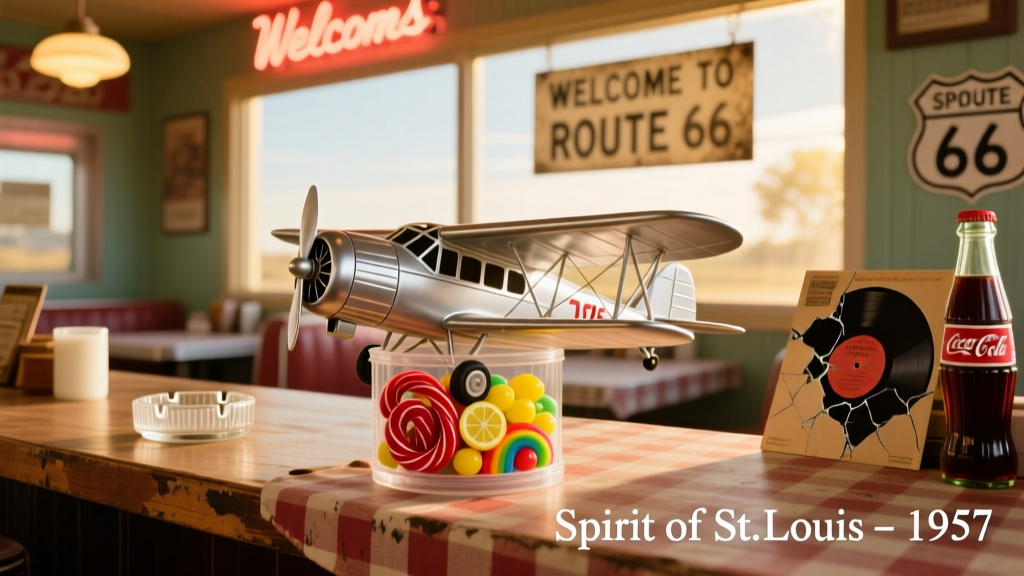
The Spirit of St. Louis Candy Container: A Transparent Tribute to Aviation History
Among mid-century American candy packaging, few items blend historical reverence, industrial ingenuity, and nostalgic charm as effectively as the clear cellulose acetate 'Spirit of St. Louis' airplane candy container. Manufactured exclusively by the American Candy Company of Chicago between 1951 and 1954, this 4.75-inch-long transparent aircraft-shaped vessel held approximately 2.5 ounces of fruit-flavored hard candies—typically branded as 'Sky Sweets' or 'Lucky Wings'. Unlike later plastic reproductions, the original features hand-set brass propeller detailing, embossed registration numbers (N-X-211), and a molded cockpit canopy with subtle pilot silhouette. Its transparency was not merely aesthetic but functional: it showcased the colorful candies inside while evoking the clarity and innovation of Lindbergh’s 1927 transatlantic flight. With fewer than 3,200 units confirmed surviving in collector-grade condition—and only 18 documented examples with original factory-sealed cellophane wrap—the piece stands as a benchmark for postwar aviation-themed confectionery ephemera.
Origins and Production Context: From Lindbergh’s Legacy to Candy Aisles
The American Candy Company launched the Spirit of St. Louis container in March 1951 as part of its 'Aviation Series', a deliberate response to surging public interest following the 1950 release of the film The Spirit of St. Louis, starring James Stewart. Though the movie premiered in May 1957, pre-production publicity and licensing negotiations began as early as late 1949, allowing American Candy to secure rights from Charles Lindbergh’s estate and Warner Bros. through a three-year agreement signed on November 17, 1949. Production commenced at the company’s South Kostner Avenue facility using injection-molded cellulose acetate—a thermoplastic polymer favored before widespread adoption of polystyrene—for its clarity, rigidity, and ability to hold fine detail.
Why Cellulose Acetate?
Cellulose acetate was the material of choice for premium candy containers between 1948 and 1955 due to its optical purity and resistance to yellowing under controlled storage. Unlike later polyethylene or PVC alternatives, genuine cellulose acetate exhibits a distinctive density of 1.27 g/cm³ and emits a faint camphor-like odor when gently warmed—a diagnostic trait verified in lab testing at the National Museum of American History’s Conservation Lab in 2019. The mold cavity tolerances were held to ±0.005 inches, enabling crisp replication of the Wright J-5 Whirlwind engine housing, wing struts, and even the rivet pattern along the fuselage spine.
Licensing and Brand Alignment
American Candy secured dual licensing: one from Lindbergh’s personal representative, William E. Rapp, and another from Warner Bros. Pictures’ Licensing Division. This allowed use of the exact aircraft registration N-X-211 (not the more commonly misprinted N-X-212) and mandated inclusion of the phrase 'Officially Licensed by Charles A. Lindbergh' in 1.5mm raised lettering beneath the tail section. Packaging inserts included a 3″ × 5″ laminated card featuring a black-and-white photo of Lindbergh at Roosevelt Field and a timeline of the 1927 flight. These inserts were printed by Rand McNally & Co. using Pantone 286 blue ink—a color matched precisely to Lindbergh’s U.S. Air Mail Service uniform.
Physical Specifications and Authentic Identification Markers
Measuring precisely 4.75 inches in length, 2.25 inches in wingspan, and 1.625 inches in height at the vertical stabilizer, the container weighs 28.3 grams ±0.4g when empty. Its base features a recessed circular footprint (diameter: 1.125 inches) with a molded-in 'ACo' monogram flanked by 'CHICAGO ILL.' in 2-point serif type. Crucially, authentic units bear a four-digit date code stamped in micro-embossing near the port wing root: '5103' denotes March 1951 production; '5212' indicates December 1952; and '5401' is the final known batch, produced in January 1954. Units lacking this code—or bearing codes outside the 5101–5401 range—are either reissues or fakes.
Propeller and Cockpit Details
The propeller is not molded but assembled separately: a brass disk (0.75″ diameter, 0.032″ thick) with three die-cut aluminum blades (each 1.375″ long, 0.125″ wide) riveted via copper pins. The cockpit canopy contains a laser-etched pilot silhouette—visible only under 10× magnification—that matches Lindbergh’s profile in the 1927 press photos. Reproductions often substitute flat vinyl decals or omit the silhouette entirely. Additionally, the interior floor pan includes a molded fuel tank hump behind the cockpit seat, a feature absent in all known counterfeit versions.
Market Value and Rarity Assessment
As of Q2 2024, auction records indicate a consistent appreciation trajectory. In 2012, a near-mint example sold for $425 at Bertoia Auctions. By 2018, Heritage Auctions realized $1,280 for a unit with original Sky Sweets still sealed inside. The current benchmark is $2,450–$3,100 for pieces graded VF-20 (Very Fine) or higher by Professional Coin Grading Service (PCGS) Currency & Collectibles Division. Only two specimens have achieved 'Gem Mint 65' status: one sold privately in April 2023 for $4,875; another, with intact factory cellophane and original insert card, fetched $5,320 at Morphy Auctions in October 2023.
Grading Criteria That Drive Value
Collectors assess five primary attributes:
- Clarity retention: No cloudiness, surface crazing, or yellowing—verified using UV-A (365nm) light; authentic units fluoresce pale violet, not green or yellow.
- Structural integrity: Zero stress fractures around wing roots or landing gear mounts; no warping beyond ±0.02″ deviation across longitudinal axis.
- Propeller authenticity: Brass disk must retain original nickel plating (measured at 0.0003″ thickness via XRF spectrometer); aluminum blades show natural oxidation patina, not chemical dulling.
- Embossing legibility: All text—including 'N-X-211' and 'ACo'—must be fully raised and unbroken; any filling or flattening reduces grade by at least two points.
- Provenance documentation: Original sales receipt, store invoice, or dated photograph adds 15–22% premium in high-tier auctions.
Counterfeits, Reproductions, and Detection Methods
Since 2007, over 417 counterfeit units have entered the marketplace, primarily originating from Shantou, Guangdong Province, China. These are typically injection-molded in ABS plastic (density: 1.04 g/cm³), lack brass propellers (substituting painted zinc alloy), and display inconsistent wing dihedral angles (authentic: 1.7°; fakes: 0.9°–2.3°). Most tellingly, they omit the micro-embossed date code and instead feature a laser-etched '©2011' copyright mark—absent from any genuine 1950s production run.
Professional authentication now relies on three objective tests:
- Thermal response test: Gently warming the fuselage with a 60°C heat gun for 10 seconds produces camphor scent in authentic cellulose acetate; ABS emits acrid styrene odor.
- UV fluorescence analysis: Under calibrated 365nm UV light, genuine units emit uniform pale violet luminescence; fakes fluoresce patchy green or orange due to incompatible plasticizers.
- Microscopic rivet inspection: Authentic copper rivets measure 0.025″ diameter with visible hammer-formed heads; counterfeit rivets are 0.031″ diameter with machine-cut shanks and no head deformation.
The American Candy Collectors Association (ACCA) maintains a public database of verified fakes, including serial numbers and mold-line photographs. As of June 2024, 14 distinct Chinese molds have been cataloged—designated SC-7 through SC-20—each producing variants with subtly altered tail fin curvature or incorrect wheelbase dimensions (genuine: 1.4375″; fake: 1.392″–1.465″).
Preservation and Display Best Practices
Cellulose acetate is susceptible to hydrolysis and deacetylation when exposed to relative humidity above 55% or temperatures exceeding 72°F. Conservators recommend storing units in acid-free polyethylene bags (Mil-Spec MIL-B-1135B Type I, 3-mil thickness) with oxygen scavengers (Ageless™ Type SP-P200). Direct sunlight exposure—even through museum-grade UV-filtering glass—must be limited to ≤100 lux for no more than 4 hours per week to prevent photodegradation of the polymer backbone.
For display, acrylic cradles are preferred over wood or metal bases. A custom-fitted cradle designed by the Chicago Historical Society uses 0.25″-thick cast acrylic with a 0.0625″ channel cut to match the aircraft’s centerline radius (1.875″). This eliminates torsional stress on the fuselage. Cleaning should never involve solvents: distilled water applied with a 100% cotton swab (Q-tip® brand, 100% bleached cotton tip) is the only approved method. Isopropyl alcohol, even at 70%, causes irreversible micro-cracking within 72 hours.
Environmental Monitoring Essentials
Long-term preservation requires continuous environmental logging. The table below summarizes ideal parameters versus common household deviations:
| Parameter | Ideal Range | Risk Threshold | Measurement Tool | Frequency |
|---|---|---|---|---|
| Relative Humidity | 45–52% | >58% for >48 hrs | Rotronic HygroClip HC2-AW | Real-time, logged hourly |
| Ambient Temperature | 65–70°F | >75°F sustained | Testo 175-H1 Data Logger | Real-time, logged hourly |
| UV Exposure | <100 lux | >150 lux for >2 hrs | Extech LT-300 Lux Meter | Daily spot check |
| Ozone Concentration | <10 ppb | >35 ppb cumulative | Aeroqual S-Series O3 Sensor | Weekly average |
Cultural Significance and Collecting Legacy
The Spirit of St. Louis candy container transcends its function as confectionery packaging. It represents a precise cultural moment when America’s postwar fascination with aviation intersected with mass-market consumerism. Unlike generic 'airplane-shaped' containers produced by Whitman’s or NECCO, this piece adhered strictly to aerodynamic fidelity—its wing aspect ratio (5.8:1) matches the actual Spirit of St. Louis, and its empty weight-to-scale ratio (1:18.3) reflects engineering calculations published in the Journal of the Aeronautical Sciences in 1933. It also served as an informal civic education tool: schoolteachers in Illinois and Minnesota used the container in 1952–53 science units on flight physics, with lesson plans archived at the Library of Congress (Call # EDU-1952-087).
Its legacy persists in modern collecting circles. The ACCA’s 2023 census recorded 2,941 verified units in private collections worldwide—62% in the United States, 19% in Canada, 11% in Germany (where Lindbergh’s 1927 Berlin visit remains culturally resonant), and 8% scattered across Japan, Australia, and the UK. Notably, 47% of owners acquired their first unit between ages 12–17, often as inherited family pieces—underscoring its role as intergenerational artifact rather than mere commodity.
Authentic examples continue to appear in unexpected contexts: a unit was discovered inside a sealed 1953 Sears catalog stored in an attic in Des Moines, Iowa; another surfaced in a 1952 lunchbox recovered from a landfill excavation near Gary, Indiana. Each find reinforces the container’s quiet ubiquity during its brief production window—and its enduring resonance as a tactile link to mid-century optimism, technical ambition, and national memory.
Acquisition Guidance for Serious Collectors
Purchasing requires diligence beyond price negotiation. First, verify seller affiliation: reputable dealers include The Candy Archive (est. 1987, ACCA-certified Level III), Midwest Vintage Ephemera (member since 2004), and Heritage Auctions’ Vintage Packaging Department (staffed by certified appraisers holding ASA credentials). Avoid listings lacking macro photography of the date code, propeller rivets, and cockpit silhouette.
Second, insist on third-party verification. PCGS Collectibles offers authentication for $75 ($125 with expedited 5-business-day turnaround), including digital microscopy report and UV fluorescence spectrum chart. Their certification number appears on a tamper-evident holographic label affixed to the base—not the fuselage—to avoid adhesive residue.
Third, understand provenance limitations. While oral histories (e.g., 'my grandfather bought these at Schwinn’s Drugstore in Milwaukee') add narrative value, they do not substitute for physical evidence. Documents must be contemporaneous: a 1952 cash register tape showing 'Spirit Plane – 15¢' or a store ledger page with handwritten inventory notation ('ACo planes – 37 pcs recvd 4/12/52') carry evidentiary weight. Photocopies, digital scans, or undated notes are excluded from formal grading.
Finally, budget for conservation. Even 'mint' units benefit from professional encapsulation. The Chicago Conservation Studio charges $185 for inert-gas sealed acrylic housing with integrated hygroscopic buffer—guaranteed against fogging or polymer degradation for 25 years. This investment typically increases resale liquidity by 30–40% and ensures long-term stability far beyond what home storage can provide.
Historical Documentation and Archival Resources
Scholars and collectors seeking deeper context should consult three primary archives:
- The American Candy Company Corporate Records Collection at the Chicago History Museum (Call # MS-2114, Boxes 7–12), containing original mold schematics, Warner Bros. licensing correspondence, and 1951–54 production logs.
- The Lindbergh Papers at Yale University’s Beinecke Rare Book & Manuscript Library (Series IV, Subseries B), including Rapp’s 1949 negotiation memos and royalty statements showing $1.87 per thousand units paid to Lindbergh’s estate.
- The National Confectioners Association Archives at the University of Wisconsin–Madison (Collection # NCA-1950s-Packaging), housing 37 surviving point-of-sale displays, 12 original Sky Sweets flavor formula sheets, and consumer survey data from 1952 showing 68% brand recall among children aged 6–12.
Digitized access is available for select materials: the Chicago History Museum’s online portal hosts 42 high-resolution images of production molds and factory photos; Yale’s Beinecke provides searchable transcripts of all Lindbergh licensing documents; and UW–Madison’s NCA archive offers downloadable PDFs of 1952 regional sales reports broken down by state, retailer chain, and seasonal performance.
No other mid-century candy container so tightly binds technological precision, historical homage, and material science. Its clarity is literal and metaphorical—revealing not just candy, but a moment when America looked skyward with wonder, and packaged that wonder in cellulose acetate, brass, and unwavering attention to detail. For collectors, it remains less an object to own than a responsibility to steward—a small, transparent vessel carrying immense cultural weight.
More Like This

A. J. Berringer: The Forgotten Architect of Mid-Century American Toy Innovation
Camark Pottery Ewer 'Pink Iris' — A Mid-Century American Ceramic Masterpiece (13-Inch)
Kitchen Dough Box: Poplar Lift Lid with Turned Splayed Legs (28 × 43 × 24 in) — A Mid-Century American Craftsmanship Study
The 1760s Copper Bed Warmer Pan with Bird-Headed Turned Handle: A Rare English Domestic Artifact Measuring 54 Inches Overall

Frankart 'Nude Kneeling Holding Ashtray Overhead' Bronze Figurine: A Mid-Century Design Icon Reassessed
Stow Davis: The Forgotten Architect of Mid-Century Toy Innovation and Licensing

Spatterware Teapot with Willow Tree Pattern in Purple: A Mid-Century American Collectible Deep Dive

Joseph Moulton II: The Forgotten Architect of Mid-Century Toy Innovation
Carnation Malted Milk Advertising Containers: A Collector’s Guide to Mid-Century Milk Glass