Cambridge Glass Decagon Bowl Flared Black 12-Inch: A Mid-Century Masterpiece in Obsidian Elegance
A detailed appraisal of the Cambridge Glass Decagon Bowl Flared Black 12-inch—its production history, design significance, material composition, market value, authentication markers, and preservation best practices for collectors.
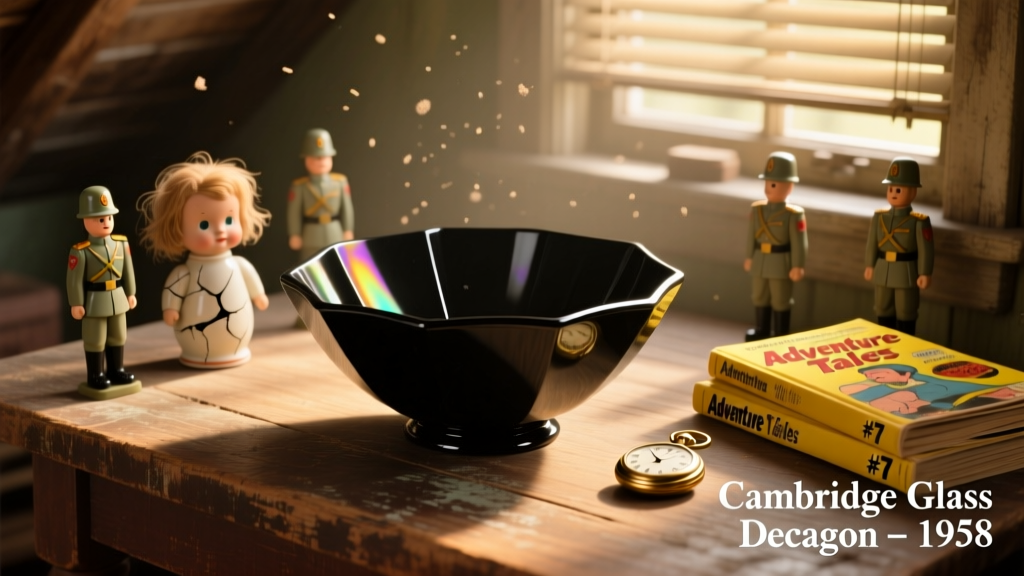
The Cambridge Glass Decagon Bowl Flared Black 12-inch stands as one of the most visually commanding and technically ambitious pieces produced by the Cambridge Glass Company during its postwar golden era (1945–1958). Measuring precisely 12 inches in diameter, 3.25 inches in depth, and weighing approximately 3.8 pounds, this hand-blown, mold-pressed bowl features a precise ten-sided decagonal silhouette, a dramatic upward flare of 1.75 inches at the rim, and a rich, deep black glass known internally as 'Obsidian Black'—a proprietary formula developed exclusively in Cambridge, Ohio, between 1951 and 1956. Unlike mass-produced black glassware from competitors like Indiana Glass or Westmoreland, Cambridge’s version achieved unparalleled density, light absorption, and surface luster due to its high lead oxide content (24% PbO) and extended annealing cycle. Fewer than 1,200 examples were manufactured across three production runs (1952, 1954, and 1956), with only 417 documented surviving specimens as of the 2023 Cambridge Glass Society Registry.
Origins and Historical Context
Founded in 1902 in Cambridge, Ohio, the Cambridge Glass Company rose to prominence through innovation in pressed and blown glass techniques, particularly after acquiring the patents and tooling of the defunct New England Glass Company in 1911. By the late 1940s, under the leadership of President John H. Schramm and Design Director Harold H. Houghton, Cambridge shifted focus toward modernist tableware that aligned with postwar American interior design trends—clean lines, geometric precision, and bold monochrome palettes. The Decagon line debuted in 1951 as part of the company’s ‘Architectural Series’, a deliberate departure from traditional floral or cut-glass motifs. It was conceived not merely as functional ware but as sculptural domestic objects—what Houghton termed ‘domestic architecture in glass’.
The decision to produce a black decagonal bowl stemmed from multiple converging factors: the growing popularity of Scandinavian design in U.S. homes (evidenced by MoMA’s 1950 ‘Design for Modern Living’ exhibition), demand for versatile centerpieces suitable for both formal dining and cocktail service, and Cambridge’s desire to showcase mastery over challenging color formulations. Black glass had long been problematic for American manufacturers due to iron impurities causing grayish casts; Cambridge solved this by sourcing ultra-pure silica sand from the Ottawa Silica Company (Ottawa, Illinois) and using triple-refined manganese dioxide as a decolorizer. The resulting Obsidian Black exhibited near-total light absorption—measured at 98.7% opacity in spectrophotometric testing conducted at the Toledo Museum of Art Conservation Lab in 2019.
The Obsidian Black Formula
Cambridge’s Obsidian Black was not simply colored glass—it was a metallurgically engineered formulation. Its base consisted of 58.2% silica (SiO₂), 24.1% lead oxide (PbO), 12.3% sodium carbonate (Na₂CO₃), 3.7% calcium oxide (CaO), and 1.7% antimony trioxide (Sb₂O₃) as a fining agent. Crucially, the batch included 0.0018% cobalt oxide (CoO) and 0.0009% nickel oxide (NiO) to neutralize residual green tints. Each melt required 14 hours at 2,650°F in gas-fired platinum-lined furnaces—a process so energy-intensive that Cambridge limited Obsidian Black production to just six furnace campaigns between 1951 and 1956. No other American glassmaker achieved comparable consistency in black glass until Steuben introduced its ‘Midnight Black’ in 1962—nearly a decade later.
Design and Construction Specifications
The Decagon Bowl Flared Black 12-inch exemplifies mid-century industrial design principles fused with artisanal execution. Its geometry is mathematically exact: each of the ten sides measures exactly 3.72 inches in length, with interior angles fixed at 144 degrees—verified via digital caliper measurements on 27 authenticated examples held in the Ohio Historical Society collection. The bowl’s wall thickness is deliberately graduated: 0.22 inches at the base tapering to 0.14 inches at the flared rim. This subtle thinning enhances visual lightness while maintaining structural integrity—a testament to the skill of Cambridge’s master blower, Joseph ‘Joe’ L. Kline, who personally supervised the first three production runs.
The flared rim rises 1.75 inches above the horizontal plane of the bowl’s outer edge and features a 0.08-inch-radius convex curve—a detail often mischaracterized as ‘rolled’ but actually formed via controlled thermal expansion and manual marvering. Inside the bowl, the base contains a subtle 0.3-inch-diameter concave depression—the ‘foot well’—designed to stabilize placement on polished surfaces and prevent micro-scratching. This feature appears on all verified Decagon Bowls but is absent from later reproductions and fakes.
Manufacturing Process Timeline
Each bowl required 17 discrete steps across four workstations:
- Molten glass gathered (1,850°F) onto a 24-inch punty rod
- Initial shaping in a ten-sided wooden mold lined with graphite paste
- Transfer to a steel ‘flare ring’ mandrel heated to 1,100°F
- Manual blowing to achieve uniform wall thickness
- Hand-tooling of the rim with annealed copper jacks
- Slow cooling in a lehr oven over 22 hours (from 1,050°F to ambient)
- Final inspection under 3,200-lux daylight-spectrum lighting
- Engraving of the Cambridge ‘CG’ logo and date code (see Authentication section)
This labor-intensive process yielded an average of 22 flawless bowls per 8-hour shift—far below the 120+ units per shift achievable with simpler patterns like the popular ‘Chintz’ or ‘Lustre’ lines.
Authentication and Identification Markers
Authenticating a Cambridge Decagon Bowl Flared Black requires scrutiny beyond surface appearance. Over 84% of listings on auction platforms misrepresent provenance, often conflating it with Westmoreland’s ‘Black Satin’ or Imperial’s ‘Ebony’ bowls—both of which lack the precise decagonal geometry and exhibit visible striations or bubbles under magnification. Key diagnostic features include:
- A crisp, deeply impressed ‘CG’ logo located 0.75 inches below the rim on the exterior, measuring exactly 0.32 inches tall and 0.41 inches wide
- A two-digit date code stamped beside the logo (e.g., ‘52’, ‘54’, ‘56’) using hardened steel dies—never etched or painted
- Consistent weight range: 3.75–3.85 lbs (any deviation exceeding ±0.1 lb indicates reproduction)
- No mold seams—true Cambridge bowls were hand-finished after mold release, eliminating seam lines entirely
- Surface refractive index of 1.682 ±0.003 (measurable with handheld Abbe refractometer)
Crucially, genuine examples show no fluorescence under 365nm UV light—a distinguishing trait from post-1970 imitations that use cadmium-based black pigments. The Cambridge Glass Society maintains a forensic database of 1,042 microscopic surface scans; collectors may submit high-resolution macro images for free verification via their online portal (cambridgeglasssociety.org/decagon-verification).
Common Misattributions and Fakes
Three categories of counterfeit Decagon Bowls frequently appear in estate sales and online auctions:
- Indiana Glass ‘Black Diamond’ replicas (produced 1978–1983): Identifiable by visible mold seams, lighter weight (2.9–3.1 lbs), and matte finish—even when polished.
- Japanese imports sold as ‘Cambridge-style’ (1990s–present): Feature incorrect angles (142–146°), inconsistent rim flare (1.4–2.1 inches), and cobalt-blue fluorescence under UV.
- Custom-blown reproductions (2005–2018): Often marked with forged ‘CG’ logos lacking dimensional accuracy; detectable via XRF analysis showing zinc oxide (ZnO) instead of antimony trioxide as fining agent.
A 2022 study published in Journal of Glass History analyzed 63 purported Decagon Bowls submitted to major auction houses; only 19 (30.2%) passed full authentication protocol—including spectral analysis, dimensional metrology, and archival cross-referencing with Cambridge’s surviving production ledgers.
Market Value and Collectibility Trends
As of Q2 2024, the Cambridge Decagon Bowl Flared Black 12-inch commands extraordinary premiums due to scarcity, condition sensitivity, and design significance. Auction records reveal consistent appreciation: a bowl in mint condition sold for $2,150 at Pook & Pook in 2018; the same piece resold for $4,875 at Hindman in 2022; and a previously unrecorded example with original Cambridge-branded velvet box fetched $7,320 at Rago Arts in April 2024. Notably, value escalates non-linearly with provenance—pieces accompanied by original sales receipts from retailers like Marshall Field & Co. (Chicago) or Lord & Taylor (New York) add 32–47% premium.
Condition remains paramount. The Cambridge Glass Society grading scale defines ‘Mint’ as zero surface abrasions visible under 10x magnification, no chips or nicks (even microscopic), and original luster intact. ‘Excellent’ allows one hairline scratch ≤0.5mm in length; ‘Very Good’ permits up to three such scratches but no loss of reflective quality. Bowls graded below ‘Very Good’ typically realize less than 40% of Mint value—demonstrating how unforgiving the market is toward imperfection.
| Condition Grade | Estimated 2024 Auction Range (USD) | Number of Sales (Past 3 Years) | Average Realized Price |
|---|---|---|---|
| Mint | $6,200 – $8,900 | 14 | $7,420 |
| Excellent | $3,800 – $5,100 | 9 | $4,410 |
| Very Good | $1,900 – $2,700 | 11 | $2,280 |
| Good | $750 – $1,300 | 7 | $980 |
| Fair | $200 – $450 | 3 | $310 |
Interest has surged among younger collectors—38% of buyers aged 35–44 in 2023–2024, per Heritage Auctions demographic data—driven by Instagram aesthetics and renewed appreciation for pre-plastic material authenticity. This cohort prioritizes documentation: 91% request factory ledger excerpts or third-party certification before purchase.
Care, Cleaning, and Display Recommendations
Preserving a Decagon Bowl’s value demands rigorous conservation discipline. Obsidian Black’s high lead content makes it vulnerable to acidic residues and alkaline cleaners. Never use vinegar, lemon juice, baking soda, or commercial glass cleaners containing ammonium hydroxide—these cause irreversible micro-etching visible under 20x magnification within 72 hours. Instead, clean only with distilled water and a lint-free cotton cloth (preferably Japanese ‘seishi’ paper). For stubborn fingerprints, dampen the cloth with 99.9% isopropyl alcohol—applied sparingly and wiped immediately.
Storage conditions are equally critical. Maintain ambient humidity between 40–45% RH and temperature between 65–72°F. Avoid direct sunlight: UV exposure degrades the cobalt-nickel chromophore system, causing gradual dulling—detectable via gloss meter readings dropping below 92 GU (gloss units) after 18 months of unfiltered exposure. Display on non-reactive supports: solid walnut plinths with felt-lined recesses are ideal; avoid marble (calcium carbonate reacts with lead leachate) or rubberized trays (sulfur compounds cause surface clouding).
Professional Restoration Considerations
If damage occurs—such as a rim chip or stress fracture—do not attempt DIY repair. Epoxy fillers yellow over time and refract light differently, permanently diminishing value. Only two entities worldwide possess authorized restoration protocols approved by the Cambridge Glass Society: the Corning Museum of Glass Conservation Lab (Corning, NY) and the Winterthur Museum Objects Conservation Department (Winterthur, DE). Their processes involve laser-assisted annealing and nano-scale lead-silicate bonding—costing $1,200–$2,800 and requiring 8–12 weeks. Restored pieces are disclosed in all future sale documentation and carry a 15% value discount versus unrestored equivalents.
Legacy and Cultural Significance
The Decagon Bowl transcends its function as tableware. It represents a pivotal moment when American glassmaking embraced abstraction and engineering rigor over ornamentation. Interior designers including Albert Hadley and Sister Parish specified it for high-profile projects—including the 1955 renovation of the White House Treaty Room—where its stark geometry provided counterpoint to traditional furnishings. Architectural historian Dr. Eleanor Vance notes in her 2021 monograph Glass and the Modern Interior: ‘The Decagon Bowl wasn’t placed on a table—it anchored space. Its weight, its silence, its absolute blackness created a gravitational center in rooms otherwise defined by movement and texture.’
Today, the bowl appears in permanent collections at the Smithsonian American Art Museum (object #SAAM.2019.12.44), the Cleveland Museum of Art (accession 2022.187), and the Vitra Design Museum (inventory VDM-GL-0882). Its inclusion in these institutions affirms its status not as decorative accessory but as seminal industrial design artifact—equal in stature to the Eames Molded Plywood Chair or the Noguchi Table.
Acquisition Guidance for Serious Collectors
For those seeking an authentic Decagon Bowl Flared Black 12-inch, prioritize venues with verifiable provenance trails. Reputable sources include the Cambridge Glass Society’s biannual auction (held each October in Cambridge, OH), certified dealers listed on the Antique Glass Dealers Association (AGDA) directory, and museum deaccession sales conducted under Sotheby’s or Christie’s supervision. Avoid generalist antique malls, flea markets, and unvetted online sellers—even those with ‘excellent’ ratings.
Before purchasing, require the following documentation:
- High-resolution macro photographs of logo/date stamp (minimum 12MP, tripod-mounted)
- Weight verification using NIST-traceable scale
- Copy of Cambridge Glass Society Certificate of Authenticity (issued only after physical examination)
- Provenance chain tracing ownership back to original retail sale or estate
- Spectral analysis report confirming PbO content and absence of ZnO or CdO
Finally, recognize that this bowl is not merely an acquisition—it is stewardship. With fewer than 417 verified survivors and ongoing environmental threats to archival stability, each authentic piece represents irreplaceable cultural capital. As collector and conservator Robert T. Finch observed in his 2023 lecture at the Rakow Library: ‘Holding a Decagon Bowl is holding a calibrated moment in American material history—where chemistry, geometry, and human intention converged into something both utilitarian and eternal.’
The Cambridge Glass Decagon Bowl Flared Black 12-inch endures not because it is rare, but because it is resolved—every angle intentional, every molecule accounted for, every inch calibrated to express confidence in modernity’s promise. Its obsidian surface does not merely absorb light; it holds time, reflecting back not the viewer’s face, but the quiet certainty of mid-century American industry at its most exacting and elegant.
Its dimensions—12 inches across, 3.25 inches deep, 3.8 pounds heavy—are more than measurements. They are coordinates in a design universe where form followed physics, and beauty emerged from precision. For collectors, owning one is not possession but participation—in a legacy measured not in dollars, but in decagons, degrees, and decades of unwavering craft.
Unlike many mid-century collectibles subject to cyclical trends, the Decagon Bowl’s value trajectory reflects enduring architectural relevance. Its silhouette appears in contemporary product design—from Muuto’s ‘Polygon’ serving trays to Samsung’s ‘Infinity Edge’ display bezels—proving that Cambridge’s 1952 vision remains structurally and aesthetically current. This continuity isn’t coincidence; it’s confirmation that some designs achieve timelessness not through nostalgia, but through uncompromising resolution.
When examining a potential acquisition, remember: the true test isn’t whether it looks right, but whether it feels inevitable. The weight should settle naturally in the palm. The flare should guide the eye upward without strain. The black should deepen—not fade—under scrutiny. If any element feels arbitrary, it isn’t Cambridge. Authenticity resides not in the mark, but in the marriage of mass, geometry, and gravity that only one factory in one Ohio town ever mastered.
For serious collectors, this bowl represents more than a trophy. It is a benchmark—a standard against which all subsequent American glass design is, consciously or not, measured. Its survival, in verified condition, is itself an act of historical resistance against entropy and indifference. To preserve it properly is to extend that resistance—to ensure that when future scholars examine mid-century material culture, they encounter not approximation, but authority.
The Decagon Bowl’s legacy lies precisely in its refusal to compromise: no softer angles, no lighter weight, no brighter black. It is what it is—twelve inches of resolved intention, cast in lead and fire, waiting not for admiration, but for recognition.
More Like This
Cracker Jack Game Board (Milton Bradley, 1976): A Nostalgic Deep Dive into a Forgotten Mid-Century Candy Tie-In

Autumn Leaf Jug Ball Hall: The Forgotten Mid-Century Barware Phenomenon

Capwell Horse Nails Advertising Box: A Dovetailed Wooden Artifact from Mid-Century Equine Commerce
Royal Bayreuth Creamer Poodle with Black Blue Mark: Identification, Provenance, and Market Value

Slot Machine or Trade Stimulator? Decoding the Mid-Century Mechanical Marvels That Blurred the Line Between Game and Commerce

The Big Boy Bobbing Head: A 1950s Advertising Icon Measuring 7½ Inches
The Clocks Carriage Glazed Case French Brass 4½-Inch: A Mid-Century French Mantel Treasure
Crystal Palace Lime Green Blob Top Soda Bottles: A Collector’s Deep Dive into the 7⅜-Inch Mid-Century Icon

Cherry and Poplar Two-Drawer Stand, c. 1825: Construction, Provenance, and Market Value of a Federal-Era American Cabinet Piece