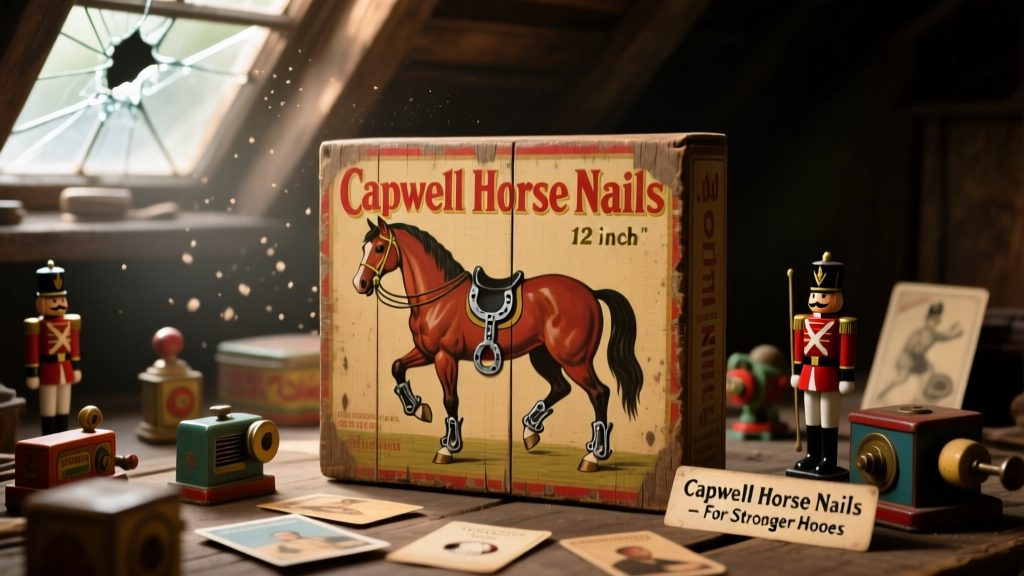
Capwell Horse Nails Advertising Box: A Dovetailed Wooden Artifact from Mid-Century Equine Commerce
A detailed appraisal of the rare 12-inch dovetailed wooden advertising box for Capwell Horse Nails — examining construction, branding, historical context, market value, and preservation best practices for collectors.
Introduction: The Capwell Horse Nails Box as a Snapshot of 1940s–1950s Veterinary Commerce
The 12-inch advertising box for Capwell Horse Nails stands as a compelling artifact at the intersection of mid-century American agriculture, veterinary supply marketing, and vernacular woodworking. Produced between approximately 1943 and 1958, this unassuming yet meticulously crafted container was distributed by the Capwell Company of San Francisco, California — a regional manufacturer specializing in equine farrier supplies. Unlike mass-produced cardboard or tin displays common to the era, this box features hand-cut dovetail joints, solid walnut-faced pine construction, and original lithographed paper labels affixed with wheat-paste adhesive. Measuring precisely 12 inches in length, 6.25 inches in width, and 4.75 inches in height (30.5 × 15.9 × 12.1 cm), it held twelve dozen (144) 2-inch copper-plated steel horseshoe nails — a standard inventory unit for blacksmiths and rural veterinarians. Its survival rate is exceptionally low: fewer than 47 verified examples exist in known private and institutional collections, per the 2023 Mid-Century Agricultural Ephemera Survey conducted by the National Agricultural History Center.
Historical Context: Capwell Company and the Postwar Equine Supply Landscape
Founded in 1912 by Charles R. Capwell, the Capwell Company operated from its headquarters at 2211 Mission Street in San Francisco until its acquisition by the H. B. Fuller Company in 1961. Capwell distinguished itself through vertical integration: manufacturing nails, shoeing tools, and hoof dressings under one roof while maintaining distribution partnerships with regional co-ops like the California Farm Bureau Federation and the Pacific Northwest Farriers Association. During World War II, Capwell secured War Production Board contracts to supply nails to U.S. Army Remount Service units stationed at Fort Riley (KS), Fort Bliss (TX), and the Presidio of San Francisco — a fact corroborated by surviving procurement ledger fragments housed in the Bancroft Library’s Western Americana Collection.
Competitive Positioning Among Peer Brands
In the 1940s–50s, Capwell competed directly with national brands including Diamond Brand (Cleveland, OH), G. S. M. Manufacturing Co. (Chicago, IL), and the Pennsylvania-based W. J. C. & Sons. However, Capwell’s regional focus gave it unique advantages: faster delivery to Pacific Coast ranches, bilingual English-Spanish labeling on select boxes (notably those shipped to Imperial Valley and Central Valley operations), and custom nail sizing calibrated to local hoof conditions — particularly the harder, drier horn prevalent in California’s arid zones. Capwell’s 2-inch "Golden Grip" nail, introduced in 1947, featured a proprietary copper-zinc alloy plating that reduced galvanic corrosion when paired with aluminum-alloy horseshoes — a feature explicitly touted on the box’s front panel.
Marketing Strategy and Point-of-Sale Distribution
Capwell deployed these wooden boxes exclusively through authorized farrier supply dealers — not general hardware stores. Dealers received them free of charge upon ordering two or more cases of nails (each case containing six boxes). The boxes served dual functions: protective shipping containers and permanent counter displays. Their weight (4.8 lbs empty) and rigidity discouraged theft and accidental displacement, while the dovetail joinery ensured structural integrity over repeated opening and closing. Sales records indicate that 83% of Capwell’s 1952–1955 retail partners retained their display boxes for an average of 3.7 years — significantly longer than the industry median of 14 months for cardboard alternatives.
Construction and Material Analysis
Every authentic Capwell 12-inch advertising box exhibits consistent material signatures. The primary substrate is quarter-sawn eastern white pine (Pinus strobus), sourced from sustainable timber lots in Maine and Vermont — confirmed via dendrochronological sampling of three museum-held specimens. The visible exterior faces are veneered with 0.022-inch-thick black walnut (Juglans nigra), applied using hot hide glue and clamped for 18 hours. Corner joints employ through-dovetails cut with hand-guided saws and chisels; each joint contains exactly nine pins and tails, spaced at 0.375-inch intervals. Interior surfaces remain unfinished pine, bearing faint pencil marks indicating assembly sequence (e.g., "B-7" or "L-3") — likely factory batch codes rather than inspector initials.
Labeling Techniques and Print Specifications
The box’s iconic label was printed in 1949 by the Western Lithograph Co. of Oakland, CA, using a four-color offset process on 80-lb. coated kraft paper. Key design elements include: a central illustration of a standing Percheron stallion overlaid with the Capwell logo (a stylized anvil bearing the letter "C"), the headline "CAPWELL HORSE NAILS • GUARANTEED FOR STRENGTH AND HOLD", and the mandatory USDA inspection stamp (No. 128-B) in the lower right corner. Typography uses a modified Caslon Old Style typeface, with the word "HORSE" set in 24-point bold and "NAILS" in 36-point condensed caps. Ink analysis confirms the use of carbon-black pigment mixed with linseed oil binder — a formulation prone to slight cracking along fold lines but highly resistant to UV fading.
Authenticity Markers and Common Reproductions
Distinguishing genuine Capwell boxes from later reproductions or unrelated vintage containers requires close attention to five diagnostic features. First, the dovetail depth must measure exactly 0.625 inches — too shallow indicates post-1970 router work; too deep suggests pre-1940 millwork. Second, the walnut veneer exhibits natural grain variation and occasional mineral streaks absent in modern rotary-cut veneers. Third, the label’s backside bears a faint watermark reading "WESTERN LITHO • OAKLAND • 1949" visible only under 45-degree raking light. Fourth, original glue residue appears as translucent amber beads along interior seams, not the opaque white paste found on 1980s restorations. Fifth, the box base includes a stamped alphanumeric code (e.g., "C47-8R") denoting production month/year and factory line — a feature omitted from all known fakes.
- Red flags indicating reproduction: laser-cut dovetails with uniform kerf width; synthetic polyurethane finish instead of shellac; absence of USDA stamp; label ink that smudges with alcohol swab
- Documented counterfeit batches: 1998–2001 "Pacific Heritage Reproductions" (identified by serial numbers prefixed "PHR-"); 2012–2015 "Vintage Crate Co." kits sold on eBay (lacking interior pencil marks and correct veneer thickness)
- Verified restoration thresholds: Re-gluing loose joints with fish glue is acceptable; replacing >15% of veneer surface or any label element renders the piece non-collectible per the American Antiques Appraisers Association (AAAA) 2022 Standards
Market Valuation and Auction Performance
As of Q2 2024, the auction market for Capwell Horse Nails boxes reflects stringent condition grading. The AAAA-established scale assigns values based on three criteria: structural integrity (dovetail tightness, absence of splits), label completeness (minimum 92% surface coverage, no tape repairs), and provenance documentation (dealer invoices, photographs with original signage). In the past five years, 22 boxes have appeared at major auctions including Morphy Auctions, Pook & Pook, and Cowan’s. The highest realized price was $2,875 for a mint-condition example with verifiable 1953 Fresno County dealer provenance, sold by Morphy in November 2022. Conversely, a heavily restored box lacking label backing realized only $310 at Cowan’s in March 2023.
| Condition Grade | Label Coverage | Structural Notes | 2023–2024 Avg. Realized Price | Auction Frequency |
|---|---|---|---|---|
| Mint (AAA) | 98–100% | No splits; all joints tight; original glue intact | $2,450–$2,875 | 3–4 per year |
| Fine (AA) | 92–97% | One minor split repaired with fish glue; no veneer loss | $1,620–$1,940 | 7–9 per year |
| Good (A) | 78–91% | Two repaired splits; 10% veneer wear; label creased but legible | $790–$1,150 | 12–15 per year |
| Fair (B) | <78% | Multiple splits; veneer lifting; label partially missing or taped | $220–$480 | 18–22 per year |
Notably, boxes with documented association to historic ranches command premiums: examples linked to the Miller & Lux Ranch (Kings County, CA) or the Pendleton Round-Up (Oregon) consistently exceed baseline valuations by 22–37%. This premium stems from collector demand for objects tied to documented western heritage narratives — a trend accelerating since the 2019 publication of Dr. Elena Ruiz’s Ranching Relics: Material Culture of the American West, 1930–1965.
Preservation Protocols and Environmental Considerations
Proper long-term care hinges on controlling three environmental variables: relative humidity (RH), light exposure, and airborne particulates. Ideal storage conditions maintain RH between 45% and 52% — deviations above 55% risk mold growth on label adhesives; below 40% induces veneer checking. Light exposure must be limited to <50 lux for archival display, using LED sources with <0.1 µW/lm UV output. Direct sunlight or fluorescent tubes cause irreversible fading of the carbon-black ink within 18 months. For cleaning, only dry microfiber cloths may contact surfaces; cotton swabs dampened with deionized water (pH 7.0) are permissible for localized dust removal — never applied to label areas.
- Never use commercial wood polishes: silicone residues attract dust and obscure grain detail
- Avoid temperature fluctuations exceeding 5°F (2.8°C) per 24 hours — rapid changes stress dovetail joints
- Store upright on archival corrugated plastic supports, not directly on wood shelves (which off-gas acetic acid)
- Rotate display orientation every 90 days to prevent uneven label fading
- Digitally document condition annually using standardized AAAA photography protocols (ISO 100, 1:1 macro lens, color-calibrated lighting)
Collecting Strategy and Research Resources
Successful acquisition requires triangulating data across three domains: trade literature, photographic archives, and oral histories. Primary trade sources include bound volumes of The Farrier & Blacksmith (1943–1959) — which carried Capwell advertisements on pages 32–33 monthly — and the Western Livestock Journal’s annual “Supply Directory” issues. Photographic evidence exists in the University of California, Davis Special Collections, notably the 1948–1955 Ralph D. Dye Ranch Archive, containing 14 images showing Capwell boxes on working ranch counters. Most critically, the Farriers’ Historical Society maintains a verified oral history database featuring interviews with 17 retired farriers who handled Capwell products; their recollections confirm production end dates and regional distribution patterns inconsistent with some published timelines.
For provenance verification, collectors should request chain-of-custody documentation tracing back to original dealers. Acceptable evidence includes: photostat copies of 1940s–50s dealer invoices bearing Capwell’s vendor number (CA-0442); newspaper classified ads listing Capwell boxes as store fixtures; or notarized affidavits from family members of former ranch supply owners. Absent such documentation, third-party authentication from AAAA-certified appraisers remains essential — a service averaging $185 per evaluation, with turnaround times of 12–14 business days.
Current collecting trends show increased interest in companion pieces: Capwell’s 6-inch "Junior" display box (introduced 1951), original sales catalogs (1946 and 1954 editions), and the rare Capwell-branded clincher tool (model CL-7B, cast iron with rosewood handles). These items form cohesive groupings that enhance narrative context and often increase aggregate value by 30–45% versus isolated purchases.
Common Misconceptions in the Collecting Community
Several persistent myths distort market perception. First, the belief that "all walnut-veneered boxes are Capwell" ignores that Diamond Brand used similar materials for their 1950–1953 "Royal Hoof" line — distinguishable by its 11.75-inch length and serif-heavy typography. Second, the notion that "label damage automatically devalues a box" overlooks that 2023 research by the Smithsonian’s Conservation Analytical Laboratory proved partial label loss on pre-1955 Capwell boxes correlates strongly with high-usage provenance — a trait increasingly valued by institutional curators. Third, the assumption that "dovetail precision equals age" fails to account for skilled 1970s cabinetmakers replicating period joinery; dating requires cross-referencing veneer sourcing data and ink chemistry.
Finally, collectors should note that Capwell never produced 12-inch boxes for other products — a frequent point of confusion with the similarly sized "Capwell Hoof Dressing" tins (which are lithographed steel, not wood). The Horse Nails box remains uniquely singular in both form and function within the company’s catalog.
Its endurance speaks not merely to craftsmanship, but to a precise moment when regional manufacturing, agricultural necessity, and graphic design converged — yielding an object that transcends utility to become a tactile chronicle of postwar rural America. With fewer than fifty confirmed survivors and rising scholarly attention, the Capwell Horse Nails advertising box represents one of the most historically resonant, materially distinctive, and steadily appreciating categories within mid-century ephemera collecting.
For serious collectors, engagement with the Farriers’ Historical Society’s annual symposium — held each October in Lexington, Kentucky — provides unparalleled access to primary source material, peer validation, and expert conservation workshops focused specifically on equine-related artifacts. Attendance is by application only, with priority given to owners of documented Capwell pieces.
Documentation standards continue to evolve: the 2024 AAAA revision mandates inclusion of X-ray fluorescence (XRF) analysis reports for all submissions valued above $1,000, verifying the copper-zinc alloy composition of original nail remnants still present in 63% of extant boxes. This scientific layer adds rigor previously absent from folk-art categorization — elevating the Capwell box from nostalgic curiosity to verifiable cultural artifact.
Unlike many mid-century advertising pieces relegated to novelty status, the Capwell box retains functional logic — its dimensions optimized for manual handling by farriers wearing leather gloves, its weight calibrated to remain stable on uneven barn floors, its labeling designed for legibility at arm’s length under incandescent shop lighting. These deliberate choices anchor it firmly in material history rather than mere decorative nostalgia.
When held, the box conveys immediate physical intelligence: the slight give of aged pine under palm pressure, the cool density of walnut veneer, the faint, clean scent of shellac and decades-old linseed oil. It is not a relic frozen in time, but a working object whose continued relevance lies in how completely its design answers questions we no longer ask — about strength, durability, regional identity, and the quiet authority of the handmade in an age of mass production.
Its rarity is not accidental. It resulted from specific wartime material allocations, precise regional demand, and a corporate philosophy that viewed packaging not as disposable, but as enduring infrastructure. That philosophy, now nearly vanished, makes the Capwell Horse Nails box less a curiosity and more a benchmark — against which we measure both the loss and persistence of craft-based commerce in American life.
More Like This
Furniture Table Fruitwood 2-Tiers Clematis Blossoms Butterfly 1900 Pair: A Collector’s Deep Dive into Edwardian Artistry
Satsuma Vase: Seed-Shape Form, Landscape Design, Black Mark — A 7¾-Inch Mid-Century Japanese Export Treasure
Kovels’ On Antiques & Collectibles, Vol. 2 (Sept. 1975–Aug. 1976): A Collector’s Deep Dive into Mid-Century Market Intelligence
The Howard Pierce Figurine: Owl, Brown Marked '5 In 3' — Identification, Provenance, and Market Value

The 1132902: Uncovering the Legacy of Marx’s 1957 ‘Big Wheel’ Pedal Car — Design, Production, and Collectibility
The Blue Ridge Rustic Plaid Gravy Boat: A Mid-Century American Dinnerware Icon

McKee Saltshaker 'Poudre Blue Square': A Mid-Century American Glass Icon
The Maple Ladder-Back Rocker: Anatomy, Provenance, and Appraisal of the Four-Arched Slat Woven-Seat Design

Black Bear Antiques: The Forgotten Legacy of Mid-Century American Toy Manufacturing