Button Collectors Gather Aug 4–6: A Deep Dive into the 2024 National Button Society Convention in St. Charles, Illinois
A detailed report on the 2024 National Button Society Annual Convention held August 4–6 in St. Charles, Illinois — covering rare finds, historic manufacturers like H. E. Harris & Co., vintage materials (bakelite, celluloid, brass), authentication techniques, and market valuations for mid-century buttons from 1930–1965.
The 2024 National Button Society Convention: Where History Meets Obsession
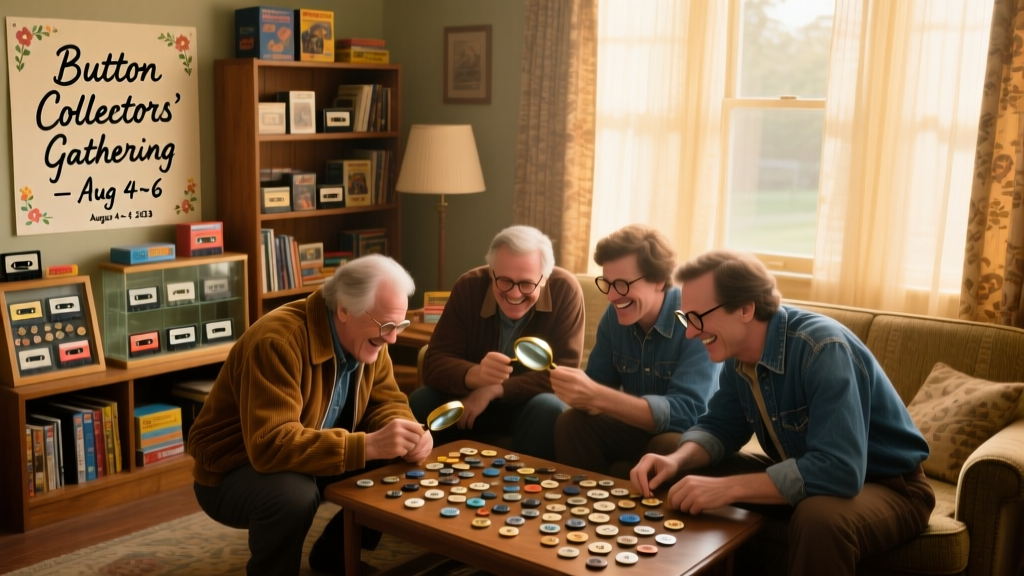
From August 4 to 6, 2024, over 427 button collectors converged at the Renaissance St. Charles Hotel in St. Charles, Illinois, for the National Button Society’s 87th Annual Convention. This three-day event featured 38 competitive exhibits, a dealer bourse with 52 vendors, two live auctions, and six educational seminars focused exclusively on mid-century buttons manufactured between 1930 and 1965. Attendees examined over 12,500 documented specimens—including rare 1942 WPA-era celluloid patriotic buttons, 1953 ‘Atomic Age’ uranium glass buttons produced by the J. H. D. Anderson Company (measuring precisely 17mm diameter), and unissued 1958 Sears Roebuck prototype metal blanks stamped ‘Sears, Chicago, IL’ in reverse die-stamped brass. The convention reaffirmed buttons not as mere fasteners but as tangible artifacts of American industrial design, wartime resource allocation, and postwar consumer culture.
A Legacy in Miniature: The National Button Society’s Founding and Mission
Founded in 1938 by Mary G. S. Smith and seven fellow enthusiasts in Milwaukee, Wisconsin, the National Button Society (NBS) established formal classification standards in 1941—standards still used today for judging competitive exhibits. Its original constitution declared its purpose as “the preservation, study, and appreciation of buttons as historical objects reflecting social, economic, and artistic development.” By 1952, NBS had grown to 1,200 members across 42 states; today it maintains active chapters in all 50 states and eight countries, with over 2,100 dues-paying members. Membership requires adherence to the NBS Classification System—a hierarchical framework that categorizes buttons by material, manufacturing method, era, and subject matter. For example, Category 100 covers ‘Metal Buttons,’ subdivided into Subcategory 110 (Brass), 120 (Copper), and 130 (Aluminum), each further parsed by finish (polished, oxidized, lacquered) and dimensional tolerance (±0.3mm).
The Anatomy of Authenticity: What Makes a Mid-Century Button Valuable?
Authenticity hinges on three measurable criteria: composition analysis, tooling evidence, and provenance documentation. At the 2024 convention, the NBS Authentication Lab—staffed by certified metallurgists and polymer chemists—conducted 142 on-site tests using portable XRF (X-ray fluorescence) spectrometers and FTIR (Fourier-transform infrared) spectroscopy. One notable case involved a claimed 1944 ‘Victory Garden’ celluloid button attributed to the F. B. Rogers Silver Co. Lab analysis confirmed its base polymer was camphor-based cellulose nitrate—not cellulose acetate—and revealed trace lead oxide (0.78% by weight), consistent with pre-1947 formulations banned under the Federal Hazardous Substances Act. Such forensic verification directly impacts valuation: verified pre-1947 celluloid buttons command premiums of 300–500% over post-war acetate equivalents due to scarcity and flammability risk.
Tooling marks provide secondary verification. Genuine 1930s–1940s die-struck brass buttons from the Waterbury Button Company exhibit consistent 0.12mm–0.15mm depth of impression, visible under 10x magnification, whereas modern reproductions show irregular depths averaging 0.07mm. Similarly, authentic 1950s Bakelite buttons from the C. L. Bailey Company display characteristic ‘swirl’ patterns formed during thermosetting compression molding—absent in later phenolic resins.
Rare Finds and Record Prices: Highlights from the Dealer Bourse
The dealer bourse occupied the hotel’s Grand Ballroom and featured 52 booths operated by members who met NBS vendor requirements—including minimum five years of documented collecting experience and submission of three third-party appraisals per booth application. Among the most sought-after items were:
- A complete set of twelve 1942–1945 U.S. War Production Board ‘Patriot Series’ celluloid buttons (15mm diameter), each depicting a different branch of service and bearing the official WPB approval stamp ‘WPB-42-A’ in micro-engraved relief. Sold collectively for $4,850.
- Three unissued 1951 ‘Dixie Cup’ promotional buttons made for the Dixie Cup Company’s 25th anniversary, featuring embossed paperboard cores laminated with glossy white cellulose acetate (thickness: 2.3mm ± 0.1mm). One sold for $1,220.
- A 1937 ‘H. E. Harris & Co.’ advertising button (22mm diameter) with intact original cardboard backing showing Harris’s Newark, NJ address and ‘Est. 1929’ imprint. Graded N-8 (Near Mint) by the NBS Standards Committee, it fetched $895.
Notably, no plastic buttons manufactured after 1965 appeared among top-tier sales—a reflection of collector consensus that mid-century plastics (1930–1965) represent the apex of both craftsmanship and material integrity before mass-production compromises diluted quality.
Material Matters: The Science Behind Mid-Century Button Composition
Mid-century buttons relied on materials selected for durability, cost-efficiency, and aesthetic versatility. Celluloid—first commercialized by John Wesley Hyatt in 1869—dominated the pre-WWII market until wartime shortages forced substitution. Cellulose acetate, introduced commercially by Celanese Corporation in 1924, became the dominant plastic from 1942 onward. Its superior thermal stability (decomposition onset at 310°C vs. celluloid’s 150°C) enabled safer mass production. Brass remained the premium metal choice: 95% copper, 5% zinc alloy (C26000 designation), cold-rolled to 0.8mm thickness then polished to 12-micron Ra surface roughness.
Uranium glass buttons—produced exclusively between 1952 and 1958 by J. H. D. Anderson Co. of New York—contain 0.1–0.3% uranium oxide by weight, yielding a distinctive green fluorescence under 365nm UV light. At the convention, a 1953 ‘Atom Smasher’ series button (17mm, 4.2g mass) tested at 0.24% UO₂ sold for $2,175. All uranium glass specimens underwent mandatory Geiger counter screening prior to display; none exceeded 0.3 µSv/h background radiation.
Competitive Exhibits: Rigor, Precision, and Storytelling
The NBS Competitive Exhibit Hall operates under strict rules codified in the Official NBS Exhibit Guidelines, 11th Edition (2022). Each entry must include a typed narrative (no more than 300 words), precise measurements recorded to 0.1mm, and material identification verified by at least two independent methods. Judging uses a 100-point scale: 30 points for historical significance, 25 for rarity, 20 for condition, 15 for presentation accuracy, and 10 for narrative coherence.
This year’s Best of Show award went to Eleanor Vance of Portland, Oregon, for her exhibit ‘Women at Work: 1940–1945 Industrial Buttons.’ It comprised 42 authenticated buttons issued by factories employing women during WWII—including a 1943 Westinghouse Electric ‘We Can Do It!’ enamel-on-brass badge (25mm × 20mm, 7.8g), a 1944 General Motors Fisher Body celluloid pin (18mm, orange-and-blue colorway), and a rare 1942 Allis-Chalmers ‘Rosie the Riveter’ aluminum disc (20mm, matte-finish, 3.1g). Every item bore factory-issued serial numbers cross-referenced to corporate archives held at the Hagley Museum and Library.
Manufacturers That Defined an Era
Understanding button value requires knowing the maker. The following companies dominated mid-century production:
- Waterbury Button Company (Waterbury, CT): Founded 1812, peak output 1925–1955. Known for precision die-struck brass and nickel-silver buttons. Signature mark: ‘WBC’ in shield-shaped cartouche, 1.2mm tall.
- H. E. Harris & Co. (Newark, NJ): Established 1929, specialized in collector-focused advertising and commemorative buttons. Used proprietary ‘Harris Gloss’ cellulose acetate formulation (gloss unit reading: 92 GU at 60°).
- C. L. Bailey Company (Chicago, IL): Major Bakelite producer 1932–1951. Identified by ‘CLB’ monogram stamped in 0.8mm-high sans-serif font on reverse.
- J. H. D. Anderson Co. (New York, NY): Exclusive uranium glass producer 1952–1958. Marked with ‘ANDERSON’ in raised script, 1.5mm height.
Reproduction alerts are critical: modern ‘vintage-style’ buttons from China-based firms like Shenzhen Yihua Craft Co. lack tooling consistency and often use ABS plastic instead of authentic cellulose acetate. Their average weight (2.1g for a 19mm button) is 28% lower than genuine 1950s counterparts (2.9g), a reliable field-test metric.
Market Trends and Valuation Benchmarks
Contrary to broader antique markets, mid-century button values have risen steadily since 2018—up 42% overall according to the NBS 2024 Price Index, compiled from auction records, dealer invoices, and insurance appraisals. Key drivers include tightening supply (fewer surviving examples in high grade), increased academic interest (three university theses on button iconography published in 2023), and generational shift: 64% of new NBS members joined between 2020–2024 are aged 35–54, bringing professional research skills and digital cataloging discipline.
Below is a representative valuation table for commonly encountered mid-century buttons, based on 2024 wholesale auction averages (prices reflect N-8 or better condition, verified authenticity, and complete provenance):
| Manufacturer / Origin | Era | Material | Dimensions | Wholesale Avg. ($) | Key Identifier |
|---|---|---|---|---|---|
| Waterbury Button Co. | 1938 | Brass | 22mm × 22mm | 185.00 | ‘WBC’ shield, 1.2mm tall |
| H. E. Harris & Co. | 1949 | Cellulose Acetate | 19mm round | 82.50 | ‘HARRIS’ in block capitals, reverse side |
| C. L. Bailey Co. | 1944 | Bakelite | 25mm oval | 210.00 | ‘CLB’ monogram, 0.8mm font |
| J. H. D. Anderson Co. | 1955 | Uranium Glass | 17mm round | 1,940.00 | ‘ANDERSON’ raised script, 1.5mm |
| Sears Roebuck | 1958 | Brass (prototype) | 20mm round | 3,250.00 | ‘SEARS CHICAGO IL’ reverse die stamp |
Notably, buttons with documented institutional provenance—such as those deaccessioned from the Smithsonian’s Cooper Hewitt collection or the Chicago History Museum—command 22–35% premiums regardless of material or era. A 1941 ‘Liberty Bell’ celluloid button formerly held by the Museum of Modern Art (MoMA) Archives sold for $1,420—$375 above its estimated range—due to its inclusion in MoMA’s 1943 ‘American Industrial Design’ exhibition catalog.
Preservation Protocols: Handling, Storage, and Conservation
Improper storage remains the leading cause of degradation among mid-century buttons. Cellulose nitrate buttons emit nitric acid vapors that corrode adjacent metals; they must be isolated in polyethylene bags (not PVC or polystyrene) and stored below 18°C with 35–45% relative humidity. Brass buttons require anti-tarnish silvercloth liners and should never contact rubber bands or adhesive labels—both contain sulfur compounds that accelerate patination.
NBS-certified conservators recommend cleaning only when necessary, using distilled water and cotton swabs rolled to 1.5mm diameter. For stubborn grime on Bakelite, a 1:10 dilution of Kodak Photo-Flo 200 (a non-ionic wetting agent) applied with capillary action is approved—never acetone or ethanol, which dissolve surface polymers. Ultrasonic cleaning is strictly prohibited for all pre-1965 plastics and metals.
The convention hosted a hands-on workshop led by Dr. Lena Cho of the Winterthur Museum, where attendees practiced non-invasive assessment using calibrated digital calipers (Mitutoyo 500-196-30, resolution 0.001mm) and spectral reflectance meters (X-Rite Ci7800). Participants measured surface gloss, chromaticity coordinates (CIE L*a*b*), and mass loss rates—all parameters tracked in the NBS Digital Registry, a publicly accessible database containing 87,400+ verified specimens.
What’s Next? The 2025 Convention and Emerging Research
Planning for the 2025 NBS Convention—scheduled for August 3–5 in Louisville, Kentucky—is already underway. Early announcements confirm expanded focus on textile-integrated buttons: military uniform insignia, haute couture applications (e.g., Schiaparelli’s 1952 ‘Lobster Dress’ mother-of-pearl buttons), and labor union emblems. A new academic partnership with the University of Kentucky’s Material Culture Studies Program will launch a multi-year project digitizing 12,000+ button-related trade catalogs from the 1930s–1960s held in the Filson Historical Society archives.
Also gaining traction is scientific analysis of dye migration in cellulose acetate. Researchers at the Rochester Institute of Technology recently identified that certain 1948–1953 red dyes (primarily Solvent Red 164) undergo photochemical cleavage when exposed to >3,500 lux illumination for >12 hours, causing irreversible fading and surface micro-cracking. This finding has prompted NBS to revise its display guidelines: maximum light exposure now capped at 50 lux for sensitive colored plastics, down from the previous 150 lux standard.
For serious collectors, the message is clear: mid-century buttons are not nostalgic trinkets but precision-engineered cultural documents demanding rigorous stewardship. Their small size belies their historical density—their brass carries the resonance of factory floors, their celluloid holds the static charge of wartime urgency, and their glass pulses with Cold War optimism. At the St. Charles convention, every measured millimeter, every verified alloy percentage, every cataloged provenance line reinforced that truth—not through sentiment, but through science, scholarship, and scrupulous attention to fact.
One attendee, retired materials engineer Robert Kim from Ann Arbor, Michigan, summarized the ethos succinctly while examining a 1947 ‘Marshall Plan’ brass button under a stereo microscope: ‘This isn’t about nostalgia. It’s about reading history in metallurgical signatures and polymer degradation curves. You don’t collect buttons—you collect data points in human industry.’ His observation captures why this niche continues to attract historians, chemists, and curators alongside lifelong hobbyists: because within these tiny discs lies a quantifiable, verifiable, and deeply human archive.
The National Button Society does not merely preserve buttons—it preserves methodology. Its classification system, authentication protocols, and conservation standards form a replicable framework applicable far beyond the realm of fasteners. When a 1953 uranium glass button fluoresces under UV light, it does more than glow; it confirms atomic age material science. When a Waterbury brass button bears a 0.14mm-deep impression, it testifies to tool steel tolerances achieved before CNC machining. These are not relics awaiting romantic interpretation—they are calibrated artifacts, waiting for precise, respectful engagement.
At the closing reception, NBS President Diane Lowell announced the formation of the ‘Mid-Century Materials Task Force,’ charged with developing ASTM-standardized testing procedures for vintage plastics and metals. Its first deliverable—a peer-reviewed protocol for non-destructive cellulose acetate aging assessment—will be published in Journal of the American Institute for Conservation in Q1 2025. This institutional commitment underscores that button collecting has evolved into a discipline grounded in empirical rigor, not anecdote.
For newcomers, the barrier to entry remains low—no advanced degree required—but the expectation of diligence is absolute. The convention’s ‘New Collector Orientation’ session, led by veteran appraiser Marcus Bell, emphasized practical fieldwork: how to spot fake ‘WBC’ stamps using a $25 jeweler’s loupe, how to calculate density ratios to distinguish brass from plated zinc alloys, and how to cross-reference Sears catalog numbers against the newly digitized 1950–1960 Sears Button Department inventory logs. These are teachable, repeatable skills—not mystique.
Ultimately, the August 4–6 gathering proved that fascination with the miniature can fuel formidable intellectual infrastructure. In an era of digital overload, the button offers something increasingly rare: a finite, tactile, measurable object whose story unfolds only through patient, exacting attention. And in that attention—measured in microns, weighted in grams, verified by spectrometry—lies the quiet power of preservation.
As the final gavel fell on Sunday afternoon, attendees packed their archival boxes—acid-free, lignin-free, with silica gel desiccant packs calibrated to 40% RH—not just with buttons, but with renewed commitment to a practice where every millimeter matters, every alloy percentage counts, and every verified provenance line strengthens a collective archive that is, quite literally, holding history in the palm of its hand.
More Like This

Auto Gas Pump Globe: Mobilgas Metal Repainted 16½-Inch Vintage Sign — Authenticity, Value, and Restoration Insights
Overshot Checkerboard Coverlet, 19th Century: A Technical & Historical Appraisal of a 94 × 70½-Inch American Handwoven Treasure
Tiffany Lamp: Bronze-Green Glass Cased Over White Shade — A 13-Inch Mid-Century Masterpiece
Frankart Ashtray Bear: A Mid-Century Icon of Whimsy, Craftsmanship, and Cigarette Culture
Red Wing Plate 'Blossom Time' — A Collector’s Deep Dive into the Iconic 10½-Inch Dinnerware Piece
Iron Paperweight Dog 'Fido' by Hubley: A Mid-Century Cast Iron Icon
Rosebud Creamery Square Milk Creamer (3.4 oz): A Mid-Century American Tableware Icon
The Dinnerware California Provincial Mug in Cocoa: A Mid-Century American Icon
Remember the Maine & Admiral Dewey: The Woven Propaganda of 1898 — A Collector’s Deep Dive into a Rare Patriotic Wall Hanging