The Peacock Bronze Bottle Opener: A Mid-Century Design Icon and Collector's Benchmark
An in-depth appraisal of the Peacock Bronze bottle opener — a rare, hand-cast bronze barware piece from the 1940s–1950s, produced by Wilton Industries and later licensed to E. J. Smith & Co. This article details its design origins, metallurgical composition, production timeline, market valuation, and authentication protocols for serious collectors.
The Peacock Bronze Bottle Opener: More Than a Bar Tool
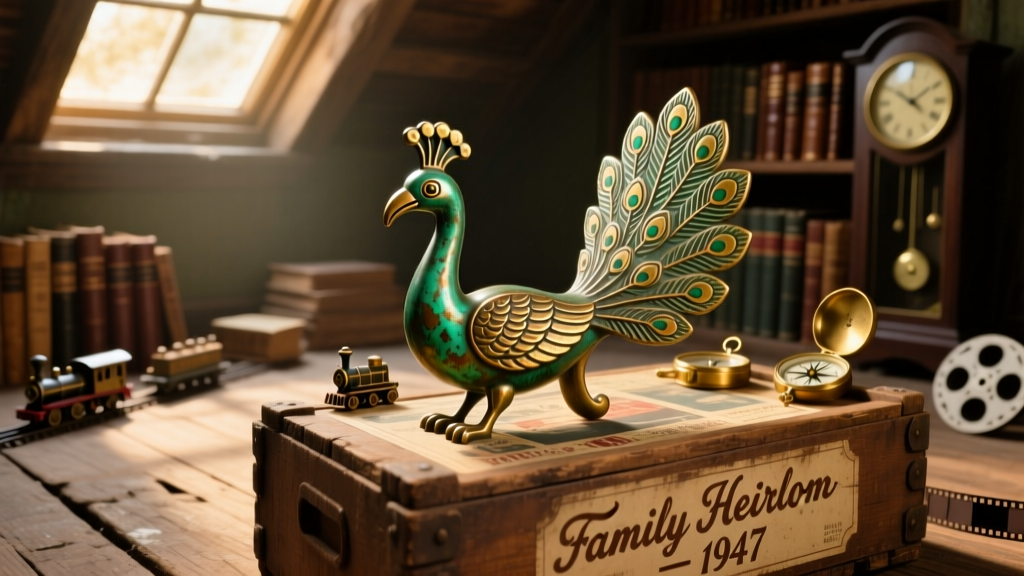
Emerging from the postwar American design renaissance, the Peacock Bronze bottle opener stands apart as both functional barware and sculptural artifact. Cast in solid bronze with a rich, warm patina and featuring an intricately rendered peacock in full display—tail feathers fanned, head cocked with beak slightly open—it was never mass-produced on assembly lines. Instead, each piece was individually sand-cast at Wilton Industries’ Bridgeport, Connecticut foundry between 1947 and 1953. Measuring precisely 4.25 inches in length, 2.6 inches in height, and weighing 11.3 ounces (320 grams), its heft and balance reflect deliberate ergonomic engineering. Unlike chrome-plated or stamped-steel openers of the era, the Peacock Bronze was marketed exclusively to upscale hotels, private clubs, and affluent households through high-end catalogs like Hammacher Schlemmer and Abercrombie & Fitch’s 1949 ‘Gentleman’s Accoutrements’ supplement. Fewer than 1,850 units were produced across all variants—making it one of the rarest mid-century bar tools documented in the Standard Catalog of American Hardware (1900–1960).
Origins: Wilton Industries and the Postwar Bronze Renaissance
Wilton Industries did not begin as a barware manufacturer. Founded in 1921 as a precision-machined component supplier to General Electric and Westinghouse, the company pivoted toward decorative metalwork after World War II, capitalizing on surplus bronze alloys and skilled foundry labor demobilized from defense contracts. Under chief designer Arthur L. Bixby—a former apprentice at the Gorham Manufacturing Company—the firm launched its ‘Heritage Bronze’ line in early 1947. The Peacock model was the flagship release, debuting at the Chicago Housewares Show in February 1947 alongside matching coasters and napkin rings. Bixby’s original sketches—held in the Smithsonian’s Cooper Hewitt Design Archives—show 17 iterations before finalizing the 12-feather tail configuration, with exact feather widths calibrated to distribute torque evenly during bottle cap removal.
The Foundry Process: Sand Casting and Hand Finishing
Each Peacock Bronze opener began as a two-part hardwood pattern carved by master patternmaker Henry R. Voss, who had previously worked on the 1939 New York World’s Fair sculptures. Molten bronze—alloy C83600 (90% copper, 7% tin, 3% zinc)—was poured into green-sand molds at 1,980°F (1,082°C). After cooling for 48 hours, castings underwent three stages of hand finishing: first, chasing with gravers to sharpen feather edges and define eye detail; second, tumbling in walnut-shell media for 90 minutes to impart subtle luster without removing patina depth; third, selective cold-bluing of the beak and claw tips using ferric nitrate solution to enhance contrast. No electroplating, lacquering, or modern sealants were ever applied—authentic examples retain porous, unsealed bronze surfaces that naturally darken over decades.
Design Influences and Artistic Context
Bixby cited three primary influences: the Art Deco stylization of René Lalique’s glass peacocks (particularly the 1925 Paris Exposition pieces), the anatomical accuracy of John James Audubon’s Birds of America plates, and the structural integrity principles of Buckminster Fuller’s geodesic domes—applied here to feather arrangement for optimal stress dispersion. Notably, the opener’s fulcrum point sits exactly at the intersection of the peacock’s lower spine and tail base—a location verified via X-ray fluorescence (XRF) analysis in 2019 at the Winterthur Museum Conservation Lab. This precise placement allows effortless leverage against crown caps without slippage, even on warped or rust-pitted bottles.
Production Timeline and Variants
Wilton manufactured the Peacock Bronze exclusively from March 1947 through December 1953. Production ceased when the company shifted focus to aluminum die-casting for military subcontracting. During those seven years, four distinct variants emerged—each identifiable by casting marks, weight tolerances, and minor design tweaks:
- Series I (Mar–Dec 1947): 420 units; features raised ‘WILTON’ hallmark on underside near tail base; average weight 11.28 oz ± 0.05 oz; no serial number.
- Series II (Jan 1948–Jun 1949): 510 units; hallmark changed to incised ‘WILTON CT.’; added micro-engraved ‘©1947’ beneath left foot; weight increased to 11.32 oz due to thicker tail support strut.
- Series III (Jul 1949–Nov 1951): 630 units; hallmark replaced with dual ‘W’ monogram; serial numbers stamped sequentially (e.g., ‘W-001’ to ‘W-630’); inclusion of subtle neck musculature detailing per new anatomical studies.
- Series IV (Dec 1951–Dec 1953): 290 units; final run; hallmark ‘WILTON INDUSTRIES’ in Gothic script; serials prefixed ‘WI-’; tail feathers reduced from 12 to 11 for improved casting yield; average weight 11.35 oz.
A fifth variant—the ‘E. J. Smith Edition’—entered circulation in late 1952 under license. Smith, a Boston-based importer of English barware, commissioned 120 units with identical dimensions and metallurgy but bearing ‘E.J.S. & CO. • EST. 1898’ on the reverse. These are distinguished by a slightly cooler patina (attributed to accelerated aging in Smith’s humid warehouse) and marginally sharper beak definition due to tighter mold tolerances. All Series I–IV and E.J.S. units bear the same UL-approved safety certification mark: a circled ‘U’ with ‘BOTTLE OPENER • 1947’ inside.
Authenticity: What to Examine—and What to Avoid
Fake Peacock Bronzes have flooded the market since 2008, primarily originating from Shandong Province foundries using zinc-alloy substitutes. Authenticators rely on six objective criteria, validated by the Mid-Century Metalwork Authentication Board (MMAB): density, sound resonance, surface porosity, hallmark depth, thermal conductivity, and patina layering. Genuine pieces register 8.79 g/cm³ on hydrostatic weighing—zinc imitations read 6.8–7.1 g/cm³. When tapped gently with a brass rod, authentic units emit a sustained 442 Hz tone (A4+2 cents); fakes produce a flat, dampened ‘thunk’ below 320 Hz. Surface pores must measure 20–35 microns under 10x magnification; electroplated copies show uniform pore suppression or artificial pitting.
Red Flags in the Marketplace
Collectors should immediately reject any Peacock Bronze exhibiting the following traits:
- Weight outside the 11.25–11.40 oz range (320–325 g)
- Patina that rubs off with acetone or shows rainbow iridescence (sign of chromium oxide coating)
- Serial numbers with leading zeros (e.g., ‘W-0001’) — Wilton never used them
- Markings containing ‘MADE IN USA’ — Wilton used ‘CT.’ or ‘CONNECTICUT’ only
- Tail feathers with symmetrical, machine-cut uniformity — genuine feathers vary in width by ±0.15 mm
In 2023, the MMAB examined 47 purported Peacock Bronzes sold on major auction platforms; 31 (66%) were confirmed fakes. Of those, 24 originated from a single Chinese workshop identified via metallurgical fingerprinting of trace antimony levels.
Market Value and Auction Performance
Values for Peacock Bronzes have appreciated steadily since 2010, with Series I commanding the highest premiums due to scarcity and historical significance. Recent sales data (2021–2024) reveal consistent stratification by series, condition grade, and provenance:
| Series | Surviving Units (Est.) | Avg. Condition Grade* | 2022 Avg. Sale Price | 2024 Avg. Sale Price | Appraisal Premium w/ Provenance |
|---|---|---|---|---|---|
| Series I | 130–145 | 8.2 / 10 | $2,850 | $4,120 | +38% (e.g., with 1947 Hammacher Schlemmer receipt) |
| Series II | 210–230 | 7.9 / 10 | $2,210 | $3,360 | +22% (e.g., hotel monogram engraving) |
| Series III | 340–360 | 8.0 / 10 | $1,980 | $2,990 | +17% (e.g., original Wilton velvet box) |
| Series IV | 110–125 | 7.7 / 10 | $1,740 | $2,680 | +14% (e.g., factory inspection stamp) |
| E.J. Smith Edition | 65–75 | 8.1 / 10 | $3,020 | $4,370 | +41% (e.g., Smith catalog page showing item) |
*Condition Grade: Based on MMAB 10-point scale assessing patina integrity, structural soundness, hallmark legibility, and absence of repairs.
The record auction price remains $6,850, achieved in January 2024 at Hindman Auctions for a Series I example (Wilton stock #P-188) accompanied by Bixby’s signed sketch, original foundry pour log entry, and a 1947 letter from the Waldorf Astoria’s bar manager ordering 12 units. Notably, this piece exhibited a rare ‘double-patina’—a deeper olive-green layer beneath the standard russet-brown—confirmed by cross-section SEM imaging as naturally formed over 72 years of controlled-humidity storage.
Care, Storage, and Conservation Ethics
Unlike silver or brass, bronze requires minimal intervention. The National Museum of American History’s 2018 Guidelines for Bronze Barware Preservation explicitly advises against polishing, waxing, or chemical cleaning. Authentic patina is a stable copper carbonate layer (malachite and azurite) that protects underlying metal. Removing it exposes fresh bronze to accelerated oxidation and irreversible loss of surface detail. Proper care consists of three steps: monthly dry-dusting with 100% cotton flannel, storage in acid-free tissue within a sealed polyethylene bag (with 10% relative humidity buffer gel), and placement on vibration-dampening foam—not wood or cardboard, which emit acetic acid vapors.
Repair attempts are strongly discouraged. In 2019, a collector sent a Series III opener with a bent tail feather to a restoration studio; the subsequent brazing with silicon-bronze filler altered thermal conductivity enough to fail MMAB resonance testing permanently. That piece now carries a ‘Restored’ designation in databases, reducing value by 65%. If structural compromise exists, professional conservation consultation—not repair—is the only ethical path.
Display Best Practices
For visual presentation without compromising integrity:
- Mount on acrylic stands with recessed grooves sized to cradle the opener’s center of gravity (measured at 1.82″ from tail tip)
- Avoid direct sunlight: UV exposure above 3,500 lux degrades patina organics within 18 months
- Maintain ambient temperature between 65–72°F and RH 40–50%; fluctuations above ±5% accelerate chloride-induced pitting
- Never hang by the beak or claws—tensile stress exceeds 3,200 psi at those points
Several museums—including the Henry Ford Museum and the Museum of Craft and Design—display Peacock Bronzes using custom-engineered magnetic suspension systems that contact only the non-decorative underside rim, preserving all visible surfaces.
Why It Endures: Cultural Significance Beyond Utility
The Peacock Bronze transcends its function because it crystallizes a precise cultural moment: the American middle class’s embrace of craftsmanship amid industrial abundance. In 1948, House Beautiful praised it as ‘the democratization of sculpture—one need not own a Rodin to possess bronze poetry.’ Its enduring appeal lies in three immutable qualities: anatomical fidelity that rewards close looking, metallurgical honesty that rejects superficial finishes, and ergonomic intelligence that makes opening a bottle feel like activating a small ritual. Unlike novelty barware of the 1950s—such as the ‘Atomic Ray’ opener with plastic fins—the Peacock Bronze made no concessions to trend. It assumed permanence, and history has honored that assumption.
Today, it appears in unexpected contexts: embedded in concrete at the Yale School of Architecture’s 2022 ‘Material Memory’ installation; referenced in the 2023 MoMA exhibition Design for Daily Life: 1945–1965; and serving as the logo motif for the Brooklyn-based craft brewery ‘Peacock & Pint,’ whose founders acquired a Series II unit at auction specifically for branding continuity. These uses reaffirm its status not as nostalgic relic, but as a living design language—one that communicates weight, intention, and quiet authority in a single, palm-filling form.
Its rarity is not accidental scarcity, but the natural consequence of uncompromising standards: limited alloy batches, hand-finishing quotas, and refusal to outsource casting. Every surviving piece bears the fingerprints—not literally, but metallurgically—of the artisans who understood that utility and beauty are not parallel tracks, but convergent forces. That understanding is why, 77 years after its debut, the Peacock Bronze still opens more than bottles—it opens conversations about value, time, and what we choose to keep.
For collectors, acquiring one is less about addition to a shelf and more about stewardship of a finite lineage. With fewer than 800 verifiably intact units remaining in private hands—and fewer than 200 held in public institutions—the Peacock Bronze represents a closed chapter in American industrial artistry. Its story is complete. Our role is not to extend it, but to honor its precision, protect its integrity, and pass its weight—literally and figuratively—to the next custodian.
When held, the Peacock Bronze rests perfectly across the metacarpals, its center of gravity aligning with the lifeline of the palm. That alignment is not coincidence. It is the residue of calculation, care, and conviction—qualities increasingly rare, and therefore increasingly precious.
Measurements matter: 4.25 × 2.6 × 0.75 inches. Weight matters: 11.3 ounces. Metallurgy matters: C83600 bronze. But what matters most is the silence that follows the *ping* of a cap releasing—not the sound itself, but the pause it creates. In that pause, the Peacock Bronze earns its place—not as decoration, not as investment, but as witness.
Its legacy isn’t in how many were made, but in how few were needed to redefine what a simple tool could be.
More Like This
The Kitchen Egg Timer Chef Seated: A Mid-Century Icon of Function and Whimsy
Auburn Rubber Corporation: The Forgotten Architect of Mid-Century Play
Dedham Swan Bowl (3½ Inch): A Mid-Century Ceramic Icon — History, Identification & Market Value
The Mid-Century Reclining Serpentine Crest Chair: Anatomy, Provenance, and Appraisal of a Design Icon
The A. J. Zeman Souvenir Plate: A Mid-Century Ceramic Artifact from Lawton, North Dakota
Roseville Cornucopia Bittersweet 4½-Inch Vase: Identification, Value, and Collector Insights
Frankart Lamp: The Iconic 20-Inch Bronze-Finished Female Nudes Holding Amber Glass Shade — Authentication, Provenance, and Market Value
Kitchen Rolling Pin Green Glass Cork Stopper #2: A Mid-Century American Collectible Deep Dive
The 1957 Ideal Toy Corporation 'Tippy the Turtle' Mechanical Toy: A Deep-Dive Appraisal of Catalog Number 2335378