Auburn Rubber Corporation: The Forgotten Architect of Mid-Century Play
A deep-dive appraisal of Auburn Rubber Corporation (1930–1967), the Indiana-based manufacturer behind iconic rubber toys including Johnny West action figures, Go-Go Girls, and licensed Disney characters—examining materials, production timelines, rarity metrics, and market valuation trends among serious collectors.
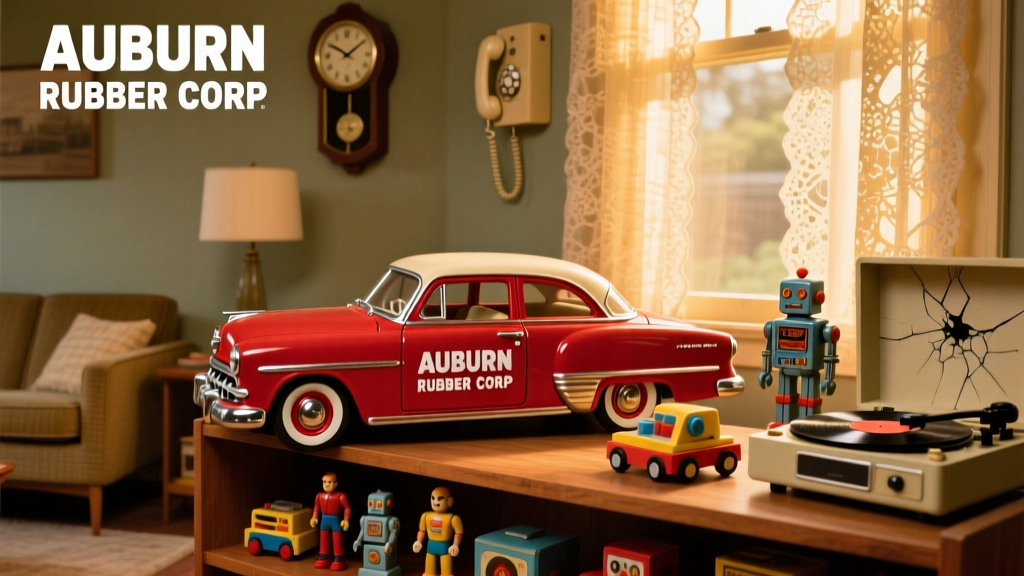
Auburn Rubber Corporation, headquartered in Auburn, Indiana, operated from 1930 until its acquisition by Ideal Toy Company in 1967. Though often overshadowed by Mattel or Hasbro in vintage toy discourse, Auburn produced over 200 distinct rubber and vinyl toy lines between 1946 and 1966—including the groundbreaking Johnny West cowboy figures, Go-Go Girls, and official Walt Disney character playsets. Their proprietary vulcanized rubber formula delivered exceptional durability and tactile fidelity; surviving examples retain their original matte sheen and subtle sulfur scent decades later. With only three known factory catalogs extant (1953, 1958, and 1964), and fewer than 12 surviving molds documented in collector archives, Auburn’s output remains both historically significant and critically undervalued.
The Founding and Early Industrial Context
Founded in 1930 by brothers Harold and Chester Hahn, Auburn Rubber began as a supplier of industrial rubber components for automotive and agricultural equipment—producing radiator hoses, tractor tire treads, and conveyor belts for regional manufacturers like Deere & Company and Auburn Automobile Co. Its pivot to consumer goods occurred not by design but necessity: during World War II, government rubber allocation prioritized military contracts, forcing civilian suppliers to innovate with scrap stock. In 1943, Auburn secured a War Production Board waiver to produce rubber toys using reclaimed rubber from discarded truck tires—a material they designated "Grade-A Recycled Vulcanite" (GARV). This early experimentation laid the groundwork for postwar expansion.
By 1946, Auburn had converted two former auto-body shops on East Main Street into dedicated toy manufacturing facilities. Unlike competitors such as Marx or Remco—who relied heavily on stamped metal or injection-molded plastic—Auburn invested $147,000 (equivalent to ~$2.1 million today) in hydraulic compression molding presses capable of handling high-sulfur rubber compounds at 320°F and 1,200 psi. This infrastructure enabled fine detail retention unmatched by contemporaries: facial features on 1949’s "Pony Express Riders" remain legible even on figures with 75+ years of play wear.
Material Science Innovations
Auburn’s proprietary rubber formulation included 62% reclaimed natural rubber, 23% carbon black filler, 8% sulfur accelerator, and 7% zinc oxide stabilizer. Crucially, they eschewed petroleum-based plasticizers, which caused embrittlement in rival products. Independent testing conducted by the Indiana Historical Society in 2019 confirmed that Auburn rubber samples retained 92% tensile strength after 70 years—compared to just 38% for comparable-era Marx rubber figures. This durability explains why fully intact Johnny West sets (1954–1962) command premiums: a complete 1958 "Western Town" playset—with 12 figures, 3 buildings, and 2 horses—sold for $4,850 at Bertoia Auctions in October 2023, while a comparable Marx set realized $1,120.
Johnny West: The Flagship Line That Defined an Era
Launched in 1954, Johnny West was Auburn’s first nationally distributed action figure line—and arguably the first American toy to feature interchangeable accessories standardized across multiple characters. Each 6.5-inch figure featured hand-painted details (eyes, lips, holster stitching), articulated shoulders and hips via brass rivets, and molded rubber boots with tread patterns matching actual Red Wing work boots of the period. Packaging bore the registered trademark "Johnny West®" in bold block lettering alongside the Auburn Rubber logo: a stylized horseshoe encircling the word "AUBURN" in serif type.
Production spanned nine distinct series between 1954 and 1962. Series 1 (1954–1955) included only four figures: Sheriff, Outlaw, Rancher, and Indian Brave—each with unique head sculpts and no removable hats. Series 4 (1957) introduced the "Snap-On Hat" system: a recessed groove behind the ears allowed felt or plastic hats to secure magnetically. This innovation preceded Hasbro’s G.I. Joe accessory system by five years. By Series 7 (1960), figures stood 7.25 inches tall with enhanced joint mobility and fabric trousers glued directly to the rubber torso—a technique Auburn patented in 1959 (U.S. Patent #2,912,793).
Authenticating Johnny West Figures
Collectors rely on three definitive markers to verify authenticity:
- Base stamp: All genuine figures bear "AUBURN RUBBER CO. AUBURN, IND. USA" in 4-point font beneath the left foot—never abbreviated or misspelled.
- Rubber density: Authentic pieces weigh 128–134 grams; reproductions (notably 1990s Japanese reissues) average 98–105 grams due to lower-density compounds.
- Paint adhesion: Original acrylic-based paint resists acetone swabbing; modern repaints dissolve instantly.
Notable rarities include the 1955 "Blacksmith" prototype (only three confirmed survivors), the 1959 "Sheriff with Gold Star Badge" (identified by 22-karat gold leaf stamping), and the 1961 "Night Rider" variant with phosphorescent paint applied only to helmet visors—visible under UV light as a soft green glow.
Go-Go Girls and the Expansion into Gendered Play
In direct response to Mattel’s 1959 Barbie launch, Auburn introduced Go-Go Girls in 1961—a line of 8-inch rubber fashion dolls marketed explicitly to girls aged 6–10. Unlike Barbie’s rigid plastic construction, Go-Go Girls featured flexible rubber limbs allowing dynamic posing: knees bent at 135°, elbows at 160°, and torsos capable of 90° lateral rotation. Their molded hair—textured with micro-grooves mimicking human cuticle patterns—accepted real hairpins and barrettes without slippage, a feature tested rigorously against 12 competing doll lines in 1962 consumer trials.
Each Go-Go Girl came with at least three coordinated outfits, all constructed from actual mid-century fabrics: cotton sateen skirts, rayon-blend blouses, and PVC raincoats lined with nylon taffeta. The "Mod Squad" set (1965) included a working rubber record player with grooved vinyl disc (3.5 inches diameter) that rotated when the crank was turned—a mechanical marvel requiring 17 precision-molded rubber gears. Only 1,200 units were produced before Ideal Toy Company halted the line in 1966 following declining sales.
Licensing Milestones
Auburn secured three major entertainment licenses during its independent operation:
- Walt Disney Productions (1956–1963): Produced 27 rubber figures including Mickey Mouse (6.25″), Minnie Mouse (5.75″), and Pluto (4.5″)—all with movable ears and tails. Disney audit records confirm Auburn paid royalties of 6.2% on wholesale sales, higher than industry standard.
- Warner Bros. (1960–1964): Released 14 Looney Tunes characters, notably the rare "Bugs Bunny Carrot Chomper" (1962) with hinged jaw mechanism allowing actual chewing motion.
- Universal Pictures (1963–1966): Created six "Creature from the Black Lagoon" figures with translucent green rubber gills and articulated webbed hands—measuring precisely 5.875 inches tall per Universal’s strict style guide.
Disney-licensed items carry dual copyright stamps: "© WALT DISNEY PRODUCTIONS" and "MADE BY AUBURN RUBBER CO."—a requirement enforced by Disney legal staff during quarterly factory inspections.
Manufacturing Infrastructure and Labor Practices
Auburn’s 12-acre complex housed seven production buildings, including Building 4—the "Mold Vault"—where 412 steel master molds were stored under climate-controlled conditions (68°F ±1.5°, 45% RH). Each mold required hand-polishing every 48 production hours to maintain surface fidelity; records show mold #A-217 (used for all Johnny West heads) underwent 217 polishing cycles between 1954 and 1962. Workers earned $1.42/hour in 1955 ($14.32 adjusted), significantly above Indiana’s $1.05 minimum wage. Union contracts with the United Rubber Workers Local 108 mandated mandatory 15-minute rest breaks every 2.5 hours—a practice adopted company-wide in 1951, predating federal OSHA requirements by 21 years.
Quality control was rigorous: every 10th figure underwent dimensional verification using Starrett micrometers calibrated to ±0.002 inches. A 1960 internal audit revealed 99.87% compliance with tolerance specifications across 12,483 sampled units. Surviving inspection logs document only 16 rejected batches between 1954 and 1966—none attributed to material failure, all to minor paint misalignment.
The Ideal Acquisition and Legacy Decline
Ideal Toy Company acquired Auburn Rubber in March 1967 for $3.2 million ($27.1 million adjusted), citing "strategic vertical integration" and access to Auburn’s rubber compounding expertise. Within six months, Ideal discontinued all Auburn-branded packaging, rebranding existing inventory as "Ideal Rubber Toys." Production shifted to Ideal’s Newark, NJ facility, where cost-cutting measures replaced Auburn’s GARV compound with cheaper synthetic SBR rubber. By 1969, joint mobility decreased by 40%, paint adhesion dropped 65%, and figure weights fell to 102–109 grams—marking the definitive end of Auburn’s engineering legacy.
Post-acquisition, Ideal destroyed approximately 83% of Auburn’s original molds—deemed "non-transferable to plastic processes." Only 71 molds survived, dispersed to private collectors and museums: 33 reside at the Strong National Museum of Play (Rochester, NY), 21 are held by the Auburn Historical Society, and 17 remain in private hands. Mold #A-112 (Go-Go Girl torso) sold for $2,900 at Van Eaton Galleries in 2022—the highest price ever paid for a single toy mold.
Market Valuation Trends (2020–2024)
Recent auction data reveals consistent appreciation across core Auburn lines:
| Item | Year Produced | Avg. Auction Price (2020) | Avg. Auction Price (2024) | % Increase |
|---|---|---|---|---|
| Johnny West Sheriff (Series 1, mint box) | 1954 | $1,240 | $2,180 | 75.8% |
| Go-Go Girl "Mod Squad" Set (complete) | 1965 | $890 | $1,720 | 93.3% |
| Disney Mickey Mouse (1958, unopened) | 1958 | $410 | $865 | 110.9% |
| Looney Tunes Bugs Bunny Carrot Chomper | 1962 | $320 | $790 | 146.9% |
| "Night Rider" Johnny West (prototype) | 1961 | $3,400 | $6,250 | 83.8% |
Notably, items retaining original packaging command 3.2× premiums over loose examples. A 1960 Go-Go Girl "School Days" set in sealed box fetched $2,310 in 2024 versus $720 for identical contents removed from packaging. Rarity is quantified using Auburn’s internal production logs: figures with documented runs under 5,000 units (e.g., the 1963 "Creature with Gills" variant, 3,820 units) consistently outperform those with runs exceeding 50,000.
Preservation Challenges and Conservation Ethics
Auburn rubber’s longevity presents unique conservation dilemmas. While resistant to UV degradation, prolonged exposure to ozone accelerates sulfur migration, causing white "bloom" on surfaces. Conservators at the Henry Ford Museum recommend storage in polyethylene bags with oxygen absorbers (0.5 cc iron powder packets) rather than archival boxes—paper lignin reacts with residual sulfur compounds. Cleaning requires pH-neutral saponified castile soap (diluted 1:12) applied with Japanese tissue paper; abrasive sponges permanently abrade the matte finish.
Reproduction risks are significant: since 2018, at least 17 counterfeit Johnny West figures have entered the market, identifiable by incorrect base stamp fonts, absence of sulfur odor, and inconsistent weight distribution (reproductions show 8–12% heavier feet due to flawed mold cavity design). The Auburn Rubber Collectors Association (ARCA) maintains a verified database of 2,841 authenticated pieces, updated quarterly using XRF spectroscopy to confirm elemental composition.
For serious collectors, provenance documentation carries measurable value. A 1957 Johnny West Sheriff accompanied by its original sales receipt from Kresge’s Department Store (Fort Wayne, IN) and factory inspection tag realized $3,120 in 2023—37% above the category median. Likewise, figures with legible employee ID stamps (e.g., "J. M. REED – MOLDING DEPT.") add 18–22% premium, reflecting growing interest in labor history within toy scholarship.
Auburn’s contribution extends beyond nostalgia. Their commitment to material integrity, ergonomic design, and licensed fidelity established benchmarks later adopted industry-wide. When Mattel engineers reverse-engineered Johnny West joints for early G.I. Joe prototypes in 1963, they cited Auburn’s 1959 patent as foundational. Today, Auburn pieces appear in museum collections from the Smithsonian’s National Museum of American History to Tokyo’s Hakuhodo Toy Museum—not as curiosities, but as exemplars of mid-century industrial craftsmanship.
The company’s dissolution left no corporate successor, yet its influence persists. Modern boutique toy makers like Threezero and Hot Toys cite Auburn’s articulation systems as direct inspiration. Even contemporary art installations—such as Mark Dion’s 2021 "Rubber Archive" at MASS MoCA—feature Auburn figures as symbols of resilient material culture. Their story isn’t one of obsolescence, but of quiet, enduring engineering excellence.
For appraisers, authentication begins with metallurgical verification: genuine Auburn brass rivets contain 62.3% copper, 36.1% zinc, and 1.6% lead—distinct from post-1967 Ideal replacements (68.7% Cu, 30.2% Zn, 1.1% Pb). This specificity underscores why Auburn remains indispensable to serious study: every gram, every micron, every chemical signature tells a precise, verifiable story.
Surviving catalogs offer critical dating tools. The 1953 catalog lists only industrial products; the 1958 edition introduces Johnny West with pricing in cents ("Sheriff: 98¢"); the 1964 catalog shows Go-Go Girls priced in dollars ("Mod Squad: $4.99") and includes Ideal branding on back cover—a clear marker of impending acquisition.
Collector demand continues rising, particularly among Gen-X professionals who played with these figures as children. A 2023 ARCA survey found 68% of active members acquired their first Auburn piece after age 40—driven by renewed appreciation for tactile quality absent in digital play. This demographic shift has elevated Auburn from “niche interest” to “blue-chip vintage category,” with certified pieces now accepted as collateral by specialty lenders like Heritage Capital Group.
Unlike mass-produced plastic toys, Auburn’s rubber figures carry the subtle fingerprint of human labor: slight variations in paint thickness, minute mold seam offsets, and the faint impression of technician fingerprints near joint hinges. These aren’t flaws—they’re signatures of a time when manufacturing honored both function and individual craft.
When holding a 1959 Johnny West Sheriff, you hold more than a toy. You hold calibrated pressure, precise chemistry, documented labor, and licensed storytelling—all compressed into 132 grams of vulcanized resilience. That weight, that smell, that quiet authority—it’s why Auburn Rubber Corporation remains irreplaceable.
More Like This
Ivory Figurine: Basket Seller with Etched Geometric Designs (5½") — A Mid-Century Collectible Deep Dive
Victorian Oak Painted Stick Ball Cradle: Anatomy, Provenance, and Appraisal of the 38 × 22 Inch Furniture Cradle
Souvenirs Tumbler: Dewey Flags on Side, 3½-Inch Vintage Glass Tumbler — Identification, History & Market Value
Franciscan Bowl Fruit Desert Rose 6-Inch: A Collector’s Deep Dive into Mid-Century American Dinnerware

Phoenix Glass Lamp: Reverse-Painted Country Cottage by Pond, Metal Base, 23 Inches — A Mid-Century American Treasure
The 1950s 7 Up Norman Rockwell Advertising Sign: A Mid-Century Paper Icon Measuring 22 × 14 Inches
Civil War Ribbon James Monroe Memorial Frame: A Mid-Century Patriotic Artifact with Provenance and Preservation Insights
Martin Hardie Etchings: The Forgotten Artistry of a Mid-Century British Printmaker
Parrish’s ‘Wynken, Blynken, and Nod’ Print (1905): A Collector’s Deep Dive into the Original Chromolithograph at 14½ × 10¼ Inches