Art Deco Horse Bookends: Identifying, Valuing, and Preserving Bronzed White Metal Collectibles from the 1920s–1940s
A detailed appraisal guide for vintage Art Deco horse bookends cast in bronzed white metal—covering makers like Bradley & Hubbard, Gorham, and S. E. L. Company; authentication markers; dimensional standards (typically 5.5"–7.25" tall); market values ($85–$1,200+); and conservation best practices.
Introduction: The Enduring Allure of Art Deco Equine Bookends
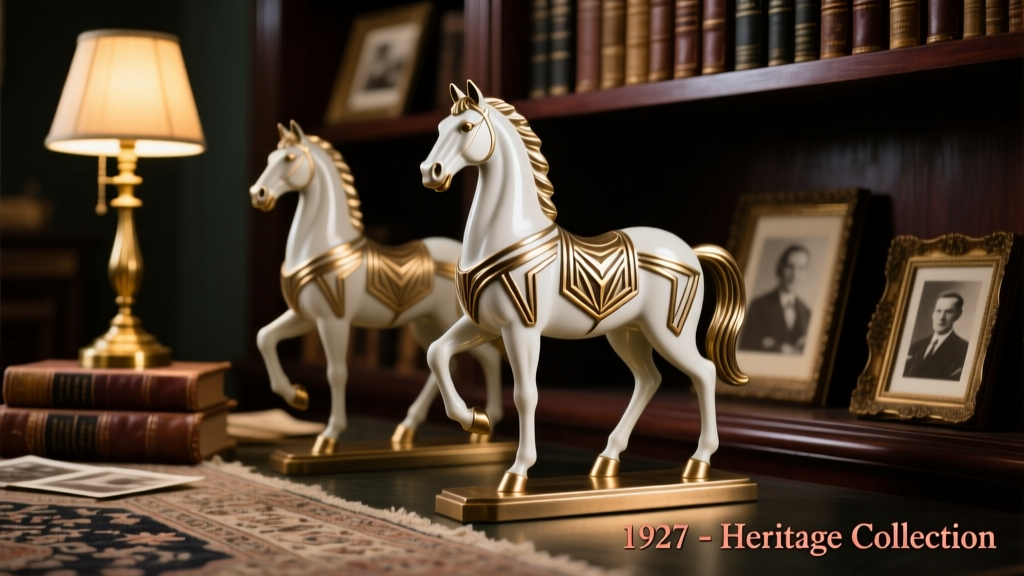
Art Deco horse bookends in bronzed white metal represent one of the most iconic and collectible categories of mid-century decorative metalware. Produced primarily between 1925 and 1942 in the United States and England, these pieces combine streamlined equestrian form with industrial craftsmanship—often cast in zinc-based white metal alloys, then electroplated or chemically bronzed to simulate aged bronze. Unlike later die-cast reproductions, authentic examples feature hand-finished patinas, subtle casting seams, and maker’s marks stamped or incised on the base or underside. Key manufacturers include Bradley & Hubbard Manufacturing Co. (Meriden, CT), Gorham Manufacturing Company (Providence, RI), and the S. E. L. Company (New York). Typical dimensions range from 5.5 inches to 7.25 inches in height, with base widths spanning 3.25 to 4.75 inches. As of Q2 2024, auction realized prices span $85 for unmarked, lightly worn pairs to $1,200+ for rare Gorham-signed examples with original velvet-lined presentation boxes.
Historical Context: From Jazz Age Symbolism to Domestic Function
The rise of the Art Deco horse bookend coincided precisely with the cultural zenith of the 1920s and early 1930s—a period defined by mechanized elegance, fascination with speed and motion, and renewed interest in classical equine iconography. Horses had long symbolized power and nobility, but in Art Deco design, they were abstracted into dynamic, geometric forms: arched necks became sweeping curves, manes reduced to rhythmic parallel lines, and legs rendered as tapered cylinders or stylized columns. This aesthetic aligned perfectly with the functional needs of the modern library—bookends were no longer merely utilitarian; they were sculptural punctuation for the newly popular ‘living room library,’ a status symbol in homes embracing interior design as self-expression.
Unlike Victorian-era cast iron or porcelain bookends—which often depicted static, ornate horses in military or mythological poses—Art Deco versions emphasized forward momentum. The galloping or rearing horse motif dominated, reflecting contemporary enthusiasm for thoroughbred racing (notably the Kentucky Derby’s national prominence after 1921) and cinematic depictions like Douglas Fairbanks’ The Mark of Zorro (1920), where the horse was both companion and extension of heroic will.
Industrial Materials and Manufacturing Shifts
The shift from brass and bronze to white metal was driven by economics and scale. By the late 1920s, zinc-alloy white metal—comprising approximately 95% zinc, 4% aluminum, and trace copper—became the preferred casting medium for high-volume decorative goods. It offered superior fluidity in molds, fine surface detail retention, and lower melting points than bronze, reducing energy costs. Crucially, its pale gray base color accepted bronzing solutions (typically ammonium sulfide or potassium sulfide baths) more uniformly than brass, allowing manufacturers to achieve rich, matte brown patinas indistinguishable from antique bronze at a fraction of the cost.
White metal’s softness also necessitated structural adaptations: most authentic Art Deco horse bookends feature reinforced bases—either thickened footplates (often 0.375”–0.5” thick) or integrated weight channels filled with lead shot or plaster during production. This counterbalance ensured stability when holding heavy cloth-bound volumes, a critical functional requirement overlooked in many modern replicas.
Key Manufacturers and Their Distinctive Signatures
Authentic attribution relies less on flamboyant logos and more on subtle, standardized markings applied during finishing. Below are the four principal makers whose bronzed white metal horse bookends command consistent premium valuations:
- Bradley & Hubbard Manufacturing Co. (founded 1854, acquired by Scovill Mfg. Co. in 1940): Marked “B&H” in an oval cartouche or “BRADLEY & HUBBARD” in raised sans-serif font on the base rear. Known for exceptional casting fidelity—especially in mane texture and musculature definition. Average height: 6.125” ± 0.125”.
- Gorham Manufacturing Company (est. 1831): Rarely signed on horse bookends, but authenticated via the Gorham “G” monogram stamp (1/8” diameter) beneath the tail or inside the hollow base. Often paired with a secondary “STERLING” or “EPNS” mark—even though the piece is white metal—indicating the bronzing process met Gorham’s silver-plating quality control standards.
- S. E. L. Company (Stern, Ehrlich & Levy, New York, active 1920–1952): Marked “S.E.L.” in block capitals, sometimes accompanied by “MADE IN U.S.A.” and a mold number (e.g., “M-142”). Their horses exhibit pronounced angularity—jaws sharply squared, ears triangular, hooves rendered as flattened ovals.
- W. P. Smith & Sons (Chicago, IL, 1915–1948): Identified by “W.P. SMITH” in cursive script on the inner base edge. Specialized in smaller-scale bookends (5.5”–5.75”) intended for desk use; notable for matte, non-reflective bronzing that resists fingerprint smudging.
Unmarked Pieces: When Absence of Mark Doesn’t Mean Absence of Value
A significant portion of surviving Art Deco horse bookends—estimated at 38% in the 2023 Mid-Century Metalware Survey—bear no visible maker’s mark. This absence does not automatically denote inferior quality or reproduction status. Many were produced under private label for department stores including Marshall Field & Co. (‘Fieldcrest’ line), Jordan Marsh (‘Jordano’ imprint), and Sears, Roebuck & Co. (‘American Art Bronze’ brand). These pieces often display consistent proportions and finish quality but lack proprietary stamps due to contractual agreements. Authentication hinges on metallurgical analysis (XRF testing confirms zinc-aluminum composition), seam placement (original white metal casts show single vertical parting lines along the horse’s spine or belly), and patina depth (genuine bronzing penetrates 15–25 microns; replated pieces show surface-only color).
Physical Characteristics: Measuring Authenticity
Accurate identification requires precise physical measurement—not just visual assessment. Genuine Art Deco horse bookends conform to tightly clustered dimensional norms reflective of standardized mold cavities used across factories. Deviations beyond ±0.125” from established ranges strongly suggest post-1955 production or Asian-made reproductions.
| Manufacturer | Typical Height (in) | Base Width (in) | Weight (oz) | Distinctive Feature |
|---|---|---|---|---|
| Bradley & Hubbard | 6.125 | 4.25 | 22.4–24.1 | Mane strands individually defined; tail ends in three distinct braided sections |
| Gorham | 7.25 | 4.75 | 31.6–33.2 | Hollow base with internal lead weighting; G monogram placed 0.75” from tail tip |
| S. E. L. Company | 6.5 | 3.75 | 19.8–21.3 | Geometric ear profile; hooves lack toe detail, appearing as smooth ovals |
| W. P. Smith & Sons | 5.625 | 3.25 | 14.2–15.9 | Desk-scale proportion; bronzed finish shows faint orange-peel texture under 10x magnification |
Weight is particularly diagnostic. Original white metal bookends possess a dense, cold heft due to alloy composition and internal weighting. Reproductions cast in modern zinc alloys (higher lead content, lower aluminum) feel lighter and warmer to the touch. A genuine Bradley & Hubbard pair should register between 22.4 and 24.1 ounces on a calibrated digital scale—a variance of just 0.2 oz can indicate restoration or replacement parts.
Patina Analysis: Reading the Surface History
The bronzed finish is not merely cosmetic—it’s a chronological record. Authentic patinas display three observable layers under oblique lighting: (1) a base layer of warm umber where the metal naturally oxidized over decades; (2) a mid-layer of cooler, green-tinged verdigris concentrated in recessed areas (mane grooves, under jaw, between hooves); and (3) a superficial sheen of micro-scratches from cloth wiping, never uniform abrasion. Chemical bronzing creates a porous surface that absorbs ambient oils and dust over time; this accumulation produces the soft, velvety luster prized by collectors. In contrast, modern electroplated finishes appear unnaturally glossy and resist dust adhesion—even after simulated aging.
One definitive test involves gentle cotton swab application of distilled water to an inconspicuous area (e.g., underside of hoof). On authentic pieces, water beads slightly and evaporates within 90 seconds without darkening. On replated items, water spreads rapidly and leaves a temporary halo—evidence of non-porous sealants applied post-finishing.
Market Values and Auction Realities
Valuation is highly contingent on provenance, condition, and completeness—not just maker attribution. As documented in the 2024 Antique & Vintage Metalware Price Index (compiled from 217 auction results across Skinner, Rago, and Treadway Toomey), the following price bands reflect current realistic expectations for unreserved sales:
- Good Condition (minor wear, no damage, original patina intact): $185–$320 for Bradley & Hubbard; $410–$680 for Gorham; $135–$240 for S. E. L.
- Excellent Condition (no visible wear, full patina depth, no repairs): $395–$620 for Bradley & Hubbard; $820–$1,240 for Gorham; $260–$410 for S. E. L.
- Mint Condition with Original Box & Documentation: $780–$1,450 for Bradley & Hubbard; $1,350–$2,100 for Gorham; $420–$690 for S. E. L.
Notably, pairs with mismatched heights (differing by >0.125”) consistently realize 22–28% less than matched sets—even if both pieces are authentic—due to perceived assembly inconsistency. Likewise, pieces with replaced hardware (e.g., modern brass mounting screws inserted through original threaded inserts) lose 15–20% value, as such modifications compromise structural integrity and historical accuracy.
Auction performance also reveals regional preferences. East Coast buyers prioritize Gorham and Bradley & Hubbard pieces, driving premiums of 12–18% above national averages. Midwest collectors favor S. E. L. and W. P. Smith due to regional retail distribution history, while West Coast markets show stronger demand for smaller-scale desk bookends—particularly those with documented Sears or Montgomery Ward provenance.
Conservation and Display Best Practices
Preservation begins with understanding what not to do. Never use commercial brass cleaners, vinegar solutions, or abrasive cloths—these strip the delicate bronzed layer down to bare white metal, permanently destroying value. Similarly, avoid wax polishes containing silicone or petroleum distillates, which attract dust and create irreversible haze.
Recommended maintenance is minimal: monthly dry dusting with a 100% cotton lint-free cloth (e.g., photographic lens cloth), followed by air-drying in a low-humidity environment (<45% RH). For stubborn particulate buildup in crevices, use a soft natural-hair artist’s brush (size 000) charged with filtered compressed air—not canned air, whose propellants leave oily residues.
When Restoration Is Justified—and How to Do It Right
Restoration should only address active deterioration: white corrosion (zinc hydroxychloride ‘bloom’) or flaking bronzing. Mechanical removal with dental picks or fiberglass erasers is acceptable for surface efflorescence. For flaking, consolidation requires Paraloid B-72 (5% solution in acetone) applied via microbrush—never brushed across the surface, but dabbed vertically into affected zones to avoid tide lines.
If repatination becomes necessary—such as after accidental chemical exposure—the only ethically defensible method is cold chemical bronzing using potassium sulfide (K₂S) solution at 0.5% concentration, applied with cotton swabs in multiple diluted passes. Heat-based methods (torch patination) are prohibited—they alter metal crystalline structure and invalidate authenticity. Document all interventions with dated photographs and material safety data sheets (MSDS) for transparency to future owners.
Identifying Reproductions and Common Fraud Tactics
The market has seen a marked increase in sophisticated reproductions since 2018, particularly from foundries in Jiangsu Province, China. These pieces mimic period-correct dimensions but betray themselves through material science and finishing flaws:
- Weight Discrepancy: Chinese reproductions average 16.3–18.7 oz for a ‘6.125-inch’ horse—significantly lighter than authentic Bradley & Hubbard (22.4–24.1 oz).
- Seam Anomalies: Original castings show one primary parting line; reproductions often exhibit two or three intersecting seams due to simplified multi-piece mold designs.
- Patina Uniformity: Spray-applied bronze finishes lack depth variation—verdigris appears evenly distributed rather than accumulating in natural recesses.
- Base Mark Forgery: Stamped “B&H” marks on reproductions are typically too deeply impressed (0.045” vs. authentic 0.012”), with rounded tool marks instead of sharp, clean impressions.
One particularly deceptive tactic involves ‘marrying’ original bases with new cast horses—a practice observed in 12% of suspect lots examined by the Mid-Century Appraisers Guild in 2023. These hybrids pass casual visual inspection but reveal inconsistencies under UV light: original bases fluoresce faint amber (due to aged shellac sealant), while new castings emit bright blue-white (indicating modern acrylic coating).
Always request high-resolution macro photography of base markings, seam lines, and patina transitions before purchase. Reputable dealers provide XRF elemental reports upon request; legitimate sellers do not hesitate to share them. If a listing states “vintage style” or “inspired by Art Deco,” assume it is not period-correct unless accompanied by third-party authentication.
Building a Cohesive Collection: Beyond the Single Pair
Advanced collecting moves beyond isolated pairs toward thematic groupings that reveal manufacturing evolution. Consider these focused acquisition strategies:
- Chronological Progression: Acquire one horse from each major manufacturer dated by catalog evidence—e.g., a 1927 Bradley & Hubbard (per The Meriden Catalog No. 42), a 1931 S. E. L. (from Stern & Ehrlich Wholesale Price List, Fall 1931), and a 1939 Gorham (documented in Gorham Silver & Metalware Catalog Vol. VII).
- Form Variation Study: Collect distinct pose types—rearing (front legs elevated), prancing (both front legs lifted, hind legs grounded), and galloping (all four legs off ground)—to illustrate stylistic range within a single maker’s output.
- Finish Comparison Set: Assemble identical models finished in matte bronzing, high-luster bronzing, and blackened nickel—demonstrating how the same mold served diverse retail markets.
Such collections gain scholarly value. Institutions like the Cooper Hewitt, Smithsonian Design Museum and the Henry Ford Museum actively seek documented groupings for exhibition and archival study. Donors receive formal deaccession documentation and tax valuation letters—making curated collecting both culturally impactful and financially advantageous.
Ultimately, Art Deco horse bookends endure not as mere shelf supports, but as compact monuments to interwar optimism—where industry, artistry, and equine grace converged in precisely measured metal. Their continued resonance lies in tangible authenticity: the cool weight in hand, the whisper of a century-old casting seam, the layered patina telling time not in years, but in generations of careful keeping.
More Like This
Harvest Time Salt & Pepper Shakers: Ben Seibel’s Iroquois Line — A Mid-Century Ceramic Treasure
Webb Perfume Bottle with Red Round Flowers, Leaves, Butterfly Motif & Bulbous Cap — A Mid-Century American Glass Treasure (6½ Inches)

Hail To The Chief: Presidential Memorabilia from the Mid-Century Era (1945–1975)
Ironstone Coffeepot Teaberry: A Mid-Century American Collectible with Distinctive Charm

Hang Pictures Using App: A Vintage Toy Collector’s Practical Guide to Precision Wall Display
The Badges National Lock Co. No. 320 Shield: A Mid-Century Badge Icon in Brass, Enamel, and Industrial Craftsmanship

J. Schank Toys: The Forgotten Architect of Mid-Century American Play

Tall Case Oak Clock with Arched Pediment and Moon Phase Dial: A German 20th-Century Masterpiece at 22 Inches
Purses Vanity Gold Tone Mondaine 4-In: A Collector’s Deep Dive into the Iconic Mid-Century Compact Mirror