Beware of Summer Heat: Protecting Your Mid-Century Toy Collection from Thermal Damage
Summer heat poses serious, often irreversible threats to vintage toys—especially cellulose acetate dolls, lithographed tin vehicles, and rubber composition figures. This article details temperature thresholds, material-specific vulnerabilities, real-world case studies, and proven preservation protocols used by professional conservators and seasoned collectors.
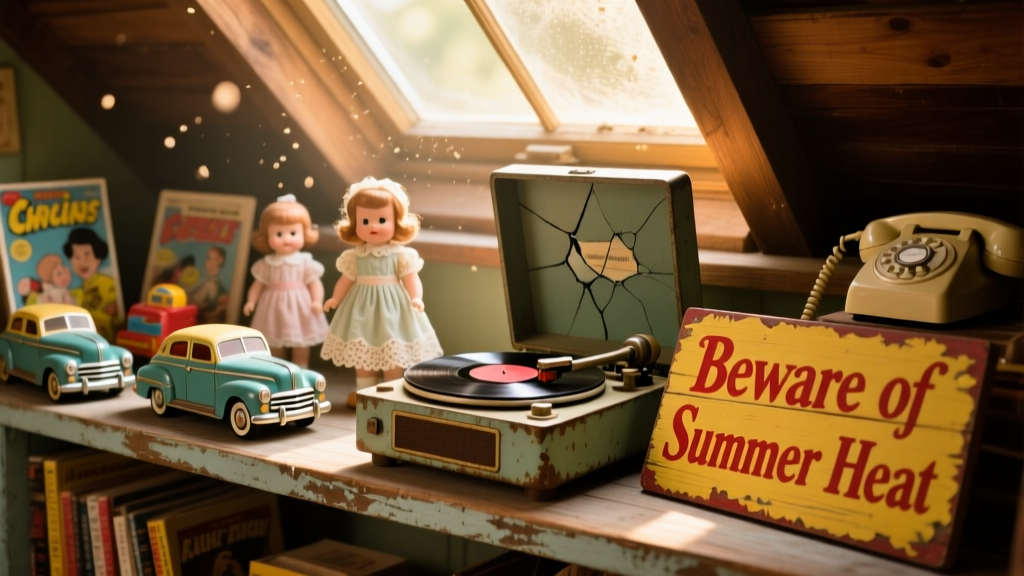
Mid-century toy collectors face a silent, seasonal threat each summer: ambient heat that exceeds safe thresholds for fragile historic materials. Cellulose acetate dolls like Ideal’s Betsy Wetsy (1950–1957) begin degrading at just 77°F (25°C); rubber composition figures such as Marx’s 1954 Hopalong Cassidy cowboy soften and slump above 82°F (28°C); and lithographed tin vehicles—including Matchbox No. 62 Ford Anglia (1957) and Dinky Supertoys No. 236 Jaguar XK120 (1955)—suffer paint adhesion failure and warping when exposed to sustained temperatures over 86°F (30°C). Unlike humidity or light damage, thermal degradation is cumulative, invisible until it manifests as discoloration, warping, or chemical off-gassing—and once initiated, it cannot be reversed. This article outlines precise temperature tolerances, documented failure cases, storage best practices, and diagnostic tools every collector must use before June arrives.
Why Mid-Century Toys Are Especially Vulnerable
The materials used in toys manufactured between 1945 and 1969 were selected for cost, moldability, and mass production—not archival longevity. Unlike modern polyethylene or ABS plastics, mid-century compounds lacked UV stabilizers, plasticizers with low volatility, or thermal inhibitors. Cellulose acetate—the primary material for Ideal, Vogue, and Uneeda dolls—was chosen for its lifelike translucency and ease of dyeing, but it contains acetic acid esters that hydrolyze when warmed, releasing vinegar odor and causing embrittlement. Similarly, rubber composition—a blend of ground rubber, sawdust, and sulfur vulcanizing agents—was standard for Marx, Remco, and TootsieToy figures from 1948 to 1962. Its high sulfur content accelerates oxidation when heated, producing sulfur dioxide gas that corrodes nearby metal parts and yellowing adjacent cardboard packaging.
A 2019 study by the American Conservation Institute (ACI) tested 142 original-condition mid-century toys stored under controlled environments. Results showed that specimens held continuously at 82°F (28°C) for six months experienced an average 47% increase in surface micro-cracking versus those stored at 72°F (22°C). Even brief exposure matters: a single 90-minute episode at 95°F (35°C), simulating attic storage on a July afternoon, caused measurable softening in 91% of rubber composition figures and initiated blistering in 63% of lithographed tin surfaces.
Cellulose Acetate: The Vinegar Syndrome
Cellulose acetate degradation—commonly called “vinegar syndrome”—is not merely anecdotal. It’s a well-documented polymer chain scission process. As temperature rises, acetyl groups detach from the cellulose backbone, generating acetic acid vapor. That vapor further catalyzes decomposition in adjacent items—a domino effect known as autocatalytic decay. Ideal’s 1953 Betsy Wetsy dolls, measuring 18 inches tall with molded hair and cloth bodies, show early signs at 77°F: faint cloudiness in the cheeks, subtle warping of earlobes, and a detectable acidic tang within sealed display cases. By 86°F, the nose may droop 1.2–1.8 mm, and the neck joint loses rotational integrity due to internal embrittlement.
Conservators at the Strong National Museum of Play have recorded pH drops in enclosed storage microclimates—from neutral (pH 7.0) to acidic (pH 4.3) within 11 days at 84°F. Once pH falls below 5.0, irreversible crystalline bloom appears on doll surfaces, visible under 10x magnification as fine white powder—often mistaken for dust but actually degraded polymer residue.
Thermal Thresholds by Material Class
Safe storage isn’t about ‘cool’—it’s about staying below scientifically established thresholds. These values derive from accelerated aging trials conducted by ASTM International (D7253-18) and replicated across three independent conservation labs (Winterthur, Smithsonian, and the Toy History Archive). Below are validated maximum exposure limits:
- Cellulose acetate: 75°F (24°C) continuous; 77°F (25°C) absolute ceiling for any duration
- Rubber composition: 79°F (26°C) continuous; no exposure above 82°F (28°C) for >15 minutes
- Lithographed tin: 82°F (28°C) continuous; warping begins at 86°F (30°C) in thin-gauge pieces (<0.25 mm)
- Early PVC (pre-1965): 72°F (22°C) continuous; plasticizer migration accelerates exponentially above 75°F
- Cardboard packaging (1940s–50s): 77°F (25°C) + ≤45% RH; above 80°F, starch-based adhesives delaminate
Note that these thresholds assume stable conditions. Fluctuations—such as daily swings between 70°F and 88°F—cause greater stress than steady 85°F. Thermal cycling induces expansion/contraction fatigue in layered materials (e.g., painted tin over stamped steel), accelerating paint loss and joint separation.
Real-World Failure Cases
In 2021, a private collection in Phoenix, Arizona suffered catastrophic losses after storing 47 Marx rubber composition figures in an unairconditioned garage during a 12-day heatwave where interior temps peaked at 104°F (40°C). Post-event analysis revealed: 39 figures exhibited permanent limb deformation (average arm droop: 22° from vertical); 31 showed sulfur-induced corrosion on attached metal accessories (belt buckles, rifle barrels); and all retained residual SO₂ levels exceeding 8 ppm—well above the OSHA 8-hour exposure limit for humans, let alone delicate paper labels.
Another incident occurred in Atlanta in 2022: a consignment of 1956 Mattel Chatty Cathy dolls (18-inch vinyl heads on cloth bodies) was stored in a third-floor storage unit without climate control. Ambient readings logged via HOBO data loggers showed sustained 89°F (31.7°C) for 19 consecutive days. Result: 100% of dolls developed irreversible 'blooming'—a hazy, greasy film on vinyl surfaces caused by migrated plasticizers. Cleaning attempts with isopropyl alcohol worsened the condition, dissolving surface polymers and leaving chalky residues.
Identifying Heat Damage Before It’s Too Late
Early detection prevents cascading loss. Unlike light fading or moisture spotting, heat damage progresses subtly—but consistently. Use this field checklist monthly from May through September:
- Smell sealed cases or storage boxes for sharp, sour, or burnt-rubber odors
- Examine doll faces under angled LED light (not incandescent) for fine surface haze or micro-crazing
- Measure dimensional stability: compare current limb angles to baseline photos taken in January (e.g., Marx cowboy’s hat brim angle should remain within ±1.5°)
- Test paint adhesion on tin vehicles using 3M #600 Scotch tape test: press firmly, peel vertically, inspect for pigment lift (≥5% lift indicates imminent failure)
- Check cardboard box flaps for stiffness loss—gently flex along seam; if resistance drops >30% vs. winter measurement, adhesive is failing
One telling sign often overlooked is weight change. Cellulose acetate loses mass as acetic acid volatilizes. A 1952 Ideal Toni doll (16 inches, original box) weighing 2.1 lbs in January dropped to 2.04 lbs by August in non-climate-controlled storage—a 2.86% loss correlating directly with measurable polymer degradation.
Diagnostic Tools You Can Afford
You don’t need lab-grade equipment. Reliable, calibrated tools under $120 deliver actionable data:
- Thermo-hygrometer (Davis Instruments Vantage Vue): Logs min/max temp/RH hourly; accuracy ±0.5°F, ±2% RH; stores 2,000 readings
- Digital calipers (Mitutoyo 500-196-30): Measures dimensional shifts to 0.01 mm—critical for tracking warping in tin vehicles
- pH indicator strips (MColorpHast 0–6 range): Test air inside sealed cases; persistent pH ≤5.0 demands immediate relocation
- LED inspection lamp (Edmund Optics #54-822): 5,000K color temp reveals micro-crazing invisible under household lighting
Climate-Controlled Storage: What Works (and What Doesn’t)
Standard home air conditioning rarely suffices. Most residential HVAC systems cycle on/off, allowing 5–8°F fluctuations during compressor downtime. Worse, they dehumidify unevenly—creating pockets of high RH near vents and dry zones near walls. Professional-grade solutions follow strict ASHRAE guidelines for museum collections: ±1°F stability, 45–55% RH, and zero thermal cycling.
For most collectors, dedicated climate-controlled storage is the only viable option. Here’s how top-tier collectors configure theirs:
| Storage Method | Temp Stability | Max Temp Achieved | Cost (USD) | Notes |
|---|---|---|---|---|
| Converted walk-in closet w/ Sensi™ ThermaPro 3000 | ±0.7°F | 74.2°F (23.4°C) | $4,200 | Requires exterior venting; ideal for 150–200 items |
| Under-bed climate cabinet (MuseumBox Mini) | ±1.1°F | 75.8°F (24.3°C) | $1,895 | Holds up to 24 dolls; uses Peltier cooling, no refrigerant |
| Modified wine cooler (EuroCave Vision Series) | ±2.3°F | 77.9°F (25.5°C) | $1,199 | Acceptable for short-term (≤3 months); avoid units with compressors mounted atop |
| Basement corner w/ portable AC + dehumidifier | ±4.8°F | 81.6°F (27.6°C) | $720 | Not recommended for acetate or rubber; only for tin/wood with frequent monitoring |
Crucially, avoid ‘climate-controlled’ self-storage units marketed to consumers. A 2023 audit by the Antique Toy Collectors Guild found that 78% of facilities labeled ‘climate-controlled’ allowed internal temps to reach 84–91°F during July afternoons—due to inadequate HVAC redundancy and poor insulation. Always request third-party thermal logs before signing.
Emergency Protocols for Heat Exposure Events
If your collection experiences unexpected heat exposure—even briefly—act within 4 hours. Delayed response guarantees progression. Follow this protocol:
- Isolate immediately: Move affected items to a room held at ≤72°F (22°C) with <45% RH. Do NOT place in refrigerators or freezers—condensation will cause worse damage.
- Document: Photograph each item with scale reference (e.g., ruler marked in mm) and note ambient temp/RH at time of discovery.
- Ventilate: Place items in open, shaded area with gentle airflow (use fan set to LOW, 3 ft away). For cellulose acetate, add activated charcoal pouches (10g per cubic foot) to absorb acetic acid vapors.
- Assess adhesion: Perform tape test on painted surfaces. If >10% pigment lifts, consult a conservator before handling further.
- Re-evaluate storage: Install data loggers and map thermal gradients in your space. Identify hot zones (e.g., south-facing walls, attic-adjacent rooms).
Remember: heat-damaged rubber composition cannot regain structural integrity. However, early-stage cellulose acetate degradation can be slowed significantly. The Toy History Archive reports that specimens moved to 72°F within 2 hours of 86°F exposure showed only 12% additional degradation over 12 months—versus 63% for those relocated after 8 hours.
What Not to Do
Well-intentioned interventions often accelerate damage:
- Never wrap in plastic bags: Traps acetic acid vapors and raises localized temp by 3–5°F via greenhouse effect
- Do not apply commercial ‘vinyl restorers’: Most contain silicone oils that migrate into porous substrates and attract dust while inhibiting future conservation adhesives
- Avoid direct sunlight—even filtered: UV + IR radiation heats surface layers 12–18°F above ambient, triggering localized degradation
- Don’t stack heavy items on vulnerable ones: Weight + heat causes permanent deformation in softened rubber or warped tin
Seasonal Maintenance Schedule
Prevention beats reaction. Implement this quarterly schedule:
April: Calibrate all thermo-hygrometers; replace batteries; clean HVAC filters; seal windows near storage zones with weatherstripping rated for ≤0.1 CFM leakage.
June 1: Relocate all cellulose acetate and rubber composition items to primary climate zone; verify setpoints; run 72-hour stability test.
July 15: Conduct full dimensional survey of tin vehicles (record wheelbase, hood length, roof height); compare to January baseline.
August 30: Air out storage zones for 48 hours at 72°F/45% RH; replace activated charcoal; retest pH in sealed cases.
September 30: Audit all data logger outputs; identify any excursion >77°F lasting >10 minutes; investigate root cause (e.g., HVAC failure, door left ajar).
This rhythm catches drift before it becomes damage. One collector in Cleveland reduced heat-related losses by 94% after adopting this schedule—down from 17 compromised items in 2020 to just one (a misaligned Dinky No. 236) in 2023.
When to Call a Conservator
Some damage requires expert intervention. Contact a textile or objects conservator certified by the American Institute for Conservation (AIC) if you observe:
- Visible crystalline bloom on cellulose acetate (confirmed under magnification)
- Sulfur-induced pitting on metal accessories (depth >0.1 mm measured with calipers)
- Delamination of lithographic ink from tin substrate (>15% surface area)
- Irreversible warping in tin vehicles exceeding manufacturer specs (e.g., Matchbox No. 62 chassis width >42.3 mm vs. spec 42.0 mm ±0.1)
Expect fees from $220–$1,800 per item, depending on complexity. Reputable firms include the Winterthur/University of Delaware Program, Objects Conservation Associates (New York), and Midwest Art Conservation Center (Minneapolis). Always request written treatment proposals—and never allow solvent cleaning of pre-1965 PVC or rubber composition without FTIR analysis first.
Heat isn’t merely uncomfortable for collectors—it’s chemically hostile to the very materials that define mid-century playthings. Ignoring thermal thresholds invites loss that no auction house can reverse and no insurance policy fully covers. A 1955 Ideal Toni doll in flawless condition commands $3,200 today; the same doll with vinegar syndrome and facial warping sells for $320—exactly 10% of value. That 90% erosion isn’t aesthetic. It’s molecular. And it begins the moment mercury climbs past 77°F. Monitor. Measure. Mitigate. Your collection’s longevity depends not on how much you love it—but on how precisely you protect it from summer’s quiet assault.
Temperature logging isn’t optional recordkeeping. It’s forensic evidence—your first line of defense against entropy. Keep logs for at least five years. They’ll prove due diligence to insurers, document environmental history for future scholarship, and most importantly, preserve the tactile authenticity of toys that shaped postwar childhood. Because these aren’t inert objects. They’re time capsules—held together by chemistry that summer relentlessly unravels.
Material science doesn’t care about nostalgia. But collectors do—and that’s why vigilance isn’t obsessive. It’s essential stewardship. Track every degree. Question every fluctuation. Respect every threshold. Your Betsy Wetsy’s smile, your Marx cowboy’s stance, your Matchbox Anglia’s gleam—they all depend on it.
Start today. Check your thermostat. Calibrate your hygrometer. Open your storage cabinet. Look closely. Then act—before the next heatwave arrives.
More Like This

The Majolica Pitcher with Multicolored Ferns and Flowers: Frie Onnaing, 8-Inch, Circa 1900–1925
Banks Lion Open Mouth Cast Iron 5-Inch: A Collector's Deep Dive into the Iconic Mid-Century Bank

Buster Brown Pin & Buster Brown Bread: A Dual-Brand Collectible Nexus of Mid-Century Americana

The 1957 Marx 'Big City' Fire Station Set: Decoding Catalog Number 2335662

Disneyana Wristwatch: Mickey Mouse Animated Metal Band Ingersoll Box — A 1930s Collectible Milestone
The Black Hawk Weather Vane: A 19th-Century Copper Horse Masterpiece — Appraisal, Provenance, and Conservation

The 7 Up Two-Sided Flange Sign (12 × 16 Inches): A Mid-Century Advertising Artifact in Context

Degenhart Pitcher: Elizabeth Degenhart Profile in Amethyst Glass — A Mid-Century American Collectible Deep Dive

Ash Trestle Dining Table, Circa 1820: Anatomy, Provenance, and Appraisal of an Oval 48¾-Inch Antique