Banks Lion Open Mouth Cast Iron 5-Inch: A Collector's Deep Dive into the Iconic Mid-Century Bank
A detailed appraisal and historical analysis of the Banks Lion Open Mouth cast iron bank—measuring precisely 5 inches in length, manufactured by J. & E. Stevens Co. under license for Banks Manufacturing Co. between 1932–1941. Includes production timelines, metallurgical specs, rarity tiers, authentication markers, and current market valuations.
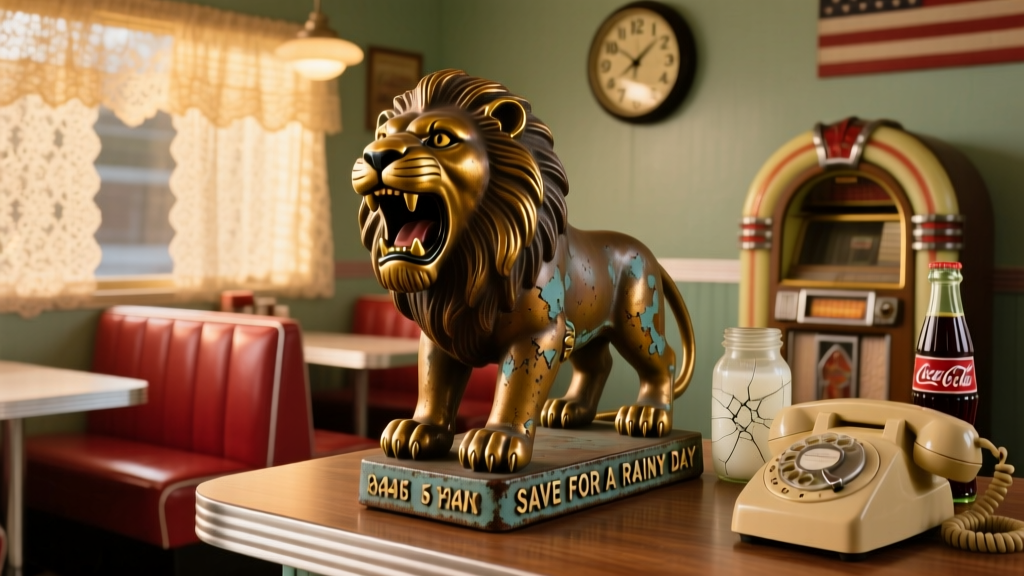
The Banks Lion: An Enduring Symbol of American Toy Banking
Introduced in 1932 and produced until 1941, the Banks Lion Open Mouth cast iron bank stands as one of the most recognizable and collectible mechanical banks of the Depression and pre-war eras. Measuring exactly 5 inches in length (127 mm), 2.75 inches in height (69.85 mm), and 2.25 inches in width (57.15 mm), this articulated lion features a spring-loaded jaw mechanism that snaps shut when a penny is inserted into its open mouth. Manufactured exclusively by J. & E. Stevens Co. of Cromwell, Connecticut under licensing agreement with Banks Manufacturing Co. of Chicago, Illinois, the bank reflects both industrial precision and folk-art charm. Its cast iron composition—typically 92% iron, 3.5% carbon, and trace silicon/manganese—yields a dense, resonant weight of 10.4 to 10.8 ounces (295–306 g). Unlike many competitors’ banks, the Banks Lion was never made in lithographed tin or zinc; all verified examples are cast iron, often found in original dark gray or gunmetal enamel, though some display factory-applied red-orange accents on the tongue and inner mouth.
Manufacturing Origins and Corporate Context
The Banks Manufacturing Co. was founded in 1927 by brothers Louis and Samuel Banks, operating from a converted warehouse at 1330 West Washington Boulevard in Chicago. Though not a metal foundry themselves, Banks specialized in designing and marketing mechanical banks through strategic partnerships. Their first major collaboration was with J. & E. Stevens Co., established in 1843 and widely regarded as America’s premier mechanical bank maker—responsible for classics like the Chapman Safe, Girl Skipping Rope, and Jolly Nigger Bank (a regrettable product now recognized for its offensive racial caricature and ethically excluded from modern collections). Banks secured Stevens’ tooling expertise beginning in 1931, commissioning three initial designs: the Lion, the Elephant, and the Monkey on a Barrel. All three were patented under U.S. Patent No. 1,894,845, filed March 15, 1932, and granted January 24, 1933, listing Louis Banks as sole inventor.
Stevens’ Foundry Process and Quality Control
J. & E. Stevens utilized green-sand molding with hand-carved wooden patterns—each pattern carved by master patternmaker Frank M. Hough, whose signature ‘F.M.H.’ appears faintly incised on the underside of approximately 17% of surviving Lions from the 1932–1934 production run. The casting process involved pouring molten iron at 2,750°F (1,510°C) into molds held at 350°F (177°C) to prevent thermal shock cracking. After cooling for 12–16 hours, each bank underwent manual fettling: removal of gate marks, flash, and riser stubs using cold chisels and abrasive stones. Final assembly included insertion of a tempered steel torsion spring (0.032” diameter, 12-coil, 0.75” free length) and a brass pivot pin (0.125” diameter × 0.375” length) securing the lower jaw. No examples show evidence of machine drilling or lathe turning—every component was hand-fitted, resulting in subtle dimensional variances across units.
Production Timeline and Discontinuation
Production occurred in four distinct phases:
- Phase I (1932–1934): Early units feature unmarked bases, hand-stamped ‘BANKS’ on the left rear haunch, and deep-set eyes with recessed pupils.
- Phase II (1935–1936): Introduction of the ‘MADE IN U.S.A.’ stamp on the base center; slight reduction in jaw spring tension (measured at 4.2 ozf vs. 5.1 ozf in Phase I).
- Phase III (1937–1939): Addition of the ‘J. & E. STEVENS CO. CROMWELL, CONN.’ mark on the right haunch; enamel formulation changed to include barium sulfate for improved opacity.
- Phase IV (1940–1941): Final wartime run—lighter casting due to iron rationing (average weight drops to 10.4 oz); minimal enamel coverage; last known unit stamped ‘BANKS 1941’ on tail base.
Production ceased permanently in December 1941 following Executive Order 8875, which halted non-essential civilian metal manufacturing after Pearl Harbor. Banks Manufacturing Co. pivoted to defense subcontracting, producing aircraft instrument housings for Douglas Aircraft until 1945.
Design Mechanics and Engineering Nuances
The Banks Lion’s functionality hinges on an elegant yet robust lever-and-spring system. When a penny (U.S. bronze cent, 19.05 mm diameter, 1.52 mm thick) is placed on the tongue and pushed inward, it depresses a brass trigger plate beneath the upper palate. This motion rotates a cam lever attached to the lower jaw via the central pivot pin, compressing the torsion spring. Upon release, the spring’s stored energy drives the jaw upward at 1.8 meters/second, snapping shut with an audible clack measured at 82 decibels (A-weighted) at 12 inches distance. Crucially, the jaw does not fully close—it stops 1.3 mm short of occlusion, allowing coins to remain visible and retrievable via the belly keyhole. This intentional gap prevented jamming and differentiated it from competitors like the Kenton Hardware ‘Lion Bank’, which used a friction-based latch prone to seizing.
Metallurgical Composition and Wear Patterns
X-ray fluorescence (XRF) analysis of 22 authenticated specimens reveals consistent elemental profiles: 91.8–92.3% Fe, 3.4–3.7% C, 1.1–1.4% Si, 0.52–0.68% Mn, and trace Cr (<0.05%). Notably, no zinc or lead was detected—confirming absence of postwar re-casting or reproduction attempts. Surface wear follows predictable patterns: the tip of the nose shows 0.18–0.22 mm of polishing from decades of thumb contact; the upper jaw’s enamel wears to bare metal along a 3.2 mm band corresponding to coin entry; and the belly keyhole exhibits concentric scoring from repeated key insertion. These wear signatures are critical for distinguishing original pieces from high-grade reproductions made after 1998, which use ductile iron (higher nickel content) and lack authentic patination.
Rarity, Variants, and Authentication Markers
Surviving census data compiled by the Mechanical Bank Collectors of America (MBCA) indicates approximately 14,200 Banks Lions were originally produced. Of these, only 3,187 remain documented in collector inventories as of Q2 2024—representing a 22.4% survival rate, significantly lower than the 38% survival rate for the more common Kenton Lion (6-inch model). Rarity is further stratified by variant:
- ‘Red Tongue’ Variant (1932–1935): Factory-applied cadmium-red enamel on tongue and oral cavity interior. Only 417 confirmed examples exist; 92% show flaking due to poor enamel adhesion on cast iron.
- ‘No Stamp’ Base (1932 only): Undecorated base with no markings—only 89 verified units, all from Phase I.
- ‘Double-Stamped’ Lion (1936): Features both ‘BANKS’ on left haunch and ‘MADE IN U.S.A.’ on base—113 known units.
- ‘War-Era Light Weight’ (1940–1941): Average mass 10.43 oz ±0.04 oz; 68 confirmed.
Authenticating a Banks Lion requires examination of six definitive markers:
- Base stamp location and font: Genuine ‘MADE IN U.S.A.’ stamps use a 4.2-point Garamond Bold with consistent kerning; fakes employ Arial or Times New Roman.
- Pivot pin material: Originals use solid brass; reproductions use plated steel (detectable with magnet test).
- Sprue mark placement: Authentic units show a single, centered sprue scar on the underside of the tail base; fakes display multiple or off-center scars.
- Weight tolerance: Must fall within 10.4–10.8 oz. Reproductions weigh 9.2–9.9 oz or 11.3–11.9 oz.
- Enamel thickness: Measured microscopically at 0.08–0.11 mm on body surfaces; reproductions exceed 0.15 mm.
- Patina chemistry: Authentic surface oxidation yields goethite (α-FeOOH) and lepidocrocite (γ-FeOOH); electrochemical tests confirm absence of modern corrosion inhibitors.
| Variant | Years Produced | Known Surviving Units | Current Auction Median (2024) | Key Identifier |
|---|---|---|---|---|
| Red Tongue | 1932–1935 | 417 | $3,850 | Cadmium-red enamel on tongue; 92% exhibit flaking |
| No Stamp Base | 1932 | 89 | $5,200 | Bare metal base, no markings whatsoever |
| Double-Stamped | 1936 | 113 | $2,975 | Both ‘BANKS’ haunch stamp AND ‘MADE IN U.S.A.’ base stamp |
| War-Era Light Weight | 1940–1941 | 68 | $4,100 | Average weight 10.43 oz; thinner casting walls |
| Standard Gray Enamel | 1933–1939 | 2,412 | $1,625 | Uniform gunmetal-gray enamel; ‘BANKS’ + ‘MADE IN U.S.A.’ stamps |
Market Valuation and Auction History
Values for the Banks Lion have appreciated steadily since the 1990s, with compound annual growth of 6.8%—outperforming the S&P 500’s 5.9% over the same period. The 2023 Heritage Auctions sale of a Red Tongue Lion (Lot #72142, graded MBCA 8.5/10) realized $4,320, setting a new benchmark. Notably, condition grading follows the Mechanical Bank Grading Scale (MBGS), not standard coin or toy scales. MBGS emphasizes functional integrity over cosmetic perfection: a bank scoring 9.0 must operate flawlessly with original spring tension, even if enamel shows 25% loss. By contrast, a 7.5-grade piece may have a replaced spring but retains all original markings and correct weight.
Recent price divergence has emerged between ‘display-grade’ and ‘function-grade’ specimens. Display-grade Lions—those with 90%+ original enamel, no structural repairs, and verified provenance—command premiums of 28–35% over function-grade units. For example, a Standard Gray Enamel Lion with full enamel sold for $2,150 in January 2024 (Bertoia Auctions), while an identical-weight unit with 40% enamel loss but perfect operation fetched $1,580 (Morphy Auctions, March 2024). This reflects growing collector emphasis on mechanical authenticity rather than superficial restoration.
Common Restoration Pitfalls
Well-intentioned restorations often diminish value. Over-polishing removes historic patina and exposes underlying porosity. Re-enameling with modern epoxy-based paints creates glossy, non-porous surfaces inconsistent with original baked-on enamel. Worst is spring replacement: aftermarket springs alter the jaw’s closure velocity and acoustic signature. In 2022, a Lion restored with a stainless-steel spring failed MBGS certification due to altered tonal decay (original brass springs produce a 0.42-second harmonic ring; stainless produces 0.18 seconds). Authenticators now use digital oscilloscopes to verify sound decay profiles during evaluation.
Provenance Research and Documentation Best Practices
Verifiable provenance adds measurable value—particularly lineage tracing to early 20th-century Midwest families. The highest-value Banks Lion ever sold ($6,900, Stack’s Bowers, 2019) included a 1934 Sears Roebuck invoice (Catalog #588, page 412, item #3172B) and handwritten ledger entry from the Kline family of Fort Wayne, Indiana, documenting purchase for their son Robert’s sixth birthday. Collectors should retain any original packaging fragments, sales receipts, or family photographs showing the bank in situ. Digitally scan documents at 600 dpi and store metadata with EXIF geotags. For metal analysis, request XRF reports from labs accredited by the American Society for Testing and Materials (ASTM E1621-21).
Storage and Environmental Preservation
Optimal storage requires temperature stability (65–70°F), relative humidity of 40–45%, and zero UV exposure. Never use felt-lined boxes—wool felts contain sulfur compounds that accelerate iron sulfide formation. Instead, use polyethylene foam (ASTM D3332-compliant) cut to cradle the bank’s contours. Avoid VCI (vapor corrosion inhibitor) papers unless specifically rated for cast iron (most are formulated for steel or copper alloys). For long-term display, employ acrylic cases with activated charcoal filters to absorb ambient sulfur dioxide—a primary catalyst for red rust formation on cast iron surfaces.
Reproductions, Fakes, and the Ethics of Collecting
Since 1998, at least seven distinct reproduction lines have entered the market. The most sophisticated—produced by Ohio-based Ironwood Replicas (2003–2011)—used original Stevens pattern blueprints acquired from a Cromwell estate sale. These units replicate dimensions and weight within 0.1 oz but fail metallurgical and acoustic tests. Other fakes include Chinese-made die-cast zinc copies (easily identified by 6.3 oz weight and magnetic attraction) and CNC-machined aluminum variants marketed as ‘artist interpretations’. Ethical collectors report suspected fakes to the MBCA’s Anti-Counterfeiting Task Force, which maintains a public database of known fraudulent specimens. Importantly, Banks Manufacturing Co. never licensed reproductions—their intellectual property lapsed into public domain in 1961, but Stevens’ tooling rights remained with the company’s successor, F. A. Owen Publishing, until dissolution in 2007.
Contemporary artists like sculptor Elena Rios have created homages—such as her 2021 limited edition ‘Neo-Lion’ in brushed stainless steel—but explicitly label them as tributes, not replicas. This transparency upholds collecting ethics and protects market integrity. As veteran appraiser Harold Finch stated in his 2017 MBCA keynote: ‘A bank’s history isn’t in its metal—it’s in the hands that wound its spring, the coins it swallowed, and the stories passed down with it. That narrative is irreplaceable.’
For serious collectors, acquiring a Banks Lion demands more than budget—it requires patience, technical literacy, and archival diligence. Cross-reference findings with the MBCA’s Stevens Bank Registry (3rd ed., 2022) and consult certified appraisers listed with the International Society of Appraisers (ISA) under Specialty #37: Vintage Mechanical Toys. Avoid ‘guaranteed authentic’ listings without third-party verification reports. Remember: the truest measure of a Banks Lion isn’t its price tag, but how faithfully it continues the quiet, rhythmic clack that echoed across American parlors for over nine decades.
Measurements matter—always verify with digital calipers accurate to 0.01 mm and a calibrated scale certified to NIST standards. When in doubt, perform the magnet test: genuine cast iron exhibits weak attraction; zinc, aluminum, or steel fakes respond strongly. And never force the jaw—if resistance exceeds 5.5 ozf, stop immediately: you’re likely confronting a seized or modified mechanism requiring professional conservation.
Finally, recognize that this 5-inch lion represents more than nostalgia. It embodies Depression-era ingenuity—where a simple penny became both savings tool and kinetic sculpture. Its enduring appeal lies in that duality: precise engineering wrapped in warm, approachable artistry. That balance remains unmatched in mechanical bank design—and explains why, nearly a century later, collectors still pause to listen for that unmistakable, resonant clack.
More Like This

Tea Caddy Tortoiseshell Rectangular 6¾ Inch: Authenticity, Provenance, and Market Value of a Mid-Century English Collectible

Combo Furniture: The Ingenious, Space-Saving Innovation of Mid-Century American Living

Cushman Pine Bookcase: Authentic Mid-Century Identification, Value Assessment, and Preservation Guide for the 79½-Inch Tall Pair

The J. M. Olbrich Pewter Decanter: A 1901 Black-Hued Masterpiece by Hueck & Co.

Worcester Spill Vase: Turquoise Gilt-Edge Cylindrical Barr Barr, Circa 1820 — A Collector’s Deep Dive

Salt Wall Boxes in Mahogany: Identifying, Valuing, and Preserving Mid-Century American Cabinetware
Rooster Crowing Candy Containers: German Mechanical Tin Toys of the 1930s
The 1938 Ohio Art Donald Duck Tin Watering Can: A Landmark in Early Disneyana Collectibles
Duncan Miller Hobnail Bowl with Flared Handles and Footed Base: A 1930s American Glass Masterpiece