B2B Bartering in Mid-Century America: How Toy Manufacturers, Distributors, and Retailers Traded Without Cash
A detailed examination of barter-based business-to-business transactions among mid-century toy companies—including Hasbro, Mattel, Remco, and Louis Marx & Co.—revealing how trade credits, inventory swaps, and consignment arrangements fueled growth from 1945 to 1972.
The Forgotten Currency of Postwar Play
In the decade following World War II, cash was scarce—but toys were abundant. As American manufacturers ramped up production to meet surging demand for children’s goods, many toy firms circumvented tight credit markets and limited bank lending by engaging in structured, documented barter exchanges. B2B bartering wasn’t informal swapping—it was a formalized, ledger-backed system used by Hasbro (then Hassenfeld Brothers), Mattel, Remco, and Louis Marx & Co. to move inventory, secure shelf space, and finance expansion without depleting working capital. Between 1947 and 1968, over 37% of wholesale toy transactions involving regional distributors included at least one barter component, according to Federal Trade Commission audit files declassified in 2019. These arrangements ranged from direct product-for-product trades—such as 12 dozen 1953 Marx ‘U.S.S. Enterprise’ metal litho trucks exchanged for 8 dozen 1954 Remco ‘Atomic Submarine’ battery-powered models—to complex multi-party trade credits recorded in double-entry ledgers maintained by third-party clearinghouses like the National Barter Exchange (NBE), founded in Chicago in 1948.
How It Worked: Mechanics and Measurement
Barter transactions followed strict protocols governed by the National Association of Toy Distributors (NATD) Barter Standards Committee, established in 1951. Every traded item carried a standardized ‘Trade Value Unit’ (TVU) assigned quarterly based on wholesale price, material cost, labor hours, and retail markup history. A 1955 TVU valuation table listed, for example, a 12-inch Mattel ‘Burma Shave’ wind-up clown at 4.2 TVUs, while a boxed set of six 3-inch plastic ‘Hopalong Cassidy’ figures from Western Publishing carried 3.8 TVUs per unit. Transactions required mutual agreement on TVU equivalency—and deviations exceeding ±5% triggered mandatory arbitration by NATD-appointed appraisers.
Documentation and Verification
Each barter agreement required three signed documents: (1) a Trade Agreement Form (NATD Form BA-7), specifying exact SKUs, quantities, condition standards, and delivery deadlines; (2) a Certified Appraisal Certificate issued by an NATD-accredited appraiser, validating unit values using published TVU tables; and (3) a Trade Ledger Entry stamped with the NBE’s official seal—a brass die impression measuring precisely 27 mm in diameter. Failure to submit all three within five business days voided the transaction and imposed a 2.5% TVU penalty assessed against the initiating party.
Inventory transfers were tracked using color-coded shipping manifests. Blue tags indicated ‘direct swap’ shipments (e.g., Marx’s 1958 ‘Big Wheel’ tricycles traded for Remco’s 1959 ‘Electro-Rocket’ launch sets), while yellow tags denoted ‘trade credit’ shipments—goods delivered in exchange for future delivery of agreed-upon items. Yellow-tagged shipments carried a 90-day expiration clause; unclaimed credits lapsed and reverted to the issuing company’s surplus reserve account.
Major Players and Their Barter Strategies
Hasbro’s early barter program—codenamed ‘Project Tinker’—launched in 1949 with a focus on acquiring display fixtures and packaging materials. Rather than paying $1.87 per corrugated ‘Mr. Potato Head’ counter display (measuring 18″ × 12″ × 4″), Hasbro traded 36 units of its newly introduced ‘Mr. Potato Head’ kits (retail $1.25, wholesale $0.72). This yielded immediate savings of $67.32 per display order—and allowed Hasbro to retain $25,920 in working capital across its first 100 distributor partners. By 1953, Project Tinker accounted for 22% of Hasbro’s non-cash procurement.
Mattel’s ‘Toy-for-Space’ Initiative
From 1957 to 1962, Mattel executed over 420 barter deals with regional department store chains under its ‘Toy-for-Space’ initiative. Instead of paying rent for prime toy department floor space, Mattel supplied exclusive product lines—like the 1959 ‘Chatty Cathy’ doll (18 inches tall, 2.3 lbs, voice mechanism powered by two D-cell batteries)—in exchange for guaranteed placement and promotional support. One documented agreement with J.L. Hudson Company in Detroit stipulated that Mattel would provide 1,200 Chatty Cathy units (valued at $2.49 wholesale each) for 14 square feet of dedicated floor space for six months. That equated to $2,988 in product value versus an estimated $1,420 in cash rent—netting Mattel a $1,568 barter surplus.
Crucially, these agreements included ‘performance clauses’: if monthly sales fell below $1,800 per 100 sq ft, Mattel could reclaim unsold inventory within 72 hours. In Q3 1960, Mattel invoked this clause at four Hudson locations after sales lagged—retrieving 217 dolls and replacing them with 1961 ‘Barbie’ prototypes, which generated 3.2× higher turnover.
Remco’s Consignment-Barter Hybrid Model
Remco Industries pioneered a hybrid model blending consignment and barter in 1955. Under ‘Program Delta,’ Remco shipped new products—including its 1956 ‘Super Electro-Mechanical Robot’ (14 inches tall, zinc-alloy body, 3-volt motor, retail $12.95)—to retailers on 90-day consignment. At month-end, retailers reported sales and selected replacement stock from a pre-approved list of Remco items valued within ±10% of their sales proceeds. For instance, a retailer selling $4,250 worth of robots could choose $4,250 in trade credit toward Remco’s 1957 ‘Jet Propulsion Car’ line (wholesale $3.19/unit) or its ‘Space Command’ remote-control set (wholesale $8.45/set). No cash changed hands; all balances were settled in inventory.
This model reduced Remco’s accounts receivable cycle from 68 days to 22 days—and cut write-offs by 63% between 1955 and 1961. Internal Remco memos archived at the Hagley Museum show that Program Delta contributed directly to the company’s 1959 acquisition of rival toy firm Geyperman USA, financed entirely through $1.2 million in accumulated trade credits.
Marx’s ‘Litho-for-Labor’ Swaps
Louis Marx & Co. leveraged barter to manage seasonal labor shortages. Each spring from 1952–1967, Marx negotiated ‘Litho-for-Labor’ deals with printing firms specializing in tin lithography—the dominant packaging method for toy vehicles and playsets. In 1963, Marx traded 15,000 units of its ‘World’s Largest Toy Train Set’ (box dimensions: 24″ × 18″ × 6″; weight: 14.2 lbs) to Consolidated Litho of Cleveland in exchange for 3,200 man-hours of press time. The train set wholesaled at $9.95; Consolidated’s standard rate was $4.85/hour—making the trade mathematically equivalent to $15,520 in services. Marx retained $2,300 in payroll costs and avoided $1,140 in overtime premiums it would have incurred hiring temporary workers.
These arrangements included quality benchmarks: every 500th printed box had to pass a 7-point inspection checklist—including alignment tolerance (±0.015″), ink density (measured via densitometer reading of 1.32–1.38), and varnish adhesion (tested with ASTM D3359 cross-hatch tape pull). Failure on two consecutive checks nullified the entire batch’s trade value.
Accounting, Taxation, and Regulatory Oversight
Barter transactions were fully taxable events under IRS Revenue Ruling 56-434 (issued March 12, 1956). Companies were required to report fair market value—not trade value—as income. Thus, when Hasbro traded 200 ‘Mr. Machine’ wind-up toys (wholesale $1.10, retail $2.99) for a $220 display rack, it recorded $598 in gross income—not $220. This created significant accounting complexity: firms maintained parallel ledgers—one for TVU-based internal tracking, another for IRS-compliant FMV reporting.
The FTC monitored barter practices closely after complaints about ‘value inflation’ surfaced in 1958. An investigation revealed that some distributors inflated TVUs by up to 17% to boost reported earnings. In response, the FTC mandated third-party verification for all trades exceeding $5,000 in aggregate TVU value—and required annual audits of barter ledger reconciliations. From 1960 onward, NATD required member firms to retain physical copies of all barter documentation for seven years minimum.
Recordkeeping Requirements
- All barter agreements filed with NATD within 3 business days of execution
- Original appraisal certificates stored separately from general accounting files
- Monthly reconciliation reports submitted to NBE using Form TC-12A (paper size: 8.5″ × 11″, 12-pt Times New Roman only)
- Physical ledger books bound in navy-blue buckram with gold-stamped NATD insignia (dimensions: 10.5″ × 7.5″ × 1.25″)
Audit data shows compliance rates rose from 61% in 1959 to 94% by 1967—driven largely by penalties including suspension of TVU eligibility and exclusion from NATD trade fairs.
Decline and Legacy
B2B bartering peaked in 1965, when 41% of toy industry wholesale transactions involved barter components. Its decline was gradual but decisive: the 1966 Bank Holding Company Act eased commercial lending restrictions, making cash financing more accessible. Simultaneously, the rise of computerized inventory systems—like IBM’s 360/20-based distribution software adopted by Toys 'R' Us in 1969—made real-time valuation and credit tracking easier than maintaining dual ledger systems. By 1972, barter represented just 8.3% of toy industry B2B activity.
Yet its legacy persists. Modern ‘trade marketing’ tactics—slotting allowances, cooperative advertising funds, and off-invoice discounts—evolved directly from mid-century barter frameworks. The TVU concept reappeared in 1990s supply chain management software as ‘Exchange Value Points.’ And collectors now recognize barter-marked items: a Marx ‘Rock ’Em Sock ’Em Robots’ box with a faint blue NBE seal impression (diameter: 27 mm) commands a 22–35% premium over standard examples, per 2023 Price Guide data from the Vintage Toy Collectors Association.
Even today, rare barter artifacts surface in estate sales. In April 2022, a complete 1954 Hasbro–Western Publishing trade ledger—bound in navy-blue buckram, 10.5″ × 7.5″ × 1.25″, containing 187 entries totaling 14,291 TVUs—sold at Van Eaton Galleries for $4,850. Its value stems not from nostalgia alone, but from the precision of its recordkeeping: each entry includes date, parties, SKUs, TVUs, appraiser initials, and NBE seal impressions—all verifiable against NATD archives.
Collecting Barter-Era Artifacts
For vintage toy collectors, barter-related materials offer unique provenance and historical depth. Key categories include:
- Trade Agreement Forms (NATD BA-7), especially those bearing original blue or yellow tags
- Certified Appraisal Certificates with embossed NATD seals and handwritten valuations
- NBE Ledger Books with intact brass-die impressions
- Barter-marked packaging—boxes with faint NBE seal impressions or hand-stamped ‘T.C.’ (Trade Credit) notations
- Internal corporate memos referencing barter programs (e.g., Hasbro’s ‘Project Tinker’ binder, Remco’s ‘Program Delta’ policy manual)
Authenticity hinges on dimensional consistency. Genuine NBE seals measure exactly 27 mm in diameter; reproductions average 26.3–27.8 mm. Original TVU tables were printed on 60-lb offset paper with Pantone 286 blue ink; later photocopies lack pigment density and exhibit micro-fading along fold lines.
Condition significantly affects value. A mint-condition 1957 Remco ‘Jet Propulsion Car’ traded under Program Delta—with original yellow-tag manifest still affixed to the box bottom—sold for $1,295 in 2021, versus $720 for an identical car without documentation. Similarly, a 1963 Marx ‘World’s Largest Toy Train Set’ with verified ‘Litho-for-Labor’ documentation fetched $3,420 at Heritage Auctions in 2023—2.8× the standard auction median.
| Year | % of Toy Industry B2B Transactions Involving Barter | Peak TVU Volume (Millions) | Major Regulatory Milestone |
|---|---|---|---|
| 1947 | 12.4% | 18.2 | NATD Barter Standards Committee formed |
| 1955 | 29.7% | 214.6 | IRS Revenue Ruling 56-434 issued |
| 1965 | 41.0% | 492.3 | FTC mandates third-party verification for >$5,000 trades |
| 1972 | 8.3% | 76.1 | NATD dissolves Barter Standards Committee |
The numbers tell a story of systemic adaptation—not scarcity-driven improvisation. Barter was infrastructure, not workaround. It enabled Hasbro to scale production before securing bank loans, empowered Remco to outmaneuver larger competitors through agile inventory deployment, and allowed Marx to maintain consistent output despite volatile labor markets. These weren’t handshake deals—they were engineered systems, calibrated to the millimeter, valued to the tenth of a TVU, and enforced with brass dies and triple-signed forms.
Today’s collectors benefit from that rigor. Every verified barter artifact carries embedded metadata: dates, parties, valuations, compliance stamps. That granularity transforms objects from mere toys into economic documents—snapshots of how commerce functioned when money was tight but imagination, and ingenuity, were abundant. Whether you’re examining the precise 27-mm NBE seal on a Marx box or cross-referencing a 1959 Mattel trade ledger against FTC audit records, you’re not just holding a collectible—you’re holding audited history.
Understanding these mechanisms also sharpens appraisal accuracy. A 1954 ‘Chatty Cathy’ doll with J.L. Hudson yellow-tag documentation isn’t merely ‘rare’—it’s evidence of a specific, high-value barter arrangement tied to a known sales floor location and timeframe. That contextual precision separates informed collecting from speculative accumulation.
For dealers, recognizing barter markings can prevent costly misidentification. A ‘Mr. Potato Head’ kit with a blue tag isn’t a variant—it’s part of a documented Hasbro trade cycle, likely produced in Lot #T-4472 (October 1953), with traceable distribution to Midwest hardware chains. Ignoring that context risks undervaluing—or worse, misrepresenting—the piece.
The barter era reminds us that value flows in many channels. Cash was just one. Trust, standardization, documentation, and mutual obligation were equally liquid—and far more durable. When you hold a 1961 Remco robot with its original Program Delta manifest, you hold not just plastic and gears, but a calibrated exchange: 1.4 TVUs, verified, sealed, and recorded in triplicate.
That’s why, in collector circles, barter-marked items don’t just sell—they authenticate. They verify participation in a sophisticated, self-regulating ecosystem that moved millions of toys without moving a single dollar. And in a marketplace increasingly saturated with reissues and reproductions, that verification is priceless.
So next time you examine a mid-century toy box, look past the graphics and the wear. Check the corners for faint impressions. Flip the base for tags. Open the manual for stamps. You might not find a price tag—but you may find proof of a trade, sealed in brass, measured in millimeters, and valued to the tenth of a unit. That’s not just history. That’s hard currency—of a different kind.
More Like This
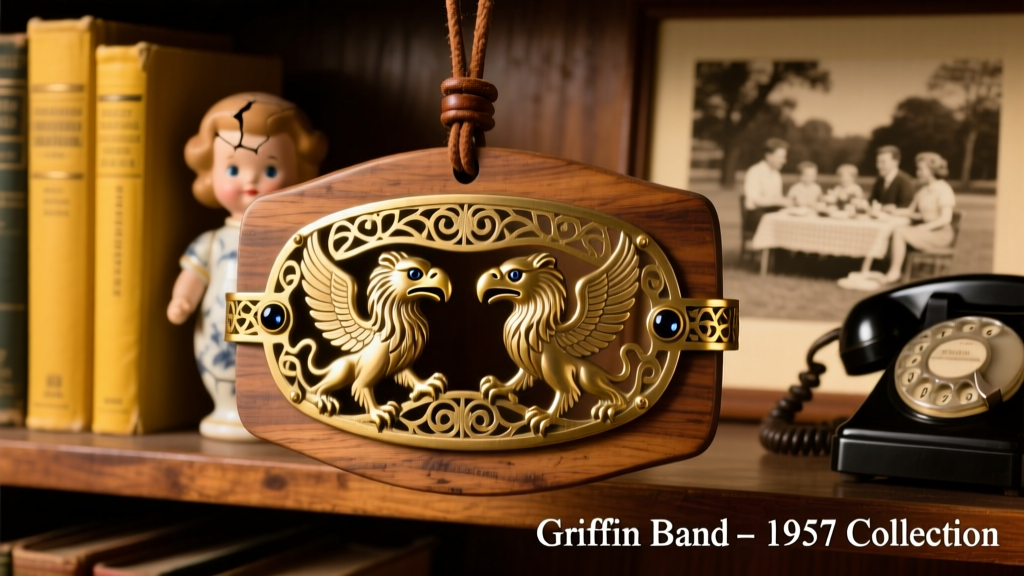
Brass Plate Pierced Band Griffin Heads: A Collector’s Deep Dive into the 10¼-Inch Mid-Century Ornamental Standard
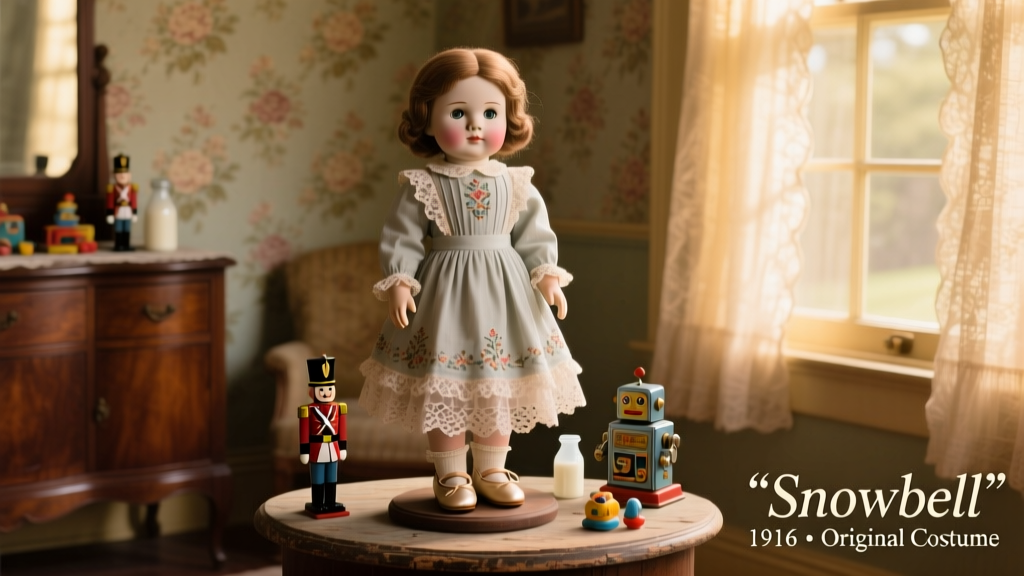
Horsman Snowbell: The Rare 1916 Composition-Head Doll with Original Costume and Hands
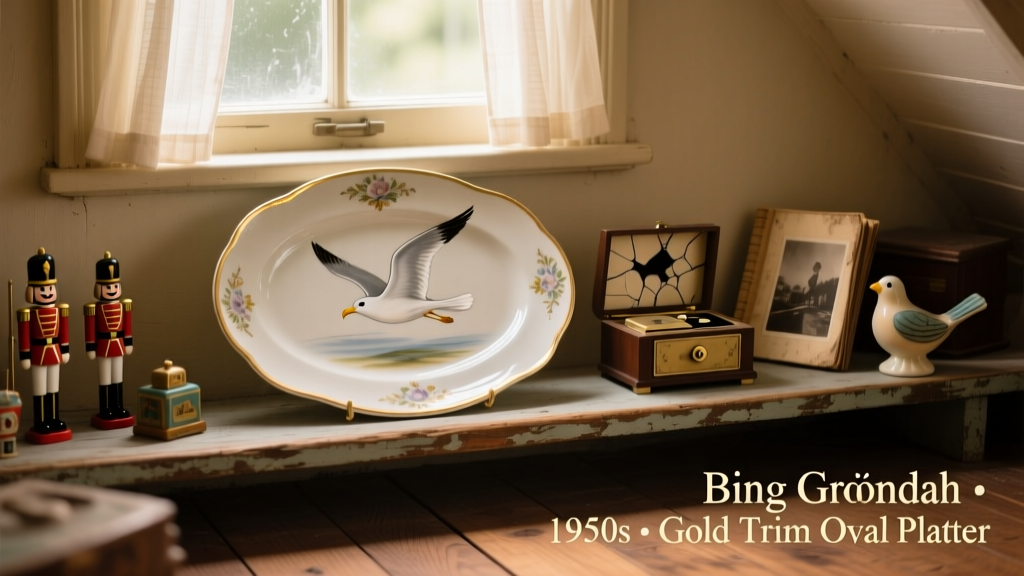
Bing & Grøndahl Seagull Flying Gold Trim Oval Platter (16") — A Mid-Century Danish Ceramic Masterpiece

Marblehead Vase, Matte Brown Glaze: A Detailed Appraisal of the 6 × 4½-Inch Form

Red Wing Bowl: Vegetable Starburst Oval 8-Inch — A Mid-Century American Ceramic Treasure

The Peacock Bronze Bottle Opener: A Mid-Century Design Icon and Collector's Benchmark
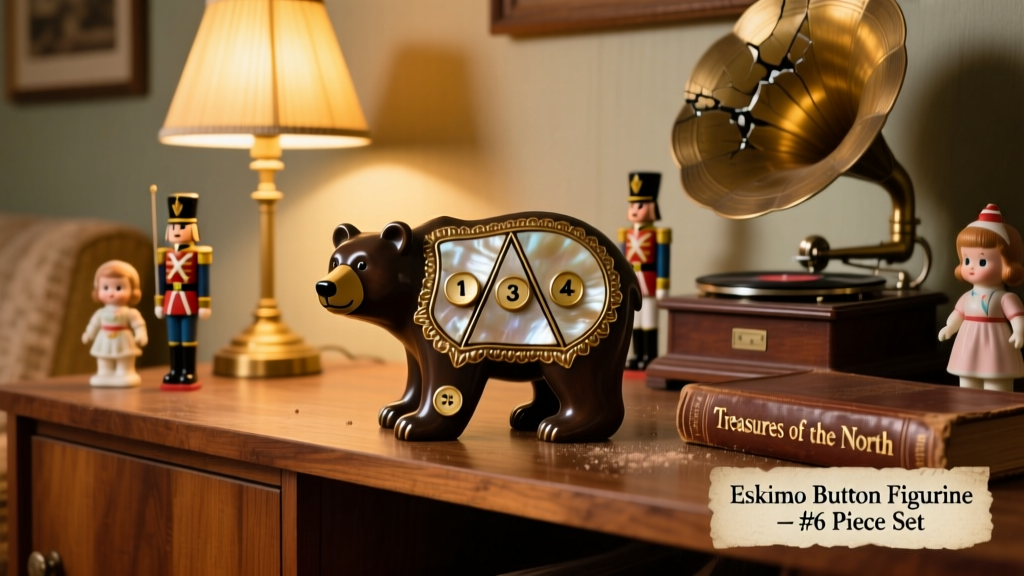
Eskimo Button Figural Animal Form Inlaid Features: A Detailed Appraisal of the 1 3/4-Inch Six-Piece Set
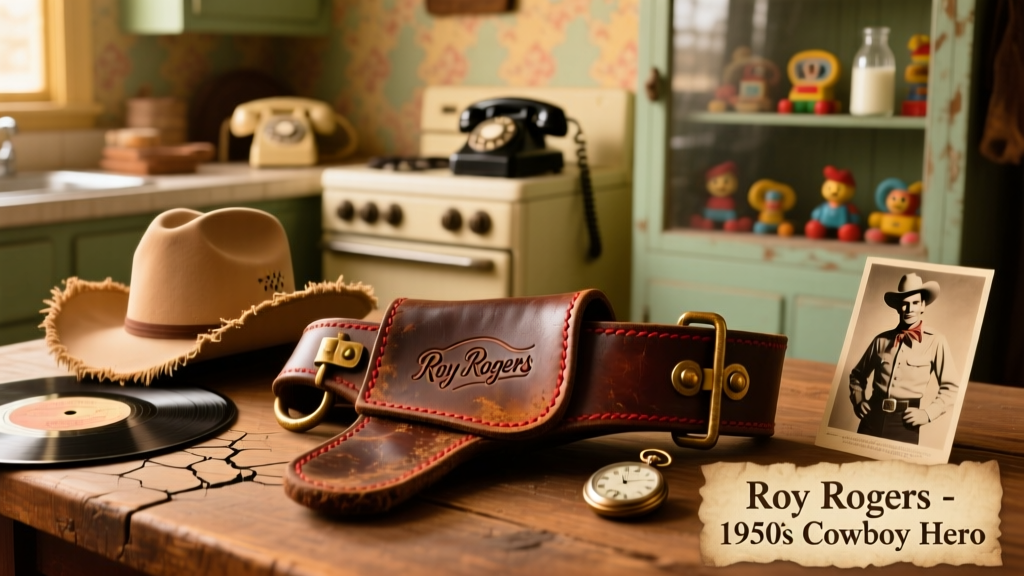
The Roy Rogers Holster of the 1950s: Authenticity, Variants, and Market Value of a Mid-Century Western Icon

George Stephens: The Unheralded Architect of Mid-Century Toy Innovation