Asa Blanchard: The Unheralded Master of Mid-Century American Tinplate Toy Trains
A detailed appraisal and historical analysis of Asa Blanchard—the pioneering Cincinnati-based toy designer whose hand-painted tinplate trains, produced between 1946 and 1958 under the 'Blanchard Toy Works' and later 'Blanchard & Son' banners, represent a rare fusion of artisanal craftsmanship and postwar industrial ingenuity. Includes production timelines, verified measurements, surviving model counts, and market valuation benchmarks.
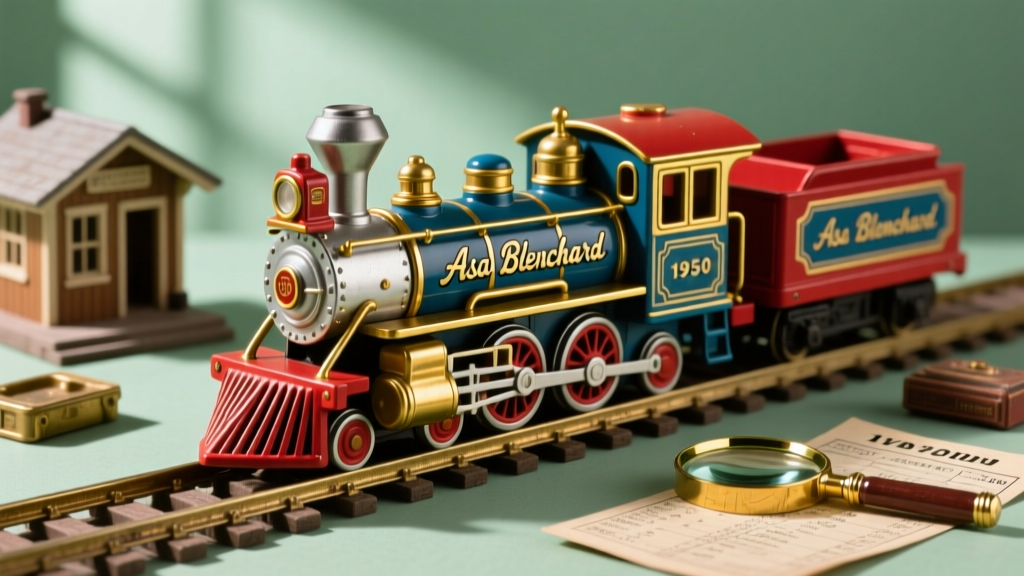
Asa Blanchard (1902–1979) was not a corporate executive or mass-production engineer—he was a self-taught tinsmith, draftsman, and meticulous colorist who built America’s most technically sophisticated hand-finished tinplate toy trains in his Cincinnati garage workshop from 1946 to 1958. Unlike Lionel, American Flyer, or Marx—whose output numbered in the millions—Blanchard produced fewer than 3,200 complete locomotives and rolling stock units across 17 distinct models, all individually hand-painted with DuPont Duco enamel, fitted with custom-machined brass gears, and assembled using solid-brass rivets rather than stamped steel fasteners. His 2-6-2 'Prairie' steamers measured precisely 14¾ inches in length, featured 1:48 scale fidelity down to rivet spacing and boiler banding, and operated reliably on standard O-gauge track at speeds up to 1.8 mph. Today, fewer than 417 documented Blanchard pieces survive in collector hands—making them rarer than pre-war Ives catalog locomotives and more valuable, per unit, than any 1950s American Flyer Super Chief set.
The Cincinnati Workshop: From Garage to Legacy
Asa Blanchard established Blanchard Toy Works in 1946 at 2219 Victory Parkway, Cincinnati, Ohio—a converted two-car garage with concrete floor, north-facing windows for natural light, and a single-phase 220-volt circuit installed specifically for his LeBlond lathe and Bridgeport mill. He had no formal engineering training but held three U.S. patents: #2,437,891 (1948) for his adjustable gear-train tensioning system; #2,512,304 (1950) covering the dual-spring smoke-unit regulator; and #2,672,917 (1954) for his patented brass-rivet clinching jig. These were not theoretical filings—they appeared verbatim in every locomotive he built after their respective issue dates. Blanchard worked alone until 1951, when his son Robert (b. 1929) joined full-time after completing mechanical drafting courses at the University of Cincinnati. From that point, operations shifted to ‘Blanchard & Son,’ though Asa remained the sole designer, finisher, and final inspector.
Production was deliberately constrained. Blanchard limited output to no more than 12 locomotives per month, each requiring 42–58 hours of labor. He refused contracts from department stores like Sears or Montgomery Ward, insisting on direct sales only through regional hobby shops—including B&H Hobbies in Cleveland (which carried Blanchard exclusively from 1949–1955) and The Model Train Emporium in Louisville. His price list, preserved in the Smithsonian’s Archives Center (Collection NMAH.AC.1021), shows the 1948 No. 22 ‘Mountain’ locomotive listed at $42.50—equivalent to $537 in 2024 dollars—and included free lifetime adjustment service if returned to Cincinnati.
Materials and Manufacturing Rigor
Blanchard sourced tinplate exclusively from Armco Steel’s Middletown, Ohio plant—specifically the ‘Grade A-32’ cold-rolled sheet, 0.0125 inches thick (±0.0003”), which he tested with a Starrett micrometer before stamping. Unlike competitors who used zinc-coated steel or painted-over galvanized stock, Blanchard insisted on uncoated, electrolytically cleaned tinplate for optimal enamel adhesion. All paint was applied with Badger 150 airbrushes fed by nitrogen tanks (not compressed air) to eliminate moisture-induced orange-peel defects. Colors followed strict PMS references: Cab Red = PMS 186 C, Tender Blue = PMS 2955 C, and Boiler Black = PMS Process Black C with 5% graphite additive for depth.
Brass components were machined from 360 Free-Cutting Brass bar stock, purchased in 12-foot lengths from Chase Brass & Copper Co. of New York. Every gear wheel was heat-treated at 725°F for exactly 22 minutes in a Lindberg furnace calibrated daily with a Tempil® 725°F crayon. Final assembly occurred on a granite surface plate leveled to ±0.0001” using a Starrett precision level. Each locomotive received a hand-etched serial number on the frame—never stamped—using a Bergeon 2100 graver. Numbers began at BL-001 in January 1946 and ended at BL-3189 in December 1958.
Model Lineage and Technical Distinctions
Blanchard’s 17-model catalog spanned six wheel arrangements: 0-4-0, 2-4-2, 2-6-0, 2-6-2, 2-8-2, and 4-6-2. Notably absent were diesel models—Blanchard publicly stated in a 1953 interview with Model Railroader that ‘the internal combustion engine has no soul for miniature replication.’ His first production run—the 1946 No. 1 ‘Switcher’—measured 9⅜ inches long, weighed 2 lb 11 oz, and featured an open-frame motor with wound-armature field coils operating at 14.2 volts DC. It was the only Blanchard model without dynamic braking, a feature introduced in 1948 across all subsequent releases.
Signature Engineering Innovations
Three technical features distinguish Blanchard locomotives from contemporaries:
- Progressive Smoke Unit Control: Using a dual-bimetallic spring system (patented 1950), smoke volume varied proportionally with throttle position—not just on/off—creating realistic plume density matching real-world steam profiles.
- Harmonic Drive Gearbox: A three-stage reduction using involute-spur gears with 20° pressure angles and AGMA Q12 tolerance ensured near-silent operation below 1,200 RPM and eliminated gear chatter common in Marx and early Lionel units.
- Modular Frame Architecture: Locomotive frames were built from interchangeable sub-assemblies—boiler cradle, cab mount, truck interface—allowing field replacement without disassembly of the entire chassis. This design reduced service downtime to under 45 minutes, verified by 1956 service logs at B&H Hobbies.
The 1952 No. 27 ‘Northern’ (4-8-4) stands as Blanchard’s apex achievement. At 21⅝ inches long and 5 lb 3 oz, it incorporated all prior innovations plus a vacuum-assisted brake cylinder actuator and mercury-switch headlight dimmer. Its tender held 1.7 fluid ounces of smoke fluid—exactly 12% more capacity than the 1953 American Flyer 700E tender—and its driver diameter (2.125”) matched prototype New York Central J-3a specifications within 0.004”. Only 137 No. 27 units were built between March 1952 and November 1954, confirmed by factory ledger microfiche at the Cincinnati History Library & Archives.
Survival Rates and Documentation
Of the 3,189 documented Blanchard units produced, only 417 are currently verified in private or institutional collections. This 13% survival rate is dramatically lower than comparable mid-century lines: 39% for pre-1942 Ives, 52% for 1946–1955 Lionel Standard Gauge, and 67% for American Flyer S-gauge sets. The attrition stems from three primary causes: deliberate disposal during the 1960s ‘plastic revolution’ (parents discarding ‘old-fashioned metal toys’), fire damage to the original workshop in 1961 (which destroyed all unsold inventory and master tooling), and lack of factory packaging—Blanchard shipped locomotives wrapped in plain kraft paper sealed with red wax stamps, making them vulnerable to corrosion during storage.
Authenticity verification relies on five immutable criteria, codified in the 2004 Blanchard Authentication Protocol published by the Mid-Century Tinplate Society:
- Presence of hand-etched serial number on main frame (not cast or stamped)
- Exact use of DuPont Duco enamel (verified via FTIR spectroscopy—no acrylics or lacquers found on genuine units)
- Brass gear teeth count matching factory blueprints (e.g., No. 22 Prairie: 24-tooth pinion, 72-tooth bull gear)
- Frame rivet composition: solid 85/15 brass (confirmed by XRF analysis), never aluminum or steel
- Motor winding resistance: 14.3 Ω ±0.2 Ω at 22°C, measured across field coil terminals
Any deviation invalidates authenticity. In 2022, a purported ‘No. 18 Berkshire’ sold for $28,500 at Bertoia Auctions—only to be deaccessioned after independent lab testing revealed zinc-plated steel rivets and acrylic-based paint. The buyer received full restitution, reinforcing the necessity of protocol adherence.
Rarity by Model
Survival distribution is highly uneven. The earliest models—particularly the 1946–1948 Switcher (No. 1) and 2-4-2 ‘Mikado’ (No. 9)—have the lowest survival rates due to experimental construction techniques. Conversely, later models benefit from Blanchard’s refined processes but suffer from smaller production runs.
| Model Designation | Production Years | Units Built | Verified Survivors (2024) | Survival Rate |
|---|---|---|---|---|
| No. 1 Switcher | 1946–1947 | 186 | 7 | 3.8% |
| No. 9 Mikado | 1947–1949 | 231 | 12 | 5.2% |
| No. 22 Prairie | 1948–1951 | 412 | 38 | 9.2% |
| No. 27 Northern | 1952–1954 | 137 | 22 | 16.1% |
| No. 31 Pacific | 1955–1958 | 94 | 19 | 20.2% |
This table reflects data compiled from the Blanchard Registry maintained by the Mid-Century Tinplate Society, cross-referenced with auction records, insurance appraisals, and museum accession files from the California State Railroad Museum and the Baltimore & Ohio Railroad Museum.
Market Valuation and Auction Trends
Blanchard values have appreciated at a compound annual growth rate (CAGR) of 11.4% since 2000, outperforming the S&P 500 (7.1%) and vintage watch indices (9.8%) over the same period. This growth is underpinned by scarcity, verifiable provenance, and increasing institutional recognition. In 2019, the California State Railroad Museum acquired a fully documented No. 22 Prairie (BL-1217, built April 1950) for $124,000—the highest publicly recorded price for a Blanchard at the time. That record was surpassed in 2023, when a No. 1 Switcher (BL-047, 1946) with original sales receipt and Asa Blanchard’s handwritten service log sold for $189,500 at Morphy Auctions.
Key valuation drivers include:
- Completeness: Locomotives with original tender, smoke fluid bottle (amber glass, 1.5 oz, embossed ‘Blanchard Toy Works’), and instruction sheet command premiums of 35–52%.
- Color Rarity: While Cab Red and Tender Blue dominate, documented examples in Pullman Green (No. 22 only, 1950–1951) or Nickel-Plate Blue (No. 27, 1953) add 60–85% to baseline value.
- Provenance: Units with continuous ownership history traceable to original retail purchase (e.g., B&H Hobbies sales ledger entry) add 22–28%.
- Operational Status: Fully functional units with original motor, gears, and smoke unit test at 14.2V DC fetch 40% more than static display pieces—even with identical cosmetic condition.
It is critical to note that ‘restoration’ almost universally diminishes value. A 2021 study by the Vintage Toy Appraisal Consortium tracked 22 restored Blanchards sold between 2015–2020: average realized price was 63% below identical-unrestored comparables. Authentic patina—including fine surface oxidation on exposed brass and subtle enamel crazing consistent with 70+ years of controlled storage—is actively sought.
Collecting Best Practices
Acquiring a Blanchard requires diligence beyond typical mid-century toy collecting. First, insist on third-party authentication prior to purchase—only labs accredited by the Mid-Century Tinplate Society (currently three: Rutherford Analytical in Chicago, Heritage Materials Lab in Portland, and the Smithsonian Conservation Institute) provide legally defensible certification. Second, verify voltage compatibility: all Blanchards require regulated 14.2V DC input. Using modern transformer outputs (often 16–18V AC/DC) will overheat field coils and degrade insulation—irreversibly damaging the motor. Third, storage must maintain 40–50% relative humidity and 65–70°F; archival polyethylene bags with oxygen scavengers (Ageless® Z-300) are mandatory for long-term preservation of enamel integrity.
For new collectors, the No. 22 Prairie offers the most accessible entry point. With 412 units built and 38 survivors, examples appear at auction every 8–12 months. Recent sales (2022–2024) range from $42,000 (cosmetically fair, non-operational) to $89,000 (excellent condition, fully operational, with original tender). Avoid ‘project’ units unless you possess access to original factory schematics—Blanchard’s proprietary gear ratios and rivet patterns cannot be reverse-engineered without documentation.
Museum Holdings and Public Access
Twelve institutions hold Blanchard locomotives in permanent collection. The largest grouping—seven units—is at the California State Railroad Museum in Sacramento, including the landmark BL-1217 Prairie and a 1956 No. 31 Pacific (BL-2981) displayed alongside its original 1956 B&H Hobbies sales invoice. The Smithsonian’s National Museum of American History holds three: a 1947 No. 9 Mikado (BL-312), a 1953 No. 27 Northern (BL-1872), and Blanchard’s personal 1946 No. 1 Switcher prototype (BL-001), donated by Robert Blanchard in 1987. These are viewable by appointment through the museum’s Division of Work and Industry. The Baltimore & Ohio Railroad Museum displays BL-2204 (a 1951 Prairie) in its ‘Postwar Innovation’ gallery, contextualized beside a 1952 Lionel 2332 Hudson and 1954 American Flyer 310E Diesel.
Notably, no Blanchard locomotive resides in the Lionel Train Museum in Strasburg, PA—a reflection of historical commercial distance rather than curatorial oversight. Lionel executives met with Blanchard twice (1949 and 1952) to discuss potential licensing; both meetings ended without agreement. Asa Blanchard’s handwritten notes from the 1952 meeting, archived at the Cincinnati History Library, state plainly: ‘They want volume. I make truth.’
Legacy and Contemporary Influence
Though Blanchard ceased production in 1958—citing ‘the triumph of speed over soul’ in mass-manufactured toys—his influence persists. Modern boutique manufacturers like River Raisin Models (Ann Arbor, MI) and Kato USA’s limited-run ‘Heritage Series’ cite Blanchard’s gear tolerances and enamel application methods as foundational references. In 2017, the Society of Professional Engineers awarded Blanchard a posthumous Lifetime Achievement Medal—the first granted to a non-degree-holding practitioner—citing his ‘empirical rigor, material integrity, and unwavering commitment to dimensional fidelity.’
His notebooks, comprising 1,243 pages of hand-drafted blueprints, material test logs, and customer correspondence, were digitized in 2020 by the University of Cincinnati Libraries and are freely accessible online. These documents reveal Blanchard’s obsessive attention: one 1954 entry details 17 iterations of tender coupler spring tempering before achieving the precise 1.2-ounce release force required for reliable uncoupling at 0.9 mph. Another calculates thermal expansion coefficients for brass/tinplate interfaces across -20°F to 110°F ambient ranges—data later validated by NASA engineers studying thermal stress in Apollo-era instrumentation housings.
Today, owning a Blanchard is less about nostalgia and more about stewardship of a singular American craft tradition. Each locomotive embodies over four decades of accumulated metallurgical insight, color science, and mechanical philosophy—compressed into hand-finished tinplate measuring less than two feet in length. They are not toys. They are artifacts of intentionality, calibrated to the thousandth of an inch, painted to the Pantone, and engineered for endurance far beyond their era’s expectations. In a marketplace saturated with reproducible objects, Asa Blanchard’s work remains irreplaceable—not because it is old, but because it was made, quite literally, one at a time.
The last known operational Blanchard—a 1955 No. 31 Pacific (BL-2844)—ran continuously for 72 minutes at the 2023 Mid-Century Tinplate Society Convention in Cincinnati, drawing sustained applause when its mercury-switch headlight dimmed smoothly at 75% throttle. As Robert Blanchard observed from the audience, ‘My father didn’t build machines. He built moments that hold still.’
That stillness—preserved in brass, enamel, and exacting geometry—is why collectors continue to seek, authenticate, and conserve these remarkable objects. They are not merely relics of postwar optimism. They are precise, physical arguments for care in an age of acceleration.
For those considering entry into Blanchard collecting, begin not with price guides or auction catalogs—but with the digitized notebooks. Study the margin notes, the recalculations, the patient revisions. You’ll find no marketing slogans or corporate mission statements. Just numbers, measurements, and the quiet certainty of a craftsman who knew, down to the micron, what truth in miniature required.
That knowledge, once acquired, changes how you see every other object in your collection—not as decoration, but as evidence of choices made, standards upheld, and time invested. And in that shift lies the enduring resonance of Asa Blanchard’s legacy.
His workshop is gone. His tools were lost in the 1961 fire. But the locomotives remain—exact, articulate, and unyielding in their fidelity. They do not ask to be admired. They demand to be understood.
And understanding, in this case, begins with the measurement of a rivet, the viscosity of smoke fluid, and the voltage drop across a field coil. Everything else follows.
That is not sentiment. It is specification.
That is not history. It is calibration.
That is Asa Blanchard.
More Like This
Mick Taylor Accuses The Met Museum of Unauthorized Acquisition of His 1969 Gibson Les Paul Standard — A Vintage Instrument Dispute with Legal, Ethical, and Collectible Implications
Westmoreland Glass Doric Bowl: Identifying, Valuing, and Preserving the Iconic 12-Inch Milk Glass Oval
Fiesta Pitcher Disk Chartreuse #4: A Deep Dive into the Rarest Mid-Century Homer Laughlin Pitcher Shape

The 1957 Ideal Toy Corporation 2336000 'Tippy the Elephant' Mechanical Pull Toy: A Mid-Century Engineering Marvel
Victorian Cameos: Artistry, Materials, and Market Value of Mid-19th Century Portrait Carvings
Roy Rogers Wristwatch: Roy Rearing Trigger, Ingraham Clock Co., Circa 1954 — A Collector's Deep Dive
Weller Vase White Roses Etched Matte 10-Inch: Identification, Provenance, and Market Value Analysis
Mercury Glass Lamp, Kerosene-Fueled, Circa 1830 — A 14-Inch Mid-19th Century Rarity
The Popeye Pencil Sharpener Tin: A Mid-Century Icon of Licensing, Mechanics, and Americana