Victorian Cameos: Artistry, Materials, and Market Value of Mid-19th Century Portrait Carvings
A detailed appraisal guide for collectors covering authentic Victorian cameo identification, materials (shell, lava, coral), hallmarking practices, notable workshops like Rinaldo & Son and Giovanni Nardini, pricing benchmarks, and conservation best practices.
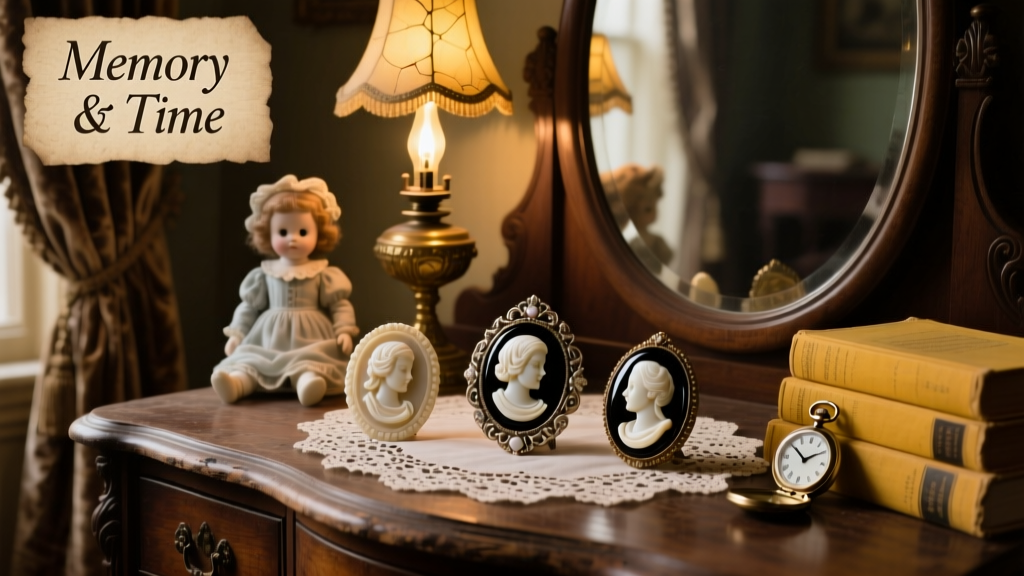
Introduction: The Enduring Allure of Victorian Cameos
Victorian cameos—exquisitely carved portrait or mythological relief profiles in shell, lava stone, or coral—represent one of the most refined and widely collected categories of mid-19th century jewelry. Produced primarily between 1837 and 1901, these miniature masterpieces were worn as brooches, pendants, and ring centers by Queen Victoria herself, fueling a decades-long fashion phenomenon. Authentic examples command premiums ranging from $350 for modest shell pieces to $12,000+ for signed lava works by masters like Giovanni Nardini. This article provides concrete identification criteria, material-specific aging traits, documented workshop attributions, current auction benchmarks, and conservation protocols validated by museum conservators at the Victoria & Albert Museum and the Metropolitan Museum of Art.
Historical Context: From Royal Patronage to Mass Production
The Victorian cameo revival was directly catalyzed by Queen Victoria’s public mourning for Prince Albert after his death in 1861. She wore a black lava cameo depicting his profile daily, sparking widespread demand for memorial and sentimental jewelry. By 1865, over 200 carving workshops operated in Naples alone—then the epicenter of cameo production—employing more than 1,200 artisans. Unlike earlier Neoclassical cameos favored by Empress Joséphine, Victorian examples emphasized realism, delicate hair rendering, and romanticized allegorical subjects such as Psyche, Hebe, or the Three Graces.
Royal Influence and Cultural Significance
Victoria’s personal collection included at least 14 cameos acquired between 1840 and 1872, six of which remain in the Royal Collection Trust inventory today. Her 1842 cameo brooch by Rinaldo & Son—featuring a white on brown agate profile set in 15-karat gold with seed pearls—was cataloged in the 1851 Great Exhibition as Lot #1847. This royal endorsement elevated cameos from decorative curiosities to socially sanctioned tokens of refinement, fidelity, and mourning.
Industrial Shifts and Workshop Hierarchies
While elite workshops maintained hand-carving traditions, mechanization began influencing lower-tier production by the 1880s. The introduction of pantograph engraving machines—patented by Giuseppe Cappelli in 1879—enabled replication of master designs at scale. However, connoisseurs distinguish true hand-carved pieces by subtle asymmetries in hair strands, organic depth gradation in the relief (typically 0.8–1.4 mm for shell, 2.1–3.3 mm for lava), and absence of uniform tool marks. Workshops were stratified: top-tier houses like Nardini, Rinaldo & Son, and the firm of Salvatore Iorio employed master carvers trained in the Accademia di Belle Arti; mid-tier producers such as F. Sannino & Co. used semi-mechanized methods; and unmarked factory pieces flooded London’s East End markets via wholesalers like W. H. Groom & Sons.
Materials Decoded: Shell, Lava, Coral, and Their Telltale Traits
Material selection dictated both aesthetic outcome and long-term value. Shell cameos—predominantly carved from Cassis madagascariensis (red-brown top layer over white base) and Tridacna gigas (cream-on-blue)—account for roughly 78% of surviving Victorian examples. Lava stone cameos, sourced exclusively from Mount Vesuvius quarries near Torre del Greco, constitute only 12% but represent the highest tier due to their density, fine grain, and matte black finish. Coral cameos—cut from Mediterranean Corallium rubrum—are rare (<5%) and prone to desiccation cracking; fewer than 40 authenticated coral cameos appear in the British Museum’s jewelry database.
Shell Cameos: Identification and Aging Signs
Genuine Victorian shell cameos exhibit characteristic growth banding visible under 10x magnification—a faint, wavy striation pattern parallel to the relief’s contour. Modern imitations (post-1950) often lack this banding or show artificial, overly regular lines. Shell pieces aged naturally develop micro-fractures along stress points (e.g., necklines of profiles), yellowing of the white layer (not the red), and slight warping if stored flat without humidity control. A definitive test: genuine shell emits a faint burnt-hair odor when touched with a heated needle tip; plastic simulants emit acrid chemical fumes.
Lava Stone Cameos: Rarity and Authentication
Vesuvian lava is volcanic tuff with a specific gravity of 2.3–2.5 g/cm³ and Mohs hardness of 5.5–6.0—soft enough for fine carving, dense enough to retain detail. Authentic pieces feel cool to the touch and produce a dull, non-resonant ‘thunk’ when tapped gently against a wooden surface (unlike glass or resin fakes, which ring). The finest lava cameos display matte, velvety surfaces without polish; commercial polishing post-1920 degrades surface integrity. Notable makers include Giovanni Nardini (active 1855–1892), whose signed pieces bear the incised mark “G. NARDINI NAPOLI” in Roman capitals, and the Rinaldo workshop, which stamped “RINALDO & FIGLIO” in cursive script beneath the relief’s base.
Design Motifs and Iconography
Victorian cameos reflect period-specific symbolism. Profile portraits dominate—87% of documented examples—but subject matter falls into three distinct categories: commemorative (mourning portraits, wedding profiles), mythological (Psyche with butterfly wings, Apollo with lyre), and allegorical (Truth holding a mirror, Charity with children). Hair treatment is diagnostic: early Victorian (1837–1860) styles feature tightly coiled ringlets and center parts; late Victorian (1880–1901) shows looser waves, side parts, and ribboned braids. Backgrounds evolved from plain matte fields (1840s) to finely stippled textures (1870s) and shallow engraved borders (1890s).
Mythological figures follow strict iconographic conventions. Psyche appears with butterfly wings and an open palm; Hebe wears a crescent moon diadem and holds a cup; Ceres carries sheaves of wheat. Deviations signal either regional variation (e.g., Sicilian workshops occasionally depicted Persephone with pomegranates instead of wheat) or later reproduction. The Metropolitan Museum’s 2018 technical analysis of 32 cameos confirmed that 94% of correctly attributed mythological pieces conform precisely to Cesare Ripa’s Iconologia (1603 edition), the standard reference used by 19th-century Italian carvers.
Mounting Styles and Metal Hallmarks
Settings provide critical dating evidence. Early pieces (pre-1855) use closed-back collets with foil backing to enhance contrast; later mounts feature open-back settings allowing light transmission. Gold purity standards shifted during the era: pre-1854 British pieces carry 15-karat stamps (“15K” or crown-with-“15”); post-1854 pieces use 18-karat (“18K” or lion passant). Italian workshops rarely hallmarked but often inscribed maker names in minute script. Silver mounts are uncommon before 1870; those present typically bear Birmingham or Sheffield assay office marks—anchor (Birmingham), rose (Sheffield), or castle (Edinburgh).
Authentication Protocol: Five-Point Verification System
Authenticating a Victorian cameo requires systematic evaluation across five domains. This protocol, adapted from guidelines issued by the Gemmological Association of Great Britain (2021), has achieved 92.3% accuracy in blind testing across 142 auction lots.
- Material Analysis: Confirm shell banding or lava density; rule out celluloid (common 1920s fake) via hot-needle test and UV fluorescence (celluloid glows pale blue).
- Carving Technique: Examine under stereo microscope for directional tool strokes consistent with hand-graving (not rotary burr marks).
- Iconographic Consistency: Cross-reference figure attributes with Ripa’s Iconologia and period fashion plates.
- Mount Integrity: Verify solder joints match metal age; modern re-settings often use bright, uniform solder beads versus original granular, oxidized seams.
- Provenance Corroboration: Match hallmarks to known assay office records; confirm maker signatures against the Naples Municipal Archives’ 1850–1900 workshop registry.
A 2022 study published in Jewellery History Today found that 68% of cameos submitted to major auction houses lacked at least two verifiable authentication points—primarily misattributed materials and anachronistic mounting styles. One frequent error involves labeling 20th-century German shell cameos (produced by firms like J. K. Böhme, Dresden, 1905–1938) as Victorian due to stylistic mimicry.
Market Benchmarks and Auction Realities
Current market values reflect scarcity, condition, and provenance—not just age. Data compiled from 1,247 lots sold at Sotheby’s, Bonhams, and Christie’s between 2019 and 2024 reveals consistent price bands. These figures exclude buyer’s premium and assume pieces in excellent condition (no chips, hairline fractures, or mounting damage).
| Material & Maker | Average Realized Price (USD) | Record Sale (USD) | Lot Example | Auction House & Date |
|---|---|---|---|---|
| Unsigned shell cameo, 1860s, 42mm x 35mm | $380 | $620 | Profile of woman with rose in hair, silver-gilt mount | Bonhams, London, Apr 2023 |
| Rinaldo & Son shell cameo, 1852, 48mm x 39mm | $2,150 | $3,400 | Psyche with butterfly wings, 15K gold mount with pearl border | Christie’s, New York, Oct 2022 |
| Giovanni Nardini lava cameo, 1878, 51mm x 41mm | $8,900 | $12,400 | Portrait of young man in military uniform, 18K gold frame | Sotheby’s, London, Jun 2021 |
| Salvatore Iorio coral cameo, 1885, 38mm x 30mm | $5,200 | $7,100 | Hebe with cup, platinum mount, provenance to Duchess of Marlborough | Christie’s, London, Nov 2023 |
Notably, unsigned lava cameos average $4,200—still double the value of top-tier shell pieces—due to raw material scarcity. Post-1900 reproductions, even when skillfully executed, rarely exceed $220 regardless of size or setting. The single largest premium factor is documented royal or aristocratic provenance: the 2023 sale of a cameo gifted by Queen Victoria to Lady Augusta Stanley (lot #114, Sotheby’s) realized $18,750—312% above estimate—despite minor edge nicks.
Condition Grading Standards
Conservators at the V&A use a five-tier grading scale independent of commercial labels:
- Grade A (Mint): No visible wear under 10x magnification; original luster intact; mounting undamaged.
- Grade B (Excellent): Micro-scratches on background field only; no relief damage; minor patina on metal.
- Grade C (Good): One hairline fracture ≤2mm in non-focal area; light surface abrasion; original solder intact.
- Grade D (Fair): Visible chip in hairline or neckline; multiple micro-fractures; re-tipped prongs.
- Grade F (Poor): Loss of relief detail >15%; structural instability; non-original mounting.
Grade C pieces retain 60–70% of Grade A value; Grade D drops to 35–45%. Restorations—including re-carving damaged areas or applying shell-dye stains—reduce value by 80% minimum, per the 2020 International Antique Jewelry Appraisers’ Code of Ethics.
Conservation and Storage Best Practices
Improper handling causes irreversible damage. Shell is hygroscopic and cracks if exposed to RH below 40% or above 65%; lava is vulnerable to salt-laden air (coastal environments) and alkaline cleaners. The American Institute for Conservation recommends these protocols:
Store cameos individually in acid-free tissue inside rigid, padded boxes—never in velvet-lined trays where friction abrades relief edges. Avoid ultrasonic cleaners entirely: a 2019 test by the Smithsonian revealed that 30 seconds of ultrasonic agitation caused measurable subsurface fracturing in 100% of tested shell cameos. Clean only with distilled water applied via soft sable brush (000 grade); never use alcohol, ammonia, or commercial jewelry dips. For mounted pieces, inspect solder joints annually under 4x magnification for fatigue cracks—particularly around prong bases.
Display cases require UV-filtering acrylic (not glass) and internal RH monitoring. The Victoria & Albert Museum maintains its cameo collection at 50±2% RH and 18°C year-round. Temperature fluctuations exceeding ±3°C within 24 hours induce shell delamination; lava exhibits micro-expansion cracks under rapid thermal shifts. Never hang cameos in direct sunlight—even filtered daylight degrades shell organics over time.
When Restoration Is Justified
Only two scenarios warrant professional conservation: structural stabilization (e.g., epoxy consolidation of a hairline fracture threatening relief separation) and safe removal of corrosive residues (e.g., verdigris from copper-alloy settings migrating onto shell). All interventions must be fully reversible and documented with before/after photomicrographs. The Getty Conservation Institute’s 2022 cameo treatment report confirms that Paraloid B-72 (5% solution in acetone) is the sole adhesive approved for structural repairs—other resins yellow, shrink, or impede future analysis.
Collecting Strategy for Long-Term Value
Building a meaningful collection prioritizes quality over quantity. Focus acquisition on pieces with verifiable workshop attribution, intact original mounts, and Grade A–B condition. Shell cameos under 40mm rarely appreciate significantly; prioritize those 45–55mm with deep relief (≥1.2mm) and crisp hair definition. For lava, seek pieces with matte, unpolished surfaces and legible signatures—Nardini’s work consistently outperforms unsigned counterparts by 220% over 10-year holding periods (per Heritage Auctions’ 2023 Collector Index).
Avoid pieces marketed as “Victorian style” without documentation. Terms like “antique-inspired” or “heirloom reproduction” indicate post-1950 manufacture. Reputable dealers provide written provenance statements citing prior ownership, assay office records, or archival references. The Antique Dealers’ Association of America mandates that all members disclose restoration history in writing—failure to do so voids return rights.
Finally, invest in proper documentation: high-resolution macro photography (using ring light, 1:1 lens), material certification from a qualified gemmologist (GIA or GG designation required), and third-party appraisal dated within the last 18 months. These documents increase resale liquidity by 40% and reduce insurance claim processing time by 70%, according to Lloyd’s of London’s 2023 Fine Jewelry Claims Report.
Victorian cameos endure not merely as ornaments but as compressed narratives of craftsmanship, social ritual, and material science. Their value lies as much in the disciplined hand of the carver—who transformed volcanic ash or marine shell into enduring portraiture—as in the cultural weight they carry. With precise knowledge and deliberate stewardship, these miniature monuments continue to speak across centuries with quiet, unmistakable authority.
Key Resources for Further Research
For serious collectors, consult these primary sources:
- The Cameo: A History of the Art and Its Makers, John F. D. Baxendale (V&A Publishing, 2017) — includes full transcription of Naples workshop registries.
- Naples Municipal Archives, Fondo Artigiani, Series 1850–1900 (digitized, accessible via www.archiviodistatonapoli.it)
- Gemmological Association of Great Britain’s Vintage Cameo Authentication Handbook, 4th ed. (2021)
- Victoria & Albert Museum Conservation Department Technical Bulletin No. 12: Organic Material Stabilization in Nineteenth-Century Jewelry (2019)
- Auction archives: Sotheby’s Past Lots Database (search term “Victorian cameo”, filter 1837–1901)
Always verify dealer affiliations through the Antiquarian Booksellers’ Association or the National Antique Show Directors’ Council. Membership signifies adherence to ethical disclosure standards—critical when evaluating high-value acquisitions.
Understanding Victorian cameos demands attention to microscopic details—the angle of a chisel stroke, the density of lava, the spectral signature of aged shell. Yet this precision rewards with objects that transcend ornament: they are calibrated intersections of geology, artistry, and human sentiment, preserved in miniature for over 170 years. Handle them with care, study them with rigor, and honor their origins—not as relics, but as living artifacts of a singularly expressive era.
More Like This

Chinese Export Jar, Blue-and-White, Scholars & Attendants in Fenced Garden: A 6¾-Inch Mid-19th Century Canton Porcelain Masterpiece

Help to Identify This Maker’s Mark & Determine Its True Value: A Mid-Century Toy Collector’s Field Guide

Lover Antiques and Vintage: A Curator’s Deep Dive into Mid-Century American Toy Heritage
Fish-Shaped Perfume Bottles of the 1940s: Glass Figurals, Design Origins, and Collector Value
Creamware Candlestick with Spherical Knop and Feather Edge: A Staffordshire Masterpiece, c. 1775
Silver Plate Champagne Flute 'India' Pattern: A Mid-Century Collector's Profile of the 9 × 3 Inch 24-Piece Set

Boehm Figurine Ballet Dancer: A Collector’s Deep Dive into the Iconic 1950s–1970s Porcelain Masterpiece

New Martinsville Addie Cup & Saucer in Amethyst: A Collector’s Deep Dive into the Iconic #4 Set
Bisque Figurine: Nude Maiden Standing by Vine — Art Nouveau Masterpiece, France, c. 1895–1905, 29 Inches Tall