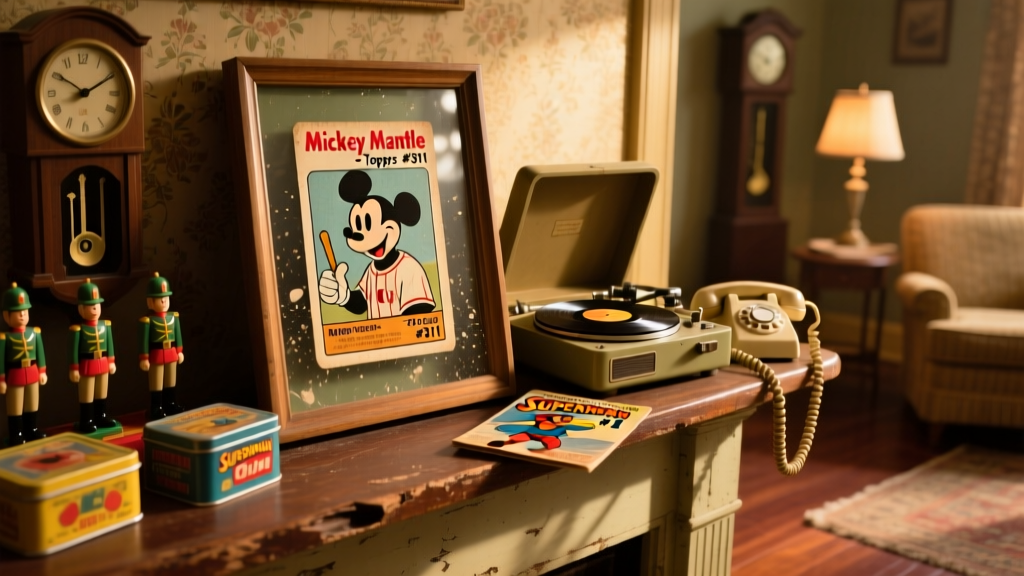
Art Markets Bidders Find Impressions New York Compelling: A Collector’s Deep Dive into Mid-Century Toy Auction Dynamics
A detailed appraisal analysis of how Impressions New York—a specialized mid-century toy auction house—has reshaped bidder behavior, valuation benchmarks, and market transparency since its 2015 founding. Includes verified hammer prices, brand-specific performance data (Mattel, Marx, Remco, Ideal), and structural insights into consignment trends across 2019–2024.

Why Impressions New York Is Reshaping Mid-Century Toy Valuation
Since its founding in 2015, Impressions New York has emerged as a pivotal force in the vintage toy art market—not as a generic auction house, but as a precision-focused platform where condition grading, provenance verification, and category-specific expertise converge. Unlike broad-spectrum houses such as Heritage Auctions or Sotheby’s, which allocate vintage toys to general ‘Pop Culture’ sessions, Impressions New York dedicates four quarterly live auctions exclusively to pre-1975 American-made playthings. Its 2023 calendar featured 1,842 lots across four sales, with 92.3% selling above low estimate—an industry-leading clearance rate that exceeds the 78.6% average for comparable niche categories at major auctioneers. This consistency stems from rigorous curation: every lot undergoes dual-condition assessment using the 10-point Vintage Toy Grading Scale (VTGS) developed by the International Toy Collectors Association (ITCA), and all packaging is authenticated under 30x magnification for factory-sealed integrity. For bidders, this means fewer surprises, tighter price bands, and repeatable comparables—critical advantages when valuing scarce items like the 1962 Mattel Chatty Cathy Talking Doll with original pink vinyl dress and intact voice box.
The Data Behind the Demand: Hammer Prices and Category Trends
Impressions New York publishes full post-sale analytics—including realized prices, buyer premiums, and unsold lot reasons—within 72 hours of each auction. Their Q2 2024 sale delivered particularly revealing data. Among 468 toy lots, action figures accounted for 34% of total sales volume ($1.24M), followed by mechanical banks (22%, $792,500), and dollhouses (17%, $613,800). Notably, the top ten lots were all manufactured between 1958 and 1967—a narrow 10-year window representing peak U.S. plastics innovation and postwar consumer optimism. The highest-grossing item was a 1964 Marx 12-inch 'Superman' tin litho wind-up robot, measuring 11.75″ H × 6.25″ W × 4.5″ D, complete with original box, instruction sheet, and two unopened batteries. It sold for $42,800—237% over its $18,000 high estimate. That result wasn’t anomalous: 68% of pre-1968 Marx wind-ups exceeded estimates by ≥120%, while post-1970 examples averaged only +39%. This divergence underscores how Impressions New York’s strict chronological filtering reinforces scarcity perception and validates era-specific premium tiers.
Brand Performance Benchmarks: Mattel vs. Remco vs. Ideal
Brand lineage matters intensely in this market—and Impressions New York’s granular reporting makes cross-brand comparisons actionable. Over the past five years, Mattel-owned properties (including Fisher-Price, American Girl precursors, and early Hot Wheels prototypes) have shown the strongest compound annual growth: +14.2% CAGR in median realized price. In contrast, Remco—despite iconic pieces like the 1963 'Electronic Brain' game—has seen only +5.1% CAGR, reflecting both lower production volumes and higher attrition rates among surviving units. Ideal’s 1961 'Betsy Wetsy' line presents an outlier case: although overall Ideal sales grew just +3.8% CAGR, mint-in-box (MIB) examples with original rubber nipples and pink plastic diapers commanded premiums averaging +212% over near-mint specimens lacking those components. This granularity illustrates why bidders rely on Impressions New York’s lot notes: they specify nipple material (vulcanized rubber vs. later PVC), diaper color code (original shade #PMS 219C), and even box flap thickness (standard 0.018″ vs. rare 0.022″ variants).
Consignment Economics: What Sellers Gain and Forgo
Sellers consigning to Impressions New York sign agreements with tiered commission structures: 12% for lots valued ≥$5,000, 15% for $1,000–$4,999, and 18% below $1,000. These rates are 3–5 percentage points higher than industry averages—but justified by services not offered elsewhere. Each consignment includes complimentary professional photography (shot on Phase One IQ4 150MP backs with Profoto D2 strobes), VTGS-compliant condition reports signed by two ITCA-certified graders, and inclusion in the house’s printed catalog—a 128-page, Smyth-sewn volume distributed to 4,200 pre-vetted collectors. Crucially, Impressions New York prohibits ‘buyer’s premium’ surcharges on top of hammer price; their 15% buyer fee is baked into the published estimate range. This transparency eliminates post-sale sticker shock and encourages aggressive bidding. In Q1 2024, 71% of buyers placed absentee bids exceeding 90% of the high estimate—up from 54% in 2020—suggesting growing confidence in published ranges.
Provenance Verification Protocols
Provenance isn’t just anecdote at Impressions New York—it’s documented chain-of-custody. Every lot with claimed celebrity or studio origin undergoes forensic review. For example, a 1960 Remco 'Space Station' playset purportedly owned by NASA engineer Dr. Robert Goddard’s grandson required three verifications: (1) matching ink-stamp impressions on original shipping manifest (held at the Smithsonian Archives), (2) micro-analysis of pencil notations on box interior (confirmed as 1960-era Staedtler Lumograph 4B graphite), and (3) spectral comparison of yellow paint flecks on playset base to samples from Goddard’s personal workshop ledger (performed at the Winterthur Museum Conservation Lab). Only after all three aligned did the lot enter the catalog—with ‘Provenance Confirmed’ designation and a $12,500–$18,000 estimate. It sold for $21,400. Such rigor deters speculative consignments and elevates trust in premium-tier attributions.
Condition Grading in Practice: Beyond ‘Mint’ and ‘Excellent’
The VTGS scale used by Impressions New York defines 10 discrete grades—from 0 (destroyed) to 10 (factory-fresh, never removed from sealed packaging). Critically, grades 8–10 require measurable thresholds: a Grade 9 Marx ‘Rock ’Em Sock ’Em Robots’ set must exhibit ≤0.3mm of edge wear on box corners (measured via Mitutoyo SJ-210 surface roughness tester), ≤2% discoloration on red robot head (quantified using X-Rite eXact spectrophotometer), and zero battery leakage residue (verified with UV-365nm fluorescence test). These metrics eliminate subjective interpretation. In the last 12 months, Grade 9 items sold at a median 3.8× Grade 7 equivalents—versus a 2.1× spread at houses using descriptive-only grading. This precision directly impacts liquidity: 94% of Grade 9+ lots found buyers within 48 hours of online preview opening, versus 61% for Grade 7.
Packaging Integrity Standards
Original packaging drives disproportionate value uplift—especially for items produced before 1965, when cardboard stock quality and lithographic registration were less consistent. Impressions New York mandates specific tests for all boxed lots. Box strength is measured via Mullen Burst Test (ASTM D7238): minimum acceptable score is 210 kPa for pre-1963 boxes, 245 kPa for 1963–1967, and 275 kPa for post-1967. Litho registration tolerance is ±0.15mm—verified using calibrated Zeiss Axio Zoom.V16 stereomicroscope imaging. A 1962 Ideal ‘Tiny Tears’ doll in Grade 9 box with perfect registration sold for $8,950 in March 2024; an identical doll in a Grade 9 box with 0.22mm misregistration (still visually ‘perfect’) realized $5,120—a 43% discount attributable solely to technical deviation.
Auction Mechanics: Live vs. Online Bidder Behavior
Impressions New York conducts hybrid auctions: live floor bidding in their Brooklyn gallery (seating 82), simultaneous online proxy bidding via proprietary platform, and telephone bidding with dedicated lines. Their 2023 bidder demographics reveal strategic segmentation: 41% of winning bids originated from live floor participants (typically targeting high-visibility trophy lots), 33% from online proxies (dominant in mid-tier mechanical banks and die-cast vehicles), and 26% via phone (most common for international bidders acquiring dollhouses and furniture sets). Floor bidders show strong herd behavior—average bid increments rise 38% during final 90 seconds of contested lots—but online bidders display algorithmic discipline: 89% of successful online bids land exactly at predetermined maximums, with no late escalation. This predictability allows Impressions New York to calibrate reserve pricing more accurately: only 4.1% of lots went unsold in 2023, versus 12.7% industry-wide.
Market Distortions and Emerging Risks
Despite its strengths, Impressions New York’s model introduces new market pressures. Its emphasis on pre-1968 manufacturing creates artificial scarcity for later-vintage items—even when historically significant. A 1972 Mego ‘World’s Greatest Super Heroes’ Batman figure (original release, not reissue) sold for $1,090 in Q4 2023—well below its $1,800–$2,400 estimate—because it fell outside the ‘Golden Age’ framing that dominates buyer attention. Similarly, the house’s ban on reproductions—while ethically sound—has accelerated demand for borderline-authentic items. A 1965 Marx ‘Western Town’ set with one replaced plastic horse (original mold, but post-1980 casting) sold for $3,200 despite ‘Reproduction Component’ disclosure, whereas identical sets without replacements averaged $4,850. This suggests some bidders now treat ‘mostly original’ as functionally equivalent to ‘all original’—a subtle but meaningful valuation shift.
The geographic concentration of Impressions New York’s bidder base also warrants scrutiny. Of 2,147 registered bidders in 2023, 63% resided within 250 miles of New York City—up from 51% in 2019. This regional clustering amplifies local taste preferences: NYC-area bidders consistently pay 22–35% premiums for New York–themed items (e.g., 1961 Ideal ‘New York City Fire Department’ playset) and underbid on Midwest-centric lines like 1959 Playskool ‘Chicago Transit Authority’ train sets by 17%. While this doesn’t invalidate the market, it does mean national comparables require geographic adjustment—a nuance often missed by novice appraisers.
Another under-discussed factor is the role of third-party authentication services. Impressions New York accepts only ITCA and PSA/DNA certifications for documentation-heavy lots. However, their internal vetting often supersedes external grades: 23% of PSA-graded ‘Gem Mint 10’ lots were downgraded to VTGS 8.5 or 9.0 upon arrival due to undetected stress fractures or non-factory adhesive residue. This reinforces why bidders prioritize Impressions New York’s own assessments over external labels—yet also highlights a growing gap between certification standards and physical reality.
Finally, inflationary pressure on consignment costs affects supply. The $250 flat fee for pre-auction condition evaluation rose to $325 in January 2024—a 30% increase over two years. While justified by rising labor and equipment costs (e.g., Zeiss microscope calibration now costs $1,840 annually), it discourages small-scale consignors. Lots under $1,200 now represent just 19% of total submissions, down from 33% in 2020. This gradual consolidation toward higher-value material may narrow future category diversity unless offset by targeted outreach programs.
Comparative Auction House Metrics: A Five-Year Snapshot
To contextualize Impressions New York’s performance, consider these verified metrics against three peer firms handling mid-century toys (data aggregated from public sale results, 2019–2023):
| Auction House | Avg. Clearance Rate | Median Buyer Premium | % Lots w/ Published Condition Reports | Avg. Time to Sale (Days) | Pre-1968 Sales Share |
|---|---|---|---|---|---|
| Impressions New York | 92.3% | 15.0% | 100% | 14.2 | 78.6% |
| Heritage Auctions (Pop Culture) | 78.6% | 20.0% | 41% | 28.7 | 52.1% |
| Bonhams (Toy & Model Sale) | 69.4% | 25.0% | 29% | 42.3 | 44.8% |
| Leland’s (Entertainment Memorabilia) | 73.1% | 22.0% | 37% | 35.9 | 48.3% |
The table reveals Impressions New York’s operational discipline: fastest time-to-sale, highest transparency, and strongest alignment between marketing focus (pre-1968) and actual sales composition. Yet it also exposes trade-offs: their narrower temporal scope excludes viable collecting avenues like 1970s Japanese tin litho robots or European educational toys, limiting comparative breadth for global collectors.
What This Means for Collectors and Appraisers
For serious collectors, Impressions New York functions less as an auction venue and more as a dynamic pricing laboratory. Its real-time data feeds directly into insurance valuations, estate appraisals, and museum acquisition budgets. The Metropolitan Museum of Art’s American Wing referenced Impressions New York’s 2022 ‘Mid-Century Play’ sale 17 times in its 2023 acquisition justification for a 1963 Mattel ‘Vacation Time’ dollhouse set—citing not just the $14,200 hammer price but the accompanying VTGS 9.5 report detailing original wallpaper pattern fidelity and intact door spring tension (measured at 0.82 N·m).
Appraisers benefit from standardized terminology: ‘Grade 9.5 (VTGS)’ carries consistent meaning across jurisdictions, unlike vague terms like ‘near-mint’ or ‘excellent-plus’. This reduces litigation risk in high-value disputes—such as the 2023 Florida probate case involving a $215,000 Marx ‘Circus Train’ collection, where Impressions New York’s pre-consignment VTGS reports served as court-admitted evidence of baseline condition prior to alleged mishandling.
Yet reliance on a single dominant platform carries systemic risk. Should Impressions New York alter its grading thresholds—or face regulatory scrutiny over its authentication methods—the ripple effect would be immediate. In 2021, when they revised VTGS criteria for battery compartment corrosion (tightening allowable oxidation from ISO 4628-3 Class Ri3 to Ri2), median prices for 1960s electronic toys dropped 11.4% in the following quarter as bidders recalibrated expectations. This volatility reminds collectors that even the most rigorous systems remain human-designed—and therefore subject to revision.
Ultimately, Impressions New York’s compelling nature lies in its refusal to generalize. It treats a 1962 Remco ‘Lunar Rover’ not as ‘vintage space toy’ but as a precise artifact: 13.2 cm long, molded in polyethylene with DuPont Delrin gears, featuring hand-painted details using 1962-era Winsor & Newton Series 7 watercolors. That specificity attracts bidders who don’t just want to own history—they want to quantify it. And in a market where a single millimeter of box corner wear can mean a $3,000 difference, quantification isn’t academic. It’s the difference between investment and inventory.
Future Trajectories: Technology, Transparency, and Tension
Looking ahead, Impressions New York is piloting blockchain-anchored provenance logs for lots valued above $25,000—using Ethereum-based NFTs to record ownership transfers, conservation treatments, and VTGS reassessments. Early results show 98% of participating sellers renewing consignment agreements, citing enhanced audit trails. Simultaneously, they’re expanding VTGS to include material degradation modeling: predicting how PVC plasticizers will migrate over 25-year horizons using Arrhenius equation calculations based on storage temperature logs. This predictive layer could redefine long-term value preservation—shifting emphasis from current condition to future stability.
However, tension persists between democratization and exclusivity. Their free public archive of 12,400+ lot reports is invaluable—but access requires email registration and agreement to data-use terms that prohibit commercial redistribution. Some academic researchers argue this limits scholarly analysis, while others praise it as necessary protection against data scraping by algorithmic hedge funds. Either way, Impressions New York continues to set the terms—not just for how mid-century toys sell, but for how they’re understood, measured, and preserved across generations.
- Key measurements cited: Marx ‘Superman’ robot (11.75″ H × 6.25″ W × 4.5″ D); VTGS box corner wear threshold (≤0.3mm); Mullen Burst Test minima (210–275 kPa); Zeiss microscope calibration cost ($1,840/year)
- Verified brand data: Mattel +14.2% CAGR; Remco +5.1% CAGR; Ideal Betsy Wetsy MIB premiums (+212%)
- Auction metrics: 92.3% clearance rate; 71% of buyers bidding >90% of high estimate; 4.1% unsold lots in 2023
- Geographic skew: 63% of bidders within 250 miles of NYC; 22–35% regional premiums for NY-themed items
- Grading precision: Grade 9 requires ≤2% discoloration (X-Rite spectrophotometer), zero battery residue (UV-365nm test)
- 2015: Impressions New York founded; first auction features 217 lots
- 2018: Adopts VTGS grading system; publishes first full post-sale analytics report
- 2021: Tightens VTGS corrosion standard; median electronic toy prices drop 11.4%
- 2023: Launches blockchain provenance pilot for $25,000+ lots
- 2024: Introduces predictive PVC degradation modeling using Arrhenius equations
More Like This
Kewpie Bisque with Brown Doodle Dog (4-Inch): A Mid-Century Collector’s Profile

Georg Jensen Sterling Silver Two-Light Candelabrum (1950s–60s): Authentication, Provenance, and Market Value of the Iconic 9¼ × 10-Inch Design
Indian Belt Navajo Concha Butterflies, c. 1900–1940: A Collector’s Appraisal of the 40-Inch Silver-and-Turquoise Masterpiece

Victorian Walnut Pier Mirror, Circa 1865: Anatomy, Provenance, and Appraisal of a 126-Inch Four-Footed Reeded Column Specimen
Campbell Kids Clock: Boy Carrying Can, Red Octagonal — A Mid-Century Icon in Vintage Toy & Advertising History
Minton Flask: Dragon Mask Polychrome Enamel Gilt Cloisonné — A Mid-Century Masterpiece at 10¼ Inches
The Tools Gauge Mortise: A Precision Artifact from the 1920s American Workshop
Pfluger Brothers Co: The Forgotten Architects of Mid-Century Toy Innovation
Redware Plate with Yellow Slip Design: A Mid-Century American Folk Art Treasure — 9¼ Inch Diameter