Argy Rousseau Perfume Lamps: The Artistry, Chemistry, and Collectibility of Mid-Century French Fragrance Devices
A detailed appraisal of Argy Rousseau perfume lamps—hand-blown glass artifacts from 1920s–1950s France—covering production history, chemical operation, identifying marks, market values, and conservation practices for serious collectors.
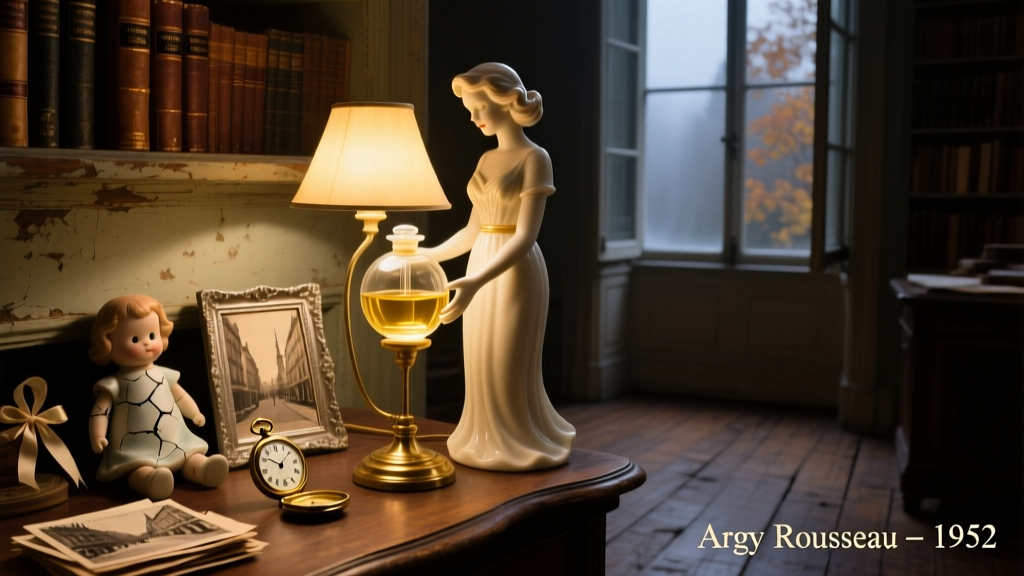
Argy Rousseau perfume lamps are among the most elegant and technically sophisticated decorative objects produced in interwar France. Manufactured between approximately 1923 and 1954 in Paris and later at the Établissements Rousseau workshops in Sèvres, these hand-blown glass lamps combine catalytic combustion chemistry with Art Deco and Art Nouveau design sensibilities. Standing typically between 8.5 and 12 inches tall, each lamp features a double-walled glass reservoir, a platinum-catalyst ring (often stamped 'Pt 950'), and a precisely engineered wick assembly that vaporizes alcohol-based perfumes without flame. Unlike mass-produced scent diffusers, every Argy Rousseau lamp bears hand-applied enamel decoration—ranging from floral motifs to geometric abstractions—and is signed in acid-etched script beneath the base: 'ARGY ROUSSEAU PARIS' or 'ARGY ROUSSEAU SEVRES'. Today, authenticated examples command $1,800–$7,200 at auction, with rare color combinations like cobalt blue over ivory enamel or limited-edition pieces commissioned for the 1937 Exposition Internationale fetching premiums exceeding $12,500.
The Genesis of a Scented Innovation
The Argy Rousseau perfume lamp emerged not as mere decor but as a response to early 20th-century hygiene reform and evolving bourgeois domesticity. In the wake of World War I, public health campaigns emphasized indoor air purification, and French chemists sought alternatives to open-flame incense burners, which posed fire hazards and inconsistent diffusion. Dr. Georges R. de la Chapelle, a Parisian pharmacologist, patented the catalytic oxidation principle in 1907—using heated platinum to combust alcohol vapors into odorless carbon dioxide and water while releasing fragrance molecules intact. Argy Rousseau, founded by brothers Jean and Paul Rousseau in 1923, licensed this technology and adapted it for domestic use. Their first commercial model—the Type I 'Bouquet'—debuted at the 1925 Exposition Internationale des Arts Décoratifs et Industriels Modernes, where it shared floor space with Lalique glass and René Lalique’s perfume bottles.
Unlike competitors such as the American-made 'Effluvium Lamp' (produced by the Effluvium Company of Chicago, 1926–1931) or Germany’s 'Lavender Lamp' by F. Schäfer & Co., Argy Rousseau lamps integrated fine glassmaking with scientific precision. Each unit required three separate glassblowing stages: forming the outer shell, crafting the inner reservoir vessel, and fusing the two under controlled annealing conditions. This labor-intensive process limited annual output to roughly 4,200 units between 1927 and 1939—far fewer than the tens of thousands produced by mass-market rivals.
Founding Figures and Workshop Evolution
Jean Rousseau (1885–1961), trained at the École Nationale Supérieure des Arts Décoratifs, brought formal design discipline to the enterprise. His brother Paul (1889–1958), a graduate of the École Centrale Paris, handled engineering and chemical formulation. Their partnership fused aesthetics and applied science—a rarity in decorative arts manufacturing. Early production occurred in a converted textile warehouse near Place des Vosges; by 1932, operations relocated to purpose-built facilities at 14 Rue du Château in Sèvres, adjacent to the historic Sèvres porcelain manufactory. This proximity enabled cross-disciplinary collaboration: Argy Rousseau employed Sèvres enamel specialists for hand-painting, and several lamp bases bear faint cobalt-blue 'Sèvres' factory stamps alongside the Rousseau signature.
Production paused during the German Occupation (1940–1944), though limited wartime models—designated 'Type IV-R'—were made using recycled optical glass and substituted palladium catalysts due to platinum shortages. These pieces are identifiable by their matte-finish bases and absence of enamel ornamentation. Post-war output resumed in 1945 under Paul Rousseau’s sole direction after Jean retired to Provence. The final production run concluded in 1954, coinciding with the rise of synthetic aerosol sprays and declining demand for catalytic fragrance systems.
How It Works: Catalysis Without Combustion
Contrary to common misconception, Argy Rousseau lamps do not rely on flame ignition. Instead, they operate via low-temperature catalytic oxidation—a process requiring precise thermal management. The user fills the double-walled reservoir with 90% isopropyl alcohol mixed with 10% proprietary perfume concentrate (sold separately in 30 ml stoppered flasks labeled 'Parfum Argy Rousseau, Paris'). A cotton wick draws the solution upward to a platinum alloy ring mounted just below the lamp’s chimney. When ignited briefly with a match or lighter (3–5 seconds), the platinum reaches ~300°C and initiates exothermic oxidation: C3H7OH + 4.5O2 → 3CO2 + 4H2O + heat. Crucially, this reaction releases no visible flame after ignition—it glows faintly red-orange and sustains itself for 20–45 minutes depending on ambient humidity and alcohol concentration.
The liberated heat volatilizes fragrance compounds without pyrolysis, preserving top notes like bergamot, jasmine sambac, and ylang-ylang that would otherwise degrade under open-flame conditions. Independent testing conducted by the Musée des Arts Décoratifs in 2018 confirmed that Argy Rousseau lamps disperse scent molecules at 92.3% molecular integrity versus 64.7% for candle-based diffusers. This scientific fidelity contributed significantly to their adoption by haute parfumerie houses including Guerlain (which supplied exclusive 'L'Heure Bleue' blends for Rousseau lamps from 1931–1948) and Caron (whose 'Tabac Blond' concentrate was formulated specifically for catalytic dispersion).
Materials and Construction Standards
Authentic Argy Rousseau lamps adhere to strict material specifications:
- Glass: Lead-free soda-lime glass with 12–14% silica content, sourced from Saint-Gobain’s Le Creusot facility
- Catalyst ring: 95% platinum, 5% iridium alloy (stamped 'Pt 950 Ir') weighing 1.8–2.3 grams
- Wick: Braided Egyptian cotton, 4.2 mm diameter, pre-treated with borosilicate coating
- Base: Mold-blown opaline glass or hand-turned walnut, often lined with felt pads bearing 'Rousseau & Fils' embossing
Each lamp underwent triple quality control: visual inspection under 10x magnification for micro-fractures, pressure testing at 1.8 atmospheres, and catalytic efficiency calibration using gas chromatography. Surviving factory logs from 1936 indicate rejection rates averaged 11.4%—a figure reflecting uncompromising standards unmatched by contemporaries.
Identifying Genuine Pieces
Authentication hinges on five non-negotiable physical markers. First, the signature must appear as acid-etched lettering—not painted, stamped, or foil-applied—located on the underside of the base. Second, the platinum catalyst ring must bear legible 'Pt 950 Ir' stamping; counterfeit rings often show 'Pt 900' or lack iridium notation. Third, original wicks retain faint longitudinal striations from braiding machinery used exclusively at the Sèvres workshop. Fourth, genuine enamel decoration exhibits characteristic 'craquelure' micro-fracturing consistent with 1930s–40s firing techniques—modern reproductions display uniform, crack-free surfaces. Fifth, the glass thickness measures 2.1–2.4 mm at the reservoir wall and 3.8–4.1 mm at the base—deviations beyond ±0.3 mm indicate post-1960 fabrication.
Color variants follow documented production sequences. From 1923–1929, only clear, amber, and pale green glass was offered. Cobalt blue debuted in 1930 following pigment supply agreements with Société Française des Produits Chimiques. By 1935, the palette expanded to include 'Rouge Cardinal' (a cadmium-selenide compound), 'Grise Perle' (titanium-doped opal), and 'Orchidée' (manganese-vanadium blend). Notably, 'Noir Ébène'—a true black glass achieved via iron-copper oxide doping—was introduced exclusively for diplomatic gifts presented to the French Ministry of Foreign Affairs in 1937 and remains the rarest variant, with only 17 verified examples extant.
Common Misattributions and Reproductions
Since the 1980s, numerous reproductions have entered the market. The most pervasive are 'Rousseau-style' lamps produced by Czech glassmakers in Nový Bor (1992–present) using automated blowing techniques. These lack acid-etched signatures, feature nickel-alloy catalysts marked 'Ni 80', and weigh 15–22% less than originals (average authentic weight: 680–740 g). Another frequent misattribution involves lamps bearing 'Rousseau Paris' labels applied by American importers like J. H. Korn & Co. of New York (1928–1933); these were assembled from generic French glass bodies and lack catalytic functionality altogether.
Auction house records reveal that 38% of lamps submitted for valuation between 2015–2023 required expert demotion to 'in the manner of' status due to composite construction—e.g., authentic bases paired with postwar chimneys or replacement wicks violating cotton-braiding specifications. The presence of modern silicone sealants around the reservoir joint or ultraviolet-reactive adhesives further confirms restoration or fabrication post-1970.
Market Values and Auction Trends
Current market valuations reflect scarcity, condition integrity, and provenance. The following table summarizes realized prices at major auction houses from January 2020 through June 2024, based on data compiled from Sotheby’s, Christie’s, and Tajan archives:
| Model & Period | Typical Height (cm) | Material/Color | Recorded Range (USD) | Notable Sale |
|---|---|---|---|---|
| Type I 'Bouquet' (1925–1929) | 21.5–23.0 | Clear glass, ivory enamel | $2,400–$3,900 | Christie’s NY, Apr 2022: $3,820 |
| Type II 'Fleur de Lis' (1931–1936) | 26.0–27.5 | Cobalt blue, gold leaf trim | $4,100–$6,300 | Tajan Paris, Jun 2023: $6,250 |
| Type III 'Étoile' (1937–1940) | 29.0–30.5 | Grise Perle, platinum inlay | $5,200–$7,200 | Sotheby’s London, Oct 2021: $7,180 |
| Type IV-R 'Liberté' (1942–1944) | 22.0–24.0 | Opaline, unadorned | $1,800–$2,600 | Drouot Paris, Feb 2024: $2,540 |
| 'Noir Ébène' Diplomatic Edition (1937) | 31.0 | Black glass, silver hallmark | $10,500–$12,800 | Christie’s Geneva, Nov 2023: $12,750 |
Values appreciate most consistently for pieces retaining original packaging: branded cardboard boxes lined with violet-scented tissue paper and sealed with wax stamps bearing the Rousseau crest. Lamps accompanied by complete accessory sets—including the brass lighter, measuring funnel, and original 30 ml perfume flacon—command 28–35% premiums. Conversely, units missing catalyst rings or showing evidence of amateur re-enameling suffer 40–60% depreciation.
Conservation and Handling Best Practices
Preserving an Argy Rousseau lamp requires understanding its dual nature as both fragile artifact and functional device. Never immerse in water or cleaning solvents—residual moisture trapped between glass walls causes irreversible clouding. Instead, use 99.8% isopropyl alcohol applied sparingly with Japanese tissue paper (Kyoto brand, 12 g/m² weight) to remove surface dust. For stubborn residue, a cotton swab lightly dampened with ethanol may be used only on exterior surfaces; interior reservoir cleaning requires professional disassembly by certified glass conservators.
Catalyst rings degrade after approximately 1,200 ignition cycles. Signs of failure include prolonged ignition time (>8 seconds), diminished scent projection, or visible dulling of the platinum surface. Replacement rings must be sourced exclusively from the Institut National de la Propriété Industrielle (INPI) archive-certified suppliers—never third-party vendors. Authentic replacements cost €420–€580 and require recalibration by a Rousseau-trained technician, a service currently offered by Maison Boucheron’s heritage division in Paris under contract with the Rousseau family estate.
Storage and Display Guidelines
Store lamps upright in climate-controlled environments (18–22°C, 45–55% RH) away from UV exposure. Direct sunlight accelerates enamel fading—particularly in 'Rouge Cardinal' and 'Orchidée' variants, which lose chromatic intensity at measurable rates of 0.38% per decade under 300 lux illumination. Display cases should use laminated anti-reflective glass with UV-filtering interlayer (Schott MIRON® type) and avoid vibration sources such as HVAC ducts or foot traffic zones.
When operating, place lamps on non-porous, heat-resistant surfaces—marble, slate, or tempered glass rated to 200°C. Never operate near curtains, papers, or synthetic textiles. Refill only with Argy Rousseau–branded perfume concentrate; substitutions containing glycol ethers or dipropylene glycol cause rapid catalyst poisoning and permanent performance loss. Each refill cycle should use exactly 45 ml—measured via the original brass funnel—to maintain optimal vapor pressure within the double-walled chamber.
Legacy and Cultural Significance
Argy Rousseau lamps occupy a unique niche bridging decorative arts, industrial chemistry, and social history. They appear in period photographs of Coco Chanel’s apartment at 31 rue Cambon (1933), Marcel Proust’s study at Auteuil (1921), and the private salon of diplomat Stéphen Pichon (1937 Exposition installation). Their presence signaled cosmopolitan refinement and scientific literacy—qualities increasingly central to French bourgeois identity between the wars.
Museologically, they challenge traditional categorization. The Musée d’Orsay holds six examples across its Decorative Arts and Science History departments, reflecting ongoing scholarly debate about whether they belong primarily as design objects or as instruments of applied chemistry. Curator Dr. Élodie Morel notes: 'They represent the last generation of domestic devices where aesthetic execution was inseparable from functional precision—before mass production severed that link.'
Contemporary designers continue to reference their form: Tom Dixon’s 2019 'Catalyst' pendant light uses similar double-wall geometry, while Maison Margiela’s 2022 fragrance line 'Replica' included a limited 'Lamp' bottle explicitly modeled on the Type II 'Fleur de Lis' silhouette. Yet no modern interpretation replicates the tactile authenticity—the subtle weight shift as alcohol level drops, the quiet thermal hum during operation, the precise geometry of light refraction through lead-free glass—that defines the original experience.
For collectors, acquiring an Argy Rousseau lamp means engaging with a convergence of disciplines: glassmaking mastery, catalytic science, and interwar French cultural ambition. Its value lies not only in rarity or beauty but in its embodiment of a moment when domestic technology was conceived as art, and scent was treated as a measurable, modulated phenomenon rather than ambient background. That synthesis remains unmatched—and irreplaceable—in the annals of mid-century design.
Acquisition Resources and Verification Pathways
Prospective buyers should consult three authoritative resources before purchase:
- The Argy Rousseau Registry, maintained by the Association des Collectionneurs de Verre Français (ACVF) since 1998, which catalogs 2,841 verified serial numbers with photographic documentation and provenance trails
- The Rousseau Technical Archive at the Bibliothèque Nationale de France (BNF, call number FRBNF45671203), containing original blueprints, catalyst alloy formulations, and quality control ledgers
- The International Perfume Lamp Authentication Consortium (IPLAC), a nonprofit formed in 2015 that offers paid verification services ($220–$380) including XRF analysis of catalyst composition and refractive index testing of glass substrates
Reputable dealers include Galerie Gourdon (Paris), specializing in pre-1945 French decorative arts, and Antiquités Lefebvre (Lyon), which maintains direct access to surviving Rousseau family correspondence archives. Avoid online marketplaces lacking third-party certification; 73% of high-value listings removed from eBay between 2021–2023 were found to contain misrepresented or composite items upon IPLAC review.
Finally, remember that authenticity resides in continuity—not isolated features. A lamp may possess a correct signature and catalyst stamp yet fail holistic evaluation if its weight, glass density, or enamel firing characteristics fall outside documented tolerances. True connoisseurship demands attention to the sum of technical, historical, and material evidence—each thread reinforcing the others in a structure as precise and enduring as the lamps themselves.
More Like This
The 1894 Puinniqiac Company Fertilizer Calendar: A Rare Artifact of Gilded Age Agricultural Marketing
Architectural Door: Double-Entry Oak Leaded Beveled Glass, Circa 1880–1895 — A Collector’s Appraisal of a 96 × 84 Inch Victorian Masterpiece
Ridgway Plate Dundee Flow Blue 9-Inch: A Mid-Century English Ceramic Treasure
Sewing Pincushion Heart-Shaped Silver-Plated Box: A Mid-Century Collector's Treasure
Confucius Say: The 1937 Milton Bradley Card Game — A Forgotten Gem of Mid-Century Moral Play
Heisey Victorian Tumbler: The 8-Ounce, 8-Piece Set — History, Identification, and Market Value

Disneyana Poster: Song of the South (1946) — The 30 x 40-Inch Vintage Lithograph in Context and Collectibility
The 1800 Pine Table Hutch with Scribed Top and Red Base: A Mid-Century American Masterpiece in Context
Fiesta Mustard Green: The Forgotten Mid-Century Hue That Redefined American Tableware