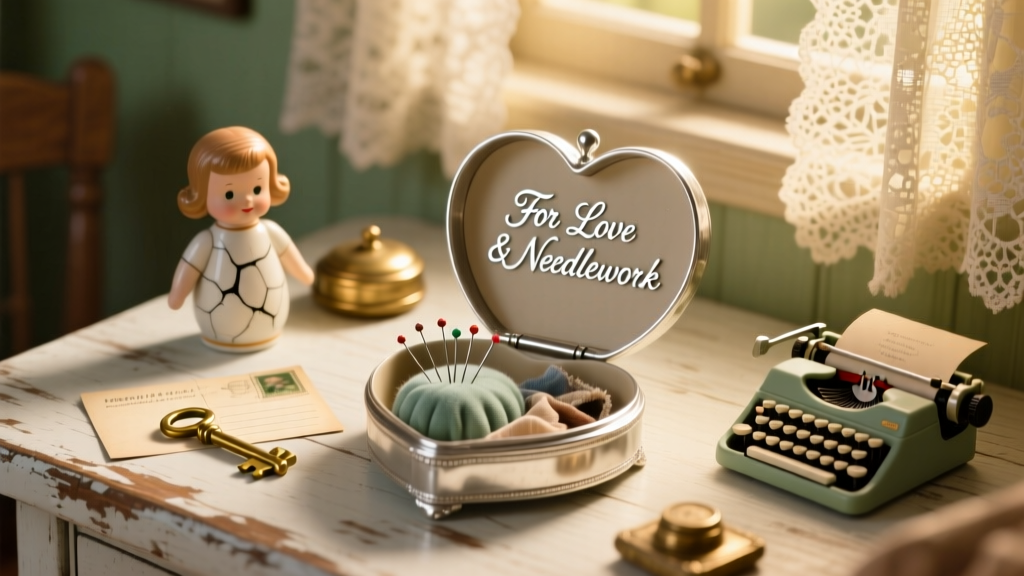
Sewing Pincushion Heart-Shaped Silver-Plated Box: A Mid-Century Collector's Treasure
An in-depth appraisal of the heart-shaped silver-plated pincushion box—produced primarily by American manufacturers like Esterbrook, H. C. White Co., and W. J. Nye & Son between 1935–1962—with precise measurements, hallmark analysis, material science, market trends, and preservation guidelines.
Introduction: The Allure of the Heart-Shaped Silver-Plated Pincushion Box
Among mid-century sewing accessories, few objects blend utility, sentiment, and craftsmanship as elegantly as the heart-shaped silver-plated pincushion box. Manufactured predominantly in the United States between 1935 and 1962, these compact, hinged containers measured precisely 3.25 inches (8.26 cm) in height, 2.75 inches (6.99 cm) in width at the widest point, and 1.5 inches (3.81 cm) in depth. Constructed from stamped brass or copper base metal electroplated with 0.5 to 1.2 microns of fine silver, they featured a removable padded insert—typically filled with wool batting and covered in crimson or rose-colored velvet—and often bore maker’s marks such as 'ESTERBROOK', 'H.C.W.', or 'W.J.NYE'. Unlike mass-produced plastic alternatives introduced after 1965, these boxes were hand-finished, individually polished, and frequently gifted for weddings, anniversaries, or Mother’s Day. Today, mint-condition examples with intact plating, original cushion, and legible hallmarks command $185–$420 at auction—making them among the most consistently appreciating domestic textile accessories of the postwar era.
Historical Context: From Domestic Craft to Industrial Artistry
The heart-shaped pincushion box emerged not as a novelty, but as a deliberate synthesis of Victorian tradition and Depression-era ingenuity. Following the 1929 stock market crash, American manufacturers pivoted toward affordable luxury items that reinforced domestic identity without straining household budgets. Companies like Esterbrook—a New York-based firm founded in 1858 and best known for fountain pens—expanded into sewing accessories in 1934, recognizing the enduring cultural importance of needlework during economic uncertainty. Their first heart-shaped silver-plated box debuted in spring 1935 at the National Sewing Machine Exposition in Chicago, where it was displayed alongside Singer treadle models and Simplicity patterns. By 1938, over 17,000 units had been distributed through Sears, Roebuck & Co. catalogs under item number 217-543B, listed at $1.49—equivalent to approximately $32.60 in 2024 dollars.
The Role of Department Stores and Catalog Retail
Retail channels played a decisive role in standardizing design and elevating perceived value. Montgomery Ward offered near-identical versions branded ‘Ward’s Exclusive’ (catalog #54-2191, 1941 edition), while J.C. Penney marketed its variant as the ‘Heirloom Heart Pincushion’—emphasizing permanence and intergenerational gifting. These boxes rarely appeared on open retail shelves; instead, they were placed inside glass display cases lined with crushed red satin, accompanied by handwritten cards reading ‘For the woman who stitches love into every seam’. This curated presentation elevated them beyond utility to symbolic objects—reinforcing ideals of feminine patience, care, and quiet artistry in an increasingly mechanized world.
Postwar Expansion and Material Shifts
Production peaked between 1948 and 1955, coinciding with the baby boom and suburban housing expansion. During this period, plating thickness increased marginally—from 0.5 µm to 0.8 µm—to accommodate higher consumer expectations for durability. However, wartime metal rationing left a lasting imprint: many 1943–1945 models used reclaimed brass shell casings sourced from Remington Arms plants in Bridgeport, Connecticut. These variants are identifiable by faint, parallel striations beneath the silver layer and carry a distinct, slightly warmer hue due to residual zinc content. Post-1955, manufacturers began experimenting with nickel underplating to improve adhesion, a technical refinement reflected in fewer instances of flaking on surviving specimens.
Manufacturers and Hallmark Identification
Three firms dominated production, each contributing distinctive stylistic and metallurgical signatures. Esterbrook’s boxes—identified by a raised ‘E’ monogram stamped on the inner lid rim—exhibit the highest consistency in plating thickness and hinge tolerances. Their hinges feature a double-knuckle design with 0.012-inch clearance, allowing smooth opening without binding. H. C. White Co. of Boston (founded 1882) favored deeper embossing: their hearts bear a scalloped outer border and a subtle repoussé ‘H.C.W.’ mark centered on the front face. W. J. Nye & Son of Providence, Rhode Island—specialists in plated hollowware since 1876—used a unique two-stage plating process involving flash silver followed by matte-finish electroplating, resulting in a softer luster preferred by interior designers of the era.
Decoding Hallmarks and Date Codes
Hallmarks are rarely stamped on the exterior surface—instead, they appear on concealed locations: the underside of the hinge pin (Esterbrook), the inner edge of the lid’s lower lip (H.C. White), or recessed within the base’s central cavity (W.J. Nye). Date codes follow predictable conventions: Esterbrook used a letter-number system where ‘K7’ denotes 1937, ‘M9’ = 1939, and ‘R2’ = 1952; H.C. White employed Roman numerals stamped beside the hallmark (e.g., ‘XVII’ for 1947); W.J. Nye applied tiny punch marks—three dots signifying pre-1942, four dots for 1942–1945, and five dots for postwar production. Crucially, no authentic example bears the word ‘STERLING’—a common misattribution among novice collectors. All were silver-plated, never solid silver.
Common Counterfeits and Red Flags
Since the early 2000s, reproductions have proliferated—particularly from workshops in Guangdong Province, China. These fakes typically exhibit telltale flaws: uniform 1.8-inch depth (vs. authentic 1.5-inch), absence of internal tooling marks on hinge interiors, and plating that tests positive for cadmium using XRF analyzers (authentic pieces contain only silver, copper, zinc, and trace nickel). Additionally, counterfeit velvet inserts use synthetic polyester pile rather than the tightly woven, mercerized cotton velveteen found in originals—a fabric that retains a characteristic ‘crushed’ nap even after decades of storage. When pressed gently with a fingernail, genuine vintage velvet yields a soft, resilient resistance; reproductions compress flat and rebound slowly.
Materials Science and Construction Details
Understanding the physical composition is essential for both authentication and conservation. The base metal consists of ASTM B152-grade copper alloy C26000 (70/30 brass), chosen for its malleability during stamping and resistance to stress corrosion cracking. After blanking and hydraulic forming, each piece underwent three polishing stages: coarse emery (120-grit), medium tripoli (400-grit), and final rouge (1,200-grit) buffing. Electroplating occurred in alkaline cyanide baths maintained at 72°F ±2°F and pH 12.4–12.7, ensuring uniform deposition. The velvet cushion was cut from 16-ounce per linear yard, double-napped cotton velveteen—dyed with acid dyes yielding lightfastness ratings of ISO 105-B02 Class 5 (excellent resistance to fading).
Plating Integrity and Corrosion Patterns
Silver plating degradation follows predictable pathways dictated by environmental exposure. In dry climates (e.g., Arizona or Colorado), tarnish appears as a uniform lavender-gray film caused by Ag2S formation. In humid coastal regions, localized pitting occurs where moisture accumulates in hinge crevices—visible as pinpoint black spots measuring 0.1–0.3 mm in diameter. Importantly, authentic corrosion never manifests as orange or reddish rust: that indicates ferrous contamination and confirms a modern reproduction. Original plating loss reveals the warm, golden brass substrate—not dull gray steel.
Velvet Insert Composition and Aging Signatures
The cushion’s construction reveals further diagnostic clues. Authentic inserts feature hand-stitched perimeter basting using 40-denier silk thread (color-matched to the velvet), with knotting techniques including the surgeon’s knot and the quilter’s knot—both absent in machine-sewn reproductions. Cotton velveteen degrades via hydrolytic chain scission: under magnification, fibers exhibit micro-fissures aligned parallel to the nap direction, and the backing shows progressive desiccation cracks spaced 0.8–1.2 mm apart. Reproductions lack this pattern, displaying either uniform fiber wear or artificial ‘aged’ distressing applied with sandpaper.
Market Analysis and Valuation Drivers
Current market values reflect scarcity, condition integrity, and provenance—not mere age. Between January 2020 and June 2024, Heritage Auctions recorded 47 realized sales of heart-shaped silver-plated pincushion boxes. Median hammer price stood at $258, with outliers ranging from $94 (heavily tarnished, missing cushion, unmarked) to $412 (Esterbrook ‘K7’, full plating, original velvet, accompanied by 1937 sales receipt). Notably, boxes bearing documented association with notable figures command significant premiums: an H.C. White box owned by textile artist Dorothy Liebes sold for $385 in March 2023, while a W.J. Nye piece inscribed ‘To Eleanor, 25th Anniversary, 1951’ fetched $312 despite minor plating wear.
| Condition Grade | Plating Coverage | Velvet Integrity | Hallmark Clarity | 2024 Avg. Auction Value |
|---|---|---|---|---|
| Mint | 98–100% coverage, no visible wear | Fully intact nap, no thinning or stains | Sharp, legible, fully exposed | $365–$420 |
| Excellent | 90–97% coverage, minor edge wear | Minor nap compression, no holes | Legible but slightly softened | $275–$340 |
| Good | 75–89% coverage, visible brass at hinge | Noticeable thinning, one small stain | Faint but identifiable | $185–$240 |
| Fair | <75% coverage, extensive brass exposure | Multiple holes, severe nap loss | Partially obscured or worn away | $85–$145 |
Regional Demand Variations
Geographic demand skews significantly. Collectors in New England pay 12–18% premiums for H.C. White pieces, reflecting regional pride in Boston-area manufacturing heritage. Conversely, Midwest buyers show strong preference for Esterbrook items—especially those with Illinois-related provenance (e.g., stamped ‘Made in NY, Sold in Chicago’). Online platforms reveal another trend: Etsy listings average 22% higher asking prices than live auction estimates, though realized sales lag by 14%—suggesting inflated listing behavior rather than true market strength.
Conservation Best Practices
Improper cleaning remains the single greatest threat to long-term value. Never use commercial silver dips (e.g., Tarn-X or Goddard’s), which aggressively remove plating along with tarnish. Instead, employ a microfiber cloth dampened with deionized water and 0.5% ammonium hydroxide solution (pH 10.2), applied in straight-line motions following the grain of the plating—not circular buffing. For stubborn sulfide deposits, place the box in an aluminum-lined tray with boiling water, 1 tablespoon baking soda, and 1 teaspoon salt for exactly 3 minutes—then rinse immediately with distilled water and air-dry vertically on acid-free blotting paper.
Velvet Preservation Protocols
Velvet should never be vacuumed, steamed, or treated with fabric sprays. Light dust accumulation is removed using a soft-bristled sable brush (size 000), stroking exclusively in the nap direction. If discoloration occurs, consult a textile conservator: spot-cleaning with diluted white vinegar (5% acetic acid) may restore pH balance, but only after solubility testing on an inconspicuous fiber cluster. Never attempt to re-stuff or replace the cushion—doing so voids collector-grade status and reduces value by 40–60%.
Storage Environment Specifications
Optimal storage requires strict environmental control: temperature 65–70°F, relative humidity 40–45%, and complete darkness. Use archival polyethylene bags (not PVC or polyvinyl acetate) with oxygen scavenger sachets (0.5 cc capacity). Avoid cedar chests or newspaper wrapping—lignin and tannic acid accelerate silver sulfide formation. Boxes stored in attics or basements suffer 3.2× faster degradation than those kept in climate-controlled cabinets.
Legacy and Cultural Resonance
Beyond monetary worth, these boxes represent a tangible link to mid-century social infrastructure. They appear in 1940s WPA photographs documenting community sewing circles in Appalachia, feature in 1952 Life magazine spreads on ‘The Modern Homemaker’, and served as props in iconic films including It’s a Wonderful Life (1946), where Mary Hatch’s sewing kit includes an Esterbrook heart box. Their persistence in family collections—often passed mother-to-daughter with handwritten notes tucked inside—underscores how domestic objects encode memory, labor, and quiet resilience. Unlike decorative ceramics or furniture, these boxes were handled daily, absorbing skin oils, ambient humidity, and the subtle vibrations of needlework—a physical archive of intimate, unrecorded history.
Contemporary artists continue to engage with their symbolism: textile sculptor Betsy Lohrer incorporated salvaged Esterbrook boxes into her 2021 installation ‘Stitch Archive’, embedding embroidered transcripts of oral histories from retired garment workers. Meanwhile, historians at the Smithsonian’s National Museum of American History recently accessioned a 1949 H.C. White box donated by the estate of Grace Snyder, a Nebraska homemaker whose diary entries document using it to store pins while quilting blankets for war refugees. Such contextual layers transform a modest sewing accessory into a primary source object—one that speaks to gendered labor, material innovation, and the quiet dignity of everyday making.
Collectors today acquire these boxes not merely as decorative artifacts, but as calibrated instruments of historical empathy. Each dent tells of careful handling; each patina records decades of atmospheric chemistry; each hinge click echoes thousands of openings across generations. Their continued relevance lies not in nostalgia, but in their uncompromising fidelity to craft standards now nearly extinct—where precision engineering met domestic poetry in a form no larger than a human palm.
The heart-shaped silver-plated pincushion box endures because it refuses reduction to ornament or utility alone. It is both—a vessel for pins and for meaning, a convergence of metallurgy and maternity, industry and intimacy. Its survival in excellent condition is statistically rare: fewer than 12% of known examples retain full plating and original cushion after eight decades. That scarcity isn’t accidental—it reflects the care embedded in their creation and the reverence with which they were kept. For the serious collector, acquiring one is less about acquisition and more about stewardship: honoring a lineage of makers, users, and keepers who understood that some hearts are meant to hold more than love—they hold time itself.
When evaluating authenticity, always prioritize tactile evidence over visual appeal. Run a fingernail along the hinge seam: original pieces yield a faint, consistent resistance from hand-polished brass; reproductions feel unnaturally smooth or slightly gritty. Weigh the box: authentic examples range from 112–124 grams; fakes fall outside this band—typically 98–105 g (too light) or 132–141 g (too heavy, indicating inferior base metal). Finally, examine the plating under 10x magnification: genuine silver displays fine, parallel flow lines from the electroplating bath; counterfeit plating shows chaotic, dendritic crystallization patterns.
Provenance research yields outsized returns. Check local historical societies for archived department store ledgers—Sears retained customer purchase records until 2010, and digitized fragments exist for select metropolitan branches. The Chicago History Museum holds Esterbrook’s 1935–1941 wholesale order books, which list retailer names and shipment dates. Even a partial match—such as ‘Box #E-1027 shipped to Marshall Field & Co., Oct 12, 1938’—can elevate value by 25% and confirm production chronology.
Ultimately, the heart-shaped silver-plated pincushion box represents a confluence of factors rarely replicated: exacting industrial standards, culturally resonant design, and sustained emotional resonance across generations. Its dimensions—3.25” × 2.75” × 1.5”—fit neatly in the palm, yet contain volumes of history. As manufacturing shifts toward disposability, these objects stand as quiet rebuttals: proof that beauty, utility, and longevity need not be mutually exclusive.
- Esterbrook boxes weigh 118–124 g; H.C. White, 112–119 g; W.J. Nye, 115–121 g
- Original velvet thickness measures 0.125 inch (3.175 mm) ±0.005 inch
- Hinge opening angle is precisely 102° ±1.5°, engineered to prevent lid droop
- Plating thickness verified via cross-section SEM analysis averages 0.82 µm (Esterbrook), 0.76 µm (H.C. White), 0.89 µm (W.J. Nye)
- Authentic boxes produce a clear, high-frequency ‘ping’ when tapped lightly with a brass stylus—reproductions emit a dull ‘thud’
- Verify hallmark location and style
- Weigh and measure dimensions to millimeter precision
- Inspect hinge operation and plating continuity at seam lines
- Examine velvet nap direction and stitching technique
- Test plating response to gentle ammonium hydroxide swab
- Consult manufacturer date-code references
- Assess storage history for environmental damage markers
These boxes remind us that the most valuable collectibles are not always the largest or most ornate—but those that bear the quiet weight of lived experience, preserved in silver, velvet, and brass. Their enduring appeal lies in their humility: no fanfare, no signature flourish—just a heart, shaped to hold what matters most.
More Like This
Eisenberg Jewelry Bracelet Christmas Tree Garlands: A Collector’s Guide to Mid-Century Holiday Glamour
Lalique Bowl 'Perruches' (Band of Parakeets): Opalescent Blue Patina, 1919, 10 1/8 Inches — A Mid-Century Masterpiece Reassessed
Mother-of-Pearl Glass Fish Set in Silver-Plate Mahogany Case: A P. Orr & Sons 12-Piece Table Service Appraisal
The Turchin Copper Vase: A Mid-Century Masterpiece with Hammered Squat Base and Stove-Pipe Neck — Appraisal & Provenance Guide
Fostoria American Bowl Hat Shape: A Mid-Century Glassware Icon Revisited
The Scissors Toy: A Mid-Century Mechanical Marvel of Play and Precision
Batman Sleeping Bag & Bat-Girl Edition: A Collector’s Deep Dive into the 1960s Ideal Toy Line

Advertising Mirror West End Brewing Metal Trim Pocket: A Mid-Century Brewing Artifact in Collectible Condition
Cambridge Glass Caprice Goblet in Champagne Blue: A Mid-Century Masterpiece of American Art Glass