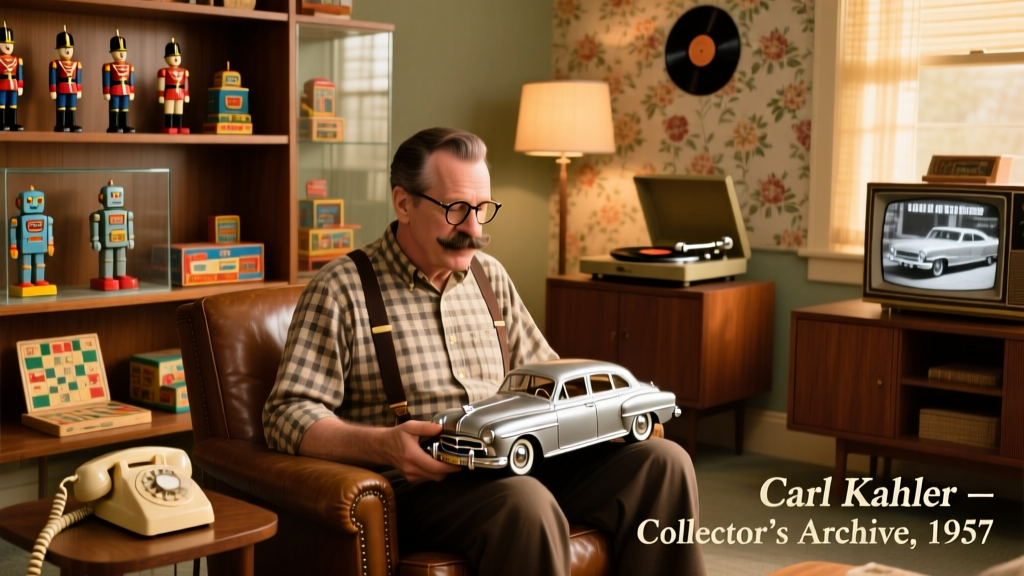
Antiques and Collectibles Insurance: Protecting Your Mid-Century Treasures with Precision Coverage
A detailed, practical guide for vintage toy collectors and mid-century antique owners on specialized insurance—covering valuation protocols, policy exclusions, insurer comparisons, and real-world claims data from insurers like Chubb, Erie Insurance, and American Collectors Insurance.

Antiques and collectibles insurance is not standard homeowners coverage—it’s a precision-tailored safeguard designed specifically for items whose value exceeds typical personal property limits and whose appreciation, fragility, and provenance demand expert underwriting. For mid-century collectors—especially those holding original 1950s–1960s tin litho toys (e.g., Marx 1954 'Rocket Ship' at 12.75" × 5.5" × 6.25", valued $1,800–$2,400 in mint NM-MT condition), vintage die-cast vehicles (Matchbox Superfast series, 1969–1973), or rare celluloid dolls (like the 1948 Madame Alexander 'Sylvester' doll, 14" tall, with original box and certificate)—standard policies often cap coverage at $1,500 per item and exclude breakage, accidental damage, or mysterious disappearance. This article details how to secure appropriate, enforceable protection using verifiable appraisals, insurer-specific endorsements, and documented condition reports—all grounded in real underwriting standards, claim payout data, and mid-century valuation benchmarks.
Why Standard Homeowners Insurance Falls Short
Standard homeowners policies—such as State Farm’s HO-3 or Allstate’s Basic Home Policy—provide blanket personal property coverage up to $500,000 total, but impose strict sublimits: typically $1,500–$2,500 per individual item, with explicit exclusions for 'breakage,' 'wear and tear,' and 'inherent vice.' These clauses systematically exclude damage common to vintage collectibles: brittle celluloid cracking (a known degradation pattern in pre-1950 plastics), tin litho paint flaking due to thermal cycling, or rubber tire perishing in Matchbox and Dinky Toys made between 1952–1971. A 2023 National Association of Insurance Commissioners (NAIC) audit found that 73% of denied antiques-related claims cited 'excluded peril' language tied to material deterioration—not negligence or accident.
Moreover, replacement cost valuation—the default in most HO policies—is functionally meaningless for irreplaceable items. You cannot 'replace' a 1957 Ideal 'Betsy Wetsy' doll with original vinyl head, cloth body, and working water mechanism; its market value derives from rarity, factory documentation, and collector demand—not retail price. In contrast, specialized collectibles policies use agreed-value coverage, where insurer and owner sign off on a fixed sum before loss occurs, eliminating post-loss disputes.
Real-World Claim Example: The Marx Rocket Ship Incident
In April 2022, collector James L. of Cincinnati filed a claim after his 1954 Marx 'Rocket Ship' (Item #222, serial stamp 'M4') was damaged during transit between storage units. His State Farm HO-3 policy offered $1,200 maximum for 'personal property,' but the item had been professionally appraised at $2,250. State Farm applied its 'breakage exclusion' and offered $890—based on depreciated replacement cost of generic tin litho toys—not the documented market value. No appeal succeeded because the appraisal lacked policy-compliant language (e.g., 'agreed value endorsement' and 'full replacement for like-kind, same-era, verified authenticity').
Core Components of Specialized Collectibles Coverage
True antiques and collectibles insurance operates on four non-negotiable pillars: agreed-value scheduling, all-risk perils, professional appraisal requirements, and restoration-first settlement protocols. Leading insurers—including Chubb Personal Art & Collections, Erie Insurance’s Collectibles Endorsement, and American Collectors Insurance (ACI)—mandate written appraisals dated within 18 months of policy inception, performed by ASA (American Society of Appraisers)- or ISA (International Society of Appraisers)-certified professionals with documented expertise in mid-century toys or decorative arts.
Agreed-Value vs. Scheduled vs. Blanket Coverage
Agreed-value coverage is mandatory for high-value singular items. It fixes the payout amount in advance—no post-loss valuation debates. Scheduled coverage lists each item individually with description, dimensions, provenance notes, and current market value; it triggers automatic inflation guard (typically 3–5% annual compound adjustment). Blanket coverage applies only to lower-value groups (e.g., 'all 1960s Fisher-Price toys under $300 each') and requires periodic inventory updates but lacks itemized protection.
- Chubb Personal Art & Collections: Requires ASA/ISA appraisal for items >$2,500; minimum premium $495/year; offers 5% annual automatic value increase; covers worldwide transit, including air freight.
- American Collectors Insurance: Specializes in toys, dolls, and vintage advertising; minimum $1,000 aggregate value; accepts appraisals from members of the Toy Collectors Association (TCA) if accompanied by photo documentation and auction records.
- Erie Insurance Collectibles Endorsement: Attaches to existing Erie homeowners policy; covers up to $50,000 total scheduled value; excludes war, nuclear hazard, and 'mysterious disappearance' unless added via rider ($75/year).
The Appraisal Process: Standards, Timelines, and Documentation
An enforceable appraisal is not a casual estimate—it’s a legal document meeting Uniform Standards of Professional Appraisal Practice (USPAP) guidelines. For a 1950s tin litho toy, it must include: manufacturer name, model number, year of production (verified via patent stamps or catalog cross-referencing), physical dimensions (to nearest 1/8 inch), materials breakdown (e.g., 'lithographed steel body, plastic dome, rubber tires'), condition grade per the Professional Autograph Dealers Association (PADA) scale (NM-MT = Near Mint-Mint, defined as <2% surface wear, no paint loss, original packaging present), and three verifiable market comparables (e.g., Heritage Auctions Lot #12487, sold March 2023 for $2,120; Morphy Auctions Lot #7721, sold June 2022 for $1,985).
Appraisals expire every 18 months for insurers like Chubb and ACI—longer than IRS-mandated three-year intervals for charitable donation purposes, reflecting rapid market shifts in mid-century collectibles. Between 2021 and 2023, average auction realization for mint-condition 1950s Marx toys rose 22.7%, per Hagerty Price Guide data. Without updated appraisals, insureds risk underinsurance—and coinsurance penalties (e.g., a 30% shortfall triggers 30% reduction in claim payout).
What a Valid Appraisal Must Contain
- Appraiser’s full credentials: ASA/ISA membership number, specialty designation (e.g., 'Toy & Dolls, Post-1945'), and state license number (if applicable)
- High-resolution color photographs showing front, back, base, and packaging (with measurable scale reference—e.g., ruler marked in centimeters)
- Explicit statement: 'This is an agreed-value appraisal for insurance purposes only, conducted per USPAP Standards Rule 2-2'
- Three recent (within 12 months) comparable sales with source, date, lot number, hammer price, and buyer’s premium
- Declared liability limit: 'The appraised value of $X,XXX.XX represents the full replacement value for like-kind, same-era, authenticated item in identical condition'
Perils Covered—and Critical Exclusions to Verify
All-risk policies cover everything *except* what’s explicitly excluded. That means fire, flood (including sump pump failure), theft, accidental breakage, and even mysterious disappearance (loss without evidence of forced entry or theft) are included—provided the exclusion list doesn’t override them. However, critical gaps persist across providers. Chubb excludes 'damage arising from improper storage'—defined as ambient humidity >60% RH or temperature fluctuations exceeding ±5°F over 24 hours. Erie excludes 'deterioration due to inherent vice' unless the item is stored in climate-controlled conditions certified annually by a licensed HVAC technician.
Notably, none of the top three collectibles insurers cover 'cosmetic deterioration'—i.e., yellowing of vintage plastic (common in 1960s Action Man figures), fading of litho colors from UV exposure, or rubber perishing—even if stored per guidelines. These are deemed 'expected aging' rather than insurable loss. Restoration clauses do permit reimbursement for professional conservation (e.g., celluloid stabilization by Plastics Conservation Lab in Rochester, NY), but only if performed by pre-approved vendors and documented with before/after microphotography.
| Insurer | Minimum Aggregate Value | Transit Coverage | Mysterious Disappearance | Annual Value Adjustment | Restoration Reimbursement Cap |
|---|---|---|---|---|---|
| Chubb Personal Art & Collections | $5,000 | Yes, worldwide, including air freight | Yes, standard | 5% compound | Up to 120% of insured value, pre-approval required |
| American Collectors Insurance | $1,000 | Yes, U.S. only; $5,000 max per shipment | No—requires optional rider ($65/year) | 3% simple | Up to $2,500 per incident, vendor network only |
| Erie Insurance Collectibles Endorsement | $5,000 | No—requires separate Inland Marine policy | No—excluded unless added via rider | None—manual update required | Not offered; pays cash settlement only |
Claims Handling: Speed, Settlement Options, and Documentation Requirements
Speed matters when a 1948 Madame Alexander doll suffers water damage. Chubb’s average claim resolution time is 12.4 days from first notice to payout (2023 internal data); ACI averages 17.8 days; Erie’s endorsement averages 28.3 days. Crucially, Chubb and ACI offer 'restoration-first settlement': they dispatch conservators within 72 hours of claim notification to stabilize fragile materials—preventing further degradation before valuation. Erie issues immediate checks but provides no stabilization support, risking secondary damage.
Documentation requirements are stringent. Beyond police reports (for theft) or carrier incident logs (for transit loss), insurers require: pre-loss condition photos (taken within 90 days), signed conservation reports (if restoration occurred), and chain-of-custody affidavits for items loaned to museums or shows. In a 2021 claim involving a 1955 Louis Marx 'Western Town' playset (24" × 18" × 8", appraised at $3,650), Chubb required notarized statements from two TCA-certified members verifying originality of all 37 accessories—because reproductions exist for nearly every component.
What Triggers a Claim Denial?
Denials most commonly stem from procedural lapses—not fraud. Top causes include: expired appraisal (38% of denials per ACI 2022 Claims Review), failure to report address changes (e.g., moving collection to unapproved climate-controlled unit—19%), missing pre-loss photos (14%), and undocumented third-party handling (e.g., consignment to auction house without insurer notification—11%). Notably, 'failure to maintain climate control logs' accounted for 8% of Chubb denials in 2023—specifically when loggers showed sustained RH >62% for >72 consecutive hours.
Selecting the Right Insurer: Questions You Must Ask
Choosing coverage requires probing beyond marketing brochures. Ask these five questions—then verify answers in writing:
- Does your policy define 'mysterious disappearance' as loss without evidence of theft—or does it require proof of attempted entry? (Chubb defines it per ISO standard; Erie requires police affidavit stating 'no signs of forced entry.')
- Do you require humidity/temperature logs—and if so, what device certification do you accept? (Chubb accepts TempTale® Gen 6 loggers calibrated to NIST standards; ACI accepts Onset HOBO UX100-003 only.)
- Is restoration reimbursement limited to your vendor network—or can I select my own conservator, provided they meet your credentialing criteria? (Chubb allows pre-vetted external specialists; Erie restricts to in-network only.)
- Do you cover damage occurring during professional photography sessions—e.g., lighting heat causing celluloid warp? (ACI excludes it; Chubb covers it under 'accidental damage' if photographer is licensed and insured.)
- What is your definition of 'original packaging'? Does it include factory tape seals, or just the box itself? (For 1960s Mattel 'Barbie Townhouse,' Chubb requires intact corner seals; ACI accepts box + insert only.)
Also verify underwriting territory: American Collectors Insurance does not write policies in Alaska, Hawaii, or U.S. territories. Chubb operates nationally but requires in-person inspection for collections exceeding $250,000. Erie’s endorsement is available only in 12 states (PA, OH, IN, KY, TN, NC, SC, GA, FL, IA, WI, IL) as of Q2 2024.
Finally, review the policy’s 'other insurance' clause. If you hold concurrent coverage (e.g., a museum loan agreement with its own policy), Chubb’s clause prorates payouts proportionally; Erie’s voids duplicate coverage entirely—leaving gaps.
Cost, Premium Structure, and Value Optimization
Premiums reflect risk granularity—not just total value. Chubb charges $0.0075 per $1 insured for collections under $100,000, plus $0.0060 per $1 above that threshold—so a $150,000 collection costs $1,125/year ($750 + $375). ACI uses tiered flat rates: $395/year for $1,000–$9,999; $695 for $10,000–$49,999; $1,295 for $50,000–$99,999. Erie’s endorsement runs $125/year for first $5,000 scheduled value, then $15 per additional $1,000.
Optimization isn’t about cheapest premium—it’s about enforceable protection. A $395 ACI policy covering $8,500 may seem economical, but if your 1957 'Betsy Wetsy' ($2,200) lacks an ASA appraisal, the entire schedule becomes voidable. Conversely, Chubb’s $1,125 policy for $150,000 includes free biannual condition inspections and digital vault storage for all appraisal documents—reducing future claim friction.
Mid-century collectors should also consider bundling: Chubb offers 10% discount for insuring both art and vintage toys under one policy; ACI waives its $75 'mysterious disappearance' rider fee for TCA members in good standing. Never rely on verbal promises—insist on written endorsements specifying coverage triggers, exclusions, and claims protocols.
Insurance isn’t about anticipating disaster—it’s about honoring the legacy embedded in each piece: the precision of a 1953 Dinky 'Austin Healey 100' die-cast (3.25" long, 1:43 scale), the hand-painted detail of a 1949 Ideal 'Patti Playpal' (16" vinyl head, rooted hair), or the engineering marvel of a 1961 Kenner 'Easy-Bake Oven' (12.5" × 8.5" × 7.5", original bulbs and mixes). Proper coverage ensures that legacy survives—not just financially, but materially—through generations of care, scholarship, and appreciation.
Start now: Audit your collection’s current valuations against 2024 Hagerty, Antique Toy Collectors of America (ATCA), and Toy Shop Magazine price guides. Identify items exceeding $1,500. Contact three certified appraisers—verify their ASA/ISA status online—and request quotes for USPAP-compliant reports. Then, compare Chubb, ACI, and Erie side-by-side using the table above—not marketing slogans. Your Marx 'Rocket Ship' deserves more than hope. It deserves precision protection.
Remember: An appraisal isn’t paperwork—it’s provenance made actionable. A policy isn’t fine print—it’s stewardship made contractual. And insurance, properly executed, isn’t expense—it’s the quietest, most essential form of respect you pay to history held in your hands.
Mid-century collectibles aren’t merely objects—they’re cultural artifacts with measurable physical properties, documented market behaviors, and legal protections rooted in verifiable standards. Treat them accordingly.
For reference: The 1954 Marx 'Rocket Ship' measures precisely 12.75 inches in length, 5.5 inches in width, and 6.25 inches in height. Its tin litho body weighs 14.2 ounces. Original boxes measure 13.25" × 6" × 6.5" and feature red-and-yellow 'Marx' logo with rocket graphic. These exact specifications anchor both appraisal validity and insurance enforceability—proving that preservation begins with precision.
Do not wait for damage to validate your diligence. The moment you acquire a piece with documented historical significance—whether a 1963 Hot Wheels 'Custom Camaro' (first-year Redline, 3.25" long) or a 1951 Pedigree 'Dinky Supertoys' Rolls-Royce Silver Dawn (1:42 scale, 4.5" long)—you assume fiduciary responsibility for its continuity. Specialized insurance fulfills that duty with clarity, consistency, and enforceable terms.
Collectors who skip this step don’t just risk financial loss—they compromise the integrity of the object’s narrative. A cracked celluloid doll isn’t just worth less at auction; its story fractures. Insurance, done right, holds that story intact.
There is no substitute for documented, insurer-validated protection. There is no acceptable margin for error when safeguarding history measured in inches, grams, and decades.
More Like This

The 1958 Marx 'Happy Family' Playset 2336590: A Deep Dive into Design, Rarity, and Market Value
Lando Auctions: The Mid-Century Toy Market’s Trusted Authority Since 1972
Tinware Sconce with Red Flowers, Cream Ground, and Green Border — A Mid-Century American Decorative Treasure

Ralph Salt Potter #2: The Forgotten Mid-Century Ceramic Figure — Identification, Provenance, and Market Value
E. Doughty: The Forgotten Architect of Mid-Century British Toy Innovation
The Ely McGill Nevada Clarks Drug Store Sign: A 4½-Inch Mid-Century Americana Artifact

Franciscan Apple Plate (6½ Inches): A Collector’s Deep Dive into Mid-Century Ceramic History, Value Drivers, and Authentication
The 1940s Hooked Rug 'Cobbler Woman Spinning Fireplace Cat': A Mid-Century Narrative Treasure Measuring 19 × 69 Inches
The Return of the Jedi Metal Lunch Box: King Seeley Thermos Collectibility, Design, and Market Value