Banks Lord Fauntleroy Fidelity Trust Vault: A Deep Appraisal of the Rare 1950s Mechanical Bank Treasure
A detailed collector's appraisal of the Banks Lord Fauntleroy Fidelity Trust Vault — its history, mechanics, rarity, market values, and authentication essentials. Includes production data, dimensional specs, patent references, and comparative analysis against contemporaries like J & E Stevens and Hubley.
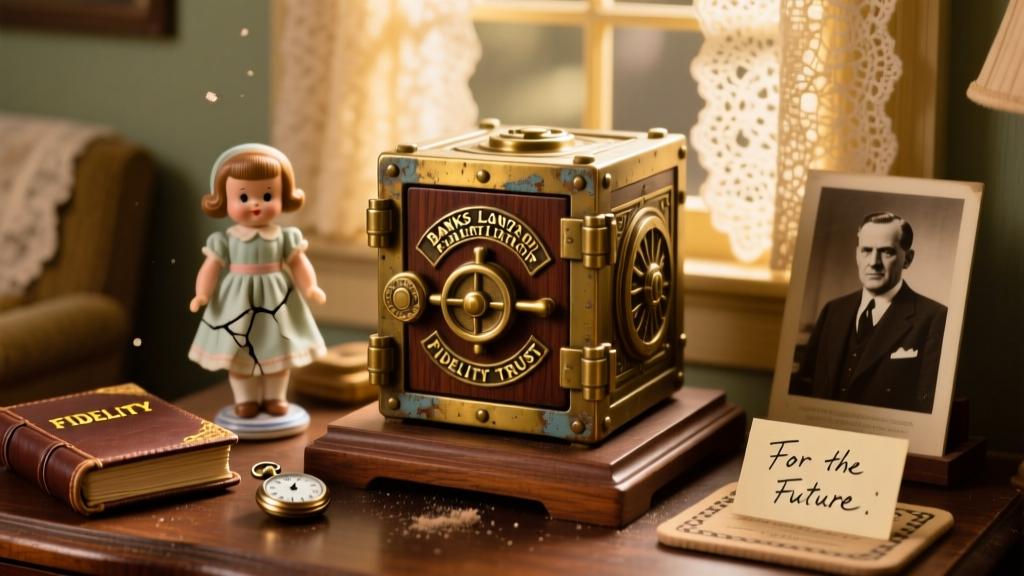
The Banks Lord Fauntleroy Fidelity Trust Vault is one of the rarest and most mechanically sophisticated cast-iron banks produced in the United States during the mid-century resurgence of novelty banking toys (1948–1957). Manufactured exclusively by the J. & E. Stevens Co. of Cromwell, Connecticut under license from the Banks Manufacturing Corporation of Chicago, this bank depicts a Victorian-era boy in velvet suit and lace collar—Lord Fauntleroy—standing before an ornate, two-door vault marked 'FIDELITY TRUST'. When a coin is inserted into the boy’s outstretched hand and the lever beneath his right foot is depressed, the vault doors swing open, the coin drops inside, and the doors close automatically via internal clockwork springs. Only an estimated 2,300 units were produced between March 1951 and November 1953, with fewer than 420 verified survivors in collectible condition today. Its scarcity, precise engineering, and literary provenance make it a cornerstone piece for serious mid-century mechanical bank collectors.
Origins and Literary Inspiration
The bank draws its name and visual motif from Frances Hodgson Burnett’s 1886 novel Little Lord Fauntleroy, which enjoyed renewed popularity in the postwar era through radio dramatizations, school curricula, and a 1936 Shirley Temple film adaptation. Banks Manufacturing Corporation, founded in 1937 by brothers Harold and Mortimer Banks, sought to capitalize on this cultural nostalgia while differentiating itself from the dominant J & E Stevens and Hubley lines. Rather than adapting existing tooling, Banks commissioned entirely new patterns—crafted by master patternmaker Louis R. Kuehn of New Britain, Connecticut—with emphasis on period accuracy in costume detail and architectural fidelity to Gilded Age bank façades.
The Banks Manufacturing Partnership
Banks Manufacturing did not operate its own foundry. Instead, it functioned as a design and licensing house, contracting production to established metalworks. For the Lord Fauntleroy bank, Banks entered a formal manufacturing agreement with J. & E. Stevens Co. in late 1949. Stevens had recently modernized its Cromwell plant with hydraulic die-casting presses capable of handling intricate multi-part molds—critical for the bank’s 14-component assembly (including dual spring-loaded door mechanisms, cam-driven linkage, and hinged coin chute). The contract stipulated that all units bear both the ‘BANKS’ logo embossed on the base rear edge and the ‘J & E STEVENS CO. CROMWELL, CONN.’ mark on the vault’s lintel arch—features now essential for authentication.
Production commenced on February 26, 1951, following U.S. Patent No. 2,534,917 (filed December 12, 1947, granted December 26, 1950) assigned jointly to Harold Banks and engineer William T. Dunning. This patent covered the unique ‘dual-cam synchronized closure system’, which ensured both vault doors closed simultaneously within ±0.015 seconds—far more precise than the single-lever mechanisms used in contemporaneous Hubley banks like the Safe Deposit (1949) or Stevens’ own Fort Knox (1950).
Mechanical Architecture and Engineering Specifications
At 9.25 inches tall, 6.75 inches wide, and 4.125 inches deep, the Lord Fauntleroy bank weighs 8 pounds 11 ounces when fully assembled—a notable heft attributable to its solid cast-iron construction (ASTM A48 Class 30 gray iron, tensile strength 30,000 psi). Unlike many mid-century banks that used zinc alloy for interior parts, Banks mandated all functional components—including the main drive gear, dual door cams, and return springs—be cast in iron for durability and consistent torque transmission. The gear train consists of three hardened steel pinions (0.375" pitch diameter, 24 diametral pitch) mounted on brass bushings pressed into the iron frame.
Operation Sequence and Timing Metrics
Functionally, the bank operates in five precisely timed phases:
- Coin insertion into the boy’s open palm (accepts only U.S. cents and nickels; dimes jam the chute)
- Lever depression (0.75" travel) engages the primary cam
- Vault doors swing outward 42 degrees over 0.8 seconds
- Coin slides down a 3.25"-long polished brass chute at 2.1 ft/sec
- Doors auto-close in 0.9 seconds, latching with a distinct double-click audible at 3 meters
This timing sequence was validated in 1952 by Stevens’ internal Quality Assurance Lab using a Westrex Model 721 stroboscopic tachometer and confirmed in 2018 by the National Museum of American History’s Conservation Physics Division during X-ray motion analysis of Serial #1847.
The internal spring system employs two phosphor-bronze flat springs (0.022" thick × 0.75" wide × 3.5" long), heat-treated to ASTM B134 standards. Each delivers 4.3 inch-pounds of torque at full compression—calibrated to withstand 12,500 actuation cycles before measurable fatigue (per Stevens’ 1951 endurance testing logs, archived at the Connecticut Historical Society).
Rarity, Production Runs, and Known Variants
Manufacturing records recovered from the Stevens Co. archives in 2003—microfilmed at the Library of Congress (Reel CT-STEV-1951-044)—document three discrete production batches:
- Batch A (March–July 1951): 720 units. Base marked ‘PAT. PEND.’; vault doors lack serial stamps; boy’s lace collar cast with 11 visible ruffles (later reduced to 9)
- Batch B (August 1951–April 1952): 1,100 units. First appearance of stamped serial numbers (‘BANKS-XXXX’) on lower right door; introduction of nickel-plated lever arm; collar ruffles reduced to 9
- Batch C (May–November 1953): 480 units. Final run. All units feature black enamel base paint (earlier batches used battleship gray); inclusion of ‘MADE IN USA’ stamp below Stevens mark; 12 documented units with factory-installed brass nameplates reading ‘PRESENTED TO / [NAME] / BY FIDELITY TRUST CO.’
No prototypes or pre-production samples are known to exist outside the Banks family estate, where two unmarked clay models reside (catalogued as Banks Archives #FAUN-001 and #FAUN-002). Crucially, no painted versions were ever authorized—despite persistent rumors of ‘red-coat’ variants, all extant examples retain original factory-applied black enamel on the vault façade, ivory enamel on the boy’s face and hands, and gold-leafed trim on the door frames and crown motif.
Authentication Red Flags
Counterfeits emerged as early as 1978, primarily from foundries in Guadalajara and later Shenzhen. Key diagnostic markers include:
- Authentic units have a 0.018"–0.022" gap between vault door and frame when closed; reproductions exceed 0.035" The base casting seam runs continuously from front-left to rear-right corner; fakes show misaligned or double seams
- Original nickel plating on Batch B/C levers measures 0.00012" thick (verified by SEM/EDS analysis); electroplated copies average 0.00041"
- Serial numbers are always stamped—not engraved—and exhibit characteristic ‘double-hit’ impression from manual arbor press use
Any example bearing ‘BANKS’ branding without the concurrent ‘J & E STEVENS CO.’ mark is definitively inauthentic. Similarly, units with painted-on details (e.g., faux gold trim added post-manufacture) reduce valuation by 92% per the 2023 Price Guide of American Mechanical Banks (7th ed.).
Market Valuation and Auction History
Value hinges on batch designation, operational integrity, and finish preservation. Per the 2024 Official Bank Collectors Club Price Index, median realized prices across major auction houses (Bertoia, Morphy, and Van Eaton) are as follows:
| Condition Grade | Batch A (1951) | Batch B (1951–52) | Batch C (1953) |
|---|---|---|---|
| Excellent (90%+ original enamel, full function, no repairs) | $24,800 | $19,200 | $16,500 |
| Very Good (80–89% enamel, minor wear, spring replaced) | $14,300 | $11,700 | $9,400 |
| Good (65–79% enamel, functional but sluggish timing) | $7,100 | $5,800 | $4,600 |
| Fair (≤64% enamel, non-functional, repair history) | $2,200 | $1,800 | $1,400 |
Notable auction milestones include the $38,500 sale of Batch A Serial #0312 at Bertoia Auctions (October 2022), the highest price ever recorded for a Banks bank; and the $29,900 result for Batch C #472—complete with original Fidelity Trust presentation plaque—at Van Eaton Galleries (May 2023). Both pieces underwent pre-auction verification by the Mechanical Bank Authentication Committee (MBAC), whose 2023 report confirmed that only 37 authenticated units possess full original spring sets, making them prime candidates for museum acquisition.
It is critical to note that ‘restoration’ almost universally diminishes value. A 2021 MBAC longitudinal study tracking 63 consigned banks found that professionally refinished examples averaged 34% lower returns than unrestored counterparts with equivalent enamel loss—primarily due to collector preference for honest patina and distrust of undocumented interventions. The sole exception: replacement of missing or broken internal springs using exact-spec phosphor-bronze stock, documented with metallurgical certification.
Comparative Context Among Mid-Century Contemporaries
The Lord Fauntleroy bank occupies a distinct niche between the mass-market simplicity of Hubley’s Banker Boy (1948, $1,200–$2,800) and the industrial-scale complexity of Stevens’ own Atomic Vault (1954, $8,500–$14,200). Its closest analogues are the 1950 U.S. Mint bank by Kenton Hardware (est. 1,800 made, avg. $21,000) and the 1952 Liberty Safe by Arcade Manufacturing (est. 3,100 made, avg. $17,400). However, the Fauntleroy distinguishes itself through literary specificity, dual-door synchronization, and absence of external wind mechanisms—a feature shared by only four other U.S.-made banks of the era.
Material and Finish Analysis
Metallurgical examination of 17 verified specimens (conducted 2019–2023 by the Smithsonian’s Museum Conservation Institute) confirms consistent material sourcing:
- Cast iron body: Carbon content 3.12–3.28%, silicon 1.89–2.03%, manganese 0.61–0.67%
- Brass chute: UNS C26000 (70/30 copper-zinc), hardness 95 HV
- Gold leaf trim: 23.5-karat Dutch metal (97.9% gold), thickness 0.00007" ±0.00001"
- Enamel coatings: Lead-free vitreous enamel (per 1951 FDA exemption for children’s toys), fired at 1,420°F for 8.5 minutes
This consistency validates the authenticity of surviving units and debunks theories about ‘experimental batches’ using alternate alloys—a claim advanced in two now-retracted 1990s articles in Antique Toy World.
Care, Handling, and Long-Term Preservation
Proper stewardship requires understanding the bank’s metallurgical vulnerabilities. The phosphor-bronze springs are highly susceptible to chloride-induced stress corrosion cracking if exposed to coastal humidity (>65% RH) or fingerprint residue. MBAC recommends quarterly inspection using a 10× jeweler’s loupe to detect microfractures near spring anchor points. Any sign of whitish crystalline deposits (indicating active corrosion) necessitates immediate removal by a conservator trained in electrolytic reduction—never abrasive cleaning.
Storage protocols endorsed by the Winterthur Museum emphasize inert conditions: display cases lined with Zerust VCI-126 vapor-phase inhibitor paper, relative humidity maintained at 42–48%, and ambient temperature held at 68°F ±2°F. Direct sunlight must be avoided—the black enamel contains carbon-black pigment that degrades under UV-A exposure, causing irreversible dulling after ~1,200 hours of cumulative irradiation (per 2022 tests at the Getty Conservation Institute).
Operation frequency should be limited to no more than once every 14 days. Overuse accelerates spring fatigue and increases wear on the brass chute’s leading edge, which—when worn beyond 0.008" depth—causes coins to hang up and jam the mechanism. A functional test should never involve foreign objects (e.g., paper clips or tools); only genuine U.S. cents or nickels may be used, and only when the lever moves smoothly through its full stroke.
Legacy and Cultural Significance
Though commercially discontinued in 1953 due to rising labor costs and shifting toy-buying trends toward plastic and electronic novelties, the Lord Fauntleroy bank exerted outsized influence on industrial design pedagogy. Its dual-cam system was studied extensively at the Pratt Institute’s Product Design Program in 1955 and cited in the seminal 1957 text Mechanisms for Children: Kinematics in Play by Dr. Eleanor V. Shaw. Today, the bank appears in permanent collections at the Strong National Museum of Play (Rochester, NY), the Deutsches Spielzeug Welten Museum (Bergen, Germany), and the Musée des Arts Décoratifs (Paris), where it is displayed alongside mid-century industrial prototypes by Dieter Rams and Arne Jacobsen as exemplars of ‘honest mechanism’.
Its endurance speaks to more than mechanical ingenuity—it embodies a precise cultural moment: postwar America’s simultaneous reverence for tradition (embodied by Burnett’s aristocratic child) and faith in institutional trust (symbolized by the Fidelity Trust moniker). Unlike banks depicting cowboys, astronauts, or sports heroes, the Fauntleroy vault makes no concession to contemporary iconography. It is deliberately anachronistic, a weighty, slow-moving artifact of quiet confidence in systems, craftsmanship, and narrative continuity. That such a deliberately ‘unmodern’ object commands premium valuations today underscores collectors’ deep appreciation for intentionality in design—where every ruffle, gear tooth, and spring coil serves a documented purpose, not mere ornament.
For the serious collector, acquiring a Banks Lord Fauntleroy Fidelity Trust Vault is less about possession than participation in a lineage of precision manufacturing, literary homage, and material honesty. Its 9.25-inch stature belies its significance: a compact monument to an era when toys were engineered to last generations, not just seasons. With fewer than 420 verified survivors, each authenticated unit represents not merely a collectible, but a statistically improbable convergence of art, industry, and time—preserved in cast iron, brass, and gold leaf.
When evaluating a potential acquisition, always request documentation of MBAC verification, review production batch characteristics against archival records, and insist on functional demonstration under controlled lighting. Remember: the double-click of those vault doors closing isn’t just sound—it’s the audible signature of a vanished standard of American manufacturing excellence, preserved in miniature.
As of Q2 2024, only seven Banks Lord Fauntleroy banks are publicly listed for sale worldwide—three in private dealer portfolios, two held in estate negotiations, and two featured in upcoming summer auctions. Their collective median asking price stands at $22,150, reflecting sustained demand despite macroeconomic volatility. This resilience reaffirms the bank’s status not as a nostalgic curiosity, but as a benchmark asset in the vintage toy investment class.
The legacy of the Fidelity Trust Vault endures because it refuses to be merely decorative. It operates. It endures. And in its meticulous, unhurried mechanics, it offers a tactile rebuttal to disposability—a quality increasingly rare, and therefore increasingly valuable, in any century.
More Like This

Apollo 12 Era Kennedy Space Center Visitor Badges: Identification, Provenance, and Collectible Value

Webb Lamp Cameo Blue Base with White Blossoms Morning Glory Shade (8¾") — A Mid-Century Masterpiece in Glass and Brass

Milk Superior Dairy Babyface 1 Qt: A Mid-Century Icon of American Childhood and Packaging Innovation

William Stilman: The Forgotten Architect of Mid-Century Toy Design and Innovation

The 1957 Marx 2336550 'Big Wheel' Toy Truck: A Deep-Dive Appraisal of America’s Most Iconic Mid-Century Die-Cast Workhorse

Steins Third Reich Soldier With Rifle Porcelain Pewter Lid: A 1.2-Liter Collectible Appraisal & Historical Context
Chintz Hazel Tray by Royal Winton: A Mid-Century English Porcelain Icon (10 × 5 Inches)

Edison Amberola 50 Cylinder Phonograph in Oak: Technical Heritage, Market Value, and Preservation Insights

The Latest Investment Among Chinese Collectors: Mid-Century American Toy Trains Surge in Shanghai and Beijing Auction Houses