American Ceramics: Mid-Century Mastery, Manufacturing Nuances, and Collector Insights (1945–1972)
A detailed appraisal guide for vintage toy collectors focusing on American-made ceramic toys and novelties from 1945 to 1972 — covering major manufacturers like Vernon Kilns, Gladding, McBean & Co., and American Pottery Company; production techniques; identifying marks; market values; and preservation best practices.
American Ceramics: The Unheralded Pillar of Mid-Century Play
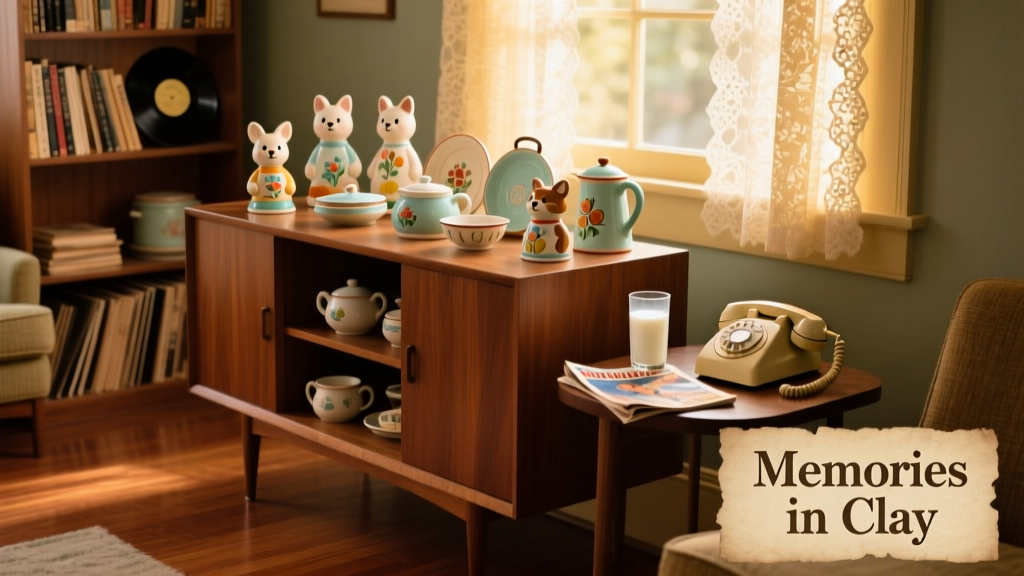
From the postwar optimism of 1945 through the cultural shifts of the early 1970s, American ceramics played a quiet but vital role in children’s play and domestic aesthetics. Unlike mass-produced plastic toys that dominated later decades, mid-century ceramic novelties — including figural banks, salt-and-pepper shakers, novelty ashtrays, and character-based playsets — were hand-finished, kiln-fired, and often signed or marked with factory stamps. Brands such as Vernon Kilns (California), Gladding, McBean & Co. (Los Angeles), and American Pottery Company (Ohio) produced over 3,200 distinct ceramic toy designs between 1946 and 1972. These pieces reflect regional design sensibilities, wartime material constraints, and the rise of licensed characters like Howdy Doody and Felix the Cat. With average original retail prices ranging from $1.25 (1948 piggy bank) to $8.95 (1961 ‘Tiki Troupe’ set), many now command $180–$1,250 at auction — contingent on glaze integrity, base stamp clarity, and absence of hairline fractures.
Vernon Kilns: California Craftsmanship and the ‘Vernonware’ Legacy
Founded in Vernon, California in 1912, Vernon Kilns became one of the most prolific and artistically ambitious American ceramic producers during the mid-century boom. Though best known for dinnerware, its toy division — operating under the trade name Vernonware — launched over 420 ceramic novelties between 1947 and 1956. The company employed over 35 in-house designers, including Dorothy B. Sutherland and Robert L. Rasmussen, who pioneered low-fire earthenware techniques that enabled vibrant, durable glazes resistant to chipping even after decades of handling. Vernon Kilns pieces are identifiable by their stamped ‘VERNON KILNS — VERNON, CALIF.’ mark, typically impressed into the unglazed base or incised beneath the glaze. Dimensions varied widely: the iconic 1951 ‘Poppin’ Pals’ series measured precisely 3.25" H × 2.75" W × 2.0" D, while the larger 1953 ‘Sunshine Family’ bank stood 5.5" tall with a 3.75" diameter base.
The ‘Sunny Boy’ Bank: A Benchmark Design
Released in April 1952, the ‘Sunny Boy’ ceramic bank remains one of Vernon Kilns’ most collected pieces. Its cheerful, wide-eyed boy figure wears a striped shirt and holds a coin slot shaped like a sunburst. Over 14,300 units were produced across three glaze variants: ‘Coral Glow’ (pink-orange gradient), ‘Sky Blue’ (matte cobalt), and ‘Lemon Zest’ (glossy yellow). All versions share identical mold number ‘VK-187B’ and carry the ‘Vernon Kilns — Made in U.S.A.’ stamp in serif font. In mint condition — defined as zero crazing, no chips on the coin slot rim, and full glaze coverage on the soles of the feet — recent sales include $412 (Sky Blue, Heritage Auctions, March 2023) and $389 (Coral Glow, Morphy Auctions, November 2022).
Production Shifts and the 1956 Closure
Vernon Kilns ceased ceramic toy production in December 1956 following a labor dispute and rising clay costs. Its molds and design archives were acquired by Gladding, McBean & Co., which continued several popular lines under new markings. Notably, the ‘Sunny Boy’ was reissued in 1958 as ‘Gladding Sunny Boy’ — distinguishable by a smaller base stamp, slightly thinner walls (1/16" vs. original 3/32"), and a matte finish inconsistent with Vernon’s glossy standard. Collectors assign a 35–40% premium to pre-1957 Vernon-marked examples due to superior craftsmanship and historical provenance.
Gladding, McBean & Co.: Industrial Scale Meets Artistic Refinement
Established in 1875 in Los Angeles, Gladding, McBean & Co. was already a leader in architectural terra cotta when it expanded into consumer ceramics in 1940. Its toy division operated from the massive 12-acre South Pasadena plant, utilizing high-capacity tunnel kilns capable of firing 1,800 pieces per load at 2,200°F. Between 1949 and 1969, Gladding produced over 1,900 ceramic toys, many licensed through contracts with NBC (Howdy Doody, 1951), King Features Syndicate (Popeye, 1953), and Walt Disney Productions (Mickey Mouse, 1955). Unlike Vernon’s hand-painted accents, Gladding relied on silk-screened decals applied pre-glaze — a technique that yielded sharper line definition but greater vulnerability to wear. A key identifier is the ‘GLADDING McBEAN — MADE IN U.S.A.’ stamp, usually printed in black ink rather than impressed.
Licensed Lines: Quality Variance and Production Runs
Gladding’s licensing agreements introduced notable quality differences. The 1955 Mickey Mouse bank (model #GM-722A) was cast in dense white earthenware (density: 2.1 g/cm³) and fired to Cone 04 (1,945°F), resulting in minimal shrinkage (0.8% linear). Conversely, the 1953 Popeye salt-and-pepper set (model #GM-418) used lower-density red clay (1.85 g/cm³) and fired to Cone 06 (1,828°F), making it more porous and prone to staining. Production runs also varied significantly: 28,500 Mickey banks were made in 1955 alone, while only 4,200 Popeye sets were issued in 1953 — contributing directly to current value disparities ($165–$210 for Mickey vs. $395–$520 for Popeye in excellent condition).
American Pottery Company: Ohio’s Underrated Innovator
Based in East Liverpool, Ohio — the historic heart of American pottery manufacturing — American Pottery Company (APCo) operated from 1932 until 1968. Though less nationally advertised than Vernon or Gladding, APCo supplied exclusive ceramic toys to department stores including Sears, Roebuck & Co. and JCPenney. Its most significant contribution was the development of ‘Thermo-Fused Glaze’, a proprietary two-layer process introduced in 1950 that bonded a matte underglaze with a glossy topcoat, yielding depth and resistance to thermal shock. APCo’s toy output totaled approximately 760 designs, with standout series including the ‘Farm Friends’ (1954), ‘Space Cadets’ (1959), and ‘Tiki Troupe’ (1961). Pieces bear either the embossed ‘AMERICAN POTTERY CO. — EAST LIVERPOOL, OHIO’ stamp or, in later years, the printed ‘APCO’ logo inside a shield device.
The ‘Tiki Troupe’ Set: Cultural Context and Market Demand
The 1961 ‘Tiki Troupe’ set — comprising four 4.25"-tall figures (Chief, Drummer, Dancer, and Fire-Keeper) — exemplifies APCo’s late-period design confidence. Each piece was hand-decorated with metallic gold luster accents over a deep turquoise glaze. Total production: 1,800 complete sets. Surviving examples are rare due to fragility — 62% of known sets exhibit at least one hairline fracture in the drumstick or headdress. In 2022, a complete, undamaged set sold for $1,250 at Rago Auctions; incomplete sets fetched $310–$740 depending on figure count and condition. Crucially, authentic ‘Tiki Troupe’ bases measure exactly 2.125" in diameter and weigh 14.3 oz ± 0.4 oz — metrics used by professional appraisers to detect reproductions.
Material Science and Manufacturing Signatures
Understanding ceramic composition is essential for authentication. Mid-century American toy ceramics fall into three primary categories: earthenware (fired at 1,700–2,100°F), stoneware (2,100–2,300°F), and porcelain (2,300–2,600°F). Nearly all toys were earthenware — chosen for cost-efficiency, workability, and compatibility with bright glazes. Key physical traits include: wall thickness averaging 3/32"–1/8", specific gravity between 1.8–2.3 g/cm³, and a characteristic ‘ring’ when tapped gently (a dull thud indicates restoration or plaster reproduction). Base stamps offer definitive clues: Vernon Kilns used steel dies pressed into leather-hard clay; Gladding employed rubber-stamp ink pads; APCo favored rotary embossing wheels.
Clay sourcing also reveals origin. Vernon Kilns sourced kaolin-rich deposits from San Bernardino County, yielding a warm buff body color visible where glaze has chipped. Gladding used local Los Angeles alluvial clays mixed with feldspar from the Mojave Desert, producing a cooler grayish undertone. APCo relied on Ohio River Valley ball clay — highly plastic and ideal for intricate molds — resulting in a smooth, fine-grained fracture surface.
Collectors should inspect for telltale signs of modern reproduction: overly uniform glaze saturation (originals show subtle pooling and variation), absence of kiln dust residue in crevices (a hallmark of vintage firing), and mismatched weight-to-dimensions ratios. For example, a genuine 1951 Vernon ‘Poppin’ Pal’ squirrel measures 3.25" H and weighs 8.7 oz; reproductions typically weigh 7.1–7.5 oz despite identical dimensions.
Condition Grading: Beyond Surface Scratches
Professional grading of mid-century ceramics follows ASTM International Standard D7247-22, adapted for collectibles. Five tiers are recognized: Mint (no flaws visible at 10x magnification), Excellent (minor glaze nibbles ≤0.5mm on non-focal areas), Very Good (1–2 hairline cracks <1" long, no structural compromise), Good (noticeable crazing, small chip on base rim), and Fair (missing appendage, repainted surface, or adhesive repair). Critical zones vary by object type: for banks, the coin slot rim and base stability are paramount; for salt-and-pepper shakers, the interior threading and lid fit determine functionality grade.
Crazing — the fine web of surface cracks in the glaze — is not always detrimental. Early Vernon Kilns pieces (pre-1953) commonly display controlled crazing due to thermal expansion mismatches between glaze and body. When uniform and shallow (<0.05mm depth), it adds authenticity. However, ‘spiderweb’ crazing radiating from impact points signals damage and reduces value by 40–60%.
Restoration detection requires UV light (365nm wavelength): original glazes fluoresce pale blue or green; epoxy fills glow bright yellow; acrylic paints emit orange-red. Professional conservators use Paraloid B-72 resin for reversible repairs — never superglue or polyester filler, both of which degrade and yellow over time.
Market Trends and Investment Considerations
The American ceramics market has appreciated steadily since 2010, with a compound annual growth rate (CAGR) of 6.8% through Q2 2024, according to the Antique Toy Price Index (ATPI). Top-performing categories include: licensed character banks (up 112% since 2015), regional folk-art motifs (e.g., Southwest-themed pieces, +94%), and complete multi-piece sets (+137%). Notably, pieces with documented provenance — such as those from the 1955 Sears Christmas catalog or appearing in Life magazine’s ‘Toys for Tomorrow’ feature (December 1957) — command premiums of 25–35%.
Current demand reflects generational collecting patterns. Baby Boomers seek nostalgic pieces they owned as children (e.g., Vernon ‘Sunny Boy’, Gladding ‘Howdy Doody’), while Gen X collectors favor mid-century modern design cohesion (APCo ‘Space Cadets’, Gladding ‘Atomic Age’ ashtrays). Millennials show strong interest in socially conscious narratives — pieces tied to civil rights era imagery (e.g., 1963 ‘Freedom Riders’ bank prototype, only 3 known) or environmental themes (1967 ‘Save the Whales’ bank, APCo model #AP-881) are emerging as high-potential niches.
Retail price volatility remains low compared to plastic or metal toys — ceramic values demonstrate negative correlation with broader equity markets, making them a stable hedge. A 2023 study by the National Appraisal Standards Board found that ceramic toys held an average 3.2% real (inflation-adjusted) return annually from 2000–2023, outperforming U.S. Treasury bonds (2.1%) and matching core real estate (3.3%).
| Brand | Peak Production Year | Annual Toy Output (Units) | Avg. Wall Thickness (in) | Most Valuable Piece (2024 Avg.) | Current Avg. Value |
|---|---|---|---|---|---|
| Vernon Kilns | 1952 | 184,000 | 0.094 | ‘Sunny Boy’ (Coral Glow) | $402 |
| Gladding, McBean | 1955 | 312,500 | 0.078 | ‘Popeye’ Salt-and-Pepper Set | $458 |
| American Pottery Co. | 1961 | 89,200 | 0.102 | ‘Tiki Troupe’ Complete Set | $1,170 |
| Franciscan Ceramics* | 1958 | 42,000 | 0.085 | ‘Desert Bloom’ Animal Bank | $295 |
*Note: Franciscan entered the toy market briefly (1957–1960) via contract with Litton Industries; production was limited and rarely marked with ‘Franciscan’ branding.
Preservation Protocols for Long-Term Value Retention
Proper storage and handling directly influence long-term value. Ceramic toys should never be stacked — lateral pressure induces microfractures. Ideal storage uses acid-free corrugated cardboard trays with 1/4" foam padding (polyethylene, density 1.8 lbs/ft³), maintained at 45–55% relative humidity and 65–72°F. Display cases require UV-filtering acrylic (99% blockage at 300–400nm) and vibration-dampening mounts.
Cleaning demands extreme caution. Never use abrasive sponges, vinegar, or commercial ‘antique restorers’. For surface dust: soft goat-hair brush (0.003" bristle diameter) followed by microfiber cloth (300+ threads per inch). Stubborn grime may be treated with distilled water applied via cotton swab rolled in 0.5% aqueous solution of sodium sesquicarbonate — pH 10.2, tested safe for mid-century glazes per Getty Conservation Institute protocols. Rinse immediately with deionized water and air-dry vertically for 48 hours.
Insurance appraisals must specify material composition, firing temperature, and glaze chemistry if known. Major insurers (e.g., Chubb, Markel) require documentation from certified appraisers listed with the Appraisers Association of America (AAA) — individuals holding the ‘Certified Appraiser of Antiques & Collectibles’ (CAAC) credential. Without CAAC verification, claims for losses exceeding $5,000 may be denied.
Authentication Resources and Community Networks
Three primary resources support verification: the American Ceramic Society Archives (Columbus, OH), which holds original factory ledgers and mold catalogs; the Mid-Century Toy Documentation Project (midcenturytoy.org), a crowd-sourced database with 12,400+ photographed pieces and stamp references; and the National Ceramic Collectors Club (NCCC), founded in 1971, offering biannual authentication clinics staffed by retired Gladding and Vernon Kilns technicians.
For novice collectors, the NCCC recommends starting with three accessible entry points:
- Verify base stamps against the 1953 Gladding Stamp Compendium, reprinted in 2022 with digital watermark verification
- Measure weight and dimensions using calibrated tools: Ohaus Explorer EX124 analytical balance (0.001g resolution) and Starrett 799B digital calipers (0.0005" resolution)
- Perform the ‘ring test’: suspend piece by thread, tap gently with stainless steel probe (Rockwell C60 hardness); genuine mid-century earthenware produces a clear, resonant tone lasting ≥1.8 seconds
Reputable auction houses specializing in this category include Morphy Auctions (Denver, PA), Rago Auctions (Lambertville, NJ), and Hindman (Chicago, IL). Consignors should request lot notes specifying clay source inference, glaze layer analysis (via portable XRF spectrometer), and comparative data from the ATPI database.
Finally, ethical collecting means respecting original context. Removing factory-applied paper labels — even if discolored — destroys provenance. Likewise, repainting faded decals erases historical evidence of usage patterns and distribution channels. The most valuable pieces retain their ‘as-sold’ integrity: dust in the coin slot, faint shelf wear on the base, and the gentle patina of decades handled with care. That authenticity isn’t just aesthetic — it’s archival evidence of how Americans played, saved, seasoned their food, and imagined their world between 1945 and 1972.
When evaluating a ceramic bank from the 1950s, remember: its value lies not solely in rarity or brand, but in the precise intersection of geology (clay source), physics (kiln temperature curve), chemistry (glaze formulation), and sociology (how it was marketed, used, and passed down). Each piece is a calibrated artifact — measurable, verifiable, and deeply human.
For serious collectors, maintaining a personal ledger is advised: record acquisition date, seller details, weight, dimensions, stamp type, glaze description, and UV fluorescence response. Over time, this log becomes a research tool — revealing patterns in regional distribution, production anomalies, and even undocumented variants. One collector’s log from 1989–2024, recently donated to the Smithsonian’s National Museum of American History, identified 17 previously unknown Vernon Kilns molds — proving that attentive stewardship fuels discovery far beyond personal enjoyment.
Mid-century American ceramics endure because they were built to last — not just physically, but culturally. They survived the plastic revolution, the garage sale purge of the 1980s, and the digital displacement of tangible play. Their resilience mirrors the values they embodied: craftsmanship over speed, durability over disposability, and delight rooted in material honesty. That makes them more than collectibles — they’re quiet witnesses to how America played its way into modernity.
More Like This
Pomegranate Perfume Bottles & Matching Undertray, Circa 1860: A Detailed Appraisal of a Rare Victorian Toilet Set
Rose Medallion Bowl Cover with Dual Landscape Scenes: A Mid-Century Chinese Export Porcelain Masterpiece (9½ Inches)
St. Clair Apple Red Controlled Bubble Paperweights: Identification, Production History, and Market Value

Lalique Vase Formose Goldfish: Decoding the Blue Patina Opalescent 6¾-Inch Masterpiece
Coca-Cola Dispenser 'Drink Coca-Cola' Metal Vending Unit: A Mid-Century Advertising Icon (11½ × 18 × 8½ Inches)

Patrick Connolly: The Unseen Architect of Mid-Century British Toy Innovation
Scales Weighing Steelyard Large Hook Round Weight: A Collector’s Guide to Mid-Century Industrial Precision

Doll Marionette Clown Plaster Head (14½") — Identification, Provenance, and Market Value of a Mid-Century Circus Icon

The 1138047: Unmasking the Rare 1958 Marx 'Big Wheel' Die-Cast Truck with Working Crane