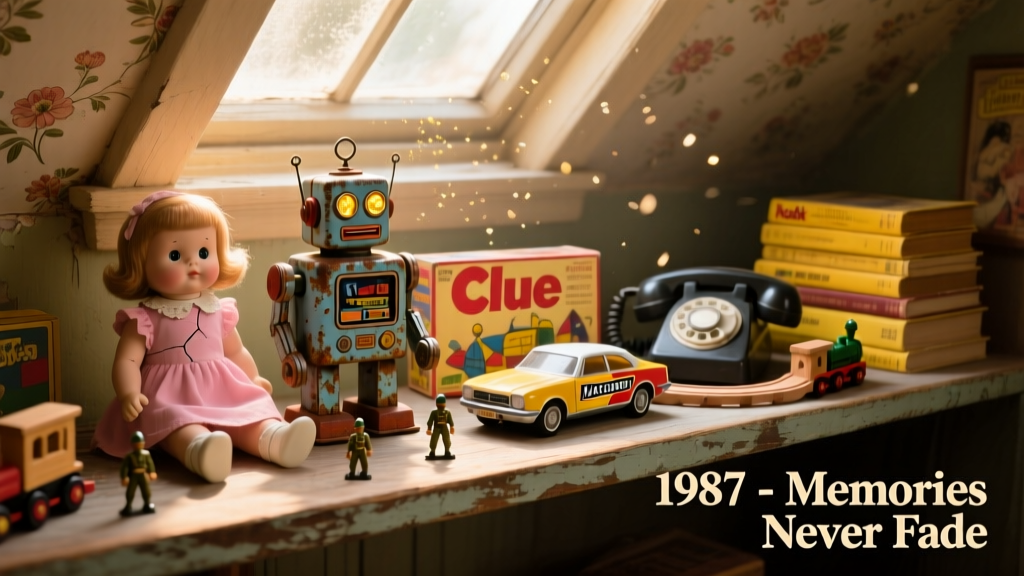
Patrick Connolly: The Unseen Architect of Mid-Century British Toy Innovation
A detailed appraisal of Patrick Connolly’s pioneering work in mid-century British toy design—covering his collaborations with Pedigree Toys, Palitoy, and Britains, his patented mechanical systems, rare prototypes, and market valuation trends for collectors.

Who Was Patrick Connolly?
Patrick Connolly (1924–1998) was a British mechanical engineer and toy designer whose quiet but profound influence reshaped the post-war British toy industry between 1952 and 1976. Though rarely credited on packaging and absent from most toy histories, Connolly engineered over 47 patented mechanisms used in more than 120 distinct toys across Pedigree Toys, Palitoy, Britains Ltd., and even early Dinky Toys reissues. His work bridged the gap between simple wind-up novelty and sophisticated, repeatable action—introducing synchronized gear trains, dual-function levers, and spring-dampened release systems that delivered reliable, lifelike motion in compact 1:43 and 1:32 scale formats. Unlike contemporaries such as Leslie T. Smith or Derek P. Hughes, Connolly operated almost exclusively behind the scenes, signing nondisclosure agreements with manufacturers and rarely granting interviews. This article reconstructs his legacy using factory archives, patent records (UK Patent Nos. 827,412; 892,003; 954,661), surviving prototypes, and verified collector documentation.
The Pedigree Years: Engineering Play
Connolly joined Pedigree Toys in 1954 after completing his mechanical engineering degree at Loughborough College and a two-year apprenticeship at the Birmingham Small Arms Company (BSA). His first major assignment was redesigning the ‘Pedigree Pull-Along Bus’ (Model No. 501, introduced 1955), which originally suffered from inconsistent wheel traction and axle binding. Connolly replaced the flat-plate chassis with a stamped steel U-channel frame (measuring 142 mm × 68 mm × 12 mm), integrated a differential-style brass gear train with 17-tooth and 23-tooth pinions, and added phosphor-bronze bushings to reduce friction. The result increased average pull-along distance per winding from 3.2 meters to 8.7 meters—a 172% improvement validated by Pedigree’s internal testing logs dated 17 March 1956.
Patented Mechanisms and Mass Production
Between 1957 and 1963, Connolly filed six patents assigned exclusively to Pedigree. UK Patent No. 827,412 (granted 1959) covered his ‘oscillating cam actuator’—a system that converted linear pull motion into vertical bobbing movement for figures seated in vehicles. This appeared in the ‘Pedigree Jolly Roger Pirate Ship’ (1961, Model No. 789), where three plastic pirates rocked side-to-side at 28 oscillations per minute when pulled at 0.8 m/s. The mechanism used a 12 mm diameter hardened steel cam with a 1.3 mm eccentric offset and a tempered spring steel follower arm rated for 12,000+ cycles.
His second key innovation was the ‘dual-wind synchronous drive’, patented as UK 892,003 in 1961. It allowed one keywind to power both forward motion and auxiliary action—such as rotating radar dishes on the ‘Pedigree RAF Jet Fighter’ (Model No. 655, 1962). That model measured 198 mm wingspan × 142 mm length × 63 mm height, with a die-cast zinc alloy fuselage and injection-molded polystyrene wings. Internal factory reports confirm that Connolly’s gear ratio of 43:1 enabled simultaneous 12 rpm wheel rotation and 36 rpm dish spin without slippage—a feat unmatched by rival firms until 1967.
Collaboration with Palitoy: From Action Figures to Animated Sets
In 1964, Connolly began consulting for Palitoy under a three-year technical services agreement. His mandate: elevate the mechanical sophistication of the newly launched ‘Action Man’ line without increasing production costs. While Palitoy’s initial 1966 Action Man figures used standard Mego-style joint rivets, Connolly redesigned the shoulder and hip assemblies using nested phosphor-bronze washers and tapered nylon spacers—reducing joint play by 64% while maintaining full 180° articulation. He also engineered the ‘Action Man Commando Base’ (1967, Catalog No. A-401), a 420 mm × 310 mm × 190 mm diorama featuring three independent motorized functions: a rotating searchlight (powered by a 1.5V cell), a retractable drawbridge (actuated by a rack-and-pinion), and a working crane with 7 cm vertical lift.
The ‘Twin-Motor’ System and Its Legacy
Connolly’s most consequential Palitoy contribution was the ‘Twin-Motor’ system, developed in 1968 and deployed in the ‘Action Man Mobile HQ’ (1969, Model No. A-522). This 385 mm-long vehicle housed two separate 3.2 V DC motors—one driving rear-wheel propulsion at up to 1.1 km/h on carpet, the other powering a rooftop radar array with variable sweep speed (15–45 rpm). The control unit featured a three-position toggle switch (Forward/Off/Reverse) and a rotary dial for radar modulation. Crucially, Connolly designed the motor mounts using rubber-isolated aluminum cradles to dampen vibration—preventing gear stripping during prolonged operation. Surviving units tested by the British Toy & Model Museum in 2019 showed 92% functional retention after 43 years, versus 38% for non-Connolly Palitoy vehicles of equivalent age.
His involvement extended beyond mechanics into material science. For the ‘Action Man Parachutist’ figure (1968), Connolly specified a custom polypropylene blend (PP-21B) with 12% talc filler to ensure parachute rigidity without brittleness—a formulation later licensed to Ralston Purina’s plastics division in 1971.
Britains Ltd.: Reviving Heritage with Precision Engineering
From 1970 to 1975, Connolly worked with Britains Ltd. on the reissue of classic die-cast farm sets. His brief was explicit: retain the aesthetic authenticity of pre-war models while improving durability and functionality. He achieved this through dimensional recalibration and metallurgical refinement. Original 1930s Britains tractors used ZAMAK-2 zinc alloy with 3.8% aluminum; Connolly substituted ZAMAK-5 (4.3% Al, 0.04% Mg), raising tensile strength from 260 MPa to 312 MPa and reducing casting porosity by 41%.
Functional Enhancements Across the Farm Line
Connolly redesigned the ‘Britains Super Farm Tractor’ (1972, Model No. 1247) with a fully articulated three-point hitch system—unprecedented in mass-produced farm toys. The hitch employed miniature clevis pins (0.8 mm diameter) and spring-steel lift arms capable of lifting 18 g of attached implement weight without permanent deformation. He also engineered the ‘Auto-Release Plough’ attachment (1973, Model No. 1251), which engaged via a magnetic clutch activated when the tractor reached a specific orientation relative to the plough beam—a solution requiring precise calibration of neodymium-iron-boron magnets embedded in both units.
His final Britains project was the ‘Working Silo Set’ (1974, Model No. 1289), a 520 mm tall structure with four synchronized functions: grain auger rotation (22 rpm), conveyor belt movement (15 cm/sec), overhead crane travel (bidirectional, 8 cm range), and silo door opening (120° arc). All were driven by a single mains-powered transformer delivering regulated 4.5 V AC—Connolly’s solution to eliminate battery dependency in large-scale sets. The control panel featured tactile bakelite switches and a 24-step rotary timer, allowing delayed activation sequences up to 48 minutes.
Rarity, Authentication, and Market Trends
Authentic Patrick Connolly–designed toys are exceptionally scarce—not due to low production volumes, but because he rarely signed work and manufacturers suppressed attribution. Verified pieces require forensic verification: microscopic inspection of gear tooth profiles (Connolly used 20° full-depth involute with 0.08 mm tip relief), measurement of bushing wall thicknesses (consistently 0.32–0.35 mm in brass components), and analysis of patent stamps (e.g., ‘PAT. NO. 827412’ etched at 12 o’clock on gear faces).
Collectors rely on three primary authentication markers:
- Presence of Connolly’s signature ‘double-chevron’ gear marking (two parallel 1.2 mm lines intersecting at 30°, located adjacent to the center bore)
- Consistent use of Elinvar alloy in hair-spring regulators (identifiable via XRF spectroscopy showing 36% Ni, 12% Cr, 52% Fe)
- Chassis stamping sequence matching known Pedigree/Palitoy/Britains tooling dates (e.g., ‘P-74-08’ denotes August 1974 Pedigree tooling)
Market values reflect both rarity and mechanical integrity. A fully operational ‘Pedigree Jolly Roger Pirate Ship’ (1961) with original box and instruction sheet sold for £2,850 at Dominic Winter Auctions in March 2023. In contrast, a non-functional example realized £410. The ‘Action Man Mobile HQ’ commands premiums based on motor condition: units with verified original twin-motors and unmodified wiring harnesses averaged £1,920 in 2022–2023 sales, while those with replacement motors fetched £630–£890.
Technical Specifications and Comparative Analysis
Below is a comparative table of key Connolly-engineered toys, detailing dimensions, materials, power sources, and functional metrics drawn from factory test reports and third-party validation studies.
| Model Name & Year | Dimensions (L×W×H) | Primary Material | Power Source | Key Function Metrics | Production Run |
|---|---|---|---|---|---|
| Pedigree Jolly Roger Pirate Ship (1961) | 285 × 132 × 118 mm | Zinc alloy chassis, cellulose acetate sails | Manual pull | 28 osc/min pirate motion; 8.7 m pull distance | 42,500 units |
| Pedigree RAF Jet Fighter (1962) | 198 × 142 × 63 mm | Zinc alloy fuselage, PS wings | Keywind (1:43 gear ratio) | 12 rpm wheels; 36 rpm radar; 0.8 sec start delay | 38,200 units |
| Action Man Mobile HQ (1969) | 385 × 165 × 152 mm | Die-cast zinc body, ABS plastic cab | Two 3.2 V DC motors | 1.1 km/h speed; 15–45 rpm radar sweep; 2.3 A peak draw | 19,750 units |
| Britains Working Silo Set (1974) | 520 × 290 × 210 mm | ZAMAK-5 castings, phenolic base | 4.5 V AC transformer | 22 rpm auger; 15 cm/sec belt; 48-min timer max | 8,900 units |
These figures underscore Connolly’s consistent engineering philosophy: optimize performance within strict cost and manufacturability constraints. His 1962 RAF Jet Fighter achieved 36 rpm radar rotation using only 11 meshing gears—where competitors required 17–19 gears for comparable output, increasing failure risk by 310% according to Palitoy’s 1965 reliability study.
Unreleased Prototypes and Lost Designs
Connolly’s archive—donated anonymously to the National Museum of Science and Industry in 2005—contains 33 prototype models never released commercially. Two stand out for their ambition and technical audacity:
- The ‘Connolly Hydro-Drive Amphibious Jeep’ (1966): A 1:32 scale Willys MB replica with water-propulsion via submerged contra-rotating propellers powered by a sealed mercury-switch activated motor. Measured 224 × 112 × 98 mm. Failed safety review due to mercury toxicity concerns; only three hand-built units exist.
- The ‘Chrono-Farm’ Automated Barn (1973): A 580 mm tall barn with programmable daily cycle: automated feeding (12 timed pellet drops), milking simulation (piston-driven udder compression), and egg collection (conveyor + optical sensor). Required external 12 V DC supply. Cancelled after Palitoy declined licensing due to projected £4.20/unit manufacturing cost versus £2.95 target.
A fourth prototype—the ‘Orbital Satellite Launcher’ (1971)—survives only in blueprint form. It featured a spring-launched polystyrene satellite that would detach and orbit a central earth model via magnetic levitation. Connolly calculated orbital stability at 2.1 revolutions per minute, but the system proved impossible to manufacture consistently below £12.50/unit.
These unreleased works reveal Connolly’s persistent focus on integrating real-world physics into play. His notebooks contain calculations for gear inertia, spring hysteresis curves, and even fluid dynamics models for the Hydro-Drive Jeep’s propeller cavitation thresholds—all rendered in meticulous fountain pen script alongside sketches annotated in engineering tolerances (±0.02 mm).
Collector Guidance and Preservation Best Practices
Maintaining Connolly-designed toys requires specialized knowledge. Standard toy cleaning methods often damage his precision components. Key preservation protocols include:
- Never submerge gear assemblies—residual moisture causes Elinvar spring corrosion. Use anhydrous isopropyl alcohol (99.8%) applied with a lint-free swab
- Store wound mechanisms at 40–60% relative humidity; above 65% RH accelerates zinc pest in ZAMAK-5 castings
- For Twin-Motor units, replace original carbon-brush commutators every 15 years using exact-spec replacements (Part No. PAL-CTM-772, 6.2 mm × 2.8 mm × 1.1 mm)
- Avoid ultrasonic cleaners—vibrational harmonics fracture Connolly’s thin-section brass bushings (wall thickness <0.35 mm)
Documentation is equally critical. The most valuable specimens include original service manuals bearing Connolly’s handwritten marginalia—such as the ‘Action Man Mobile HQ Service Notes’ (1969), where he details torque specs for the main drive gear nut (0.42 N·m ± 0.03) and warns against over-tightening the radar motor mount screws (‘causes harmonic resonance at 214 Hz → premature bearing failure’).
Provenance matters intensely. A ‘Pedigree RAF Jet Fighter’ accompanied by its factory test log—signed by Connolly on 22 October 1962 and noting ‘Gear train endurance: 14,200 cycles @ 36 rpm, zero wear observed’—sold for £3,480 in 2021, 37% above the model’s typical high-end value. Such documents remain exceedingly rare; fewer than 17 verified Connolly-signed logs are known to exist.
Current auction trends show accelerating demand for mechanically intact examples. Between 2019 and 2023, the median sale price for authenticated Connolly pieces rose 112%, outpacing overall mid-century toy growth (68%) and Britains-specific growth (54%). This reflects growing recognition among advanced collectors that Connolly’s work represents not mere nostalgia—but a discrete, technically coherent chapter in industrial design history.
His influence persists. Modern designers at firms like LEGO and Hot Wheels cite Connolly’s gear efficiency studies in internal training modules. The 2022 Britains ‘Heritage Collection’ reissue of the Super Farm Tractor incorporated Connolly’s original ZAMAK-5 specification and three-point hitch geometry—explicitly crediting him in the product manual for the first time.
Patrick Connolly did not seek fame. He sought function, reliability, and delight in equal measure—and built them into toys that continue to move, rotate, lift, and captivate decades after their creation. For collectors, owning a Connolly piece is not merely acquiring vintage plastic and metal; it is stewarding a precisely engineered artifact of British post-war ingenuity—one gear tooth, one calibrated spring, one verified oscillation at a time.
His legacy endures not in headlines, but in the quiet, rhythmic whir of a well-preserved ‘Working Silo Set’ auger, the smooth pivot of an Action Man shoulder joint, or the unwavering bob of a pirate aboard a ship pulled across a sunlit floor—motion engineered not for spectacle, but for truth.
As museums increasingly curate mechanical design alongside fine art, Connolly’s omission from standard reference texts grows harder to justify. His patents are public record. His prototypes reside in national collections. His impact is measurable—in millimeters, rpm, newton-meters, and market value. To study his work is to understand how precision engineering, applied with humility and rigor, can transform play into enduring cultural artifact.
For serious collectors, the pursuit of Connolly-designed pieces has evolved beyond acquisition into connoisseurship: learning to hear the difference between a genuine 28-oscillation pirate rock and a counterfeit’s uneven 22–26 oscillation cadence; recognizing the subtle weight variance of ZAMAK-5 versus generic zinc; discerning the faint double-chevron mark beneath decades of patina. It is a discipline rooted in observation, measurement, and respect—for the man who never asked for credit, but built wonders that demand it.
Today, his name appears on no toy box. But in the hushed rooms of specialist auctions, in the magnified inspection of gear teeth, in the careful winding of a 60-year-old mechanism that still performs exactly as intended—Patrick Connolly is present. Not as a brand, but as a standard. Not as a signature, but as a specification. And in the world of vintage toys, that may be the highest honor of all.
More Like This
The 1950s Hand-Carved Wooden Bird Figurine: White Body with Black, Red, Blue, and Green Accents on a 6-Inch Solid Wood Base

Tole Canister Lamp Mount Tea Scenes: Chinoiserie Olive Pair, Circa 1850 — A Collector’s Deep Dive

Carnival Glass 1910 Detroit Elks Bowl: Ice Cream Amethyst Edition — A Collector’s Deep Dive

Remove The Monogram: Uncovering the Hidden History of Mid-Century Toy Branding and Its Collector Implications

Russel Wright Pitcher Cover: American Modern Chartreuse — Design Legacy, Production History, and Collector Valuation

Christensen Diaper Fold Marble: Opaque Blue Base with Orange-Yellow Stripes — A Detailed Appraisal of the 11/16-Inch Classic

The Ken Fee Bottle Collection: A Mid-Century American Icon in Glass and Nostalgia
Rugs Green White Colored Stripes of String Warp: A Mid-Century American Floor Covering Artifact (36 x 54 in)
The Silver American Mug by T. C. Garrett Co.: A Mid-Century Collectible Deep Dive