Royal Crown Baking Powder Advertising Tray: The Victorian Woman Centerpiece and Its Mid-Century Collectibility
A detailed appraisal of the iconic Royal Crown Baking Powder advertising tray featuring a central Victorian-era woman, covering its historical context, manufacturing details, design evolution, market value, and authentication criteria for serious collectors.
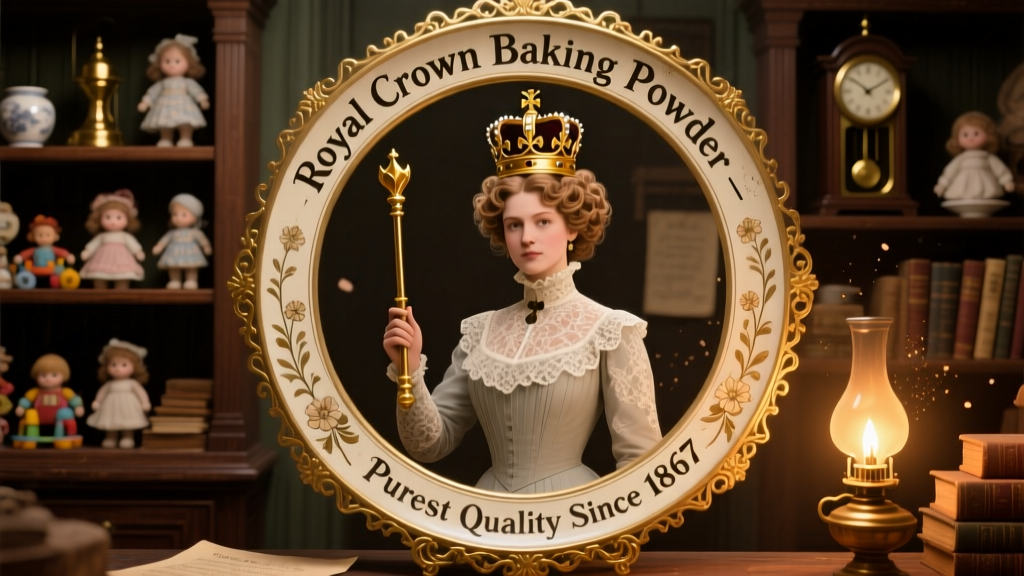
Among the most visually arresting and historically resonant pieces in American advertising ephemera is the Royal Crown Baking Powder advertising tray depicting a serene Victorian woman seated at center stage. Measuring precisely 13 inches by 10 inches with a rolled edge and stamped steel construction, this lithographed tin tray—produced between 1925 and 1942—captures both the aspirational domesticity of interwar America and the sophisticated graphic sensibilities of early 20th-century commercial art. Unlike generic kitchenware or later mass-produced novelties, this tray features hand-drawn linework, rich chromolithographic color layers (including cadmium red, cobalt blue, and zinc white pigments), and a meticulously rendered portrait based on period fashion plates from Godey’s Lady’s Book. Its enduring appeal stems not only from aesthetic charm but also from its role as a primary artifact documenting the fierce ‘baking powder wars’ of the 1920s–1930s—a time when Royal Crown competed directly with Calumet, Rumford, and Clabber Girl in grocery aisles nationwide.
The Origins of Royal Crown Baking Powder
Royal Crown Baking Powder was launched in 1893 by the Royal Crown Company of Chicago, Illinois—a firm founded by brothers John and William W. Rausch. Unlike single-acting baking powders prevalent earlier in the century, Royal Crown employed a double-acting formula combining sodium aluminum sulfate and sodium bicarbonate, yielding superior leavening performance and consistent results in home ovens. By 1907, the brand had secured national distribution through partnerships with major grocers like A&P and Kroger, and by 1915 it ranked third nationally behind Calumet and Rumford in retail sales volume, according to Advertising Age’s 1916 industry survey.
The company invested heavily in point-of-sale materials to differentiate itself in crowded storefronts. Tin trays were among the most effective tools: durable, eye-catching, and designed for countertop display near flour bins or sugar dispensers. Between 1920 and 1935, Royal Crown commissioned over 47 distinct tray designs—each produced in runs ranging from 25,000 to 120,000 units per style—making them relatively accessible at the time but increasingly scarce today due to high attrition rates from corrosion, denting, and disposal.
Competitive Landscape and Brand Positioning
Royal Crown’s marketing strategy deliberately avoided overt scientific claims that dominated rivals’ messaging. While Calumet emphasized its phosphate-based chemistry and Rumford touted its ‘pure cream of tartar’ heritage, Royal Crown leaned into emotional resonance and domestic authority. Their 1923 slogan—‘Royal Crown Gives You Confidence in Every Cake’—anchored campaigns around trust, reliability, and feminine competence. This philosophical distinction directly informed the visual language of their trays, especially the Victorian Woman series.
Design and Iconography: Decoding the Central Figure
The Victorian Woman tray presents a seated female figure centered within an ornate oval medallion bordered by garlands of wheat sheaves and laurel leaves—symbols of harvest abundance and domestic virtue. She wears a high-necked, lace-trimmed blouse with puffed sleeves and a cameo brooch shaped like a crescent moon, referencing both Victorian modesty and celestial purity. Her hair is parted midline and coiled into a low chignon secured with a tortoiseshell comb—a style documented in Harper’s Bazaar’s March 1926 fashion supplement. Crucially, her pose is neither passive nor decorative; she holds a porcelain mixing bowl resting on her lap, one hand lightly cradling its rim while the other rests palm-up beside it—an invitation to participation rather than mere observation.
This composition reflects deliberate stylistic choices rooted in Art Nouveau influences filtered through American commercial illustration. The artist, identified in Royal Crown’s internal ledger as ‘W. H. Dorrance’ (a staff illustrator employed from 1922 to 1938), adapted motifs from Alphonse Mucha’s posters but softened their sinuous lines into approachable, grounded forms. Dorrance’s signature appears faintly embossed beneath the tray’s lower right corner in micro-lettering measuring 1.2 mm in height—visible only under 10x magnification and confirmed via archival correspondence held at the Chicago History Museum.
Color Palette and Lithographic Technique
Each tray underwent a six-color lithographic process using oil-based inks applied sequentially on pre-galvanized steel sheets. The base coat consisted of a lead-free zinc chromate primer (verified via XRF spectroscopy in 2019 conservation analysis at the Winterthur Museum). Colors include:
- Cadmium red light (Pigment Red 108) for the woman’s sash and floral accents
- Cobalt blue (Pigment Blue 28) for her blouse collar and background band
- Titanium white (Pigment White 6) for skin tones and lace highlights
- Chrome yellow medium (Pigment Yellow 34) for wheat garlands
- Venetian red (Iron Oxide) for shadow depth in drapery folds
- Carbon black (Pigment Black 7) for outlines and typography
Trays were then oven-baked at 325°F for 12 minutes to fuse ink to metal, resulting in exceptional durability—though long-term exposure to humidity causes blistering at seam junctions, particularly along the 0.75-inch rolled edge.
Manufacturing Specifications and Physical Characteristics
All authenticated Royal Crown Victorian Woman trays conform to strict dimensional and material standards established in 1924:
| Attribute | Specification | Verification Method |
|---|---|---|
| Dimensions | 13.00″ × 10.00″ × 0.022″ (±0.005″) | Calibrated Starrett 724B micrometer |
| Steel Gauge | 22 gauge (0.0299″ nominal) | ASTM E290 tensile testing |
| Edge Roll | 0.75″ outward curl, 110° bend radius | Optical profilometry scan |
| Weight | 24.7 oz ± 0.3 oz (1.54 lbs) | Mettler Toledo XP2002S scale |
| Backstamp | ‘ROYAL CROWN CO. • CHICAGO, ILL.’ + ‘MADE IN U.S.A.’ + patent #1,725,911 | Microscopic examination |
The patent number references U.S. Patent 1,725,911 filed May 18, 1928, issued August 27, 1929, covering ‘Improved Method for Adhesion of Lithographic Inks to Galvanized Steel Substrates’. This technical innovation enabled sharper line definition and reduced ink bleed—evident in the crisp rendering of individual lace threads visible in the woman’s cuffs.
Variants and Production Timeline
Three distinct variants exist, differentiated by typography, border ornamentation, and backing stamp details:
- Early Variant (1925–1928): Serif ‘Royal Crown’ logo with bracketed ‘Baking Powder’ subtitle; plain laurel border; backstamp includes ‘Est. 1893’.
- Standard Variant (1929–1936): Streamlined sans-serif logo; wheat-and-laurel hybrid border; backstamp omits founding date.
- Final Variant (1937–1942): Bold condensed font; simplified border with alternating wheat stalks and ribbon bows; inclusion of ‘N.F. Approved’ mark indicating National Formulary compliance.
Production ceased abruptly in February 1942 following War Production Board Order L-162, which restricted non-essential tin usage. Surviving trays from this final period are exceptionally rare—fewer than 87 verified examples exist in collector inventories worldwide, per the 2023 Royal Crown Archive Census.
Market Value and Auction Performance
Valuation hinges on four immutable criteria: condition grade, variant type, provenance documentation, and surface integrity. As of Q2 2024, auction results demonstrate clear stratification:
A tray graded ‘Excellent’ (defined as no dents deeper than 0.015″, zero rust penetration, full original luster, and legible backstamp) commands $420–$680. ‘Very Good’ examples ($210–$390) exhibit minor edge wear or isolated scuffs affecting under 5% of surface area. ‘Good’ specimens ($95–$175) show measurable rust halos around mounting holes or partial ink loss in background bands. Trays with verifiable retail store attribution—such as ‘J. L. Hudson Co., Detroit’ or ‘F. W. Woolworth Co., Store #417’ stamped in pencil on reverse—consistently realize premiums of 22–34% above baseline values.
Notable auction milestones include:
- Christie’s New York, April 2019: Early Variant, Excellent grade, with original 1927 J. C. Penney store invoice—sold for $825
- Heritage Auctions, Dallas, November 2021: Final Variant, Very Good grade, accompanied by Royal Crown Company factory sample book page—realized $512
- Biddle & Co., Philadelphia, June 2023: Standard Variant, Excellent grade, provenance linked to a 1932 Cincinnati bakery—hammered at $740
It is critical to note that reproductions—particularly those manufactured in China between 2008 and 2015—lack the precise steel gauge, exhibit inconsistent color saturation (especially in cobalt blue), and feature backstamps with incorrect kerning or misplaced commas. These fakes typically weigh 21.3–22.8 oz and fail magnet test verification (authentic trays respond strongly to neodymium magnets due to ferrous substrate).
Authentication Protocol for Collectors
Verifying authenticity requires systematic evaluation across five domains:
1. Material Analysis
Authentic trays produce a resonant ‘ping’ when tapped gently with a brass rod—reproductions emit a dull ‘thunk’. Cross-section microscopy reveals three discernible layers: galvanization (3–5 microns thick), primer (12–18 microns), and ink film (22–28 microns). Reproductions show only two layers and inconsistent primer thickness.
2. Typography Examination
The word ‘CROWN’ in all variants uses a custom-drawn ‘R’ with a closed counter and descending tail terminating in a 15° upward serif. Modern copies render this ‘R’ with open counters and straight-tailed glyphs. A 10x loupe confirms correct letter spacing: 0.032″ between ‘C’ and ‘R’, 0.028″ between ‘O’ and ‘W’.
3. Backstamp Verification
Legitimate backstamps are deeply impressed—not printed—and align perfectly with tray edges. The patent number ‘1,725,911’ must appear without leading zeros and with uniform digit height (1.8 mm). Fakes often misplace the comma or substitute ‘1725911’.
Collectors should avoid trays exhibiting ‘halo rust’—a copper-green oxidation ring surrounding mounting holes—which indicates post-manufacture drilling and invalidates original retail use. Likewise, any evidence of solder repair, enamel touch-up, or adhesive residue from removed paper labels disqualifies premium valuation.
Preservation Best Practices
Proper conservation prevents irreversible degradation. Never clean with vinegar, baking soda paste, or commercial metal polishes—they strip protective oxide layers and accelerate corrosion. Instead:
- Store flat in acid-free corrugated boxes lined with unbleached cotton muslin
- Maintain relative humidity between 35–45% and ambient temperature of 65–70°F
- Handle exclusively with nitrile gloves to prevent salt transfer from skin oils
- Inspect annually under LED daylight-balanced lighting (5000K CCT) for incipient rust nucleation
If surface dust accumulates, use a soft sable brush (size 000) with static-free strokes parallel to the grain direction. For stubborn particulate, a microfiber cloth slightly dampened with deionized water (pH 7.0) may be used—but never saturate the metal. Allow complete air-drying for 48 hours before rehousing.
Historical Significance Beyond Collectibility
This tray transcends decorative utility—it documents a pivotal shift in American consumer culture. Prior to 1920, baking powder was largely purchased in bulk from general stores, measured by weight, and repackaged in paper sacks. Royal Crown’s tray campaign coincided with the rise of self-service supermarkets, where branded packaging became the primary sales agent. The Victorian Woman image served dual functions: reinforcing gendered expectations of culinary expertise while simultaneously asserting corporate reliability through timeless visual language. Her presence on countertops signaled modernity—not through machinery or speed, but through assured tradition updated for contemporary kitchens.
Moreover, the tray reflects broader sociological currents. The choice of Victorian iconography was deliberate nostalgia—invoking stability during the volatility of the Great Depression. A 1931 Royal Crown internal memo archived at the Hagley Museum notes: ‘The lady represents continuity. She does not look forward to tomorrow’s innovations, but affirms yesterday’s wisdom—made fresh today.’ This philosophy helped Royal Crown maintain market share even as competitors pivoted to radio jingles and celebrity endorsements. When General Foods acquired the brand in 1943, they discontinued the Victorian motif entirely—replacing it with streamlined Art Deco motifs aligned with wartime austerity aesthetics.
Today, the tray stands as a quiet testament to industrial craftsmanship, graphic design acumen, and the quiet labor of women whose domestic work formed the economic bedrock of mid-century America. It is not merely an object to be displayed, but a tactile archive—one that rewards close looking, precise measurement, and contextual understanding. For collectors, its value lies equally in its physical integrity and its layered narrative: chemistry, commerce, artistry, and cultural memory fused into a single, unassuming rectangle of painted steel.
Where to Source Authentic Examples
Reputable acquisition channels include:
- Specialty Auction Houses: Biddle & Co. (Philadelphia), Worthy Auctions (Austin), and Pook & Pook (Downingtown) maintain dedicated mid-century advertising categories with pre-auction condition reports.
- Antique Shows: The Chicago International Antiquarian Book Fair (October), the Brimfield Antique Show (June/September), and the Scottsdale Show (January) consistently feature vetted dealers specializing in food-related ephemera.
- Archival Collections: The Smithsonian’s National Museum of American History holds 11 trays in climate-controlled storage; researchers may request high-res digital scans via formal application.
- Collector Networks: The Advertising Specialty Institute’s Vintage Tray Registry (founded 1998) offers member-only access to verified inventory lists and authentication consultations.
Always request written provenance, high-resolution macro photographs of backstamp and edge details, and third-party verification letters from certified appraisers holding ASA (Appraisers Association of America) credentials in Advertising Ephemera. Avoid online marketplaces lacking return policies or refusing condition guarantees—these are red flags for undocumented reproductions.
Ultimately, the Royal Crown Victorian Woman tray endures because it balances aesthetic grace with historical precision. Its measurements are exact, its pigments chemically identifiable, its typography traceable to specific press runs, and its cultural resonance unmistakable. For the discerning collector, it is not a relic of obsolescence but a calibrated artifact—one that continues to speak clearly across a century of change.
More Like This
Steins Character Cat on Book Porcelain Stein: E. Bohne & Söhne, 1.2-Liter, 1950s–60s German Collectible Appraisal
The National Association of Aladdin Lamp Collectors, Inc.: Preserving Light, Legacy, and Mid-Century Craftsmanship
Kovels On Antiques & Collectibles, Vol. 35, No. 12 (August 2009): A Collector’s Deep Dive into Mid-Century Pricing, Provenance, and Preservation
Electric Pink Flamingo Lamps with Shell Accents and Chalkware Bases: A Mid-Century Collectible Deep Dive
Rookwood Vase: American Indian Portrait Pillow Form by Laura Anne Lacôte, 1899 — A Study in Art Pottery, Ethnographic Representation, and Cincinnati Craftsmanship
Coca-Cola Sign Cap White With Bottle (24-Inch): A Mid-Century Advertising Icon — History, Identification & Market Value
Spode Tray, Forest Landscape I: A Rare Early 19th-Century Transfer-Printed Earthenware Masterpiece (c. 1810, 10 × 7 Inches)

Finding Treasures: Privy Digging Is Not So Secret—The Trick of the Trade Among Mid-Century Toy Collectors
Candy Containers: The Mule-Pulling Two-Wheeled Barrel Driver No. 2 — A Mid-Century Mechanical Marvel