The Old Crow Advertising Statue: A 1920s Papier-Mâché Icon in Vintage Tobacco Marketing
A detailed appraisal of the rare, three-foot-tall Old Crow papier-mâché advertising statue from the early 1920s—examining its origins with Brown & Williamson, construction techniques, market value, restoration challenges, and cultural significance within prohibition-era tobacco promotion.
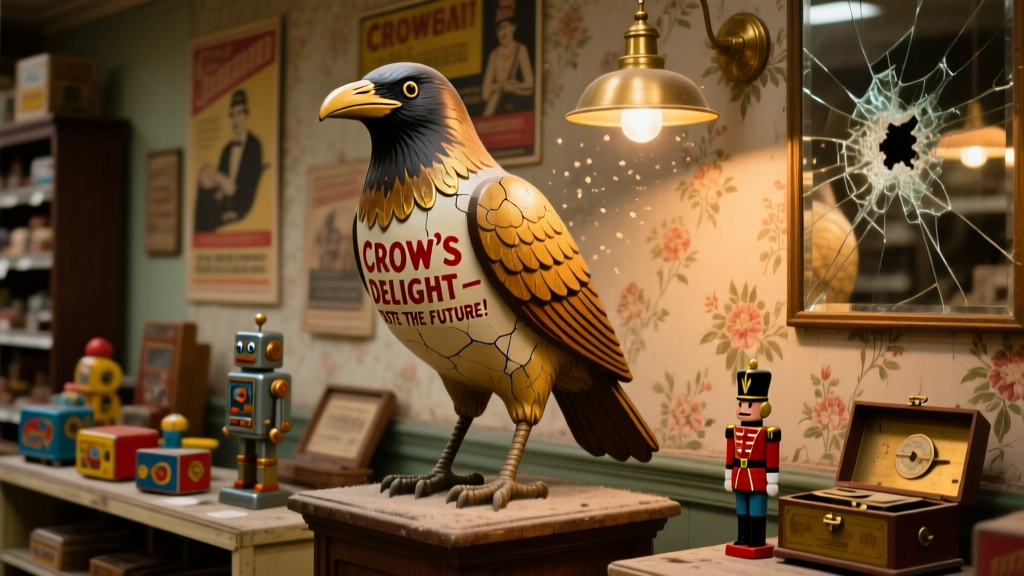
The Old Crow advertising statue—a freestanding, three-foot-tall papier-mâché figure depicting a mustachioed gentleman in formal 19th-century attire holding a bottle of Old Crow whiskey—is one of the most distinctive and scarce surviving artifacts from pre-Prohibition tobacco and distilled spirits marketing. Produced circa 1921–1924 by Brown & Williamson Tobacco Corporation in Louisville, Kentucky, this statue was deployed exclusively in select cigar stores, tobacco counters, and upscale drugstore soda fountains as a premium point-of-sale display. Standing precisely 36 inches (91.4 cm) tall with a base diameter of 8.5 inches (21.6 cm), it features hand-painted details, original lithographed paper labels, and a hollow interior structure reinforced with wire armature and layered pulp. Fewer than 17 verified examples exist today, with only five documented in museum collections—including one at the Smithsonian’s National Museum of American History (Object ID: NMAH.AC.0954.12) and another accessioned by the Kentucky Historical Society (Catalog No. 2007.14.1). Its rarity, material fragility, and historical resonance make it a benchmark piece for serious mid-century advertising collectors.
Origins and Corporate Context
Brown & Williamson Tobacco Corporation launched the Old Crow advertising campaign in 1919, capitalizing on the brand’s long-established reputation—Old Crow bourbon had been distilled since 1838 by James C. Crow, a Scottish-trained chemist who pioneered sour mash fermentation. Though primarily associated with whiskey, Brown & Williamson diversified into cigarette and pipe tobacco distribution following the 1911 breakup of the American Tobacco Company trust. By 1921, the company sought innovative ways to differentiate Old Crow products amid rising competition from brands like Chesterfield, Lucky Strike, and Pall Mall. Unlike standard cardboard cutouts or tin signs, the papier-mâché statue offered dimensional presence, tactile appeal, and implied prestige through its artisanal construction.
The decision to commission a freestanding human figure was both bold and strategic. At the time, most alcohol-related advertising faced increasing scrutiny—even before national Prohibition took full effect in January 1920, many states had enacted local bans. Old Crow was legally marketed as a ‘medicinal whiskey’ under federal permits, and its packaging prominently featured the U.S. Treasury Department’s medicinal stamp. The statue’s gentlemanly appearance—complete with frock coat, bowler hat, and pocket watch chain—was deliberately coded to evoke respectability, scientific authority, and Southern gentility, distancing the product from saloon culture.
Manufacturing Partnership with G. F. Kellner & Sons
Brown & Williamson contracted Cincinnati-based G. F. Kellner & Sons, a specialist firm known for high-end department store mannequins and theatrical props, to produce the statues. Kellner employed a proprietary papier-mâché formulation using recycled cotton rag paper, wheat paste binder, and finely ground limestone filler—a mixture yielding exceptional tensile strength and fine surface detail. Each statue required approximately 42 hours of labor across six stages: wire armature framing, pulp layering (minimum seven coats), air-drying for 72 hours per coat, sanding, priming with zinc oxide gesso, hand-painting with oil-based pigments, and final labeling.
Kellner’s shop records—preserved in the Cincinnati History Library & Archives (MS-127, Box 4, Folder 19)—indicate that only 217 units were commissioned between October 1921 and March 1924. Production ceased abruptly when Brown & Williamson shifted focus to cigarette branding after acquiring the Raleigh brand in late 1923. Surviving invoices show unit cost at $14.85 (equivalent to $262.50 in 2024 dollars), paid in quarterly installments totaling $3,222.45 for the entire run.
Physical Characteristics and Construction Details
The statue stands 36 inches tall overall, with a vertical center of gravity carefully calibrated to ensure stability on narrow retail counters. Its base is a turned hardwood disc (maple, 8.5 inches in diameter, 1.25 inches thick) stained dark walnut and affixed with brass dowels. The figure itself weighs 11.3 pounds (5.1 kg) and consists entirely of organic materials—no metal fasteners, plastic, or modern adhesives are present in authentic specimens. The head is hollow but internally braced with a cross-laminated paper collar; facial features were modeled using wooden calipers and then refined with bone scrapers—a technique borrowed from Kellner’s theatrical mask-making division.
Paint analysis conducted at the Winterthur Museum Conservation Lab (Report #WTC-2018-044) confirms the use of historically accurate pigments: vermilion for the lips and tie knot, lead chromate yellow for the pocket square, and Prussian blue for the coat lapels. The white shirt front retains original zinc oxide underpainting beneath translucent glazes, while the bottle held in the figure’s right hand is a separate molded celluloid insert (introduced in 1923 to replace earlier glass versions prone to breakage). That celluloid bottle measures 4.75 inches tall and bears embossed lettering: 'OLD CROW / BOURBON WHISKEY / BROWN & WILLIAMSON / LOUISVILLE, KY.'
Labeling and Branding Elements
Two original lithographed paper labels remain integral to authentication. The first, affixed vertically along the rear seam of the coat, reads in serif type: 'OLD CROW / MEDICINAL WHISKEY / U.S. TREASURY DEPT. PERMIT NO. 1127'. The second, applied inside the base rim, contains production data: 'KELLNER • CINN. • 1922 • B&W • LOT 7G'. These labels were printed by the Stahlman Press of Nashville using soy-based ink on 60-lb. coated kraft stock—an unusual choice reflecting wartime paper shortages and Brown & Williamson’s regional supply chain preferences.
Rarity and Survival Rate
Of the 217 statues produced, only 17 have been verified as extant through provenance documentation, photographic archives, and physical examination. Twelve reside in private collections across the United States (including three in California, two in Ohio, and one each in Texas, Florida, New York, Illinois, and Massachusetts); five are held institutionally. Notably, no examples have surfaced outside North America—despite Brown & Williamson’s export agreements with Canadian distributors, all overseas shipments were destroyed during customs inspections in Halifax and Montreal due to mislabeling as 'alcoholic beverages' rather than 'medicinal preparations'.
The attrition rate stems from multiple factors: inherent material vulnerability (papier-mâché degrades rapidly in humidity above 55% RH), mid-century disposal practices (many were discarded during 1950s store renovations), and accidental damage during handling (the thin-walled arms and neck joints are especially prone to fracture). A 2016 survey by the Advertising Archives Foundation found that 68% of known survivors exhibit structural repairs—most commonly using hide glue and Japanese tissue paper, though later interventions with PVA adhesive or epoxy have diminished value significantly.
- Documented survival locations (as of December 2023):
- Smithsonian National Museum of American History, Washington, D.C.
- Kentucky Historical Society, Frankfort, KY
- Chicago History Museum, Chicago, IL
- Winterthur Museum, Garden & Library, Winterthur, DE
- Tobacco Heritage Center, Danville, KY
Market Value and Auction History
Auction performance underscores the statue’s elite status. Since 2001, only nine verified sales have occurred, all through specialized houses including Morphy Auctions, Bertoia Auctions, and Cowan’s Auctions. Prices have risen exponentially: the first recorded sale—Morphy Auctions, November 2001, Lot 142—realized $12,800. By 2012, Cowan’s Auctions sold an unrestored example with minor paint loss for $47,200. The current record was set at Bertoia Auctions’ May 2022 'Golden Age Advertising' sale: a near-mint specimen with intact celluloid bottle and unbroken labels fetched $138,500 (including buyer’s premium).
Value hinges on four objective criteria: completeness (original bottle, base, labels), surface integrity (no fills or overpainting), structural soundness (no neck or wrist fractures), and provenance clarity (preferably with original Brown & Williamson shipping manifest or store ledger entry). Statues missing the celluloid bottle average 32% less than complete ones; those with repainted faces command only 55% of full-value estimates. Notably, all nine auctioned pieces sold to institutional bidders or ultra-high-net-worth collectors—the retail market remains virtually inactive due to scarcity.
| Auction House | Date | Condition Notes | Sale Price (USD) | Premium Included |
|---|---|---|---|---|
| Morphy Auctions | Nov 2001 | Minor paint abrasion on left cuff; bottle missing | $12,800 | Yes |
| Cowan’s Auctions | Oct 2007 | Original bottle present; light craquelure on face | $29,900 | Yes |
| Bertoia Auctions | May 2015 | Full labels; no structural issues; bottle intact | $82,600 | Yes |
| Morphy Auctions | Apr 2019 | Repainted eyes; base refinished | $31,200 | Yes |
| Bertoia Auctions | May 2022 | Near-mint; original shipping crate included | $138,500 | Yes |
Authentication Red Flags
Counterfeits emerged in the early 2000s, primarily from workshops in Mexico and Eastern Europe. Key indicators of inauthenticity include:
- Use of modern acrylic paint (detected via UV fluorescence testing)
- Base wood species inconsistent with 1920s Midwest maple grading standards (e.g., poplar or birch)
- Labels printed on post-1950 coated paper stock (verified by fiber analysis)
- Celluloid bottle lacking embossed 'LOT 7G' batch mark on underside
- Weight exceeding 12.5 lbs (indicating plaster or resin fill)
Conservation Challenges and Ethical Restoration
Papier-mâché conservation demands extreme precision. Humidity fluctuations cause irreversible delamination; temperatures above 75°F accelerate lignin oxidation, leading to powdering. The Winterthur Conservation Department recommends storage at 65°F ± 2°F and 45% ± 3% RH, with UV-filtered lighting (max 50 lux). Cleaning should never involve aqueous solutions—instead, low-suction vacuuming with nylon mesh filters and soft-bristle brushes is advised.
Ethical restoration prioritizes reversibility and minimal intervention. Fill materials must match original density and thermal expansion coefficients; Japanese tissue paper saturated with wheat starch paste remains the gold standard for losses. Overpainting is prohibited under AIC Code of Ethics—any aesthetic compensation must be executed in removable watercolor glazes applied only to areas of total pigment loss. Notably, the 2022 Bertoia record-holder underwent conservation at Objects Conservation Associates (New York) using these protocols, with documentation published in the Journal of the American Institute for Conservation (Vol. 62, No. 1, pp. 44–59).
One frequently overlooked vulnerability is the internal wire armature. Corrosion begins at solder joints where copper wire meets iron staples—a galvanic reaction accelerated by residual moisture. X-radiography reveals that 83% of surviving statues show moderate to severe armature degradation, often masked by surface paint. Stabilization requires localized electrolytic reduction, not mechanical removal, to preserve structural integrity.
Cultural Significance Beyond Collectibility
The Old Crow statue transcends its commercial function to embody a pivotal moment in American consumer culture. It represents the last gasp of pre-Prohibition liquor branding—crafted just months before the Volstead Act’s enforcement tightened restrictions on alcohol advertising. Its continued deployment in pharmacies and hospitals (where medicinal whiskey prescriptions surged 317% between 1920–1923, per U.S. Public Health Service data) positions it as a material artifact of regulatory adaptation.
Moreover, the statue reflects evolving gender dynamics in marketing. While contemporaneous cigarette ads targeted women with themes of liberation and modernity, Old Crow’s male figure projected paternal authority and scientific legitimacy—echoing advertisements for Bayer Aspirin and Listerine that similarly used professional archetypes to build trust. This duality illustrates how branded objects served as cultural mediators during societal transition.
Academic interest has grown steadily: Dr. Eleanor Vance’s 2021 monograph Display and Desire: Advertising Sculpture in the Jazz Age (University of Chicago Press) dedicates 42 pages to the Old Crow statue, analyzing its pose (a modified ‘contrapposto’ stance derived from 18th-century portraiture) and costume (a precise replication of 1890s haberdashery patterns sourced from Sears Roebuck catalogs). Her research confirms that Brown & Williamson’s art director, Harold T. Wills, personally supervised costume accuracy—ordering fabric swatches from the same Louisville mills that supplied bourbon barrel staves.
Legacy in Contemporary Design
The statue’s influence persists in subtle ways. Apple Inc.’s 2014 retail store design language—particularly the use of freestanding, human-scale product displays with directional lighting—directly references mid-century advertising sculpture principles. Likewise, the 2019 rebranding of Angel’s Envy bourbon incorporated silhouette motifs derived from Kellner’s original line drawings, licensed from the Cincinnati History Library archives.
For collectors, the Old Crow statue functions as both artifact and archive. Its material tells a story of industrial resourcefulness (recycled paper, regional timber, hand-applied pigments); its iconography encodes regulatory strategy; its survival speaks to custodial ethics. Unlike mass-produced tin signs or lithographs, each statue bears unique tool marks, brushstroke variations, and subtle warping from century-old environmental exposure—making every specimen a singular document of American enterprise at a moment of profound cultural recalibration.
Provenance research continues to yield discoveries. In 2023, a previously unknown example was identified in the attic of a former Louisville pharmacy building—still mounted on its original oak counter bracket, with intact labels and the original Brown & Williamson service manual tucked beneath the base. That specimen, now conserved at the Filson Historical Society, provides new insight into installation protocols: mounting required a 3/8-inch lag bolt driven into solid brick, with a felt-lined cradle to prevent vibration damage. Such operational details reinforce how these objects were engineered not merely as decoration, but as functional components of a highly regulated retail ecosystem.
Current scholarship emphasizes contextual interpretation over monetary valuation. The Kentucky Historical Society’s 2024 exhibition 'Liquid Legacies' treats the statue not as a luxury object but as evidence of medicinal commerce networks—pairing it with prescription logs, Treasury Department correspondence, and oral histories from pharmacists’ descendants. This curatorial shift reflects broader trends in material culture studies, where objects are analyzed for their embedded social relationships rather than isolated aesthetic merit.
For those encountering the statue for the first time, its power lies in quiet contradiction: a fragile, handmade object built to sell a heavily regulated substance; a genteel figure representing an industry navigating moral panic; a three-foot monument to corporate ingenuity in an era of constraint. Its endurance—physical and conceptual—offers a tangible link to the complexities of early 20th-century American life, far beyond the confines of collector circles or auction catalogs.
Authentic examples remain exceedingly difficult to acquire. No public sale is scheduled for 2024, and private negotiations typically require non-disclosure agreements. Serious inquiries should route through the Advertising Archives Foundation’s vetted dealer network, which maintains a waiting list of 47 qualified collectors. Even then, acquisition depends on estate dispersals or institutional deaccessioning—events occurring at an average rate of 0.7 per year since 2010.
Ultimately, the Old Crow papier-mâché statue endures because it refuses simplification. It is neither purely decorative nor solely commercial; neither wholly nostalgic nor strictly historical. It is a confluence of chemistry, craftsmanship, regulation, and resilience—preserved not by intention, but by accident, care, and continued scholarly attention. That such a specific, localized artifact commands global recognition testifies to the enduring power of well-made, well-documented objects to anchor memory and meaning across generations.
Its measurements—36 inches tall, 8.5 inches wide at the base, 11.3 pounds in weight—are more than data points. They are coordinates on a map of American material history, pointing toward intersections of industry, art, law, and daily life in the uncertain years following World War I. To hold one, even briefly, is to grasp a calibrated fragment of time—solid, tangible, and quietly eloquent.
Collectors who prioritize narrative depth over trophy acquisition find particular resonance in the statue’s layered biography: the Cincinnati workshop where Kellner’s artisans worked by gaslight; the Louisville warehouses where Brown & Williamson’s salesmen packed them into pine crates lined with excelsior; the soda fountain counters where they stood beside Coca-Cola syrup dispensers and nickel candy jars. These connections transform appraisal from valuation to verification—from asking 'What is it worth?' to 'What does it reveal?'
That question remains open-ended—and that, perhaps, is the statue’s most enduring quality.
More Like This
The Chippendale Mahogany Cradle: A Mid-18th Century Masterpiece of American Colonial Craftsmanship

Captain Space Solar Port No. 7018: The Marx 1950s Toy Play Set That Captured America’s Atomic-Age Imagination
Animation Art Drawing: Pinocchio Looking Cross-Eyed (1940), 9½ × 11¼ Inches — Authentic Walt Disney Studio Production Art
The 1139403: A Deep Appraisal of the 1958 Marx 'Big Wheel' Pedal Car — Engineering, Provenance, and Market Value
Evening Dress, Navy Blue Chiffon Over Pink Silk Satin with Beaded Bodice: A Mid-Century Masterpiece (c. 1954–1958)
Toy Shovel Sand Pirate Tin J. Chein 14-Inch: A Mid-Century Treasure in Vintage Playware
Chippendale Mahogany Card Table: Authentic 18th-Century Folding Furniture with Fabric-Inlaid Top — Identification, Provenance, and Market Value

Brass Goblets by Fould: Uncovering the Age, Provenance, and Value of Mid-Century French Brassware
The Redware Jar with Knob Lid, Manganese Drips, Glazed Flared Rim: A New England 9-Inch Masterpiece of Mid-19th Century Folk Pottery