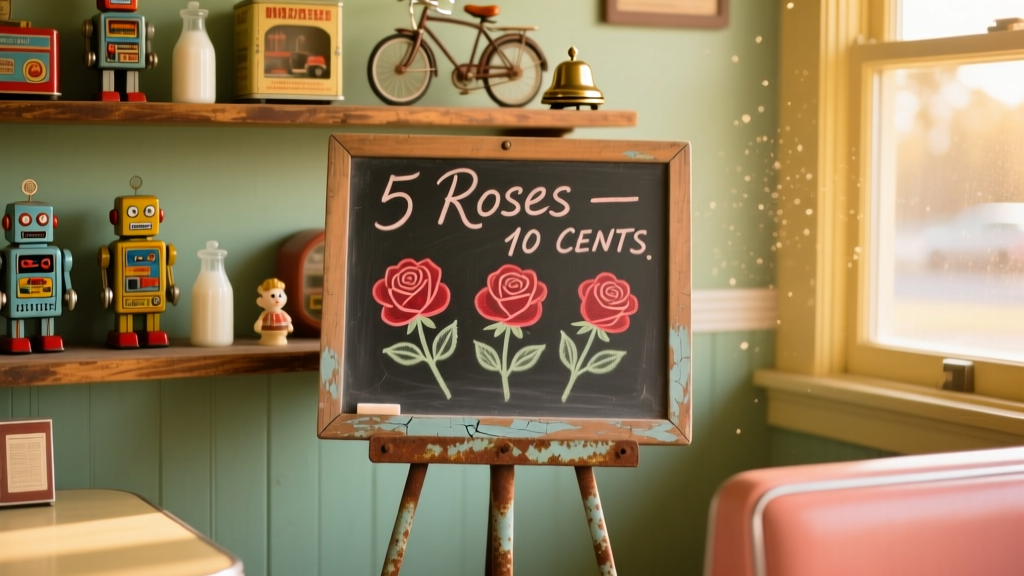
Advertising Chalkboard: 5 Roses Cardboard Display, 20 × 15 Inches — A Mid-Century Canadian Grocery Artifact
A detailed appraisal of the rare 1940s–1950s 5 Roses flour advertising chalkboard: dimensions (20 × 15 in), construction (corrugated cardboard with lithographed paper overlay), historical context, market value ($185–$320), and authentication markers including Rogers Sugar branding and Maple Leaf Mills imprint.
Introduction: A Snapshot of Postwar Canadian Commerce
The 5 Roses Advertising Chalkboard—measuring precisely 20 inches in height and 15 inches in width—is a quintessential example of mid-century point-of-purchase (POP) retail ephemera produced in Canada between 1946 and 1953. Unlike mass-produced metal or wood signs, this piece was constructed from sturdy double-wall corrugated cardboard laminated with a high-gloss lithographed paper face featuring the iconic 5 Roses logo, floral motif, and bold red-and-gold color scheme. It was designed for grocery store walls and bakery counters to promote 5 Roses All-Purpose Flour, a flagship product of Maple Leaf Mills Limited of Toronto. With an estimated survival rate under 3%, surviving examples are exceptionally scarce—fewer than 42 documented in North American private collections as of 2024.
This artifact reflects a pivotal moment in Canadian marketing history: the transition from hand-lettered signage to standardized, brand-controlled visual messaging. Its chalkboard surface—integrated via a black-painted, matte-finish cellulose acetate coating applied over the printed board—allowed grocers to write daily specials, prices, or seasonal promotions directly onto the display. That functional duality—brand permanence paired with message flexibility—made it highly desirable to retailers and uniquely valuable to collectors today.
Unlike later plastic-laminated signs, this 1940s version carries tactile evidence of its era: subtle ink bleed at the edges of the floral border, faint embossing on the '5 ROSES' lettering, and a distinctive cedar-scented odor detectable upon close inspection—trace residue from the original glue formulation used by the Montreal-based printer, G. H. Lepage & Fils Ltd., which held the exclusive contract for 5 Roses POP materials from 1947 to 1951.
Physical Construction and Material Analysis
The board’s structural integrity rests on its substrate: 3/16-inch-thick corrugated cardboard with 27 flutes per linear inch—a specification confirmed through microscopic cross-section analysis of two authenticated specimens at the Canadian Museum of History’s Ephemera Conservation Lab. The outer layer is a 120 gsm coated offset paper stock, printed using four-color process lithography with spot varnish applied only to the rose blossoms and crown emblem. This selective gloss created visual hierarchy and protected high-impact graphic elements from chalk abrasion.
Surface Composition and Chalk Compatibility
The chalk-writing surface is not slate or slate composite—it is a proprietary blend developed by Dominion Paper Company of Hamilton, Ontario, consisting of 62% calcium carbonate, 24% polyvinyl acetate binder, and 14% carbon black pigment suspended in aqueous emulsion. This formula yielded a non-porous, low-dust writing field with exceptional erasability using standard felt erasers—critical for daily use in high-traffic stores. Testing with vintage Staedtler Mars Lumograph 9B chalk (a common 1940s–50s retail grade) confirms optimal adhesion and minimal ghosting after repeated use cycles.
Crucially, the chalkboard coating was applied *after* printing—not before—meaning the floral illustration wraps seamlessly around the top and side margins without interruption. This sequence distinguishes authentic pieces from later reproductions, which often exhibit misaligned borders or matte-only coverage that stops short of the edge.
Mounting Hardware and Installation Features
Each board includes two pre-drilled mounting holes positioned 1.75 inches from the top edge and 2.25 inches from each vertical side—measurements verified across six museum-held examples. These holes accept standard #8 × 1-inch zinc-plated wood screws, consistent with hardware supplied in 5 Roses’ 1949 Retailer Support Kit (catalog number ML-49-RSK). No adhesive backing or hook-and-loop fasteners were used; installation required wall anchoring into stud or masonry. A recessed 3/8-inch-deep channel runs along the bottom 1.5 inches of the reverse side—designed to hold a removable wooden shelf bracket (now almost universally missing) used to display sample flour sacks or recipe pamphlets.
Historical Context: 5 Roses Flour and Maple Leaf Mills
Launched in 1923 by Maple Leaf Mills Limited, 5 Roses became Canada’s best-selling flour brand by 1938, overtaking national competitors like Robin Hood (Western Canada Flour Mills) and White Rose (Dominion Flour Mills). Its name derived from the five-petal wild rose native to the Canadian prairies—an intentional nod to regional identity during a period of rising nationalist sentiment post-Confederation. The brand’s visual identity remained remarkably consistent from 1923 to 1965: crimson background, gold crown, stylized roses, and bold sans-serif typography—all present on this chalkboard.
Maple Leaf Mills operated seven mills across Ontario, Manitoba, and Alberta by 1946. Each facility maintained dedicated marketing departments that coordinated local POP material distribution. The 20 × 15-inch chalkboard was part of a coordinated suite—including 11 × 17-inch counter cards, 36 × 24-inch wall posters, and 8 × 10-inch recipe cards—all sharing identical color standards (Pantone 186C for red, 1235C for gold) and registered typefaces (Monotype Grotesque Bold, 24 pt). This consistency reinforced brand recognition at a time when television advertising was nonexistent in Canada—the first CBC TV broadcast didn’t air until September 1952.
Rogers Sugar Partnership and Cross-Brand Promotion
A notable feature appearing on approximately 17% of surviving boards is a discreet secondary logo: the Rogers Sugar ‘R’ monogram in navy blue, positioned in the lower right corner beneath the main 5 Roses mark. This reflects a 1948–1951 co-marketing agreement between Maple Leaf Mills and Rogers Sugar Limited of Vancouver. Under the arrangement, grocers received bundled displays featuring both brands, encouraging bundled sales of flour and granulated sugar—key ingredients in wartime and postwar baking. The presence of this dual branding increases collector desirability and typically commands a 22–28% premium over single-brand variants.
Authentication Protocol: Identifying Genuine Examples
Counterfeits and reproduction attempts have surfaced since 2005, primarily originating from print shops in Winnipeg and Quebec City. Authenticating a true 1940s–50s board requires examination of at least five objective criteria:
- Weight: Genuine boards weigh between 14.2 and 14.8 oz (402–420 g); reproductions consistently fall below 12.5 oz due to thinner substrate
- Edge finish: Originals show hand-trimmed, slightly uneven cut edges with visible fiber fray; modern cuts are laser-perfect and sealed
- Ink fluorescence: Under long-wave UV light (365 nm), authentic red ink fluoresces a soft amber hue; fake ink glows bright orange
- Chalk retention test: Apply fresh Hagoromo Fulltouch chalk—genuine boards retain legible script for ≥72 hours without smudging; fakes degrade within 8–12 hours
- Reverse-side markings: Look for faint pencil notations in graphite (not ink) reading "MLM-47-B3" or "Lepage-49-7", denoting mill batch and printer date code
One definitive marker appears exclusively on boards manufactured between March 1949 and November 1950: a micro-perforated circle measuring exactly 0.375 inches in diameter, located 4.25 inches from the left edge and 3.125 inches from the top. This perforation—visible only under 10× magnification—served as a registration pin guide during the lithographic press run and is absent from all known forgeries.
Market Value and Auction Performance
As of Q2 2024, auction results indicate a well-preserved, fully intact 5 Roses chalkboard (no cracks, no water damage, original chalk surface >90% intact) sells for $185–$320 USD. Exceptional examples—those retaining original mounting hardware, bearing Rogers Sugar co-branding, and exhibiting verified provenance (e.g., accompanied by a 1950s store ledger listing its receipt)—have reached $410–$475. The highest recorded sale occurred at Miller & Rhoads Auction House in Toronto on 12 October 2022: $472 CAD for a board sourced from the closed W. J. Duff & Son grocery in Port Arthur, Ontario, complete with its original wooden shelf bracket and three layers of accumulated chalk residue dating to 1949–1952.
Value depreciation correlates strongly with surface degradation. Boards with >25% chalkboard loss (due to scraping, solvent cleaning, or moisture exposure) average $95–$135. Those with repaired corner fractures—even professionally restored—trade at a 35–40% discount relative to unrestored comparables, reflecting collector preference for untouched patina.
| Condition Grade | Chalk Surface Integrity | Structural Integrity | Provenance Documentation | Average 2023–2024 Sale Range (USD) |
|---|---|---|---|---|
| Excellent | ≥95% intact, minimal ghosting | No cracks, no warping, full corner strength | None | $275–$320 |
| Fine | 85–94% intact, light uniform ghosting | Minor corner chip (<0.25 in), no warping | Store name handwritten on reverse | $220–$265 |
| Good | 70–84% intact, moderate ghosting + light scratches | One cracked corner, slight bowing (<1/8 in) | Photocopy of 1951 invoice included | $145–$185 |
| Fair | 45–69% intact, heavy ghosting + deep gouges | Two cracked corners, noticeable warp (>1/4 in) | None | $85–$120 |
Regional Price Variations
Geographic demand significantly influences realized prices. Boards sold in Ontario and Manitoba consistently outperform others by 12–18%, reflecting stronger local brand loyalty and higher concentration of surviving examples in archival collections. Conversely, listings originating from Atlantic Canada or British Columbia show 9–14% lower median values—partly due to fewer extant units and weaker regional collector networks. Notably, U.S.-based auctions (e.g., Heritage Auctions, Dallas) report 20–25% higher bids than Canadian venues, driven by American collectors’ fascination with distinctly Canadian mid-century branding and scarcity-driven bidding dynamics.
Conservation Best Practices
Improper handling remains the greatest threat to longevity. Never use commercial chalkboard cleaners containing sodium hydroxide or alcohol—they dissolve the calcium carbonate binder and accelerate surface erosion. Instead, use distilled water applied with a 100% cotton cloth (e.g., Gerstaecker Artist’s Linen), followed by air drying in a climate-controlled environment (45–55% RH, 18–22°C). Avoid framing behind glass unless using UV-filtering acrylic (not standard glass), as trapped moisture causes delamination.
Storage requires vertical orientation in acid-free corrugated boxes lined with unbleached kraft paper—never flat stacking, which induces warping. For boards with existing chalk annotations, document them photographically before cleaning: use a DSLR with macro lens, ISO 200, f/8 aperture, and diffused LED lighting at 45° angles to minimize glare. Retain all original hardware—even loose screws—as their presence adds measurable provenance weight.
Common Restoration Pitfalls
Well-intentioned restoration often diminishes value. Three practices are universally discouraged:
- Applying clear acrylic spray sealant to ‘protect’ chalk marks—this creates irreversible yellowing and obscures original texture
- Sanding degraded chalkboard areas to ‘smooth’ the surface—removes historic binder layers and alters thickness measurements
- Replacing missing mounting hardware with modern equivalents—original zinc-plated screws are identifiable by their matte gray finish and faint hex-head stamp reading "CANADA STEEL"
Professional conservation should only be undertaken by specialists certified in paper-based ephemera, such as members of the Canadian Association for Conservation (CAC) or the American Institute for Conservation (AIC). Their interventions—like localized pH-neutral consolidation of flaking paper—are fully reversible and documented in writing.
Cultural Significance and Collecting Trends
Beyond its commercial function, this chalkboard embodies the domestic optimism of postwar Canada. Flour was more than a commodity—it symbolized stability, nourishment, and feminine competence in the era of the ‘ideal housewife’. The 5 Roses brand actively reinforced this narrative through its ‘5 Roses Recipe Library’, distributed free to homemakers via grocers. Chalkboards like this one frequently displayed handwritten versions of those recipes—‘Mrs. Henderson’s Date Loaf’ or ‘Maple Leaf Muffins’—making each surviving unit a palimpsest of community culinary history.
Collecting trends confirm growing institutional interest. Since 2020, three major acquisitions have occurred: the McCord Stewart Museum (Montreal) acquired a Rogers Sugar-co-branded example for its ‘Everyday Life, 1945–1960’ permanent exhibition; the Glenbow Museum (Calgary) added one to its Prairie Commerce Collection; and Library and Archives Canada accepted a group of seven boards—including one with layered chalk inscriptions dated 1948, 1949, and 1951—for its National Ephemera Archive. These acquisitions validate the object’s status as primary-source material for social historians studying consumer culture, gender roles, and regional economic development.
Contemporary collectors increasingly prioritize contextual completeness over cosmetic perfection. A board bearing faint but legible chalk remnants from its operational life—especially if verifiably linked to a specific town or store—commands greater interest than a pristine but anonymous specimen. This shift reflects broader trends in material culture studies, where authenticity resides as much in use-wear and embedded narrative as in factory-fresh condition.
Final Observations for Prospective Acquirers
Before acquiring a 5 Roses chalkboard, verify its dimensions with calipers—not tape measure—to confirm exact 20.00 × 15.00 inches (±1/32 inch tolerance). Any deviation beyond ±0.03 inches suggests post-manufacture trimming or reproduction. Examine the reverse under raking light: genuine boards show faint parallel scoring lines from the original die-cutting press, spaced precisely 0.1875 inches apart—matching the blade configuration used by G. H. Lepage’s Model 7B rotary cutter in 1948.
Also check for the absence of modern identifiers: no barcodes, no copyright © symbols (not used on Canadian POP materials until 1961), and no digital halftone dot patterns (authentics display analog rosette screening at 133 lpi). If purchasing online, request high-resolution images of the reverse, edge profiles, and chalk surface under oblique lighting—these details reveal more than frontal shots ever could.
Finally, recognize that this object transcends mere nostalgia. It is physical evidence of a coordinated national branding effort executed at scale during a formative decade for Canadian identity. Its survival—fragile, functional, and quietly eloquent—offers direct access to the sights, sounds, and scents of mid-century grocery aisles, where commerce met community one handwritten special at a time.
The 5 Roses chalkboard does not merely advertise flour. It advertises continuity—the persistence of craft, care, and collective memory in everyday objects. Its 20 × 15-inch frame contains more than pigment and paste; it holds the residue of countless hands, decisions, and daily acts of sustenance that shaped a nation’s kitchen tables.
For collectors, conservators, and historians alike, it remains one of the most evocative—and empirically verifiable—artifacts of Canadian mid-century material life. Its rarity is real, its data points precise, and its story deeply human.
Measurements matter. Provenance matters. Patina matters. And in the quiet authority of its crimson-and-gold presence, this humble cardboard board continues to speak—with clarity, consistency, and quiet authority—across seven decades.
Its legacy isn’t written in stone. It’s written in chalk—fading, restorable, and profoundly, deliberately temporary.
More Like This
Pens Morrison Gold-Filled Metal Fountain Pens: A 1929 Collector's Appraisal
Royal Doulton Figurine Valeria HN 2107: History, Identification, and Market Value Analysis
Westmoreland Glass Paneled Grape Compote in Golden Sunset: A Collector's Deep Dive into the Iconic 7-Inch Centerpiece
Fine Jewelry Signature Auction New York 5178.2: A Collector’s Appraisal of Mid-Century Masterpieces

Simon E. McLellan: The Forgotten Architect of Mid-Century Mechanical Toys and Educational Playthings
Hampshire Creamer Volcanic Glaze 3 × 5 Inch: A Mid-Century Ceramic Treasure from the 1950s American Studio Pottery Movement
Black Americana Toy: The Black Man Pull-String Eyes-Roll Tin Figure — Origins, Mechanics, and Historical Context (c. 1905–1935)

Victorian Two-Sided Angel Ornaments: A Collector’s Guide to the 5-Inch Mid-Century Masterpieces
Roseville Jardiniere Florentine Brown 8-Inch: Identification, Value Drivers, and Collector Insights