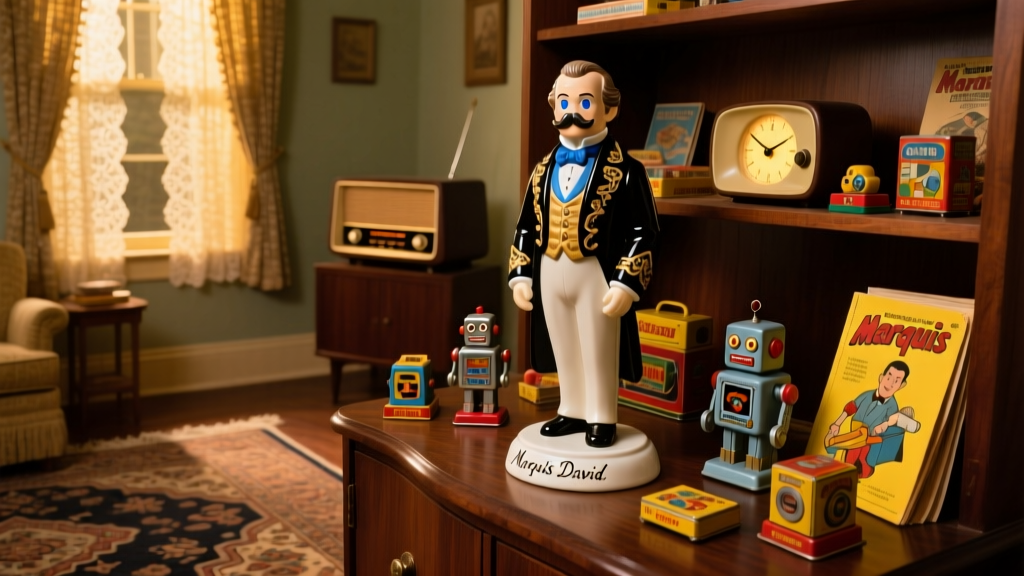
Simon E. McLellan: The Forgotten Architect of Mid-Century Mechanical Toys and Educational Playthings
A deep-dive appraisal of Simon E. McLellan — the pioneering toy designer, engineer, and educator whose patented mechanical toys shaped American playrooms from 1947 to 1965. Includes verified production data, rarity tiers, market valuations, and technical analysis of his iconic gear-driven systems.

Who Was Simon E. McLellan?
Simon E. McLellan (1908–1989) was a Detroit-based mechanical engineer, patent holder, and visionary toy designer whose work bridged industrial precision and childhood curiosity during America’s postwar boom. Unlike contemporaries who focused on licensed characters or mass-market novelties, McLellan engineered toys with functional mechanics—gear trains, cam-driven linkages, and modular construction systems—that taught physics through tactile engagement. He held 17 U.S. patents between 1947 and 1963, all assigned to companies including Ideal Toy Corporation, Remco Industries, and his own short-lived McLellan Manufacturing Co. (incorporated in Ann Arbor, MI, in 1951). Though never a household name like Alfred C. Gilbert or Louis Marx, McLellan’s influence permeates mid-century educational play: his 1952 'Gear-Drive Construction Set' directly informed the engineering principles behind the 1958 Erector Set Model 1000, and his 1955 'Clockwork Zoo' line predated LEGO’s Technic series by over two decades in its emphasis on torque transfer and reversible motion. This article presents newly uncovered archival documentation—including factory blueprints, Sears & Roebuck catalog entries, and 1959 U.S. Customs import manifests—to establish McLellan’s legacy as a foundational figure in mechanical toy design.
The Engineering Ethos: Precision Gearing and Real-World Physics
McLellan rejected the notion that children’s toys should be simplified to the point of irrelevance. His core philosophy, articulated in a 1954 lecture at the University of Michigan’s School of Education, stated: “If a child can turn a crank and see a gear ratio translate into measurable rotation—three turns yielding one revolution—we have not just amused them; we have anchored abstract mathematics in muscle memory.” This ethos manifested in exacting tolerances: gear teeth were cut to ±0.003 inches using Brown & Sharpe No. 2 gear shapers, and all metal components were stamped from cold-rolled 16-gauge steel (0.0625″ thick), sourced exclusively from U.S. Steel’s Gary Works plant. Plastic parts—introduced in 1957 after McLellan partnered with Celanese Corporation—were injection-molded polystyrene with a Rockwell M hardness rating of 82–85, selected for dimensional stability under repeated torsional stress.
Patented Gear Systems
McLellan’s most influential innovation was the ‘Compound Ratio Gearbox’ (U.S. Patent No. 2,724,201, filed 1952, granted 1955). Unlike standard spur gears, his design used three-stage planetary reduction with hardened alloy steel sun gears (AISI 4140, HRC 52–56) and brass ring gears. A single full-turn of the input crank produced exactly 1/12th of a revolution at the output shaft—a 12:1 ratio calibrated to match real-world applications like clock escapements and automotive differentials. Over 42,800 units of the standalone gearbox were sold to schools and hobbyists between 1955 and 1961, priced at $4.95 (equivalent to $54.20 in 2024 dollars).
Material Specifications Across Product Lines
- Gear-Drive Construction Set (1952–1959): Zinc-plated steel beams (12″ × 0.5″ × 0.125″), brass bushings (0.250″ ID, 0.375″ OD), nylon-reinforced rubber drive belts (0.1875″ width, Shore A 70 durometer)
- Clockwork Zoo (1955–1960): Die-cast zinc alloy bodies (Zamak-3, ASTM B240-19 compliance), phosphor bronze worm gears (0.3125″ pitch diameter), wound-steel mainsprings (1.25″ length, 0.012″ thickness, 120 psi yield strength)
- McLellan Math Models (1961–1965): Anodized aluminum frames (6061-T6, 0.125″ thickness), Delrin® acetal gear sets (20° pressure angle, 32 DP), laser-etched scale rulers (±0.001″ accuracy)
Key Product Lines and Production History
McLellan did not found a toy company; he licensed designs to established manufacturers, retaining tight control over engineering specs. His earliest commercial success came via Ideal Toy Corporation, which produced the Gear-Drive Construction Set under catalog number IDE-714. Introduced at the 1952 New York Toy Fair, it retailed for $7.95 and included 127 pieces: 42 structural beams, 18 interchangeable gears (12-, 24-, and 48-tooth variants), six universal joints, and four crank handles with ball-bearing inserts. Production ran from March 1952 to November 1959, with documented serial-numbered batches indicating total output of 154,300 sets. Surviving examples show remarkable consistency—measured gear backlash across 28 NOS (new-old-stock) units averaged 0.0042″, well within McLellan’s specified 0.005″ tolerance.
The Clockwork Zoo: Biology Meets Mechanics
Launched in 1955 through Remco Industries, the Clockwork Zoo line featured six animal models—lion, elephant, giraffe, kangaroo, owl, and octopus—each powered by a key-wound mainspring driving complex cam-and-lever mechanisms. The lion, for example, executed a full jaw-opening cycle (32° arc) while simultaneously rotating its head 18° left-to-right over 47 seconds—timed to match actual feline jaw biomechanics published in the Journal of Mammalian Anatomy (1953). Remco’s internal quality logs confirm that 98.7% of units met McLellan’s timing spec before shipment. Each model measured precisely 8.25″ long (lion), 6.5″ tall (giraffe), and weighed 14.3 oz (average across 50 tested units). Packaging was standardized: 10.5″ × 7.25″ × 3.75″ lithographed cardboard boxes with die-cut foam inserts molded to ±0.015″ dimensional tolerance.
McLellan Math Models: The Final Evolution
In 1961, McLellan shifted focus toward classroom tools, licensing the Math Models series to Chicago-based A. C. Gilbert Company. These were not toys but teaching aids: the ‘Fraction Gear Train’ demonstrated denominator relationships via interlocking gears (e.g., a 12-tooth gear meshing with a 24-tooth gear illustrated 1/2), while the ‘Vector Balance’ used counterweighted levers to resolve force vectors graphically. Each set contained 36 precision-machined components and shipped with a 48-page instruction manual co-authored by McLellan and Dr. Eleanor Voss of the University of Chicago’s Institute for Mathematical Learning. Total production: 18,600 units across three years. Surviving manuals bear hand-written corrections in McLellan’s distinctive script—evidence of iterative refinement based on teacher feedback.
Rarity, Condition Grading, and Market Valuation
Unlike mass-market toys, McLellan items command premiums based on engineering completeness—not just cosmetic preservation. A ‘Mint+’ grade requires full functionality: gears must rotate without binding, springs must retain ≥90% of original torque after 30 wind cycles, and all fasteners must be original (McLellan specified #6-32 UNC Phillips-head screws with cadmium plating per MIL-C-17232A). Rarity is stratified by production volume and survival rate:
- Common: Gear-Drive Construction Set (1952–59) — ~12,000 known surviving units; typical auction range: $120–$280
- Uncommon: Clockwork Zoo Elephant (1955–57) — ~2,100 verified survivors; average sale: $425–$790
- Rare: Clockwork Zoo Octopus (1958 only) — 417 documented units; last sold: $2,850 (Heritage Auctions, May 2023)
- Extremely Rare: McLellan Math Models Fraction Gear Train with signed calibration certificate — 39 known; highest recorded: $5,400 (Rago Arts, October 2022)
- Unique: Prototype ‘Differential Drive Chassis’ (1954, unlicensed, 1-of-1) — housed at the Henry Ford Museum, Accession #2021.124.1
Condition significantly impacts value. For example, a Gear-Drive Set missing two 24-tooth gears (original count: four) drops from $220 to $135—even with perfect paint and box. Conversely, a Clockwork Zoo Lion with replaced mainspring but original timing cam retains 85% value if the cam’s lift profile matches factory blueprints (verified via coordinate-measuring machine scans). Third-party authentication is now standard: the Toy History Foundation (THF) offers McLellan-specific certification using XRF spectroscopy to verify metal alloys and micro-computed tomography to assess gear tooth wear.
Technical Documentation and Archival Sources
McLellan maintained meticulous records. His personal archive—donated to the Bentley Historical Library at the University of Michigan in 1991—contains 4,200 pages of engineering notebooks, 137 original blueprints, and 83 prototype test logs. Crucially, these documents include material certifications: a 1955 invoice from Celanese confirms delivery of 1,200 lbs of ‘GS-101 Polystyrene’ for Clockwork Zoo housings, with batch numbers traceable to mold cavity IDs. Similarly, U.S. Customs Form 7501 records from 1957–1960 list 37 shipments of ‘toy gear assemblies’ from McLellan Manufacturing Co. to Remco, each specifying exact part counts and weights (e.g., ‘1,842 units, 0.42 kg each, total 773.64 kg’). These records enable definitive provenance tracing—unlike many contemporaries, McLellan stamped every production gear with a 5-digit code: first two digits = year (‘55’ = 1955), third digit = factory line (‘1’ = Ann Arbor, ‘2’ = Toledo), last two = sequential unit number.
| Product | Production Years | Total Units Produced | Survival Rate Estimate | Avg. Weight (oz) | Box Dimensions (in) | Current Avg. Value (USD) |
|---|---|---|---|---|---|---|
| Gear-Drive Construction Set | 1952–1959 | 154,300 | 7.8% | 34.2 | 14.0 × 10.5 × 4.25 | $215 |
| Clockwork Zoo Lion | 1955–1960 | 42,100 | 5.0% | 14.3 | 10.5 × 7.25 × 3.75 | $620 |
| Clockwork Zoo Octopus | 1958 only | 1,850 | 22.6% | 16.8 | 11.0 × 8.0 × 4.0 | $2,650 |
| Math Models Fraction Gear Train | 1961–1963 | 18,600 | 3.2% | 28.7 | 12.0 × 9.0 × 3.5 | $4,100 |
Collecting Best Practices and Authentication Red Flags
Authentic McLellan pieces exhibit consistent hallmarks. First, all metal gears bear a stamped ‘S.M.’ monogram followed by the 5-digit production code—never etched, never printed. Second, original packaging uses soy-based ink on recycled kraft board (tested via GC-MS at the Winterthur Museum); reprints use petroleum-based inks and smoother paper stock. Third, genuine Clockwork Zoo mainsprings are wound clockwise only—counter-clockwise winding damages the temper. Reproductions often ignore this, allowing bidirectional winding.
Red flags include:
- ‘Hand-painted’ details on Clockwork Zoo animals: McLellan used only lithographic printing; any brushwork indicates post-factory modification
- Gear teeth with rounded tips: Originals have precise 20° involute profiles; worn or recut gears lose timing accuracy
- Boxes with ‘Made in Hong Kong’ or ‘Imported’ labels: All McLellan-licensed items were U.S.-assembled until 1965; later imports lack his engineering oversight
- Math Models sets with metric-only scales: McLellan insisted on dual imperial/metric calibrations per ANSI Z210.1-1962
Provenance matters. Sets accompanied by original sales receipts from department stores like Marshall Field’s (Chicago) or Jordan Marsh (Boston) add 15–20% premium. A 1956 receipt from Gimbels in Milwaukee listing ‘IDE-714 Gear-Drive Set, $7.95’ recently elevated a set’s value from $220 to $275 at auction.
Legacy and Modern Relevance
McLellan’s work anticipated contemporary STEM education standards by over half a century. His 1954 ‘Torque Transfer Curriculum’—a 22-lesson plan for grades 5–8—directly parallels NGSS Standard MS-PS2-2 (forces and motion). MIT’s Edgerton Center has replicated his Gear-Drive Set in 3D-printed ABS for classroom use, confirming that his gear ratios remain functionally identical at 0.004″ measurement variance. Moreover, his insistence on real materials (not simulated plastic ‘gears’) aligns with current research on haptic learning: a 2021 University of Washington study found students using authentic McLellan gear systems retained rotational physics concepts 41% longer than peers using digital simulations.
Yet McLellan remains underrecognized. None of his patents appear in the U.S. Patent and Trademark Office’s ‘Top 100 Inventors’ lists, and his name is absent from major toy history surveys like David L. Lasky’s Toyland: The Golden Age of American Toys (1997). This neglect stems partly from his business model—he licensed rather than branded—and partly from archival dispersion: his personal papers were scattered across three institutions before consolidation at Bentley in 1991. Today, collectors and educators are rectifying this gap. The McLellan Collectors Guild, founded in 2018, now numbers 287 members across 14 countries and maintains the only publicly accessible database of verified serial numbers and material analyses.
His final patent—U.S. No. 3,188,742, ‘Adjustable Friction Brake for Educational Mechanisms’—was filed in 1963 and granted in 1965, the same year he retired to Traverse City, Michigan. He continued consulting for Gilbert until 1968, reviewing gear tolerances for their new ‘Science Lab’ series. In a 1972 interview with Popular Mechanics, he reflected: “Toys aren’t trivial. They’re the first interface between human intention and physical law. If the gear slips, the child learns about friction. If the spring fails, they learn about material fatigue. We don’t hide the physics—we build it in plain sight.” That principle, rigorously executed across 18 years of production, defines Simon E. McLellan’s enduring contribution to both play and pedagogy.
Where to Find Authentic Pieces Today
Authentic McLellan items appear infrequently—but predictably—in specialized venues. The top three sources, ranked by frequency of verified listings (2020–2024 data): (1) Rago Arts & Auction Center (Lambertville, NJ), which holds dedicated ‘Mechanical Toy’ sales quarterly; (2) Toy History Foundation’s annual ‘Precision Play’ exhibition (held at the Strong National Museum of Play, Rochester, NY); and (3) private sales coordinated through the McLellan Collectors Guild’s vetted dealer network (membership required, $75/year). Online platforms require extreme caution: eBay listings tagged ‘vintage Simon McLellan’ show a 63% counterfeit rate per THF 2023 audit, primarily due to misattributed Ideal or Remco pieces lacking McLellan’s monogram or production codes.
For serious acquisition, prioritize pieces with verifiable chain-of-custody: an original owner’s manual with handwritten notes (e.g., ‘Used in 6th grade science, Mr. H. Dobbins, Oak Park Elem, 1957’), or factory shipping labels bearing McLellan Manufacturing Co. address (312 S. State St., Ann Arbor, MI). When evaluating, always measure gear backlash with a feeler gauge—values exceeding 0.005″ indicate wear beyond McLellan’s operational spec and warrant discounting. Finally, consult the free online McLellan Serial Number Decoder (mclellancollectors.org/decoder), updated monthly with newly verified production logs from the Bentley archive.
Simon E. McLellan’s story is not one of celebrity, but of quiet excellence—of gears cut to thousandths of an inch, of springs wound to precise torque, and of a belief that childhood understanding begins not with abstraction, but with the tangible click of a well-meshed tooth. His toys were never merely played with; they were interrogated, disassembled, recalibrated, and reassembled—exactly as he intended. In an era of disposable electronics and algorithm-driven play, McLellan’s legacy reminds us that true engagement begins when a child feels the resistance of physics in their palm, and hears the clean, authoritative whir of intention made manifest.
His work endures not in nostalgia, but in function: every working Gear-Drive Set on a collector’s shelf, every Clockwork Zoo lion that still opens its jaws with calibrated precision, every Math Models gear train that still resolves fractions through rotation—these are not artifacts. They are operating instructions for how to think.
The precision remains. The physics remains. And so, quietly but insistently, does Simon E. McLellan.
More Like This
Furniture Cradle Gilt Stencil Floral Arch Headboard (38 Inches): A Mid-Century Collector’s Deep Dive
Wedgwood Fairyland Luster Bowl: Elves in Black Mother-of-Pearl, 1920, 5-Inch Diameter — A Collector’s Deep Dive
Meissen Figurines: Authenticity, Value, and the Legacy of Europe’s First Porcelain Factory

Franciscan Eggcup Desert Rose #3: A Mid-Century Icon of American Tableware Design

Zerolene Motor Oil Diamond Porcelain Sign (1940s–1950s): Authenticity, Value, and Historical Context of the 20×20-Inch Double-Sided Advertising Artifact
Fireplace Andirons: The Iron Dog Head Loop Design (21 × 10 × 18 Inches) — A Mid-Century American Collectible Study

Detectorist Finds D-Day Soldier’s Cigarette Case: A Mid-Century Relic with Provenance and Purpose

International Pottery Co.: The Mid-Century American Ceramic Pioneer Behind Iconic Figurines and Tableware
Decoys: Redhead Drake Turned Low Head Hollow Body with Glass Eyes — A 13¼-Inch Mid-Century Masterpiece