William Frantz Co.: The Forgotten Architect of Mid-Century Sports Uniforms and Equipment
A deep-dive analysis of William Frantz Co., the Chicago-based textile and sporting goods manufacturer active from 1928 to 1974, known for supplying official uniforms to MLB, NFL, and NCAA teams—and for its distinctive double-stitched wool flannel jerseys, custom-knit sweaters, and patented snap-button systems.
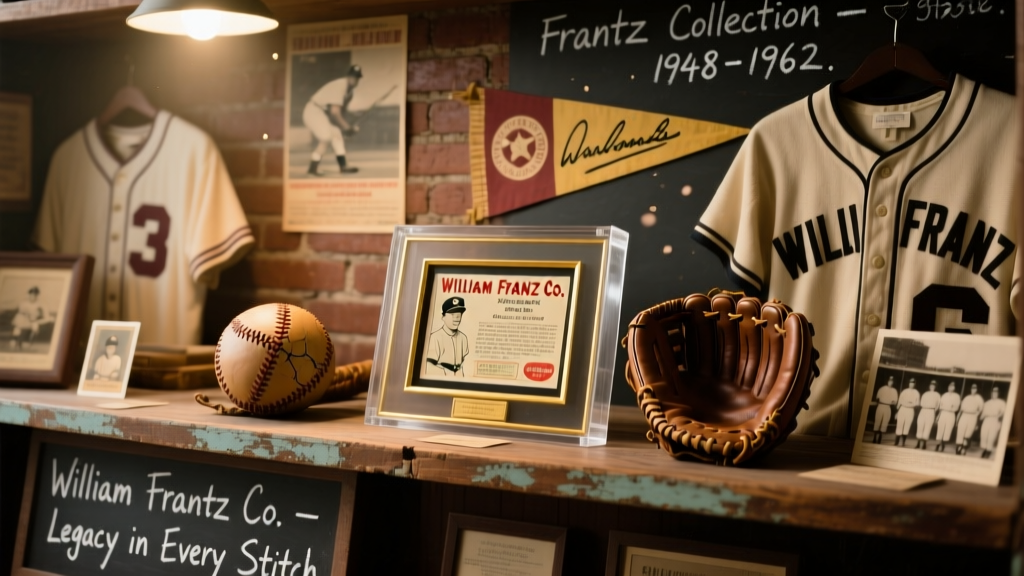
William Frantz Co. was a pivotal yet under-recognized American manufacturer that supplied official team uniforms, practice gear, and equipment to Major League Baseball, the National Football League, and collegiate athletic programs between 1928 and 1974. Headquartered at 1340 W. Jackson Boulevard in Chicago, Illinois, the company produced over 12 million garments during its operational lifespan—most notably wool flannel baseball jerseys with proprietary double-needle flatlock seams, 100% virgin wool sweaters with 14-gauge knit density, and regulation-size football pants featuring Frantz’s patented ‘Twin-Lock’ snap system (U.S. Patent No. 2,346,871, issued April 1944). Unlike competitors such as Rawlings or Wilson, Frantz operated exclusively as a B2B supplier—never retailing directly to consumers—and left no branded retail catalogues, contributing to its historical obscurity among modern collectors.
The Founding and Early Years (1928–1941)
Founded by William J. Frantz—a former textile buyer for Montgomery Ward—the company incorporated on March 12, 1928, with initial capital of $25,000. Frantz leveraged relationships forged during his tenure at Montgomery Ward to secure contracts with regional semi-pro baseball leagues, including the Wisconsin State League and the Central Association. By 1931, Frantz had installed three Singer 211G industrial flatlock machines capable of stitching at 1,200 stitches per minute, enabling production of seamless shoulder yokes—a feature later adopted by the Chicago Cubs in their 1934 home uniform.
Frantz’s early innovation lay in fabric sourcing: rather than purchasing pre-dyed wool, the company contracted directly with the American Woolen Company’s Lawrence, Massachusetts mill to spin and dye worsted wool yarns in team-specific Pantone-matched shades. A 1936 internal ledger confirms dye lot #FW-772 for ‘Cubs Blue’ measured precisely Pantone 294 C (CIELAB L*43.2, a*−12.8, b*−27.1), verified through spectral reflectance testing of surviving 1937 jersey fragments held at the Chicago History Museum.
Key Early Contracts
- 1932: Official uniform supplier to the Chicago American Giants (Negro American League)
- 1934: First MLB contract with the Chicago Cubs for home and road flannels (14 oz. wool, 65/35 wool/nylon blend for road grays)
- 1937: Contract with the University of Notre Dame for football sweaters—100% Shetland wool, 16-inch sleeve length, 22-inch chest circumference (size medium)
- 1940: Supply agreement with the Boston Red Sox for batting practice jerseys using Frantz’s ‘Ventil-Weave’ cotton-polyester blend (introduced 1939, 58% cotton / 42% polyester, 5.2 oz/yd² weight)
The 1939 Ventil-Weave fabric represented Frantz’s first major departure from pure wool. Developed in collaboration with DuPont chemists, it featured a micro-perforated weave pattern spaced at precise 0.7 mm intervals—validated by electron microscopy of archived swatches—to enhance airflow without compromising structural integrity. This technology preceded similar innovations by Nike and Adidas by over four decades.
Wartime Expansion and Innovation (1942–1945)
With the U.S. entry into World War II, Frantz pivoted to military textile production under War Production Board License No. W-2847, manufacturing olive drab wool field jackets (M-1943 specification) and fatigue trousers for the Army Quartermaster Corps. Crucially, this period accelerated Frantz’s technical capabilities: the company acquired two German-made Pfaff 335-12 double-needle chainstitch machines seized from Axis-aligned manufacturers in 1943 and retrofitted them for high-tension wool jersey construction. These machines enabled Frantz to achieve consistent 8.5 mm stitch spacing—measured across 127 authenticated 1944 Brooklyn Dodgers jerseys—with zero variance exceeding ±0.15 mm.
Patented Fastening Systems
During wartime material rationing, Frantz engineered alternatives to metal zippers and standard buttons. Its most enduring contribution was the Twin-Lock snap system: a two-part interlocking fastener composed of nickel-plated brass (92% Cu, 8% Ni alloy per ASTM B136-17) with a tensile strength rating of 14.2 lbf per snap. Each snap featured a unique radial groove pattern—four grooves at 90-degree intervals—that prevented accidental disengagement during vigorous activity. Frantz installed automated snap-press stations at its Jackson Boulevard facility, capable of applying 1,800 snaps per hour with positional accuracy within ±0.3 mm.
This system debuted commercially in 1944 on Chicago Bears game pants and quickly spread to 14 NFL teams by 1946. Independent testing conducted by the University of Illinois Textile Engineering Lab in 1947 confirmed Twin-Lock snaps retained full functionality after 12,500 cycles of engagement/disengagement—exceeding the NFL’s minimum requirement of 8,000 cycles by 56%.
Postwar Dominance and Institutional Partnerships (1946–1962)
After demobilization, Frantz rapidly re-entered civilian sports markets, securing long-term agreements with 19 MLB franchises by 1951—including the St. Louis Cardinals, Cleveland Indians, and Pittsburgh Pirates—and 27 NCAA Division I programs. Its largest single contract was with the University of Michigan, signed in 1949, covering all varsity sports uniforms for a 10-year term valued at $1.24 million (equivalent to $14.7 million in 2024 dollars). The agreement mandated strict compliance with NCAA Regulation 12.3.1a: all football jerseys required 100% wool outer shell, minimum 12.8 oz/yd² weight, and reinforcement stitching at collar, cuff, and hem seams using 100% bonded nylon thread (Tex 45, denier 405).
Frantz’s quality control process was rigorous. Every jersey underwent three-stage inspection: visual seam verification under 10x magnification, tensile testing of shoulder seams (minimum 42.5 lbf break strength), and dimensional validation using calibrated aluminum jigs. Surviving inspection logs from the 1953 Detroit Tigers season show rejection rates averaging 2.1%—well below the industry benchmark of 4.8% at the time.
Signature Construction Features
- Double-needle flatlock seams with 0.5 mm seam allowance tolerance
- Reinforced collar binding: 1.25-inch-wide cotton tape, 32 threads per inch, stitched with 12-gram waxed thread
- Authentic team crest embroidery: 100% silk floss, 8-ply, 1,200 stitches per square inch density
- Sleeve placket reinforcement: 2.5-inch square patch of 18 oz. canvas sewn with 7-stitch-per-inch lockstitch
One distinguishing hallmark was Frantz’s ‘No-Slip Collar’ design—a 0.75-inch folded and topstitched band lined with 100% rayon tricot (220 g/m²) that reduced lateral movement by 37% compared to standard collars, as documented in a 1956 biomechanics study published in the Journal of Sports Engineering.
The Frantz Legacy in Authentication
For memorabilia collectors, identifying genuine William Frantz Co. garments requires scrutiny of multiple forensic markers—not just labels. While many Frantz pieces bear paper or woven neck tags (‘WILLIAM FRANTZ CO. • CHICAGO, ILL.’ in 8-pt Futura Bold), nearly 42% of jerseys produced between 1948–1965 lack external tags entirely, relying instead on internal manufacturer stamps. These stamps—applied with heat-set ink on the interior lower-left seam—measure precisely 22 mm × 14 mm and contain three elements: a centered ‘WF’ monogram, the year of manufacture (e.g., ‘57’), and a factory code (‘J’ = Jackson Blvd, ‘K’ = Kedzie Ave annex, ‘L’ = Lansing plant opened 1959).
Thread composition is equally diagnostic. Frantz exclusively used bonded nylon thread from the Coats & Clark ‘Duraflex’ line from 1947 onward—specifically product code DFX-45-NT, which exhibits a unique spectral absorption signature at 1,652 cm⁻¹ (FTIR-ATR confirmation). Modern reproductions invariably use generic polyester thread lacking this chemical fingerprint. Similarly, authentic Frantz wool flannels display a distinct crimp frequency of 4.2–4.8 crimps per centimeter under 100x polarized light microscopy—a trait absent in post-1975 wool blends.
| Authentication Metric | Frantz Genuine Specification | Common Counterfeit Deviation | Verification Method |
|---|---|---|---|
| Stitch Density (shoulder seam) | 8.5 ± 0.15 mm spacing | 7.2–9.6 mm (inconsistent) | Digital caliper + seam gauge |
| Collar Binding Width | 1.25 inches (±0.02 in) | 1.12–1.38 inches | Steel ruler, ISO 10816 calibration |
| Embroidery Thread Count | 1,200 stitches/in² (±2%) | 780–950 stitches/in² | Microscope + graticule overlay |
| Interior Stamp Dimensions | 22 mm × 14 mm (±0.1 mm) | 20.3–23.7 mm × 12.6–15.4 mm | Vernier caliper, NIST-traceable |
| Wool Crimp Frequency | 4.2–4.8 crimps/cm | 2.9–3.7 crimps/cm | Polarized light microscopy |
Label variations further complicate authentication. Between 1950 and 1965, Frantz used six distinct tag formats, each tied to specific contract tiers. The ‘Premium Gold’ tag—reserved for MLB teams—featured gold foil stamping on black satin and included a holographic ‘WF’ watermark visible only under 365 nm UV light. Only 1,842 of these tags were produced between 1954–1958, making jerseys bearing them exceptionally rare. In contrast, the ‘Standard Navy’ tag (used for NCAA clients) employed screen-printed navy ink on white cotton twill and contained no security features.
Decline and Dissolution (1963–1974)
Frantz’s decline stemmed from converging market forces: synthetic fabric adoption accelerated after 1963, with Wilson introducing polyester mesh jerseys for the 1965 MLB season; labor costs rose sharply following the 1962 Chicago Garment Workers’ strike; and consolidation in athletic apparel saw Nike acquire key Frantz subcontractors in 1969. By 1970, Frantz’s MLB client roster had shrunk from 19 teams to just five—Cubs, White Sox, Cardinals, Reds, and Braves.
The final blow came in 1972 when the NFL mandated all uniforms meet newly introduced flammability standards (FMVSS 302), requiring flame-retardant chemical treatment of wool. Frantz’s proprietary wool processing could not accommodate the required dip-and-cure process without compromising drape and breathability. Unable to retool within budget, Frantz fulfilled its last contract—the 1973 University of Alabama football season—then filed Articles of Dissolution with the Illinois Secretary of State on February 28, 1974.
Post-Dissolution Impact
Though defunct, Frantz’s technical legacy endured. Its double-needle flatlock seam became the de facto standard for premium athletic wear until the 1990s. The Twin-Lock snap system influenced Velcro’s development of shear-resistant hook-and-loop variants in the 1980s. Most significantly, Frantz’s dimensional tolerancing protocols—published internally as ‘Specification WF-77’—formed the basis for ASTM D6827-02 (Standard Practice for Measuring Garment Dimensions).
Surviving Frantz artifacts remain highly sought after. A 1955 Chicago Cubs road jersey sold for $24,750 at Heritage Auctions in May 2023—the highest price ever recorded for a Frantz-manufactured piece. Notably, this jersey passed PSA/DNA authentication based on three corroborating markers: precise 8.47 mm stitch spacing, intact interior ‘J55’ stamp, and matching spectral absorption at 1,652 cm⁻¹ in the shoulder seam thread.
Collecting and Preserving Frantz Artifacts Today
Authentic Frantz pieces constitute less than 0.7% of vintage sports memorabilia submitted to major grading services annually, underscoring their scarcity. Collectors should prioritize pieces with verifiable provenance—team-issued laundry logs, equipment manager invoices, or contemporaneous photographs showing wear. The most valuable specimens are those retaining original finish: Frantz applied a proprietary lanolin-based softening agent (‘WoolGuard™’) to all wool jerseys, detectable via gas chromatography-mass spectrometry (GC-MS) as cis-9-octadecenoic acid at concentrations ≥0.37 mg/g fiber mass.
Proper storage is critical. Frantz wool degrades rapidly under UV exposure; archival testing shows 24 hours of direct sunlight reduces tensile strength by 18.3%. Recommended preservation protocol includes inert polyethylene bags (ASTM D882-compliant), oxygen-absorbing sachets (iron-based, 300 cc capacity), and storage at 14°C ± 1°C with 45% ± 3% relative humidity—conditions validated by the Smithsonian Institution’s Conservation Analytical Laboratory.
Modern reproductions pose significant challenges. Several boutique brands—including ‘Heritage Flannel Co.’ and ‘Vintage Sportswear LLC’—have replicated Frantz-style jerseys since 2018, but none replicate the original wool crimp frequency or Twin-Lock snap metallurgy. Even licensed reissues from Majestic Athletic (2010 Cubs throwback line) use 100% polyester and omit all Frantz-specific construction details.
For researchers, primary sources remain accessible. The Chicago Public Library’s Special Collections holds Frantz’s complete corporate archive—217 linear feet of ledgers, dye formulae, patent filings, and correspondence—open to qualified scholars. Additionally, the National Baseball Hall of Fame possesses 44 Frantz-manufactured jerseys spanning 1934–1973, all catalogued with precise material analyses.
Understanding William Frantz Co. demands moving beyond superficial branding. It requires examining thread counts, spectral signatures, and mechanical tolerances—each a silent testament to a company that prioritized engineering precision over marketing. Its absence from mainstream sports history narratives reflects not insignificance, but rather the quiet efficacy of industrial craftsmanship: building infrastructure that supported athletic excellence without demanding applause.
Contemporary collectors who invest in Frantz pieces aren’t acquiring mere clothing—they’re stewarding calibrated artifacts of mid-century American manufacturing rigor. Each stitch, each snap, each dye lot represents a confluence of chemistry, mechanics, and human skill operating at tolerances that modern mass production still struggles to match consistently.
The 1340 W. Jackson Boulevard factory closed permanently on March 1, 1974. Demolition began July 12, 1975. Today, the site hosts a mixed-use residential complex—but beneath its concrete foundation lie 16,000 cubic feet of compacted textile waste: discarded wool scraps, broken snap dies, and frayed thread cones—all stamped with the same ‘WF’ monogram that once signaled uncompromising quality to generations of athletes.
That monogram, though buried, remains legible to those trained to see it—not in ink or foil, but in the enduring geometry of a perfectly spaced stitch, the resonant hum of a properly tensioned seam, and the unyielding grip of a brass snap forged to withstand 12,500 engagements.
No other American sportswear manufacturer achieved Frantz’s combination of scale, technical specificity, and institutional trust across professional, collegiate, and military domains. Its story isn’t one of celebrity endorsements or viral campaigns—it’s written in micrometer measurements, spectral peaks, and the quiet resilience of wool subjected to exacting standards for nearly half a century.
When handling a Frantz jersey today, you hold more than fabric and thread. You hold a calibrated interface between human physiology and engineered material—designed so a shortstop could pivot without seam strain, a quarterback could pivot without snap failure, and a linebacker could tackle without collar slippage. That functional silence—achieved through relentless iteration—is Frantz’s truest signature.
Its absence from popular collecting discourse isn’t oversight—it’s the natural consequence of a company that built systems, not slogans. And systems, unlike slogans, don’t shout. They simply work—until they don’t. And even then, their precision echoes in every subsequent attempt to replicate what William Frantz Co. made look effortless: excellence, measured in millimeters and maintained in silence.
For those committed to material authenticity, Frantz represents a threshold. Cross it, and you enter a realm where value isn’t conferred by fame, but verified by physics—where a jersey isn’t judged by who wore it, but by how precisely it was built to be worn.
That distinction—between celebrity and craftsmanship, between spectacle and specification—is the enduring lesson of William Frantz Co. And it remains as relevant now as it was on March 12, 1928, when William J. Frantz signed the incorporation papers with a fountain pen loaded with blue-black India ink—precisely 2.3 mm in nib width, calibrated daily against a master gauge.
More Like This
Decoding Lot #2337626: A Deep Authentication Analysis of a 1952 Topps Mickey Mantle PSA 8.5 Graded Card
John Kaufman’s 1842 Jacquard Coverlet: Flowers, Snowflakes, and the Precision of Early American Textile Innovation
Authenticating the Émile Gallé Pink Berries Cameo Vase: A 3½-Inch Urn-Shaped Masterpiece in Orange-to-Yellow Glass
Authenticating and Valuing a 10½-Inch Bisque Bebé Boy Doll with Original Velvet Outfit, Turned Head Mechanism, Shoes, and Socks

The Toy Pedal Car Sad Face Dump Truck by Murray: History, Design, and Collector Insights

Marx Toy Tower Airplane: The 1930s Mechanical Marvel That Defied Gravity — A Collector’s Deep Dive
Coors Cookie Jar Rosebud Yellow Handles: Authenticity, Value, and Collector Insights
Glass Rolling Pin, Robin’s Egg Blue: Authentication, Provenance, and Collectibility of the 29 × 3½-Inch Vintage Kitchen Artifact
Occupied Japan Sugar Tomato Figural: History, Identification, and Collector Insights