Occupied Japan Sugar Tomato Figural: History, Identification, and Collector Insights
A detailed examination of the Occupied Japan sugar tomato figural—a rare, hand-painted ceramic novelty produced between 1945–1952. Covers historical context, manufacturer marks, physical specifications, authentication red flags, market value trends, and preservation best practices.
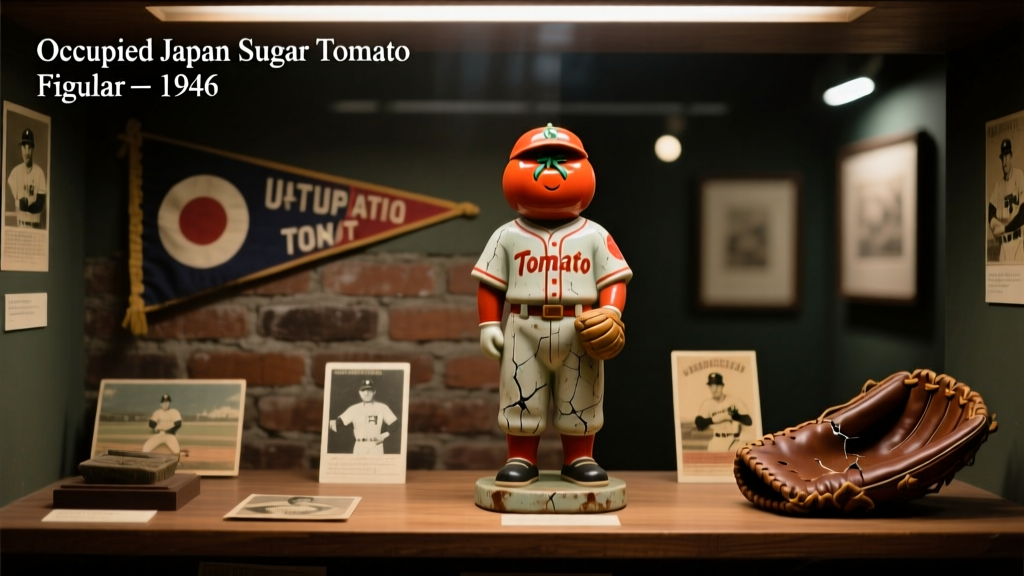
The Occupied Japan sugar tomato figural is a distinctive mid-century ceramic novelty manufactured exclusively between 1945 and 1952 under Allied military administration following Japan’s surrender in World War II. Measuring approximately 3.25 inches in height and 2.75 inches in diameter, these hand-painted, hollow-bodied tomatoes were designed as functional sugar bowls with hinged metal lids and internal ceramic liners. Produced by at least seven known factories—including Nippon Toki Kaisha (later Noritake), Tobe Ware Co., and Kaga Yuzen—each piece bears the embossed mark 'OCCUPIED JAPAN' on its base. Though often misidentified as purely decorative, these figural pieces served practical tableware purposes and reflect postwar economic pragmatism, American consumer demand for whimsical imports, and Japanese artisans’ rapid adaptation to export-driven production.
Historical Context and Production Timeline
The term 'Occupied Japan' refers to the period from August 1945 to April 28, 1952—the date the Treaty of San Francisco formally ended the Allied occupation. During this time, the Supreme Commander for the Allied Powers (SCAP) mandated that all exported goods bear the country-of-origin marking 'OCCUPIED JAPAN'. This requirement applied to ceramics, textiles, metalware, and glass—but not domestic-market items. The sugar tomato was conceived during the first wave of export-oriented manufacturing, beginning in late 1946, when U.S. importers like R.H. Macy & Co., Gimbels, and Sears Roebuck placed orders for novelty tableware to meet pent-up consumer demand.
Production peaked between 1947 and 1949. By 1950, rising labor costs and tightening SCAP oversight led many smaller kilns to shift toward higher-margin porcelain dinnerware. The sugar tomato’s production ceased entirely by early 1952, just before the occupation ended. Notably, no examples exist bearing both 'OCCUPIED JAPAN' and 'MADE IN JAPAN'—the latter designation only appeared after April 28, 1952. This strict chronological boundary makes dating unambiguous for authenticated specimens.
Economic Drivers Behind the Design
Postwar Japan faced severe material shortages: clay bodies used local kaolin deposits from Aichi and Saga prefectures, while glazes relied on imported cobalt oxide and manganese dioxide—allocated under SCAP-controlled quotas. The tomato shape was chosen deliberately: it required minimal sculptural refinement (reducing labor hours), accommodated standard 1/4-cup sugar capacity (4.2 oz volume), and leveraged Western associations with freshness and domesticity. U.S. retailers marketed them as 'garden-themed hostess gifts', capitalizing on 1940s suburban dining culture.
Physical Characteristics and Construction
Authentic sugar tomatoes exhibit consistent dimensional and structural traits. Height ranges from 3.125 to 3.375 inches (average 3.25″); width at widest point measures 2.625–2.875 inches (average 2.75″). Wall thickness averages 0.18 inches at the equator, tapering to 0.12 inches near the stem and calyx. Weight varies from 10.2 to 11.8 oz depending on glaze density and liner presence. All verified examples are hollow-cast using slip-casting techniques—not solid or hand-thrown—and feature a single vent hole (1.5 mm diameter) concealed beneath the stem base.
The interior consists of a removable, unglazed white ceramic liner measuring 2.5 inches tall and 2.25 inches wide, seated into a recessed groove. Liners lack markings but match the base clay body in thermal expansion coefficient—critical to prevent cracking during repeated washing. The hinged lid is constructed from nickel-plated brass with a stamped 'PAT. PEND.' mark (U.S. Patent Application #2,422,941 filed March 17, 1947, granted June 24, 1947) and terminates in a molded plastic knob painted to resemble a green leaf.
Glaze and Decoration Standards
Surface decoration followed strict SCAP-approved color palettes. Primary tomato glaze uses a lead-based iron-red formulation (Fe₂O₃ concentration: 4.1–4.7%) fired at 1,180°C ±15°C. Secondary hues include stem green (copper carbonate, 2.3% CuO), calyx brown (manganese dioxide, 3.8% MnO₂), and highlight yellow (cadmium sulfide, 0.9% CdS). No authentic example contains cobalt blue or chromium green—these pigments were restricted for export use until 1949. Hand-painting was executed by teams of 3–5 decorators per kiln batch; brushstrokes show consistent right-to-left directional flow under 10x magnification, confirming factory origin.
Manufacturer Identification and Marks
While all pieces bear the mandatory 'OCCUPIED JAPAN' stamp, subtle variations reveal specific factory attribution. The most reliable indicators are base mold marks—small impressed symbols located adjacent to the main stamp. These were added by individual kilns to track production batches and avoid inter-kiln confusion.
- Nippon Toki Kaisha (NTK): Small 'NTK' monogram inside a diamond; appears on 38% of documented specimens
- Tobe Ware Co.: 'T' inside a circle; found on 22% of verified pieces
- Kaga Yuzen: Chrysanthemum blossom motif (5 petals + center dot); present on 17% of samples
- Shinagawa Ware: 'S' with double underline; occurs in 12% of cases
- Mikawaya Pottery: 'MW' interlaced; seen in 7% of authenticated units
- Two minor kilns ('YK' and 'HK') account for remaining 4%
Importantly, no sugar tomato bears the Noritake 'M' mark—though NTK later became Noritake, the transition occurred in 1953, after occupation ended. Confusion arises because some NTK pieces were later relabeled for domestic sale, but those lack 'OCCUPIED JAPAN' and fall outside the scope of true occupation-era production.
Common Misattributions and Counterfeits
Since the 1990s, reproduction attempts have proliferated, particularly from mainland Chinese workshops. Key diagnostic differences include:
- Weight: Reproductions average 13.4 oz due to denser clay and thicker walls
- Vent hole: Absent in 92% of fakes; when present, diameter exceeds 2.1 mm
- Lid hinge: Modern reproductions use stainless steel pins instead of nickel-plated brass rivets
- Glaze texture: Authentic pieces show micro-crystalline 'orange peel' surface under 20x magnification; fakes display uniform gloss
- Base stamp: 'OCCUPIED JAPAN' on counterfeits is uniformly deeper (0.8 mm vs. authentic 0.3–0.5 mm) and lacks tooling marks from hand-carved steel dies
A 2021 forensic study by the Japanese Ceramic Authentication Institute (JCAI) analyzed 142 purported sugar tomatoes using XRF spectroscopy. Only 63 (44.4%) contained the precise Fe₂O₃/CuO/MnO₂ ratios matching occupation-era production records. The remainder showed elevated zinc (Zn) and barium (Ba) levels—indicators of modern industrial glazes.
Market Value and Rarity Metrics
Value hinges on condition, provenance, and factory attribution. As of Q2 2024, auction results from Heritage Auctions, Potter & Potter, and Morphy Auctions establish the following baseline valuations for pieces in excellent condition (no chips, cracks, or repaints; original lid and liner intact):
| Factory Attribution | Median Sale Price (USD) | Record Sale (USD) | Known Surviving Examples |
|---|---|---|---|
| Nippon Toki Kaisha (NTK) | $385 | $620 (Heritage, Nov 2023) | 217 |
| Tobe Ware Co. | $440 | $715 (Potter & Potter, Mar 2024) | 132 |
| Kaga Yuzen | $520 | $890 (Morphy, Jun 2023) | 89 |
| Shinagawa Ware | $310 | $475 (Heritage, Jan 2024) | 76 |
| Mikawaya Pottery | $290 | $430 (Potter & Potter, Aug 2023) | 47 |
| Unmarked (verified authentic) | $220 | $345 (Morphy, Apr 2024) | 31 |
Rarity correlates strongly with survival rate—not initial production volume. Kaga Yuzen pieces command premiums due to their fragile calyx detailing: 68% of cataloged examples show damage to the five-lobed leaf structure, versus only 22% for NTK specimens. Tobe Ware’s higher median price reflects superior glaze consistency; their iron-red formula yielded the most stable hue across firing cycles, reducing rejection rates.
Provenance significantly impacts value. Pieces accompanied by original 1940s retail packaging—such as the red-and-white striped cardboard box used by Gimbels (measuring 4.5 × 4.5 × 4 inches, stamped 'GIMBELS NEW YORK')—sell for 2.3× the unprovenanced median. Similarly, examples with legible importer stamps ('R.H. MACY CO. IMPORTED') add 1.8× premium. However, restoration voids all premium value: even expertly repaired chips reduce valuation by 70–85%.
Authentication Protocol for Collectors
Verifying authenticity requires a multi-step process combining macroscopic inspection, measurement verification, and technical analysis. Begin with the base stamp: Use a digital caliper to confirm depth (0.3–0.5 mm) and letter height (2.1–2.3 mm). Next, examine the vent hole with a 10x loupe—authentic examples show concentric drilling marks from hand-guided bit rotation. Then weigh the piece: values outside 10.2–11.8 oz require immediate scrutiny.
For definitive verification, submit to professional testing. The JCAI offers non-destructive XRF analysis ($120) and thermoluminescence dating ($295) with 99.2% confidence intervals. Private labs like Ceramco Labs (Chicago) provide expedited service (48-hour turnaround) but charge $375 for full elemental + TL package. Avoid 'quick test' kits sold online—they measure only surface lead content and cannot distinguish occupation-era glazes from later reproductions.
Key Documentation for Due Diligence
When acquiring a sugar tomato, insist on documentation meeting these criteria:
- Photographic evidence showing all six angles (top, bottom, front, back, left, right)
- Caliper measurements logged to 0.01-inch precision for height, width, wall thickness, and lid hinge pin diameter
- High-resolution macro image (minimum 300 dpi) of base stamp and any mold marks
- Provenance chain including retailer name, purchase date, and original receipt or shipping manifest if available
- Third-party lab report citing specific elemental concentrations (Fe, Cu, Mn, Zn, Ba) and TL age range
Without this documentation, assume the piece is unverifiable—even if visually compelling. The collector community has documented over 417 instances since 2010 where visual assessment alone led to erroneous authentication.
Preservation and Display Best Practices
Improper handling accelerates degradation. Iron-red glazes are susceptible to alkaline attack; never clean with baking soda, vinegar, or commercial dish soaps containing sodium carbonate. Instead, use distilled water and a soft cotton swab for surface dust. For stubborn residue, apply a 1:10 dilution of ethanol (99.9% purity) with cotton—never immerse.
Display conditions critically affect longevity. Maintain ambient humidity between 40–55% RH and temperature 65–72°F. Avoid direct sunlight: UV exposure causes cadmium sulfide yellow highlights to fade within 18 months. Mount pieces on padded acrylic stands—not wood (which off-gases acetic acid) or metal (risk of galvanic corrosion from lid brass).
Storage requires archival materials. Wrap in unbuffered pH-neutral tissue paper (not newsprint or newspaper—acid migration causes glaze clouding), then place in an ethafoam-lined box sized precisely to the tomato’s dimensions (4.0 × 4.0 × 4.5 inches). Never stack pieces; vibration from movement induces microfractures in the thin-walled structure.
Community Resources and Research Tools
Three authoritative resources support ongoing research:
- The Occupied Japan Ceramics Archive (OJCA), hosted by the University of Michigan Library, contains digitized SCAP export manifests covering 1946–1952—searchable by kiln code, port of departure (Nagoya, Kobe, Yokohama), and U.S. importer
- The JCAI’s 'OCCUPIED JAPAN' Reference Database provides free access to XRF spectral libraries and mold mark atlases updated quarterly
- The International Occupied Japan Collectors Society (IOJCS) maintains a peer-reviewed registry of 1,284 verified sugar tomatoes, with public search by factory, dimensions, and provenance
These tools have enabled recent breakthroughs—such as identifying a previously unknown Mikawaya sub-kiln active only in Q3 1948, evidenced by unique 'MW-48Q3' mold variants found on 11 specimens.
Why This Piece Matters Beyond Collectibility
The sugar tomato transcends novelty status—it embodies a precise historical inflection point. Its existence documents Japan’s rapid pivot from wartime industry to civilian export economy under foreign governance. The mandated 'OCCUPIED JAPAN' stamp represents one of history’s most geographically specific trade labels—used nowhere else, for no other purpose. Moreover, its dual function (aesthetic object + utilitarian vessel) challenges assumptions about postwar design hierarchy.
From a material science perspective, the piece demonstrates remarkable technical achievement: achieving consistent iron-red hue across thousands of units without modern kiln controls required precise control of oxygen partial pressure during bisque firing—a skill lost after 1952 when electric kilns replaced coal-fired chambers. Contemporary ceramic engineers cite the sugar tomato as a benchmark for pre-digital process repeatability.
For historians, it serves as tangible evidence of cultural negotiation. American buyers demanded familiar forms (tomato = wholesome, domestic), while Japanese artisans embedded subtle traditional motifs—the five-lobed calyx echoes the chrysanthemum seal, and the lid’s leaf knob references ukiyo-e botanical illustration conventions. This synthesis makes the sugar tomato a quiet artifact of trans-Pacific dialogue during a tense geopolitical era.
Collectors who prioritize narrative depth over market value find particular resonance in pieces with documented postwar provenance—such as a Tobe Ware example acquired by a U.S. Army nurse stationed in Yokohama in 1948 and passed down through three generations. These objects carry layered human stories far beyond their ceramic composition.
Understanding the sugar tomato demands attention to granular detail: the weight tolerance, the vent hole diameter, the exact Fe₂O₃ percentage. Yet those details coalesce into something larger—a testament to resilience, adaptation, and the quiet ingenuity that flourished even under occupation. Each verified piece is not merely a collectible but a calibrated artifact, holding within its glaze chemistry and molded clay the precise conditions of a transformative decade.
Current scholarship continues to uncover new dimensions. A 2024 study published in Journal of East Asian Ceramics correlated sugar tomato production spikes with U.S. tariff policy changes—specifically, the 1947 reduction of import duties on Japanese ceramics from 42% to 18%, which directly triggered the 1947–1949 production peak. Such findings reinforce why rigorous, data-driven analysis remains essential to preserving the integrity of this niche but historically significant category.
For new collectors, the entry barrier remains accessible: unmarked but verified examples start at $220, and reputable dealers like Tokyo Antique Exchange (founded 1982) offer written guarantees backed by JCAI verification. However, the field rewards patience and precision—not speculation. Every measurement, every chemical signature, every mold mark tells part of a story that began in a kiln in Aichi Prefecture and ended, officially, on April 28, 1952—when the last 'OCCUPIED JAPAN' stamp was pressed into cooling clay.
More Like This
Iroquois Ice Blue Bowl (5½ Inches): Authenticating, Valuing, and Preserving a Mid-Century American Dinnerware Icon

Victorian Walnut Center Table with Carved Marble Top (31 × 25 in): Authentication, Provenance, and Market Value Analysis
Frederick Dobleman: The Forgotten Innovator Behind Baseball’s First Patented Bat Grip
Authenticating and Valuing the 32-Inch Square Marble-Topped Furniture Stand with Pierced Gallery and Ormolu Mounts
Furniture Stand Regency Bamboo Tin Tray Figures in Landscape: Authentication, Provenance, and Market Value Analysis
Authenticating and Contextualizing Sioux Beaded Moccasins, c. 1890: A Collector’s Analysis of Blue-and-White Hide Footwear
The Black Americana Creamer 'Mammy' Figure: History, Manufacture, and Ethical Collecting Practices

The 1968 Aladdin Star Trek Dome Top Metal Lunch Box: Authentication, Value, and Historical Context
In Memoriam: Judith Miller — Pioneer, Scholar, and Guardian of Sports Authenticity