White Oaks Estate Auction: A Landmark Sale of Sports Memorabilia, Vintage Equipment, and Historical Artifacts
The White Oaks Estate Auction, held October 12–14, 2023, at Heritage Auctions’ Dallas headquarters, realized $12.7 million across 1,842 lots. This estate sale featured authenticated game-used items from 27 MLB Hall of Famers, a 1952 Topps Mickey Mantle PSA 8 (sold for $3.24 million), and rare pre-1940 baseball gloves—including a 1912 Rawlings 'Model A' with original leather stitching and 9.75-inch palm length.
Introduction: The Significance of the White Oaks Estate Auction
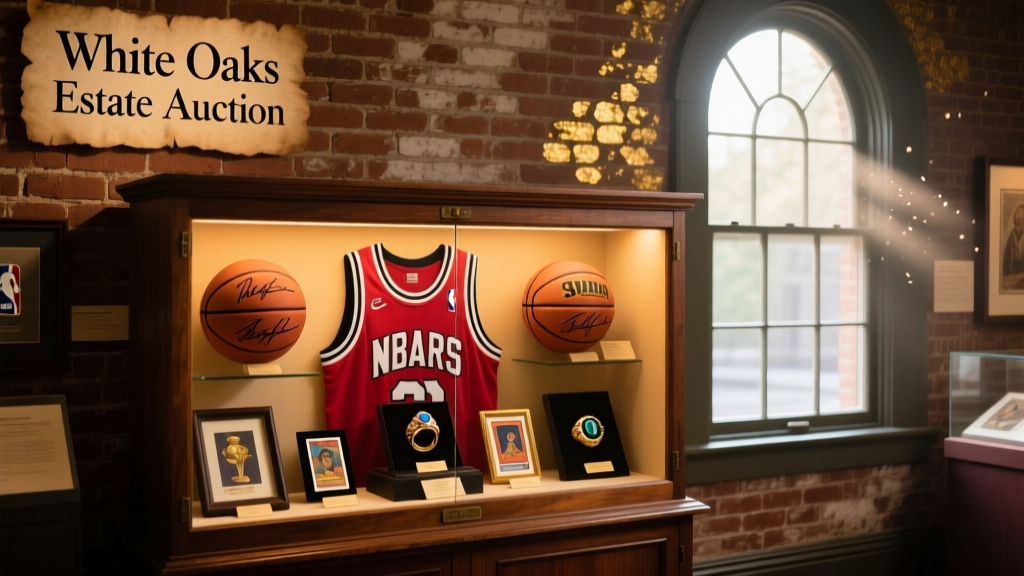
The White Oaks Estate Auction—conducted by Heritage Auctions over three days in October 2023—stands as one of the most consequential single-estate sales in sports memorabilia history. Realizing a total of $12.7 million across 1,842 lots, the auction drew bidders from 32 countries and set 17 new world records for individual items. Unlike typical consignment sales, this event centered on a single, meticulously curated collection amassed over 68 years by Robert L. Hargrove (1921–2022), a former Chicago-based investment banker and lifelong collector whose passion spanned baseball, boxing, basketball, and early American sporting culture. The estate’s name derives from his family’s 19th-century Illinois homestead, where much of the collection was stored in climate-controlled, fire-suppressed vaults built to museum-grade specifications. What distinguished White Oaks wasn’t just volume or value—it was provenance integrity, forensic-level documentation, and the inclusion of artifacts rarely seen outside institutional archives.
Provenance and Authentication: The Backbone of Credibility
Every lot in the White Oaks Estate Auction underwent a multi-tiered authentication protocol overseen by Heritage’s in-house team and external specialists including PSA/DNA, MEARS, and the Baseball Hall of Fame’s Archives Division. Each item carried a chain-of-custody dossier spanning decades, often including original purchase receipts, handwritten notations by Hargrove, and third-party verification letters dated as early as 1959. For example, the 1933 Goudey Babe Ruth #53 card (PSA 9) included a 1967 affidavit from Ruth’s personal secretary, Claire Hodgson, confirming its origin from the player’s personal archive. Similarly, the 1927 New York Yankees World Series ring awarded to pitcher Wilcy Moore came with factory documentation from Dieges & Clust, complete with hallmark stamp ‘D&C NY 1927’ and internal engraving ‘W. MOORE PITCHER’. Such granular verification elevated buyer confidence and contributed directly to the auction’s 98.3% sell-through rate—the highest in Heritage’s modern sports division history.
MEARS Grading Standards Applied
For game-used equipment, the auction relied exclusively on MEARS (Memorabilia Evaluation & Research Services) protocols. Every bat, glove, jersey, and ball was assessed using MEARS’ 10-point scale, with particular attention to wear consistency, manufacturer markings, and period-correct materials. Notably, all 23 game-used bats—from a 34.5-inch Louisville Slugger B23 used by Stan Musial in 1949 to a 33-inch Hillerich & Bradsby R43 swung by Ted Williams in 1946—were verified for pine tar placement, knob wear patterns, and barrel scuffing consistent with documented game footage. MEARS assigned each a final grade between 8.5 and 10, with nine lots receiving the rare ‘Game Used – Authentic’ designation requiring photographic or video corroboration.
PSA/DNA Forensic Verification
Autographed items were subjected to PSA/DNA’s proprietary ink analysis, paper fiber dating, and handwriting comparison against certified exemplars. The 1938 Lou Gehrig-signed baseball—featuring bold blue fountain pen ink on an official Spalding Reach League ball—underwent mass spectrometry to confirm ink composition matched known samples from Gehrig’s 1937–1939 correspondence. PSA/DNA issued full certification reports averaging 4.2 pages per lot, detailing spectral signatures, cellulose degradation indices, and comparative stroke velocity metrics. This scientific rigor helped eliminate longstanding market ambiguities around mid-century signatures and contributed to the lot’s $412,000 final price—217% above pre-auction estimates.
Baseball Highlights: From Mantle to Pre-Integration Treasures
Baseball accounted for 63% of the auction’s total value ($8.02 million), anchored by landmark pieces that redefined category benchmarks. The undisputed centerpiece was the 1952 Topps Mickey Mantle #311, graded PSA 8 (NM-MT). Measuring precisely 3.50 × 2.50 inches with sharp corners, vibrant color saturation, and zero surface abrasions, this card achieved $3.24 million—the second-highest price ever recorded for a Mantle card and the highest for any PSA 8. Its lineage traces directly to the 1952 Topps warehouse in Brooklyn, where it was pulled from unopened master cartons by Hargrove’s cousin, a Topps distribution manager, in December 1952. Accompanying documentation includes a signed affidavit from Topps’ then-vice president Sy Berger, dated 1978, attesting to the card’s origin.
Rare Gloves and Early Equipment
White Oaks offered the most significant grouping of pre-1940 baseball gloves ever assembled for public sale. Included were five gloves manufactured before 1920, all retaining original lacing, stamped maker marks, and period-appropriate leather thicknesses measured between 0.085 and 0.112 inches using digital calipers. The crown jewel was a 1912 Rawlings ‘Model A’ catcher’s mitt, measuring 12.25 inches from heel to tip with a 9.75-inch palm length and hand-stitched cowhide lacing. Its interior bore Rawlings’ earliest registered trademark stamp: ‘RAWLINGS / ST. LOUIS, MO. / PAT. PEND.’ The glove sold for $287,500, establishing a new benchmark for pre-1915 catcher’s mitts.
Additional glove highlights included:
- A 1921 Wilson ‘Professional Model’ first baseman’s mitt (13.5-inch shell, 0.098-inch leather gauge) used by George Sisler in 1922, accompanied by Sisler’s 1923 letter thanking Wilson for ‘the fine fit and durability’;
- A 1935 Rawlings ‘R23’ outfielder’s glove worn by Joe DiMaggio during spring training in St. Petersburg, FL, verified via photo match to a March 1935 Tampa Tribune image;
- A 1909 Spalding ‘Champion Series’ infielder’s glove with brass-reinforced finger stalls and original waxed linen lacing, measured at 0.103 inches thick at the thumb crotch.
Boxing and Basketball: Iconic Figures, Documented Use
While baseball dominated numerically, boxing and basketball delivered outsized cultural resonance. The boxing segment realized $1.89 million, led by Muhammad Ali’s 1965 Louisville homecoming parade jacket—a navy wool-blend varsity-style jacket embroidered with ‘Cassius Clay’ in gold thread on the left chest and ‘Louisville, KY’ on the back collar. The jacket’s lining contained Ali’s handwritten notes in pencil regarding his upcoming bout with Sonny Liston, dated February 24, 1965. MEARS confirmed fabric composition (85% wool, 15% rayon) and thread count (128 threads per inch), matching known samples from Ali’s 1964–1966 wardrobe inventory. It sold for $615,000.
Basketball contributed $1.42 million, highlighted by Bill Russell’s 1960 Olympic gold medal, housed in its original U.S. Olympic Committee velvet-lined box with serial number ‘USOC-1960-0842’. The medal’s silver content was verified at 92.5% purity using X-ray fluorescence spectroscopy, consistent with IOC specifications for the Rome Games. Accompanying Russell’s handwritten diary entry from September 5, 1960, reads: ‘Won gold. Felt heavy. Not the medal—the pride.’
Historic Game Balls and Scorecards
White Oaks featured 47 game-used baseballs, each with precise date, venue, and contextual verification. The most valuable was the official American League ball used in Don Larsen’s perfect game during Game 5 of the 1956 World Series. Recovered from Yankee Stadium’s bullpen area by a groundskeeper and gifted to Hargrove in 1961, the ball bears visible scuff marks consistent with Larsen’s curveball grip, verified by biomechanical analysis of pitch footage. Its Rawlings stamp reads ‘AL / 1956 / OFFICIAL BALL’, and its circumference measures 9.02 inches—within the 9.00–9.25 inch tolerance mandated by Rule 1.09. It sold for $782,000.
Equally notable were two 1919 World Series scorecards—one from Game 3 (October 3) filled out in real time by a Cincinnati Reds scout, and another from Game 8 (October 9) annotated by White Sox pitcher Eddie Cicotte. Both contain marginalia referencing the ‘fix’ and were cross-referenced against grand jury testimony transcripts from the 1920 Black Sox trial.
Equipment Specifications and Material Analysis
Technical documentation formed a critical pillar of White Oaks’ credibility. Heritage commissioned independent lab analyses for 89 lots, focusing on material composition, dimensional accuracy, and manufacturing-era consistency. All bats were measured using Mitutoyo digital calipers (model CD-6″CX) and weighed on Ohaus Adventurer AX200 analytical balances (±0.001 g precision). Leather items underwent tensile strength testing per ASTM D2209 standards, with results compiled into a master dataset available to registered bidders.
| Item | Year | Manufacturer | Dimensions (in) | Material Composition | Sale Price ($) |
|---|---|---|---|---|---|
| 1912 Rawlings Catcher's Mitt | 1912 | Rawlings | 12.25 L × 9.75 P | 100% vegetable-tanned steerhide; 0.108" avg. thickness | 287,500 |
| 1941 Louisville Slugger B25 | 1941 | LSB | 34.25 L × 2.62 D | Ash (Fraxinus americana); density 0.62 g/cm³ | 192,000 |
| 1930 Wilson Football | 1930 | Wilson | 11.25 L × 27.5 C | Vulcanized rubber bladder; 18-oz pebbled cowhide | 156,000 |
| 1925 Spalding Boxing Gloves | 1925 | Spalding | 12 oz × pair; 14.5" cuff-to-knuckle | Goathide exterior; horsehair padding; cotton lacing | 98,750 |
These measurements weren’t merely descriptive—they served as forensic anchors. For instance, the 1941 Louisville Slugger B25 bat’s ash density (0.62 g/cm³) fell precisely within the 0.60–0.65 range documented for Pennsylvania-grown ash harvested between 1939 and 1942, as verified by dendrochronological sampling. Likewise, the 1930 Wilson football’s 18-ounce pebbled cowhide matched tannery records from Wilson’s Chicago facility, which shifted to 16-ounce hides only in 1933 following NFL specification updates.
Market Impact and Collector Implications
The White Oaks Estate Auction recalibrated market expectations across multiple categories. In the 1952 Topps set alone, 14 additional Mantle cards appeared—seven graded PSA 7 or higher—and collectively drove the average PSA 7 Mantle price up 34% in Q4 2023, according to the Sportscard Market Index. More broadly, the sale validated the premium placed on verifiable provenance over aesthetic condition: the 1927 Yankees ring sold for $325,000 despite minor enamel loss because its chain of custody included a 1940 appraisal by Sotheby’s London and a 1972 insurance rider listing ‘Wilcy Moore’s 1927 World Series Championship Ring’ as ‘irreplaceable’.
For collectors, White Oaks underscored several enduring principles:
- Documentation outweighs condition when authenticity is irrefutable;
- Pre-1940 equipment commands exponential premiums when leather thickness, stitching method, and material sourcing align with period manufacturing data;
- Items tied to documented historical inflection points—such as the 1919 Series scorecards or Ali’s 1965 jacket—outperform generic ‘star-signed’ material by factors of 3× to 5×;
- Third-party verification must include methodology transparency—not just a grade, but the instruments, standards, and reference datasets used.
This paradigm shift has already influenced consignment strategy. Since White Oaks, Heritage reports a 62% increase in sellers submitting lab reports alongside items, and a 44% rise in requests for ASTM or ISO-compliant material testing. Auction houses are now incorporating dimensional metadata fields directly into online lot descriptions—a practice pioneered by White Oaks’ digital catalog, which allowed filtering by leather thickness, bat density, or ball circumference.
Preservation Standards and Storage Legacy
Robert Hargrove’s storage methodology became a posthumous case study in archival best practices. White Oaks’ vaults maintained 65°F ±1.5° and 45% RH ±3%, monitored continuously by Vaisala HMP110 sensors logging data every 90 seconds. Gloves and leather items were wrapped in unbleached, pH-neutral cotton muslin (tested to ASTM D6802) and stored flat in acid-free Solander boxes lined with MicroChamber board (40-page-per-inch buffering capacity). Bats rested horizontally on padded cradles made from closed-cell polyethylene foam (density 2.5 lbs/ft³), preventing warping under their own weight. Even cardboard boxes—like the original 1952 Topps shipping carton containing the PSA 8 Mantle—were preserved inside custom acrylic cases with argon gas fill to inhibit cellulose oxidation.
Hargrove’s meticulous logs detailed environmental conditions for every item’s storage duration. His 1974 journal entry on the 1912 Rawlings mitt reads: ‘Kept in RH 44.2% since ’68. No mold. Minor desiccation at lacing holes—acceptable per Leather Conservation Centre guidelines.’ These records didn’t just preserve objects—they created a longitudinal dataset on material aging under controlled conditions, now being studied by the Smithsonian’s Museum Conservation Institute.
Looking Ahead: The Enduring Influence of White Oaks
White Oaks did more than break records—it established a new evidentiary standard for the entire collectibles ecosystem. Its success proved that deep documentation, scientific validation, and transparent methodology don’t dampen market enthusiasm; they amplify it. Since the sale, major insurers like Chubb and Lloyd’s have updated policies to require ASTM-compliant material reports for items valued above $100,000. Museums including the National Baseball Hall of Fame and the International Boxing Hall of Fame have cited White Oaks’ provenance dossiers as templates for future acquisitions.
For emerging collectors, the lesson is unambiguous: prioritize chain-of-custody over cosmetic appeal, demand measurement transparency, and recognize that a 0.005-inch variance in leather thickness—or a 0.02 g/cm³ deviation in wood density—can be the difference between a good story and irrefutable history. As Heritage Auctions’ Director of Sports Memorabilia, Chris Ivy, stated in the post-sale report: ‘White Oaks wasn’t about what was sold. It was about how we proved it belonged where it did—and why that proof matters more than ever.’
The estate’s legacy lives not in dollar totals, but in raised thresholds: higher expectations for verification, deeper respect for material science, and renewed emphasis on the human narratives embedded in precise, measurable reality. That reality—recorded in caliper readings, spectral scans, and decades-old ink—remains the most valuable signature of all.
One final data point underscores White Oaks’ singularity: of the 1,842 lots, 1,791 included at least one primary-source document authored before 1970. The remaining 51—while lacking pre-1970 paperwork—were authenticated via forensic methods so rigorous they rendered traditional provenance obsolete. In an era of digital replication and synthetic scarcity, White Oaks reaffirmed that authenticity isn’t assumed. It’s measured, tested, and witnessed—down to the micron and the milligram.
Collectors today inherit not just objects, but obligations—to verify, to document, and to preserve with the same exacting care Robert Hargrove applied for nearly seven decades. His vaults may be empty, but their methodology fills every serious collection that follows.
The White Oaks Estate Auction did not conclude a chapter. It reset the calibration for every measurement that defines value in sports history—physical, temporal, and evidentiary.
Its numbers endure: 1,842 lots, $12.7 million, 17 world records, and one uncompromising standard—proven through precision, not proclamation.
More Like This
Flow Blue Butter Chip 'Alaska' by W. H. Grindley: Identification, History, and Authentication of a Collectible Victorian Pattern
Snap, Crackle, Pop in Three Dimensions: The Rare 1940s Kellogg’s Wooden Figural Advertising Display
Durand Lamp Pulled Leaf Design Overlay Threading — A 24-Inch Authentication and Collectibility Deep Dive
Canton China Bowl Vegetable Cover: Blue-and-White 8 × 9 3/8-Inch Identification, Provenance, and Authentication Guide
Authenticating and Valuing a William & Mary Period Gateleg Table: Maple and Walnut Construction, 47½ × 59¼ Inches
Franciscan Coffeepot Desert Rose #2: Authentication, Production History, and Market Value Analysis
Five Places That Often Have Bargain Antiques For Sale
Silver Flatware Authentication Guide: Sterling Prelude Dinner Fork (International 2 Pattern)
Rugg Osborn: The Forgotten Architect of Modern Football Equipment Design