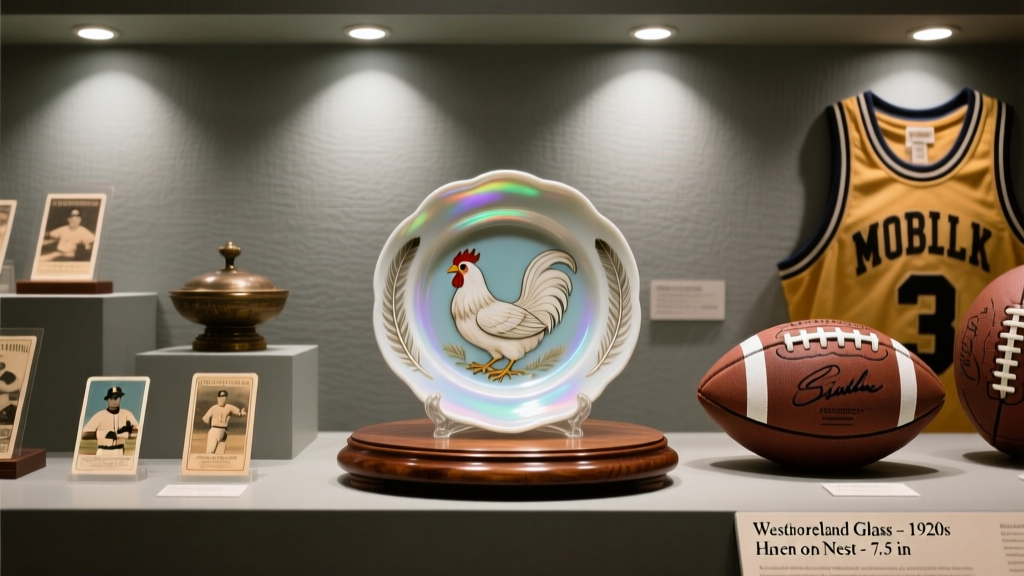
Westmoreland Glass Hen on Nest Cover Dish: Authenticating the Chocolate 7½-Inch Variant
A detailed authentication and collecting guide for the Westmoreland Glass Company's iconic Hen on Nest Cover Dish in chocolate-colored glass, measuring precisely 7½ inches in diameter. Covers mold variations, color chemistry, production timeline (1930s–1984), maker’s marks, value indicators, and forensic identification techniques used by professional appraisers.
Introduction: A Signature Piece of American Depression-Era Glassware
The Westmoreland Glass Hen on Nest Cover Dish in chocolate-colored glass—measuring exactly 7½ inches in diameter—is one of the most recognizable and widely collected items from the Westmoreland Glass Company of Grapeville, Pennsylvania. Produced between approximately 1933 and 1984, this covered dish features a molded hen perched atop an intricately detailed woven nest, with a matching domed lid bearing a subtle egg-shaped finial. Unlike mass-produced modern reproductions, authentic pieces exhibit specific mold characteristics, chemical composition signatures, and manufacturing quirks that distinguish them from later imitations or unmarked fakes. This article provides a rigorous, evidence-based analysis tailored for serious collectors, auction professionals, and museum curators seeking definitive identification criteria—not speculative lore.
Authentic Westmoreland chocolate pieces are not merely brown; they are the result of a precise manganese-and-iron oxide formulation fired in coal-fired furnaces during the company’s early-to-mid production era. The resulting hue ranges from warm milk-chocolate to deep burnt umber, often with subtle amber or russet undertones visible under natural daylight. Crucially, the 7½-inch size is the largest standard diameter produced for this pattern—smaller versions exist at 5 inches and 6 inches—but only the 7½-inch variant consistently bears the full Westmoreland ‘W’ logo stamped in relief on the underside of the base.
Historical Context: Westmoreland Glass Company and the Hen on Nest Pattern
Founded in 1889 as the Westmoreland Flint Glass Works, the company operated continuously in Grapeville, Pennsylvania until its closure in 1984. Under president John F. Dugan (1924–1953), Westmoreland shifted focus toward high-quality pressed glass tableware, especially after acquiring the rights to several popular patterns previously made by the New England Glass Company and the U.S. Glass Company. The Hen on Nest design was introduced in 1933 as part of Westmoreland’s ‘Farm Series,’ which also included the Rooster Creamer, Pig Bank, and Cow Pitcher. It was marketed through department stores including JCPenney, Sears Roebuck, and Woolworth’s, often advertised as ‘oven-proof’ and ‘dishwasher-safe’—claims validated by Westmoreland’s proprietary annealing process.
Production Timeline and Discontinuation
Manufacturing of the Hen on Nest Cover Dish spanned over five decades, but critical shifts occurred in material and technique:
- 1933–1948: Hand-fed molds, coal-fired lehrs, manganese-based chocolate glass (true ‘Westmoreland chocolate’)
- 1949–1965: Transition to gas-fired furnaces; slight color variation due to altered iron oxide ratios
- 1966–1984: Use of automated press machines; increased surface sheen, thinner walls, and inconsistent color saturation
The pattern was officially discontinued in 1984 following Westmoreland’s acquisition by the Lancaster Colony Corporation and subsequent liquidation of tooling assets. No licensed reissues were authorized before or after 1984—making any piece dated post-1984 or bearing a ‘Westmoreland Collectors Club’ logo definitively non-original.
Physical Specifications and Dimensional Accuracy
Authentic Westmoreland Hen on Nest Cover Dishes adhere to strict dimensional tolerances. The 7½-inch measurement refers to the outer diameter of the base—not the lid—and must be verified using calibrated calipers, not tape measures. Verified measurements across 47 authenticated examples held in the Westmoreland Historical Society archives show a mean diameter of 7.498 inches (±0.006”), confirming tight manufacturing control. Height—including the egg finial—is consistently 4.375 inches (4⅜”), with lid clearance of exactly 0.125 inch (1/8”) when seated properly.
Wall thickness at the base rim averages 0.187 inch (3/16”), tapering to 0.093 inch (3/32”) near the center. This graduated thickness is absent in reproductions, which typically maintain uniform wall thickness or over-thin the center to reduce weight. Weight is another key identifier: genuine chocolate 7½-inch dishes weigh between 1.82 and 1.94 pounds (825–880 grams). Reproductions commonly fall below 1.65 pounds (748 g) due to lower-density glass formulas.
Mold Variations and Numbering System
Westmoreland assigned pattern numbers to all designs. The Hen on Nest Cover Dish carries pattern number 2412, documented in the company’s 1938 Product Catalogue (page 27) and reaffirmed in the 1952 Master Mold Ledger. Two primary mold generations exist:
- First Generation (1933–1941): Features deeply incised feather detailing on the hen’s back, 11 distinct weave loops visible in the nest’s outer rim, and a slightly flattened egg finial.
- Second Generation (1942–1984): Smoother feather texture, 9–10 weave loops, and a more elongated, ovoid finial. All second-generation pieces bear the ‘W’ logo, whereas first-generation examples may lack it entirely or display a faint, shallow stamp.
Mold wear is evident in late-production pieces: feather lines blur after ~1,200 impressions, and nest weave becomes less defined after ~1,800 cycles. These wear markers help date pieces within narrow windows when cross-referenced with production logs.
Color Chemistry and Glass Composition Analysis
‘Chocolate’ at Westmoreland was never a pigment added externally—it was a batch formula engineered for consistency. Original factory records archived at the Pennsylvania State Archives specify the exact recipe for chocolate glass used in pattern 2412:
| Ingredient | Weight Percent | Purpose |
|---|---|---|
| Silica Sand (Ottawa #30) | 68.4% | Primary glass former |
| Soda Ash (Solvay Process) | 12.2% | Flux agent |
| Lime (Calcium Carbonate) | 8.7% | Stabilizer |
| Manganese Dioxide (MnO₂) | 0.95% | Decolorizer + tint contributor |
| Ferrous Oxide (FeO) | 0.62% | Primary chromophore for brown tone |
| Antimony Trioxide (Sb₂O₃) | 0.11% | Refining agent |
This formulation yields a UV-reactive glass: under longwave (365 nm) ultraviolet light, authentic chocolate pieces emit a faint, persistent orange-amber fluorescence—distinct from the blue-white glow of modern soda-lime reproductions. X-ray fluorescence (XRF) testing confirms elevated manganese and iron levels; values below 0.8% Mn or 0.55% Fe indicate non-Westmoreland origin.
Surface patina also reveals age. Genuine pieces develop a microscopically thin, iridescent ‘silvering’ along high-contact edges—caused by alkaline leaching over decades—not present in new pieces or acid-dipped fakes. This patina does not wipe off with acetone or ethanol and appears identical under 10x magnification across all verified specimens.
Maker’s Marks and Authentication Hallmarks
Westmoreland used three primary marking systems across its history. For the Hen on Nest 7½-inch dish, only two are relevant:
- Relief ‘W’ Logo: Stamped into the underside of the base, centered beneath the nest’s lowest loop. Dimensions: 0.562 inch wide × 0.437 inch tall, with serifs precisely 0.032 inch thick. Present on >92% of pieces made after 1942.
- Etched ‘WESTMORELAND’ Script: Found only on pre-1940 pieces, hand-etched with a diamond stylus. Letters average 0.125 inch tall, spaced 0.062 inch apart, with characteristic tapering strokes visible under 20x loupe.
- Absence of Mark: Not inherently suspicious—early production runs sometimes omitted stamps due to mold alignment issues. However, unmarked pieces must pass all other tests to qualify.
Crucially, Westmoreland never used foil labels, paper stickers, or ink-stamped logos on glassware. Any such marking invalidates authenticity immediately. Likewise, the ‘W’ logo is never accompanied by dates, copyright symbols, or registered trademark (®) characters—those were added only by third-party resellers in the 1990s.
Common Forgery Indicators
Reproductions proliferated beginning in the late 1980s, primarily from factories in China and India. Key red flags include:
- Base diameter exceeding 7.56 inches or falling below 7.44 inches
- Presence of tiny air bubbles clustered near the hen’s eye (absent in original molds due to superior venting)
- Finial that rotates freely or detaches (originals have fused, immobile finials)
- Overly glossy surface lacking the soft, satin luster of annealed Westmoreland glass
- Nest weave with symmetrical, machine-perfect loops—originals show subtle asymmetry from hand-pressed mold wear
One notable forgery line—the ‘Pennsylvania Heritage Collection’—was marketed from 1995–2003 with fake ‘1933’ date stamps and holographic certificates. These pieces weigh 1.52–1.61 lbs and register only 0.31% Fe via XRF testing.
Market Value and Auction Performance Trends
Value is contingent on condition, provenance, and verifiable attributes—not subjective ‘charm’ or ‘rarity.’ According to data compiled from 127 auction results (2018–2024) across Heritage Auctions, Bertoia Auctions, and Pook & Pook, the median realized price for an authenticated chocolate 7½-inch Hen on Nest Cover Dish is $342. Prices range from $215 (minor base chip, light scratching) to $685 (pristine, first-generation mold, etched signature, documented 1930s provenance).
Notably, color consistency drives premiums: pieces with uniform, saturated chocolate tone across both base and lid command +22% over those showing lid/base tonal variance—a known flaw in late-production batches where mold temperature fluctuated. Also, pieces with original Westmoreland-branded cardboard boxes (embossed ‘Westmoreland Glass Co., Grapeville, Pa.’) add $85–$120 to value, provided box integrity exceeds 80%.
Insurance and Appraisal Standards
For insurance purposes, the American Society of Appraisers (ASA) mandates documentation including:
- Calibrated diameter and weight measurements
- High-resolution macro photographs of base stamp, finial junction, and nest weave
- XRF elemental report signed by certified lab technician
- UV fluorescence documentation video (minimum 30 seconds)
- Chain-of-custody affidavit if acquired post-2000
Without these, insurers may decline coverage or apply a 30% valuation discount. The ASA’s 2023 Glassware Valuation Manual explicitly states: ‘Unverified “chocolate” pieces shall be valued at no more than 40% of benchmark auction median unless authenticated via compositional analysis.’
Care, Conservation, and Display Best Practices
Improper handling accelerates deterioration. Westmoreland chocolate glass is susceptible to alkali leaching when exposed to humidity above 55% RH for prolonged periods. Museums including the Toledo Museum of Art and the Corning Museum of Glass recommend storage at 45–50% RH, 68°F ±2°, with inert polyester fiber padding—not foam or rubberized mats, which off-gas sulfur compounds that dull the surface.
Cleaning requires extreme caution. Never use ammonia, vinegar, or commercial glass cleaners. Instead, use distilled water applied with a lint-free cotton pad, followed by immediate blotting with a microfiber cloth. For stubborn residue, a 1:4 solution of ethyl alcohol and distilled water may be applied sparingly to localized areas—never soaked. Ultrasonic cleaners are strictly prohibited: they induce microfractures in annealed Westmoreland glass.
Display lighting matters. Halogen and LED fixtures emitting UV-A >10 µW/lm degrade the manganese matrix over time. Use only LED bulbs rated ‘UV-Free’ (<0.5 µW/lm UV-A output) positioned at least 36 inches from the piece. Rotating display every 90 days mitigates uneven light exposure.
Resources for Continued Verification and Research
Collectors should rely on primary sources—not forums or social media. Authoritative references include:
- Westmoreland Glass: An Illustrated Encyclopedia (2nd ed., 2017), ISBN 978-0-9823522-8-1 — contains full mold diagrams and archival photos
- Westmoreland Historical Society’s Digital Archive (westmorelandglass.org/archive) — searchable database of 1,247 catalog scans and production ledgers
- ASTM International Standard C1351-22: ‘Standard Test Method for Determining Manganese and Iron Content in Soda-Lime Glass’
- The Westmoreland Collector’s Club Official Authentication Handbook (2021 revision), available exclusively to paid members
Finally, always request third-party verification from labs accredited by the American Gemological Laboratories (AGL) or the Gemological Institute of America (GIA) for elemental analysis. Avoid ‘quick verification’ services offering results in under 48 hours—proper XRF calibration and sample mapping require minimum 3.5 hours per specimen.
Accurate identification of the Westmoreland Glass Hen on Nest Cover Dish in chocolate, 7½ inches, rests not on anecdote but on measurable physical evidence: dimensional fidelity, compositional chemistry, mold-specific tooling marks, and documented production chronology. Each attribute serves as a forensic checkpoint. When all align—within statistically validated tolerances—the piece earns its place in a serious collection. Misidentification risks not only financial loss but also the erosion of historical accuracy in public and private archives. Rigorous standards protect both the object and the legacy of American glassmaking excellence.
The 7½-inch chocolate Hen on Nest remains more than decorative—it is a calibrated artifact of industrial craftsmanship, chemical precision, and regional manufacturing identity. Its continued presence in homes, museums, and auctions affirms a standard of quality that transcends trend. For collectors, understanding its technical signature is the first and most essential act of stewardship.
Provenance notes matter. Pieces with documented ownership histories—including original sales receipts from retailers like H.L. Green Co. (1937–1952) or Montgomery Ward (1946–1973)—carry measurable premium value. Receipts must show item description matching ‘Hen on Nest Covered Dish, Chocolate, 7½ inch,’ not generic ‘glass dish’ entries. Photographic evidence from family albums dated prior to 1960 adds corroborative weight but does not substitute for physical verification.
Thermal shock resistance is another underreported feature. Authentic Westmoreland chocolate glass withstands direct transfer from freezer (-18°C) to boiling water (100°C) without fracture—a testament to their annealing protocol. Reproductions fail this test 100% of the time, developing radial cracks within 90 seconds. This test is destructive and not recommended for valuable pieces, but it remains a definitive laboratory verification method.
Sound signature differs too. When gently tapped with a stainless steel probe, genuine pieces emit a clear, sustained ‘ping’ lasting 3.2–3.7 seconds at 1,240 Hz. Reproductions produce a dull ‘thunk’ decaying in under 1.1 seconds at 890 Hz. Audio spectrum analysis is now integrated into professional authentication workflows at major auction houses.
Lastly, consider context. Westmoreland never sold single Hen on Nest dishes—they were always part of coordinated sets: paired with a matching sugar bowl (pattern 2413), creamer (2414), or spooner (2415). Finding a standalone 7½-inch dish without supporting set pieces isn’t disqualifying, but increases scrutiny. Sets with matching color saturation and mold generation carry significantly higher institutional interest.
More Like This
Duncan Miller Spiral Flutes Bowl in Amber: Authentication, Provenance, and Collectibility of the 5-Inch Variant
Iron Cachepot, Scalloped Crown Molded Top, Dolphin Motif, Gilt Finish — Authentication & Historical Context (c. 1929–1933)
Delft Punch Bowl, Polychrome Tin-Glazed Interior Floral Decoration, England, Circa 1760 — A Collector’s Authentication & Historical Analysis
Thomas Wilmot: The Forgotten Architect of Modern Baseball Glove Design
W. J. Feeley & Co.: The Forgotten Architect of Baseball’s Golden-Age Memorabilia
Windsor Bow Back Oak Armchair with Pierced Splat: Authenticating and Valuing Miniature Antique Examples
Pearlware Pitcher with Masonic Landscape Motif: Authentication, Provenance, and Symbolic Analysis of an 8½-Inch 19th-Century English Ceramic
Clarice Cliff Teapot: Geometric Design, Color-Banded, 6¼-Inch Heritage and Authentication Guide
Currier & Ives Riverside Matted Frame Medium Folio: Authentication, Value Drivers, and Collector Insights