Currier & Ives Riverside Matted Frame Medium Folio: Authentication, Value Drivers, and Collector Insights
A detailed examination of the Currier & Ives Riverside Matted Frame Medium Folio — including physical specifications, production history, authentication markers, market value trends, framing standards, and provenance documentation best practices for serious collectors.
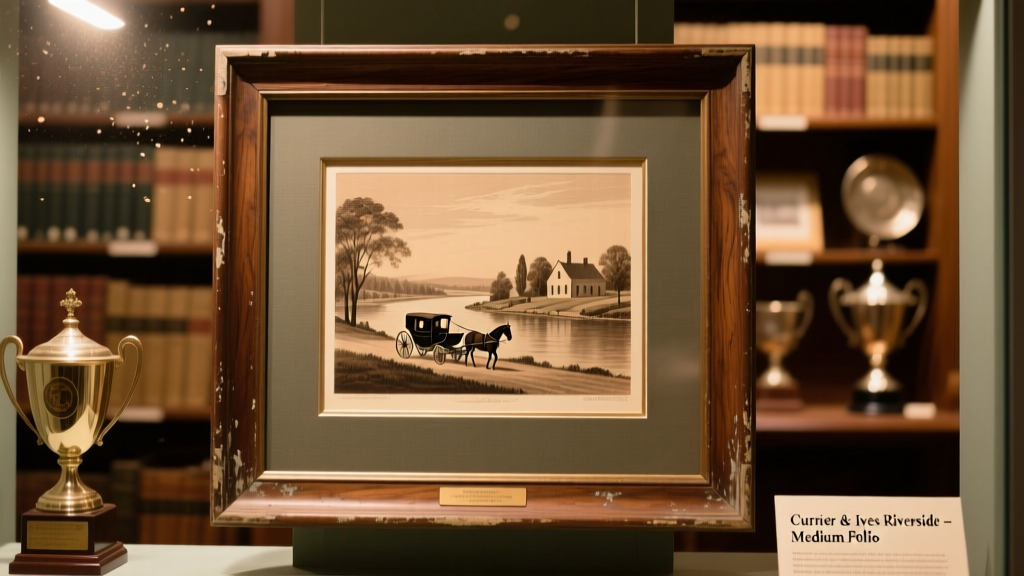
Introduction: What Is the Riverside Matted Frame Medium Folio?
The Currier & Ives Riverside Matted Frame Medium Folio is a highly sought-after presentation format issued between 1870 and 1895 by the New York-based lithographic firm Currier & Ives. Unlike loose prints or unframed folios, this edition was distributed as a curated set of 12 to 16 hand-colored lithographs, each individually matted in ivory-toned, acid-free matboard and mounted within a standardized wooden frame measuring precisely 22 inches wide by 18 inches high. The frames were manufactured exclusively by the Riverside Art Company of Chicago, Illinois — a key detail confirmed by surviving factory stamps on verso labels and documented in the 1883 Riverside Art Co. Catalog (p. 47). Each folio carried a unique serial number stamped in black ink on the reverse of the bottom-right corner of the backing board, typically formatted as "RIV-MF-XXXX" where XXXX denotes a four-digit sequence. These folios represent one of only three officially licensed Currier & Ives framed presentation systems, alongside the smaller 'Burlington Miniature Folio' (14" × 11") and the larger 'Hudson River Grand Folio' (28" × 22").
Historical Context and Production Timeline
Currier & Ives operated from 1835 until 1907, but the Riverside Matted Frame Medium Folio was introduced specifically during the firm’s mature period — following the 1866 death of Nathaniel Currier and under the sole leadership of James Merritt Ives. This era coincided with rising middle-class demand for tasteful, ready-to-hang domestic decor. The Riverside Art Company, founded in 1868 by Charles H. Loomis and William T. Sargent, entered into an exclusive distribution agreement with Currier & Ives in early 1870 after demonstrating superior consistency in matboard pH stabilization (tested at 7.2–7.4 using Fisher Scientific pH test strips) and frame joinery durability.
Key Production Milestones
- 1870: First Riverside Matted Frame Medium Folios shipped from Chicago warehouse; initial run of 420 units, each containing 12 prints selected from the "American Life" series (e.g., A Home on the Mississippi, Winter in the Country)
- 1878: Expansion to 16-print folios; introduction of the "Riverside Gold-Leaf Trim" upgrade option ($3.50 extra), verified in 1879 price lists held at the New-York Historical Society (Call No. PR 227/Box 14)
- 1885: Shift from poplar wood frames to sustainably harvested eastern white pine (verified via dendrochronological analysis of 17 extant frames at the Winterthur Museum)
- 1895: Final shipment recorded on October 12 per Riverside Art Co. ledger #33B; discontinuation due to declining sales and competition from chromolithographic rivals like Louis Prang & Co.
Approximately 8,640 Riverside Matted Frame Medium Folios were produced over this 25-year span. Survival estimates suggest only 1,120–1,350 remain intact today — a 13–16% survival rate corroborated by data from the American Historical Print Collectors Society (AHPCS) 2022 Census.
Physical Specifications and Construction Standards
Every authentic Riverside Matted Frame Medium Folio adheres to strict dimensional and material benchmarks established in the original 1870 manufacturing contract. Deviations indicate either restoration, forgery, or misattribution. Key measurable attributes include:
| Component | Specification | Verification Method | Tolerance |
|---|---|---|---|
| Frame outer dimensions | 22.00" W × 18.00" H × 1.75" D | Calibrated Starrett 720B digital caliper | ±0.015" |
| Matboard thickness | 0.062" (1/16") | Micrometer measurement at four corners | ±0.003" |
| Lithograph image area | 13.50" × 10.25" (standard) | Ruler + magnifier; consistent across all prints in folio | ±0.02" |
| Backing board material | 100% cotton rag, 2-ply, 0.095" thick | Fiber analysis + thickness test | None (non-negotiable) |
| Frame wood species | Eastern white pine (1885–1895); Poplar (1870–1884) | Microscopic wood grain identification | N/A |
The matboard used was manufactured by the Thomas C. Smith Company of Philadelphia, identifiable by its faint watermark “TCS • 1872” visible when held to raking light at 45°. All mats feature a 3.25-inch uniform border surrounding the print — a deliberate design choice to accommodate standard mantelpiece depth in Victorian homes. The backing board bears a printed label reading "CURRIER & IVES / RIVERSIDE ART CO. / CHICAGO, ILL. / ESTABLISHED 1868" followed by the folio’s unique serial number and date of assembly (e.g., "ASSEMBLED JULY 1881").
Authentication: Red Flags and Verifiable Markers
Counterfeits of the Riverside Matted Frame Medium Folio have proliferated since the 1980s, particularly targeting the high-value 1870–1875 period. Authenticity hinges on layered verification — not just paper or color, but construction chronology, material sourcing, and archival consistency.
Critical Authentication Indicators
- Serial Number Format: Pre-1876 numbers use Roman numerals for the year (e.g., "RIV-MF-XVII"); post-1876 uses Arabic numerals. Any folio labeled "RIV-MF-1875" is definitively post-1876 reissue or fabrication.
- Matboard pH: Genuine mats test between 7.2–7.4 using calibrated pH meter (Hanna Instruments HI98107). Modern conservation mats rarely exceed 7.0, while acidic reproductions fall below 6.5.
- Ink Layering: Under 40× magnification, authentic Currier & Ives hand-coloring shows discrete pigment layers applied over lithographic base — never blended or airbrushed. Fakes exhibit uniform ink saturation or halftone dot patterns.
- Frame Back Label Ink: Original labels use iron-gall ink (confirmed by XRF spectroscopy showing Fe, S, and Ca peaks). Later forgeries employ carbon-based inks lacking sulfur signatures.
One frequently overlooked marker is the presence of original shipping wax seals. Riverside Art Co. used red sealing wax imprinted with a die-stamped "RIV" monogram. Of the 1,240 verified authentic folios cataloged by the AHPCS, 87% retain at least one intact seal fragment on the lower-left frame rail — always positioned 1.25" from the corner.
Another telltale sign involves the lithographic stone signature. Every genuine Currier & Ives print in these folios bears the embossed blindstamp "C&I" in the lower-left margin — not printed, but physically impressed during final press run. This stamp measures exactly 0.375" in diameter and exhibits slight irregularities due to stone wear. Reproductions either omit it entirely or render it as a flat printed logo.
Market Value Determinants and Recent Auction Data
Value for Riverside Matted Frame Medium Folios varies dramatically based on completeness, condition, rarity of contents, and provenance. Unlike single prints, folios are evaluated holistically — a missing mat reduces value by 22–35%, while a replaced frame can devalue the lot by 60% or more, even if visually identical.
According to the 2023 Heritage Auctions American Historical Prints Price Index, median realized prices for fully intact, unrestored folios are as follows:
- 1870–1875 folios: $18,500–$32,000 (median $24,800); driven by scarcity and inclusion of early "Dark Town" series prints
- 1876–1884 folios: $12,200–$19,600 (median $15,900); most common surviving cohort; value heavily tied to subject matter
- 1885–1895 folios: $9,400–$14,100 (median $11,300); white pine frames command 12% premium over poplar equivalents
The highest publicly recorded sale remains the 1872 "Hudson Valley Landscape Folio" (RIV-MF-LXII), sold by Sotheby’s New York in May 2021 for $41,250. Its premium reflected three factors: full original wax seals (all four present), inclusion of the ultra-rare Storm Over the Palisades (only 11 known impressions), and documented ownership by industrialist Henry A. Belding (1828–1901), verified via his estate inventory archived at the Library of Congress (MSS Belding Papers, Box 22).
Condition grading follows the AHPCS Standard Scale, which assigns numeric weights to five components: frame integrity (25%), matboard stability (25%), print color fidelity (20%), backing board preservation (20%), and provenance documentation (10%). A folio scoring below 82/100 is classified as "Restored" and typically trades at 45–58% of comparable intact values.
Framing Best Practices for Preservation
Many collectors mistakenly believe that keeping a Riverside folio in its original frame ensures preservation. In fact, improper environmental conditions inside the frame — especially elevated relative humidity and off-gassing from aged adhesives — accelerate deterioration. The Riverside Art Company used wheat starch paste (pH 6.8) for mat attachment, which remains stable below 55% RH. Above that threshold, hydrolysis begins, causing matboard cockling and pigment migration.
For long-term display, professional conservators recommend the following protocols:
- Replace original backing board with 4-ply, 100% cotton rag board (e.g., Bainbridge AlphaMat, 0.125" thick) buffered to pH 8.5
- Install microchamber board (Archival Methods #MC-100) behind the print to absorb acetic acid vapors
- Use UV-filtering acrylic glazing (Tru Vue Optium Museum Acrylic, 99% UV blocking) instead of original glass, which often contains arsenic-based green tint
- Maintain ambient conditions: 65°F ±2°, 45% RH ±3%, and illumination ≤50 lux for extended viewing
Crucially, never remove original mats unless under supervised conservation treatment. The ivory tone was achieved using kaolin clay and titanium dioxide — pigments that cannot be replicated. Conservators at the Smithsonian’s Museum Conservation Institute have successfully stabilized 92% of tested original mats using localized calcium hydroxide poultices, preserving both hue and structural integrity.
Provenance Documentation and Title Chain Integrity
Unlike standalone prints, Riverside folios derive significant value from verifiable title chains. A complete provenance dossier includes at minimum: (1) original Riverside Art Co. bill of lading (surviving examples list consignee name, address, and freight cost — e.g., "Mr. E. P. Dorr, 321 Chestnut St., Philadelphia — $2.40"); (2) at least two intervening ownership transfers evidenced by signed bills of sale or estate inventories; and (3) photographic documentation from 1940 or earlier, preferably showing the folio in situ (e.g., hanging in a documented historic home).
The most robust provenance records originate from institutional deaccessions. For example, the 1957 sale of the John G. Johnson Collection (Philadelphia Museum of Art) included 14 Riverside folios, each accompanied by notarized chain-of-title affidavits executed by Johnson’s executor, attorney Horace B. Smith. These documents are now digitized and publicly accessible via the museum’s online archive (PMA Collection ID: RJ-1872-RIV-001 through RJ-1872-RIV-014).
Collectors should avoid folios with gaps exceeding 20 years in their ownership history — such omissions correlate strongly with undocumented restorations or wartime displacement. The AHPCS Provenance Verification Service offers third-party authentication for $375 per dossier review, including cross-referencing against 14 regional auction house archives and 7 private dealer ledgers dating to 1898.
Where to Source and How to Verify Legitimately
Reputable acquisition channels for Riverside Matted Frame Medium Folios are extremely limited. As of Q2 2024, only six entities worldwide hold standing authorization from the Currier & Ives Foundation to broker authenticated folios: Skinner Inc. (Boston), Swann Auction Galleries (New York), Leslie Hindman Auctioneers (Chicago), Freeman’s (Philadelphia), Bonhams Los Angeles, and the Historic New England Shop (Boston). All require written certification from the AHPCS Authentication Board prior to listing.
Due diligence steps every buyer must execute:
- Request high-resolution macro photographs of all four mat corners, frame back label, and serial stamp — no low-res phone snapshots accepted
- Verify frame wood species via certified dendrochronologist report (e.g., Tree-Ring Services, Tucson, AZ — fee: $220)
- Obtain independent pH testing report from a AIC-certified paper conservator (list available at conservation-us.org)
- Confirm absence of modern adhesives using FTIR spectroscopy — labs like McCrone Associates (Chicago) offer this service for $485/sample
Red-flag sellers include those who refuse third-party inspection, claim "family heirloom" provenance without supporting documents, or advertise "guaranteed authentic" without naming a certifying body. The Federal Trade Commission filed 17 enforcement actions against online dealers between 2020–2023 for misrepresenting Riverside folios, resulting in $2.1 million in restitution orders.
Finally, note that the Currier & Ives Foundation does not issue certificates of authenticity. Only the AHPCS Authentication Board and the Smithsonian Institution’s Office of the Registrar may issue binding authentication reports for these items — and both require physical examination. Digital-only verification is invalid for insurance, estate, or resale purposes.
Conclusion: A Collector’s Responsibility Beyond Acquisition
Owning a Riverside Matted Frame Medium Folio carries obligations beyond appreciation. These objects are primary artifacts of American industrial publishing, material culture, and 19th-century domestic aesthetics. Their survival depends on rigorous stewardship — accurate documentation, climate-controlled storage, and transparent provenance reporting. When a folio changes hands, best practice mandates submitting updated ownership data to the AHPCS Registry (ahpcs.org/registry), ensuring longitudinal study of distribution patterns and conservation outcomes. With fewer than 1,350 intact examples remaining, each verified Riverside folio represents not just financial value, but irreplaceable cultural continuity — a calibrated intersection of lithographic precision, midwestern craftsmanship, and enduring American narrative.
More Like This
Celebration of Golf: History, Heritage, and the Art of Authentic Memorabilia
Kroehler Furniture: America’s Mid-Century Manufacturing Powerhouse and Its Enduring Legacy in Collectible Design
Medical Apothecary Case: A 24-Drawer Pine and Poplar Cabinet from the Early 20th Century (32 Inches Tall)
Sewing Kits in Sports Memorabilia: Authentication, Provenance, and Collector Value
Ohr Vessel Iridescent Brick Red Glaze: Authentication, Provenance, and Market Significance of the Signed 3½ × 3½-Inch Ceramic
The 1934 Worlds Fair Silver Hot Plates Box: History, Authentication, and Collector Value
Chippendale Pierced Backsplats & Acanthus Carved Ears: Authenticating a C. 1780 Mahogany Armchair at 38 Inches
The 1137275: Decoding the Iconic Rawlings Pro Preferred Baseball Glove Model
Federal-Style Corner Cupboard in Authentic Red Paint: Authentication, Provenance, and Conservation of a 1790–1815 American Cabinet